



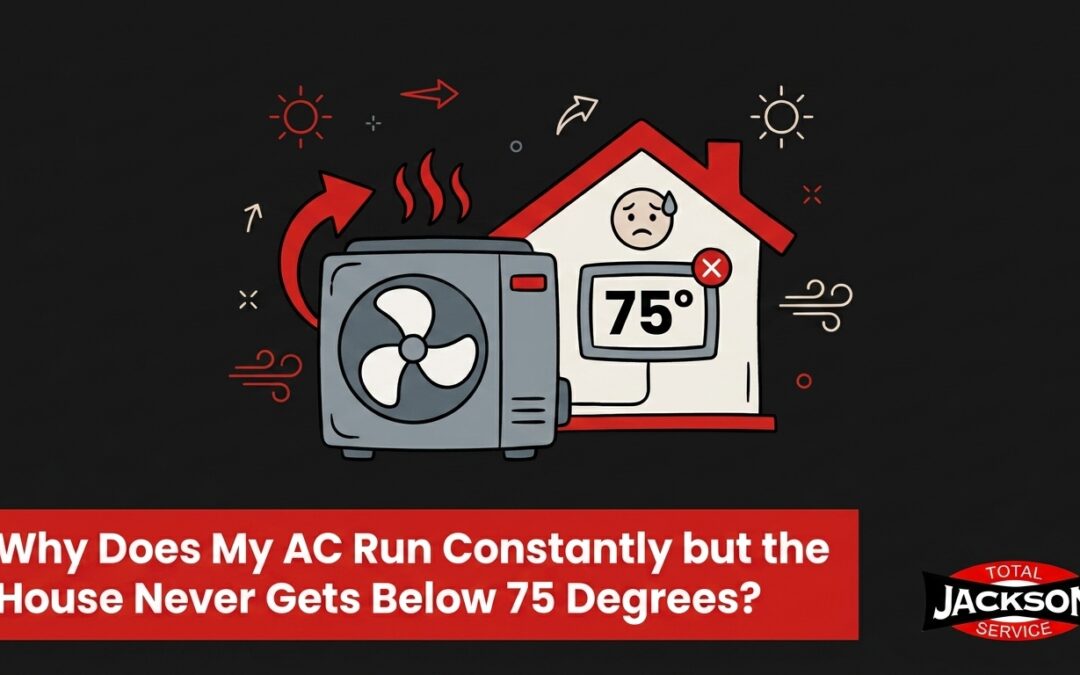
The Frustration of a Thermostat That Refuses to Budge
Your system has been humming for hours, prompting the frustrating question: why does my AC run constantly but the house never gets below 75 degrees? At Jackson Total Service, our team fields this exact question daily from Naples homeowners during peak summer. You set the thermostat to a crisp 72 degrees, yet the indoor temperature remains stubbornly stuck at 75 despite the equipment running without a break. While some continuous operation is expected during extreme heat waves, failing to reach the set temperature indicates a systemic issue that requires attention.
Many homeowners find themselves at a crucial decision point when this happens. They must determine whether the constant running is a normal response to extreme Southwest Florida summer heat, a sign of severe duct leakage in a baking attic, or a mechanical failure that requires immediate intervention. Ignoring a system that refuses to cycle off usually leads to inflated energy bills and eventual compressor failure. Resolving these complex thermal and mechanical issues requires professional HVAC services to properly diagnose the root cause.
When a thermostat is stuck at 75 degrees despite lower settings, the primary culprits typically fall into three categories: extreme humidity loads, severe duct leakage, or hidden mechanical failures. An air conditioner is designed to remove heat and moisture from the indoor air, but when the thermal load exceeds the system’s capacity, it will run indefinitely in a futile attempt to catch up. Understanding the physics behind this struggle is the first step toward restoring your home’s comfort.
Sensible vs. Latent Cooling: The Florida Climate Factor
To understand why your system is working so hard just to maintain 75 degrees, it helps to look at the physics of cooling in extreme humidity. Air conditioners perform two distinct types of work simultaneously: sensible cooling and latent cooling. Sensible cooling refers to lowering the actual temperature on the thermostat—the physical drop in degrees that you can feel. Latent cooling, on the other hand, is the process of removing moisture and humidity from the air.
During a July peak summer here in Naples, the extreme latent heat load puts maximum stress on residential cooling systems. In our years of servicing local HVAC systems, we’ve seen that before an air conditioner can even begin to drop the sensible temperature in your living room, it must spend a massive amount of its energy dehumidifying the heavy, saturated air. If the indoor humidity is exceptionally high, the evaporator coil works overtime just pulling water out of the atmosphere. The system will run continuously without achieving the desired sensible temperature drop because its capacity is entirely consumed by the latent load.
Understanding Design Temperatures
Every air conditioning system is engineered based on regional “design temperatures.” This metric represents the maximum outdoor heat an AC is mathematically designed to handle before it reaches its absolute cooling capacity limit. In Southwest Florida, systems are typically designed to maintain a 75-degree indoor environment when the outside temperature hits roughly 92 to 95 degrees.
When outdoor temperatures spike beyond that design limit—especially when combined with oppressive humidity—the system simply does not have the capacity to cool the home to 70 or 72 degrees. It will run 24/7 trying to reach a target it cannot mathematically achieve.
| Cooling Type | Primary Function | Impact on Thermostat | Florida Summer Challenge |
|---|---|---|---|
| Sensible Cooling | Lowers the actual air temperature | Directly moves the thermostat reading down | Delayed until latent heat is managed |
| Latent Cooling | Removes airborne moisture (humidity) | Does not change the temperature reading | Consumes massive energy during peak humidity |

The Hidden Heat Trap: Severe Attic Duct Leaks
Even if your air conditioning unit is functioning perfectly, compromised ductwork in a hostile environment can entirely negate the system’s cooling efforts. In Southwest Florida, attic temperatures can routinely exceed 130 degrees during peak summer afternoons. Your ductwork acts as the circulatory system for your home’s conditioned air, and a significant portion of it likely runs directly through that baking attic.
If there are leaks, tears, or disconnected joints in the return ducts, the system pulls that extreme, unconditioned 130-degree heat directly into the home’s cooling cycle. Instead of cooling 75-degree indoor air down to 55 degrees at the vent, the system is trying to cool 130-degree attic air. The result is a thermostat stuck at 75 degrees despite lower settings, as the AC constantly battles the infiltration of severe heat. According to Energy Star data, leaky ducts in unconditioned spaces can reduce cooling system efficiency by up to 20 percent.
Sometimes homeowners suspect their ductwork is the issue, but they aren’t sure exactly what needs to be done. Recently, a Naples homeowner called us at Jackson Total Service because they were unsure if their air ducts needed cleaning to improve airflow. One of our technicians investigated the system and provided an honest assessment, revealing that the ducts did not actually need cleaning—they had a severe tear pulling in attic heat. Proper diagnostics by our North Naples AC repair experts can determine if your issue is a simple blockage, a need for cleaning, or a catastrophic leak pulling attic heat into your home.
Signs Your Ductwork is Compromised
- Uneven cooling across different rooms: Some rooms feel like iceboxes while others remain warm and stagnant.
- Excessive dust accumulation: A sudden increase in dust around vents often indicates the system is pulling particulate matter from the attic.
- Higher than normal energy consumption: The system draws massive amounts of electricity, yet the home never feels truly cool.
Mechanical Strain: Failing Condenser Fans and Electrical Issues
If the ductwork is intact and the system is properly sized, a constantly running air conditioner often points to mechanical and electrical failures that prevent the system from exhausting heat efficiently. An air conditioner does not actually “create” cold air; it absorbs heat from inside your home and pumps it outside. The outdoor condenser unit is responsible for releasing that absorbed heat into the outdoor air.
The condenser fan plays a critical role in this process. It pulls outside air across the hot condenser coils to dissipate the heat. If you have a failing condenser fan motor or a weak run capacitor, the fan blade will spin too slowly—or stop spinning entirely. When this happens, the system loses its ability to release heat. The compressor will continue to run, working harder and hotter, but the indoor temperature will barely budge because the heat has nowhere to go.
The Danger of Electrical Diagnostics
Electrical issues often masquerade as simple cooling failures. A homeowner might notice the house is warm and assume the system is low on refrigerant, when in reality, a degraded capacitor is preventing the fan from reaching its required RPMs. Fixing an AC running constantly might require deep electrical diagnostics, ensuring a comprehensive, one-stop solution. This highlights the value of multi-trade expertise. At Jackson Total Service, our technicians understand the complex crossover between HVAC mechanicals and home electrical systems, a pattern we see often in older Naples properties.
A critical warning: Never attempt DIY diagnostics on outdoor unit electrical failures. The capacitors inside a condenser unit store high-voltage charges that can be lethal, even when the power is disconnected at the breaker. Diagnosing failing fan motors, contactors, and capacitors requires specialized multimeters and extensive safety training.
Capacity Limits: Is Your System Undersized for Peak Heat?
Another common reason a thermostat gets stuck at 75 degrees despite lower settings is a fundamental mismatch in equipment capacity. If your air conditioning unit simply lacks the tonnage required to cool the home during extreme weather events, it will run continuously. An undersized AC will operate 24/7 trying to reach a temperature it was never mathematically designed to achieve under heavy thermal loads.
Many homeowners assume their system is sized correctly because it worked well in previous years. However, our team typically sees that a home’s cooling requirements can alter over time. Home additions, degraded attic insulation, the installation of heat-generating appliances, or even removing large shade trees from the property can dramatically increase the thermal load on the house. What was once an adequately sized system may now be undersized for the home’s current footprint.
Undersized vs. Oversized Systems
It is important to contrast an undersized unit with an oversized unit, as both cause comfort issues but in entirely different ways. An undersized unit runs constantly and never cools the house down. An oversized unit drops the sensible temperature too quickly (short-cycling) and shuts off before it has time to remove the humidity, leaving the home feeling cold but clammy.
| System Sizing Issue | Typical Run Time | Indoor Comfort Result | Impact on Humidity |
|---|---|---|---|
| Undersized Unit | Runs constantly (24/7) | House never reaches set temperature | Excellent dehumidification, but too warm |
| Oversized Unit | Short-cycles (on and off quickly) | Temperature drops rapidly | Poor dehumidification; feels cold and clammy |
A professional load calculation, known as a Manual J calculation, is the only definitive way to determine if equipment size is the root cause of your constant runtime. A licensed technician will measure the square footage, window orientation, insulation values, and ductwork to calculate the exact tonnage required for your specific home.
What Homeowners Can Check vs. When to Call a Professional
Before assuming you have a catastrophic mechanical failure or a severe duct leak, there are a few safe, actionable troubleshooting steps you can take. Providing safe checks for the homeowner helps establish clear boundaries for professional intervention while ensuring you don’t overlook a simple fix.
- Verify thermostat settings: Ensure the thermostat is set to “cool” and the fan is set to “auto” rather than “on.” If the fan is set to “on,” it will blow continuously even when the compressor isn’t running, making it seem like the AC is constantly cooling when it is just circulating warm air.
- Inspect and replace air filters: A severely clogged air filter restricts airflow over the indoor evaporator coil. Without sufficient airflow, the system cannot absorb heat from the house, causing it to run continuously. Check your filter and replace it if it is visibly dirty.
- Check indoor vents: Ensure all supply and return vents are open and unblocked by furniture, rugs, or drapes. Closing vents in unused rooms actually increases static pressure and makes the system work harder.
- Clear the outdoor condenser: The outdoor unit needs at least two feet of clearance on all sides to exhaust heat properly. Ensure the unit is free of debris, tall grass, encroaching bushes, or obstructions that impede airflow.
When to stop: If these basic airflow checks do not resolve the issue, you have reached the limit of safe homeowner troubleshooting. The problem likely lies in refrigerant levels, electrical components, or ductwork. If you need to troubleshoot an AC not cooling beyond these basic steps, it is time to call a professional.
During a July peak summer in Naples, addressing a constantly running system is urgent. Just last week, a local customer experienced an air conditioning failure during mid-summer. Our Jackson Total Service dispatch sent a technician within two hours to complete the necessary work, ensuring the system was repaired professionally and on time. Prompt action prevents an overworked compressor from failing entirely.
Frequently Asked Questions About AC Cooling Limits
Why won’t my AC cool below 75 degrees in summer?
During extreme summer heat, your AC may be hitting its design temperature limit. Systems are engineered to maintain a certain temperature differential between the inside and outside air. If it is 95 degrees outside with high humidity, maintaining 75 degrees indoors might be the maximum capacity of your system. Additionally, severe duct leaks or dirty coils can severely limit cooling performance.
Why is my AC running but the temperature is not dropping?
If the system is running but the temperature remains stagnant, the AC is likely absorbing heat at the exact same rate that heat is entering the home. This equilibrium often occurs due to high latent heat loads (humidity), compromised attic ductwork pulling in 130-degree air, or an undersized unit that lacks the tonnage to overcome the home’s thermal load.
Is it normal for an AC to run constantly in extreme heat?
It is normal for an air conditioner to run for long, continuous cycles during the hottest parts of a peak summer afternoon. However, it should eventually reach the set temperature and cycle off. If it runs for 12 hours straight without ever satisfying the thermostat, there is likely an underlying inefficiency or mechanical strain that needs professional diagnosis.
At what outside temperature does an AC struggle to cool?
Most standard residential air conditioners in Southwest Florida are designed to handle outdoor temperatures up to roughly 95 degrees. Once the outside temperature climbs above this design limit, the system will struggle to maintain indoor temperatures below 75 degrees, especially when combined with high humidity levels.
How does high indoor humidity affect my air conditioner’s performance?
High indoor humidity forces the air conditioner to use a massive portion of its energy capacity on latent cooling (removing moisture) rather than sensible cooling (lowering the temperature). The system must extract the heavy moisture from the air before you will see a noticeable drop on the thermostat, leading to longer run times.
Can a failing condenser fan motor cause my AC to run constantly?
Yes. The condenser fan is responsible for blowing outside air over the hot coils to release the heat absorbed from your home. If the fan motor is failing or spinning too slowly due to a weak capacitor, the system cannot reject heat efficiently. The compressor will run constantly in a futile attempt to cool the house, eventually risking total failure.
Restore Your Home’s Comfort Before the Heat Takes a Toll
A constantly running AC is a cry for help from your system. Whether it is battling an extreme July peak summer in Southwest Florida, fighting against severe attic duct leaks, or struggling with a failing condenser fan, continuous operation without reaching the set temperature is a clear sign of mechanical or thermal distress. Allowing the system to run indefinitely will not only cause your energy bills to skyrocket but also put massive strain on the compressor, risking a total breakdown.
You need a clear, regionally-aware explanation of why this is happening and definitive guidance on how to fix it. Prompt professional intervention will save you money and restore your peace of mind. Don’t let your system work itself to death; contact our AC repair team at Jackson Total Service today for comprehensive diagnostics and get your Naples home back to a comfortable temperature.