



Why Electrical Requirements for Pool and Spa Installations Matter for Every Southwest Florida Homeowner
Electrical requirements for pool and spa installations cover a specific set of National Electrical Code (NEC) rules designed to keep swimmers, families, and property safe from electric shock and electrocution hazards.
Here is a quick overview of the core requirements:
| Requirement | Key Rule |
|---|---|
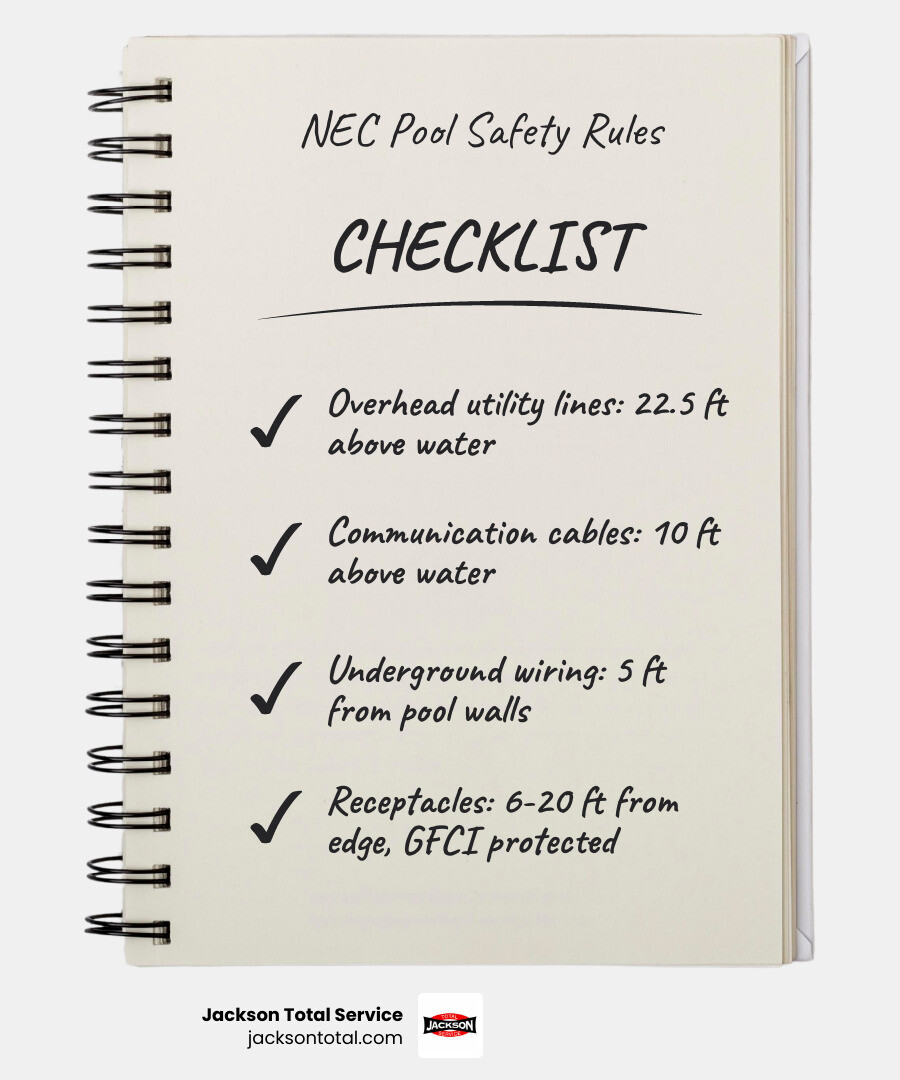
| Overhead utility lines | At least 22.5 ft above the water surface |
| Communication cables | At least 10 ft above the water surface |
| Underground wiring | At least 5 ft from pool or spa sidewalls |
| Convenience receptacles | Between 6 ft and 20 ft from the pool edge, GFCI protected |
| Maintenance disconnect | Within sight, at least 5 ft from the water |
| Pool motors (60A or less) | GFCI protection required |
| Underwater luminaires | Top of lens at least 18 inches below water level |
| Equipotential bonding wire | Solid copper, minimum 8 AWG |
These rules come from NEC Article 680, the section of the National Electrical Code dedicated entirely to swimming pools, spas, hot tubs, fountains, and similar installations.
If you live in Southwest Florida — where the warm climate means pools and spas get used year-round — getting these details right is not optional. A missing GFCI breaker, an improperly bonded ladder, or an outlet too close to the water’s edge can all create life-threatening hazards. On top of the safety risks, code violations can lead to failed inspections, insurance claim denials, and expensive retrofits down the road.
One real-world concern that illustrates why these rules exist: long-handled metal pool cleaning nets can easily reach overhead power lines that are not installed at the correct height. That single scenario is part of why NEC clearance requirements are so precise.
Whether you are building a new pool, replacing equipment, or upgrading an older installation in Naples, Bonita Springs, or anywhere in Lee or Collier County, understanding these requirements before work begins can save you from serious problems later.
Understanding NEC Electrical Requirements for Pool and Spa Installations
When we talk about electrical requirements for pool and spa installations, we are primarily looking at the standards set by Article 680 of the National Electrical Code (NEC). These standards are updated every few years—with May 2026 being our current benchmark—to account for new technology and safety data. The primary goal is simple: keep electricity and people in the water completely separate.
One of the first things we look at during an inspection in Naples or Marco Island is overhead clearances. Utility power lines running over a pool or spa must be at least 22.5 feet above the water level or the base of a diving platform. This height accounts for the “reach” of common maintenance tools like long-handled skimmers. Communications cables (like your internet or telephone lines) have a slightly lower threshold but must still be maintained at a height of at least 10 feet above the water level. For more details on local standards, you can check out our Electrical Installation Naples Fl Complete Guide/.
Underground Wiring and Clearance Rules
What happens beneath the surface is just as important as what is overhead. Generally, underground wiring is prohibited within 5 feet of any pool or spa sidewall. This “buffer zone” prevents accidental contact with energized lines if the pool structure shifts or if someone is digging for landscaping nearby.
However, there are exceptions. If the wiring is necessary to supply the pool equipment itself, it can be closer, provided it follows strict wiring methods. For instance, rigid metal conduit (RMC) or intermediate metal conduit (IMC) usually requires at least 6 inches of earth cover. If you are using nonmetallic raceways like PVC, the burial depth typically increases to 18 inches, though this can be reduced to 6 inches if the conduit is covered by at least 4 inches of concrete. Ensuring these depths are correct is a major part of any Electrical Installation Fort Myers Fl Guide/.
Maintenance Disconnect Locations
Every pool or spa system requires a maintenance disconnecting means. This is a switch that allows a technician (or a homeowner in an emergency) to cut power to the pumps, heaters, and lights. Per the NEC, this disconnect must be:
- Readily Accessible: You shouldn’t need a ladder or a screwdriver to get to it.
- Within Sight: It must be visible from the equipment it serves.
- At a Safe Distance: It must be located at least 5 feet horizontally from the inside walls of the pool or spa.
This 5-foot rule is designed to prevent someone from reaching out and touching an electrical switch while they are still in the water. In public or multi-family installations, an emergency shutoff is also required, though single-family homes in places like Estero are often exempt from the “emergency” button specifically, provided the maintenance disconnect is properly placed. You can read more in our Electrical Installation Estero Fl Guide/.
Essential GFCI Protection and Receptacle Placement

Ground-Fault Circuit Interrupter (GFCI) protection is the most critical life-safety component in any pool electrical system. A GFCI monitors the flow of electricity and “trips” (cuts power) if it detects a tiny leak—as small as 4 to 6 milliamps—which is enough to cause a fatal shock in water. For homeowners in North Naples, ensuring these devices are tested regularly is a top priority. Learn more at our Electrical Installation North Naples Fl Guide/.
Receptacle Electrical Requirements for Pool and Spa Installations
You can’t just put an outlet anywhere you want near a pool. The NEC has strict “zones” for receptacle placement:
- The 6-20 Foot Rule: For in-ground pools, you are required to have at least one 125-volt, 15- or 20-amp convenience outlet located between 6 feet and 20 feet from the pool’s edge. This ensures you can plug in a radio or a vacuum without needing a dangerous extension cord.
- Weatherproof Covers: All outdoor receptacles must have “extra-duty” (in-use) covers that stay weatherproof even when something is plugged in.
- Indoor Spas: The rules are slightly tighter for indoor setups in places like Ave Maria, where outlets are typically required between 6 and 10 feet from the wall.
For more specifics on these distances, see our Electrical Installation Ave Maria Fl Guide/.
Equipment and Motor Protection
Pool pumps and motors are heavy-duty pieces of equipment that operate in wet, often corrosive environments. The electrical requirements for pool and spa installations mandate GFCI protection for all pool motors rated 60 amperes or less, regardless of whether they are hard-wired or connected by a plug.
This rule also applies to replacement motors. If your old pump dies and you buy a new one, the current code requires you to add GFCI protection to that circuit if it wasn’t there before. This is a common point of confusion in Immokalee, but it is a non-negotiable safety upgrade. Check out our Best Electrical Installation Immokalee Fl/ for more equipment advice.
Equipotential Bonding: The Key to Shock Prevention
One of the most misunderstood concepts in pool safety is the difference between “grounding” and “bonding.” While grounding provides a path for fault current to return to the breaker panel, equipotential bonding is designed to bring all metal parts of the pool area to the same electrical potential.
| Feature | Grounding | Equipotential Bonding |
|---|---|---|
| Purpose | Trips the breaker during a short circuit | Eliminates “stray voltage” between surfaces |
| Material | Insulated copper wire | Solid, bare 8 AWG copper wire |
| Connection | Connected to the home’s electrical panel | Connected to all metal pool parts and the shell |
By connecting the pool’s rebar, the pump motor, the ladder, and even the water itself into one big “grid” using a solid 8 AWG copper conductor, we ensure that no voltage difference can exist between them. If there is no voltage difference, electricity won’t flow through a swimmer’s body. This is a critical focus for our Best Electrical Installation Bonita Springs Guide/.
Perimeter Bonding and Conductive Shells
In Southwest Florida, most of our pools are made of “conductive” materials like poured concrete or shotcrete. These require a perimeter bonding ring. This copper ring must be placed between 18 inches and 24 inches from the inside walls of the pool and secured between 4 inches and 6 inches below the subgrade.
If you have a non-conductive pool (like fiberglass or vinyl), you still need this perimeter bond to protect people standing on the pool deck. This is a vital step in Electrical Installation Pine Island Fl Guide 2025/.
Lighting and Accessory Electrical Requirements for Pool and Spa Installations
Nothing transforms a backyard like underwater lighting, but mixing high-voltage lights with water requires extreme caution. Underwater wall-mounted luminaires must be installed so that the top of the lens is at least 18 inches below the normal water level. This depth prevents the light from being easily broken and ensures it stays cool.
For the wiring, we use “forming shells” and junction boxes that are specifically listed for swimming pool use. These boxes must be located at least 4 inches above the ground level (or 8 inches above the water level) and at least 4 feet from the pool’s edge. We also use a special “potting compound” to encapsulate the cord terminations, protecting them from the corrosive effects of pool chemicals. If you’re looking for aesthetics as well as safety, see How To Choose The Best Landscape Lighting Installation In Fort Myers Fl/.
Overhead Lights and Ceiling Fans
If you have a pool cage or a covered lanai in Naples, you might want a ceiling fan or light fixture directly over the water. The rules here are strict:
- Standard Fixtures: Must be at least 12 feet above the maximum water level.
- GFCI-Protected Fixtures: Can be as low as 7.5 feet.
- Low-Voltage Lighting: Systems that do not exceed the “low-voltage contact limit” (usually 15V AC or 30V DC) offer more flexibility but must still be installed by a pro.
If you’re in the middle of a home update, check out our guide: Im Renovating And Need New Lighting Fixtures Installed Who Can I Hire For Electrical Installation In Naples Fl/.
Frequently Asked Questions about Pool Wiring
What is the difference between a storable and permanent pool?
The NEC defines a storable pool as one that has a maximum water depth of 42 inches or less, or one with nonmetallic, inflatable walls regardless of size. These pools are intended to be disassembled for the winter. Anything deeper than 42 inches or any pool installed in-ground is considered a permanently installed pool and must follow the much stricter wiring and bonding rules we’ve discussed.
Can I use an extension cord for my pool pump?
For permanent pools, the answer is a firm no. The flexible cord for a pool motor must not exceed 3 feet in length and must include an insulated copper equipment grounding conductor. For storable pools, manufacturers often provide a 25-foot cord to prevent the use of extension cords, which are a major trip and shock hazard near water.
Do I need a permit for a spa installation in Southwest Florida?
Yes. Whether you are in Cape Coral, Fort Myers Beach, or Sanibel Island, a spa or hot tub installation almost always requires an electrical permit. This is because the installation involves high-voltage circuits (often 240V and 50-60 amps) and requires a professional to verify that the GFCI protection, bonding, and disconnect distances meet the current Florida Building Code.
Conclusion
Navigating the electrical requirements for pool and spa installations can feel overwhelming, but these rules are the only thing standing between a relaxing afternoon and a dangerous electrical incident. From the precise height of overhead lines to the hidden copper bonding grid beneath your deck, every detail serves a purpose.
At Jackson Total Service, we have been the trusted name for home comfort in Southwest Florida since 1964. Our licensed electricians understand the unique challenges of our local environment—from salt-air corrosion in Naples to the high water tables in Lehigh Acres. We provide all your comfort solutions in one place, so you don’t have to juggle multiple contractors for your pool’s electrical, plumbing, and heating needs.
Ready to ensure your pool or spa is up to code? Visit our pool and spa wiring service page today to schedule an inspection or installation. We’re here to keep your family safe and your summer fun going year-round.