


Is It Time to Repair or Replace Your AC in Naples or Southwest Florida?
Knowing when to repair vs replace your AC system is one of the most important decisions you’ll face as a homeowner, especially in Southwest Florida, where your air conditioner runs hard for most of the year.
Here’s a quick answer to help you decide right now:
| Situation | Likely Best Choice |
|---|---|
| System is under 10 years old, minor issue | Repair |
| Major repair on an aging system | Consider Replace |
| Repair involves a major component on an older unit | Replace |
| System is 10-15+ years old with frequent breakdowns | Replace |
| Unit uses R-22 refrigerant and has a leak | Replace |
| Recent repair, still under parts warranty | Repair |
| Rising energy bills, low SEER rating, poor comfort | Replace |
| Minor one-time issue, system cools evenly | Repair |
Most AC systems last between 10 and 15 years. But age alone doesn’t tell the whole story. Repair history, refrigerant type, energy efficiency, and how often your system breaks down all play a role. For Southwest Florida homeowners, the long cooling season and salt air humidity can shorten that lifespan further, making the repair-vs-replace question come up sooner than expected.
This guide walks you through every factor that matters, so you can make a confident, informed decision instead of guessing under pressure.
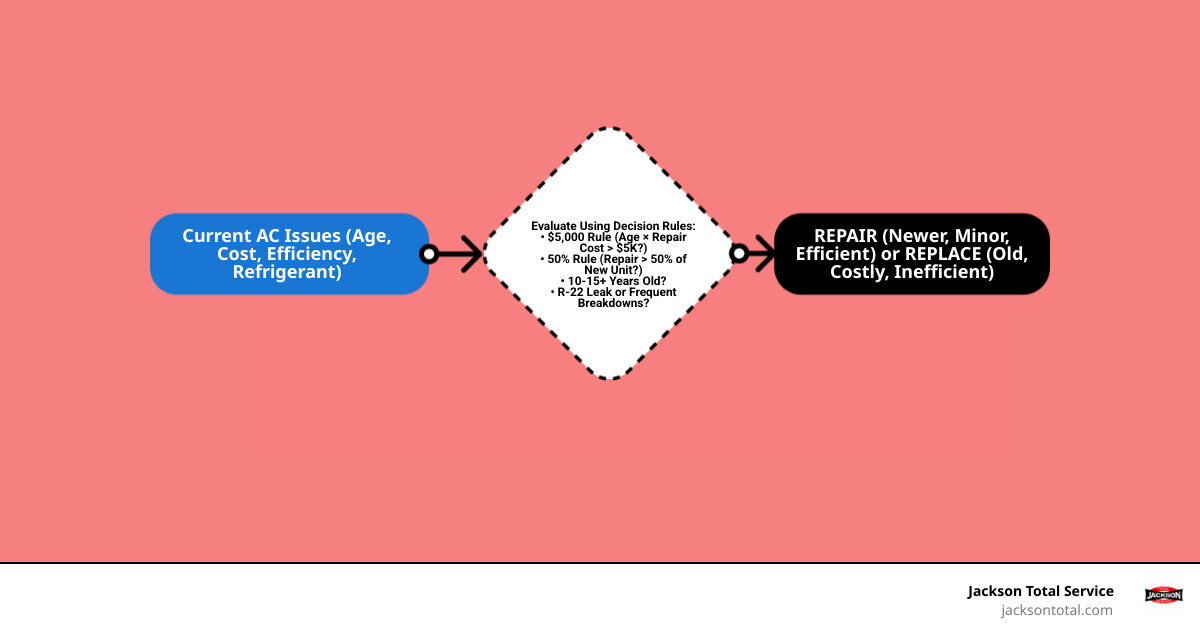
When to Repair vs Replace Your AC System: The Fast Decision Framework
Making a choice between a quick fix and a total system overhaul doesn’t have to be a guessing game. In Southwest Florida, we look at a combination of system age, repair frequency, and efficiency loss when evaluating home cooling performance.
If your unit is struggling with uneven cooling or high humidity, it might be more than just a dirty filter. Furthermore, the type of refrigerant your system uses is a major “go/no-go” factor. If you are dealing with safety issues like burnt electrical components or persistent mold within the air handler, the decision often shifts toward replacement for the sake of your family’s health and safety.
Simple Rules Homeowners Use First
Two common rules of thumb can help you think through the decision: the age of the system and how significant the repair is. If your AC is newer and the issue is minor, repair is often the right move. If the system is older and the repair involves a major component, replacement may make more sense.
Why Major Repairs on Older Systems Matter
Another helpful framework is this: if a single repair is substantial compared to the condition and age of the system, replacement is often the smarter long-term choice. A newer system can offer improved reliability, better efficiency, and renewed warranty coverage.
When to Repair vs Replace Your AC System Based on Age
Age is one of the biggest factors homeowners consider. Most AC units have a typical lifespan of 10-15 years, though some well-maintained systems can stretch longer. However, if your heat pump or air conditioner is more than 10 years old, it may be time to start planning ahead. By the time a system hits the 12-to-15-year mark, it has reached its later-life stage. At that point, even if it is currently running, its efficiency has likely dropped compared to modern standards.
When a Professional Evaluation Beats a Guess
While rules of thumb are helpful, they can’t tell the whole story. A professional HVAC assessment involves load testing, checking static pressure (how hard your fan has to work to push air through ducts), and measuring amp draw. These technical readings help show whether a motor is struggling or if your coils are wearing down.
Jackson Total Service provides written findings to help you see the “health” of your system clearly. If you’re unsure where your system stands, you can explore our full range of air conditioning services to get a better idea of how we evaluate home comfort.
Signs Repair Usually Makes Sense
Not every breakdown is a death knell for your AC. In many cases, a targeted repair is the most logical and budget-friendly move, especially if the system has been well-maintained and isn’t showing signs of systemic failure.
Newer Systems With One-Time Problems
If your system is only five or six years old, it’s usually in its prime. Common issues like a blown capacitor, a worn-out contactor, a faulty thermostat, or even a fan motor are often isolated incidents. These components are designed to be replaced, and doing so can restore your system to perfect working order without the need for a total replacement.

Systems That Still Cool Evenly and Efficiently
If your home still feels comfortable, the humidity is under control, and your energy bills haven’t spiked, your system likely has plenty of life left. If the repair list is short and the unit doesn’t run constantly (short-cycling), a repair is a safe bet.
Units Protected by a Parts Warranty
Always check your warranty status! Most modern systems come with a 5-to-10-year parts warranty. If your repair is covered, you might only be responsible for the labor. This significantly tilts the scales in favor of repairing the unit. Keeping detailed service records and ensuring your installation was registered can save you thousands in these scenarios.
Cases Where Maintenance Can Prevent Bigger Repairs
Many “repairs” are actually just neglected maintenance. A clogged drain line or a dirty evaporator coil can cause a system to shut down, but these are easily fixed with a professional tune-up. Regular maintenance is the best way to extend the life of your unit. We highly recommend looking into maintenance agreements to catch small issues before they become expensive replacements. If you’re currently facing a breakdown, our air conditioning repair team can help diagnose whether it’s a simple fix or something more serious.
Signs It’s Time to Replace Your AC Instead of Repair It
Sometimes, repairing an old AC is like putting a new transmission in a car with very high mileage and a rusted frame. It might get you down the road, but for how long?
When to Repair vs Replace Your AC System if It Keeps Breaking Down
If you find yourself calling for air conditioning repair in Naples, FL every few months, your system is sending you a message. Frequent breakdowns, especially involving the same components, indicate that the system is failing as a whole. Reliability is one of the main reasons homeowners choose to replace; nobody wants their AC to quit on a Saturday afternoon in July.
Rising Energy Bills and Older SEER Ratings
Efficiency is measured by the Seasonal Energy Efficiency Ratio (SEER). Older units might be rated at SEER 10 or 13. Today, the standard has moved to SEER2, with many high-efficiency units reaching 18 to 25+. Switching from an older system to a modern high-efficiency unit can significantly reduce energy use while improving indoor comfort.
| Feature | Older AC System (10+ Years) | Modern High-Efficiency Replacement |
|---|---|---|
| SEER Rating | 9 – 13 SEER | 16 – 25+ SEER2 |
| Refrigerant | R-22 (Phased out) | R-410A or R-454B |
| Energy Use | Higher | Lower |
| Humidity Control | Basic / Poor | Advanced (Variable speed) |
| Sound Level | Noisy / Rattling | Ultra-quiet operation |
Uneven Cooling, Humidity, Dust, and Noise Problems
Is one bedroom a sauna while the living room is an icebox? This often points to a system that is no longer sized correctly for your home or a blower motor that is losing its strength. If you notice excessive dust or a home that feels sticky despite the AC running, your unit may no longer be managing humidity well. If your system has become noisy with clanking or squealing sounds, that’s often a sign of mechanical failure. For more insights on this, read our guide on why your air conditioner isn’t cooling your house.
Safety or IAQ Problems That Shouldn’t Be Ignored
Safety should always be the priority. Burnt wiring, frequent tripped breakers, or a cracked heat pump cabinet can lead to serious hazards. Additionally, poor Indoor Air Quality (IAQ) caused by mold growth inside an old, leaky air handler can affect your health. If a system poses a risk to your home or family, replacement isn’t just a comfort decision – it’s a necessary one.
Refrigerant, Efficiency, and Warranty Factors That Change the Answer
The guts of your AC system – the refrigerant and the efficiency standards – have changed more in the last few years than in the previous two decades.
Why R-22 Systems Are Often Replacement Candidates
If your unit was manufactured before 2010, there is a high chance it uses R-22 (Freon). Production of R-22 ended in 2020, making it extremely scarce and expensive. If an R-22 system develops a refrigerant leak, the decision to keep repairing it becomes much harder. In almost every case, we recommend replacing an R-22 unit rather than attempting a leak repair.
How R-410A and R-454B Affect Future Service Decisions
Most systems installed in the last decade use R-410A. However, as of 2026, the industry is transitioning to newer, even more environmentally friendly refrigerants like R-454B. When deciding when to repair vs replace your AC system, consider that parts and refrigerant for R-410A will remain available for years, but the newest systems offer the best future-proofing for your home.
SEER and SEER2: How Efficiency Influences Repair vs Replace
The transition to SEER2 standards means that new units are tested under more realistic conditions that mimic actual home ductwork. Upgrading to a high-efficiency unit doesn’t just support better energy performance; it can also improve comfort. Modern variable-speed compressors can slow down and speed up as needed, which is significantly better at removing Florida humidity than older on-or-off systems.
What to Check Before Deciding Based on Warranty
Before you sign off on a replacement, verify your warranty. Some high-end systems have 12-year warranties. However, keep in mind that many warranties are only valid if the system has received annual professional maintenance. If you haven’t had a tune-up in years, the manufacturer might deny the claim.
Real-Life Situations Homeowners Ask About Most
Every home is different, and your personal goals for your property will influence the best path forward.
Should You Repair or Replace If You Plan to Sell Your Home Soon?
If you are putting your home on the market in the next six months, a full AC replacement may not always be necessary. In some cases, a repair that gets the system running properly through a home inspection is the preferred route. However, a newer AC with a transferable warranty can still be a helpful selling point in Southwest Florida.
When Replacement Wins for Long-Term Savings and Reliability
If you plan to stay in your home for five or more years, replacement is often the better long-term option. You’ll reduce the chances of ongoing breakdowns, may lower your monthly utility use, and gain the peace of mind that comes with a new warranty. Plus, modern systems are compatible with smart thermostats and advanced diagnostics that can help identify issues earlier.
How Southwest Florida Conditions Can Shorten AC Life
Living in places like Naples, Marco Island, or Sanibel means your AC faces unique challenges.
- Salt Air: Coastal air causes rapid corrosion of the aluminum fins on your outdoor condenser.
- High Humidity: Our evaporator coils stay damp longer, which can lead to biological growth and “pitting” corrosion.
- Long Runtime: While a unit in a cooler climate might run for only part of the year, a Florida AC runs for 10 or 11 months.
- Lightning & Surges: Frequent afternoon thunderstorms can damage sensitive electronics in older units.
How to Prepare for an HVAC Assessment Appointment
When you call Jackson Total Service for an evaluation, having a few things ready can speed up the process. Find the serial number on your unit (usually on a sticker on the side), look up your last few utility bills to see if there’s a trend of rising usage, and make a list of any “hot spots” in your house. If you’re in Lee County, check out our AC problems Fort Myers, FL guide for more localized tips.
Frequently Asked Questions About When to Repair vs Replace Your AC System
What is the typical lifespan of an AC unit?
In our region, the typical lifespan is 10 to 15 years. While units can last longer, the combination of salt air and near-constant operation means that by year 12, most systems are nearing the end of their reliable service life.
Should I replace my AC if it’s more than 10 years old?
Not necessarily. If a 10-year-old system is running efficiently and hasn’t needed major repairs, it may have several good years left. However, you should start budgeting for a replacement and consider it seriously if a significant repair comes up on an aging unit.
Can uneven cooling mean I need replacement instead of repair?
It can. While uneven cooling is sometimes caused by leaky ducts or poor insulation, it often indicates that the AC’s blower motor is failing or the system was never sized correctly for the home. A professional can determine if a repair to your ductwork or a new, properly sized system is the answer.
Conclusion
Deciding when to repair vs replace your AC system is about balancing your immediate comfort with your long-term goals as a homeowner. Whether you need a quick fix to get through the weekend or a high-efficiency upgrade for better comfort, Jackson Total Service is here to help.
Since 1964, Jackson Total Service has helped homeowners across Southwest Florida with dependable home comfort solutions. We understand the unique climate conditions in Naples, Bonita Springs, Fort Myers, Marco Island, and surrounding Lee and Collier County communities, and we provide honest, professional assessments to help you make the right choice for your home. Our licensed technicians are available with fast service and 24/7 emergency support when you need us most.
Ready to find out the best path for your home’s comfort? Contact us today for a professional air conditioning services evaluation and let us help you keep your home a cool, comfortable sanctuary.