



Why Late-Summer Musty Odors Demand a Closer Look at Your AC
A standard one-inch fiberglass air filter is all you need to keep your home’s air clean and fresh—or so the common myth goes, until you start researching Air Purifiers vs. UV Lights for Fighting Duct Mold in Humid Florida Homes. The truth is that a basic, off-the-shelf filter simply cannot handle the extreme moisture load your air conditioning system processes during the hottest, most humid months of the year. When you notice a damp, earthy, or musty smell blowing through your vents, that is not just stale air. It is a clear indicator that microbial growth has taken root inside your ductwork or air handler.
Before investing in advanced air quality hardware, scheduling professional AC maintenance is always the crucial first step. You cannot permanently fix an underlying mechanical issue with an air quality accessory. Technicians often refer to this musty odor as “dirty sock syndrome,” a highly descriptive term for the smell produced when bacteria and mold colonies multiply on a constantly damp evaporator coil. During periods of intense late-summer August humidity, your AC system pulls gallons of water out of the indoor air every single day. If that moisture does not drain perfectly, the inside of your air handler becomes a dark, wet, and warm environment—the absolute perfect breeding ground for mold.
The core decision point: Once you confirm that your system is mechanically sound and properly maintained, you are left with a critical choice for your indoor air quality (IAQ) strategy. Do you install a system designed to capture airborne spores as they circulate through your living space, or do you install a system designed to stop those spores from growing at the source? Understanding the mechanical differences between these two approaches is the key to finally eliminating those late-summer odors and protecting your home’s air.
Treating the Source vs. the Symptom: How Mold Thrives in HVAC Systems
To understand why certain air quality solutions work better than others, you have to look at how mold actually behaves inside a residential cooling system. In places like Naples, FL, the climate puts an incredible amount of stress on your air conditioner’s dehumidification capabilities. Southwest Florida averages over 70% relative humidity in late summer, making it extremely difficult to maintain the EPA’s recommended 30-50% indoor humidity range without targeted, professional interventions.
When warm, moisture-heavy air is pulled through your return vents, it passes over the freezing cold copper or aluminum fins of the evaporator coil. This rapid temperature drop causes the moisture in the air to condense into liquid water on the coil. In a perfectly functioning system, this water drips into a drain pan and flows safely outside. However, because the AC runs almost constantly during the summer, that evaporator coil almost never has a chance to completely dry out.
Here is how the problem develops from a mechanical standpoint:
- The Problem (The Source): Dust and microscopic organic matter bypass standard air filters and stick to the wet evaporator coil. This creates a nutrient-rich “biofilm” on the damp metal. Mold spores naturally present in the air land on this wet biofilm and begin to aggressively reproduce.
- The Cause (The Environment): The dark, enclosed cabinet of the air handler provides protection, while the constant flow of humid air provides endless moisture and food. The wet coil becomes a mold manufacturing plant.
- The Symptom (Airborne Spores): As the blower fan forces cold air over the contaminated coil, it picks up thousands of newly generated mold spores and blasts them through your ductwork into every room of your house. This is when you start to smell the musty odor and experience allergy flare-ups.
As you read through any comprehensive guide to mold-free air conditioning, you will notice a recurring theme: airborne spores are merely the symptom of an underlying moisture problem. Capturing the circulating spores in your living room is certainly helpful for your immediate comfort, but leaving a wet, untreated coil inside the air handler allows the mold colony to continuously reproduce. You are essentially bailing water out of a boat without plugging the hole in the hull.
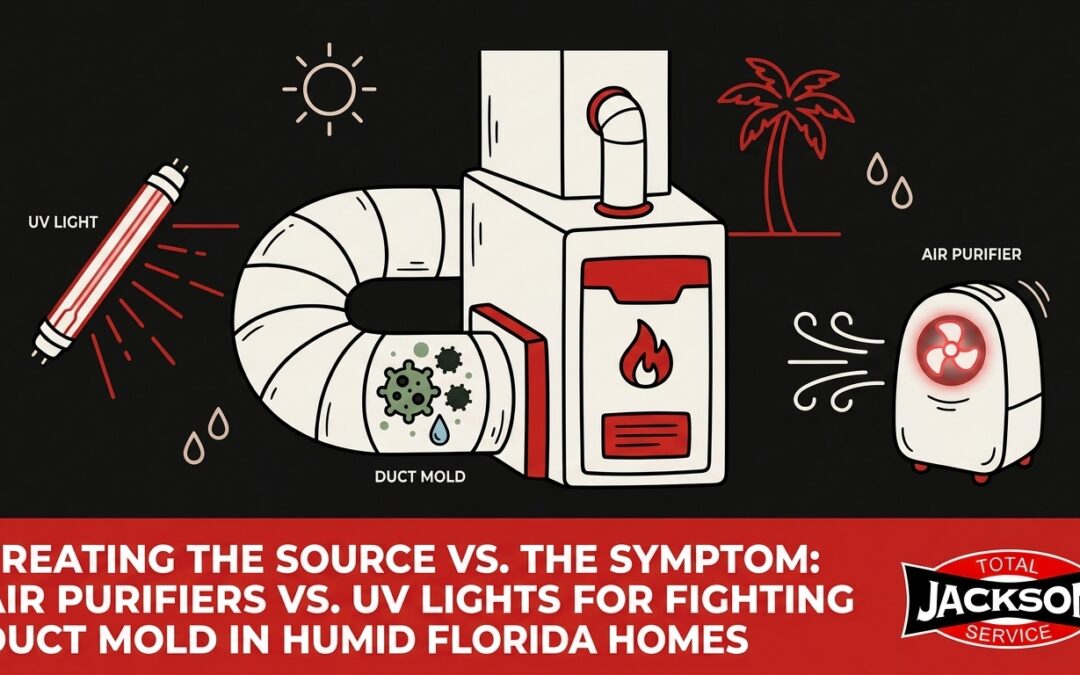
How In-Duct UV Lights Neutralize Mold at the Source
If the wet evaporator coil is the source of the problem, in-duct ultraviolet (UV) lights are the direct, targeted solution. UV germicidal irradiation has been used for decades in hospitals, laboratories, and water treatment facilities to sterilize environments and neutralize pathogens. When applied to residential HVAC systems, this technology fundamentally changes the biology of the air handler.
In-duct UV lights utilize a highly specific wavelength of ultraviolet light—typically UV-C at 254 nanometers. This specific wavelength is lethal to microorganisms. When the intense UV-C light hits mold spores, bacteria, or viruses resting on the evaporator coil, it penetrates their cellular walls and scrambles their DNA. This genetic disruption prevents the microorganisms from reproducing. Because mold cannot multiply, the colony collapses, and the biofilm is safely neutralized.
What makes UV lights so effective against extreme late-summer August humidity?
- Continuous Sterilization: The UV lamp is mounted directly inside the air handler and remains on 24 hours a day, 7 days a week. It shines a constant, sterilizing beam of light across the damp evaporator coil, ensuring that nothing can grow on the metal surfaces, even when the AC compressor cycles off.
- Restored Efficiency: A thick layer of mold and biofilm acts as an insulator on your cooling coil. By keeping the metal perfectly clean, a UV light allows the coil to transfer heat more effectively, which can lower your energy bills and reduce wear and tear on the compressor.
- Odor Elimination: By killing the bacteria and mold at the source, the root cause of “dirty sock syndrome” is eliminated before the air ever reaches your ductwork.
It is important to note that UV-C light is powerful enough to degrade standard plastics over time. If a light is installed incorrectly, it can make the plastic drain pan brittle or damage the internal wiring of the air handler. This is why you should always rely on AC repair experts in North Naples to properly position the lamps. Professionals use specialized shielding and UV-rated materials to ensure the light maximizes coil coverage without harming the surrounding mechanical components.
The Role of Whole-Home Air Purifiers in Capturing Airborne Spores
While UV lights are exceptional at treating the source of the problem on the coil, they are not actually filters. They do not remove physical particles from the air. This is where whole-home air purifiers step in to treat the symptom—the airborne spores, dust, and allergens that have already entered your home’s air supply.
A true whole-home air purifier is typically installed directly into the return ductwork, just before the air reaches the HVAC equipment. The gold standard for this type of filtration is the HEPA (High-Efficiency Particulate Air) standard. To qualify as a true HEPA filter, the media must capture 99.97% of all airborne particles that are as small as 0.3 microns. To put that into perspective, a single strand of human hair is roughly 70 microns thick. Mold spores typically range from 3 to 40 microns, making them incredibly easy for a high-quality purifier to trap.
What Whole-Home Purifiers Do Best
If you live in Naples, FL, your home is likely sealed tight to keep the oppressive heat out. Unfortunately, a tightly sealed home also traps indoor pollutants. A whole-home purifier excels at scrubbing the air inside your living space.
- Broad-Spectrum Allergen Removal: Purifiers capture pet dander, pollen, fine dust, and dust mites that a UV light would simply ignore (since UV light only affects living DNA, not inert dust).
- Airborne Spore Capture: If mold spores blow in through an open door or are tracked in on your shoes, the air purifier will catch them as soon as the HVAC system cycles the air through the return vent.
- Odor and VOC Reduction: Many advanced whole-home purifiers include activated carbon layers that absorb volatile organic compounds (VOCs), cooking smells, and chemical off-gassing from furniture and cleaning supplies.
However, purifiers have one major limitation when it comes to fighting severe HVAC mold: they cannot reach inside the air handler to clean a dirty, wet coil. If your AC coil is already contaminated, the purifier will capture the spores as they circulate back through the return duct, but the colony on the coil will continue to thrive and push new spores out through the supply vents. Purifiers are exceptional overall air scrubbers, but they are fundamentally symptom-treaters when it comes to coil-based mold.
Side-by-Side Comparison: Air Purifiers vs. UV Lights for Fighting Duct Mold in Humid Florida Homes
When you are staring down the barrel of late-summer August humidity and trying to decide which indoor air quality upgrade makes the most sense for your family, it helps to look at the hard facts side-by-side. Both technologies are highly effective, but they perform completely different jobs within your HVAC infrastructure.
| Feature | In-Duct UV Lights | Whole-Home Air Purifiers |
|---|---|---|
| Primary Target | The wet evaporator coil (Treats the Source) | The circulating indoor air (Treats the Symptom) |
| Technology Used | UV-C 254 nm germicidal wavelength light | Thick media filtration (HEPA) and active particle capture |
| System Impact | Keeps the AC running efficiently by keeping coils clean and free of biofilm | Dramatically improves overall breathing air quality and reduces household dust |
| Maintenance Needs | Annual bulb replacements (UV intensity degrades over 12 months) | Periodic media filter replacements (typically every 6 to 12 months) |
When to Choose UV Lights
An in-duct UV light is usually the best primary investment if your main complaint is a musty, dirty sock odor coming directly from the vents when the AC kicks on. If your technician has noted that your coil is constantly saturated due to high humidity, or if you have had to pay for chemical coil cleanings in the past due to organic buildup, a UV light will stop the problem at its root. It is a protective measure for the mechanical equipment itself.
When to Choose Air Purifiers
A whole-home air purifier is the better standalone choice if your AC coil is relatively clean and dry, but your indoor air still feels stale, heavy, or contaminated. If your primary concerns are general seasonal allergies, heavy dust accumulation on furniture, pet dander, or cooking odors, a purifier will provide the broad-spectrum filtration you need to breathe easier in every room.

Why the Best Strategy Often Combines Both Technologies
For decades, Florida homes relied on drafty construction to passively cycle fresh air indoors. Leveraging a 60-year family legacy in the local HVAC industry, we have seen firsthand how historically, Florida HVAC systems degraded in IAQ performance over time as building codes tightened. Today’s modern, energy-efficient homes in Naples, FL, are built like sealed plastic containers. While this is fantastic for keeping the heat out and lowering cooling costs, it completely traps humidity, VOCs, and biological contaminants indoors. Because of this architectural shift, relying on just one air quality tool is often no longer enough.
The absolute best strategy for a healthy home often combines both technologies to create a comprehensive defense system. Think of it as a two-stage security protocol for your air.
First, the in-duct UV light acts as the internal security guard for the HVAC equipment. By shining continuously on the wet evaporator coil, it ensures that no new mold colonies can form, and no new bacteria can breed. This protects the mechanical integrity of the system and completely eliminates source-based odors. By stopping mold at the coil, you drastically reduce the workload on your filtration system.
Second, the whole-home air purifier acts as the environmental scrubber for the living space. Even with a pristine, UV-sterilized coil, older ductwork might still harbor residual dust, and daily life brings new allergens into the home constantly. The purifier aggressively filters out pet dander, pollen, and any stray spores that blow in through an open window.
Because every home’s ductwork and humidity profile is unique, a professional assessment is vital. Before making a final decision, consulting with experts in residential AC repair in Bonita Springs will help you determine the exact right combination of UV sterilization and media filtration to match your home’s specific airflow and moisture challenges.
Frequently Asked Questions About Combating AC Mold
Do UV lights in HVAC actually kill mold?
Yes, UV-C lights are highly effective at neutralizing mold on stationary surfaces. When the 254 nm wavelength light shines directly on the wet evaporator coil, it penetrates the cellular walls of mold spores and scrambles their DNA. This prevents the mold from reproducing, effectively killing the colony and stopping it from spreading through your system.
Which is better for mold: an air purifier or a UV light?
If the mold is actively growing on your AC coil due to extreme late-summer August humidity, a UV light is better because it treats the source of the growth. If the mold spores are simply blowing into your home from the outside and circulating in the air, a high-efficiency air purifier is better for capturing them. For severe mold issues, using both is the most effective approach.
Does a UV light replace the need for an air purifier?
No, a UV light does not replace an air purifier. UV lights do not filter physical particles out of the air; they only neutralize living organisms that pass directly through the light or grow on the illuminated surfaces. You still need an air purifier or a high-quality media filter to remove dust, pet dander, pollen, and dead spores from your breathing air.
Do HVAC UV lights produce harmful ozone?
Modern, high-quality HVAC UV lights designed for residential use do not produce harmful levels of ozone. Reputable manufacturers use specific glass coatings on the UV-C bulbs to block the 185 nm wavelength that creates ozone, ensuring that the light only emits the safe, germicidal 254 nm wavelength. Always verify that your chosen unit is certified as zero-ozone.
How often do in-duct UV bulbs need to be replaced in humid climates?
In-duct UV bulbs should be replaced once a year, regardless of the climate. Even if the bulb still lights up and glows blue after 12 months, the actual invisible UV-C intensity degrades significantly over time. To maintain enough germicidal power to fight off rapid mold growth during humid summer months, an annual bulb replacement during your routine maintenance visit is essential.
Secure Your Home’s Air Quality Against Florida’s Toughest Humidity
Ultimately, choosing between Air Purifiers vs. UV Lights for Fighting Duct Mold in Humid Florida Homes comes down to a simple concept: treating the source versus treating the symptom. If your primary battle is against a wet, contaminated AC coil producing musty odors, a UV light is your strongest frontline defense. If your goal is to scrub the circulating air of dust, dander, and external allergens, a whole-home purifier is the right tool for the job.
Living in Naples, FL, means dealing with relentless humidity, but you do not have to accept stale, musty air as a normal part of late summer. A regionally-tailored approach can solve your specific mold and odor problems permanently. Reach out to a local indoor air quality expert to evaluate your system’s unique needs, assess your ductwork, and recommend the exact right combination of technologies to keep your home’s air clean, fresh, and healthy all year long.