




The Smartest Way to Hire for Your Home: One Company or Several?
Choosing one multi trade company vs separate contractors is one of the most important decisions you’ll make before starting any home project. Get it right, and your project runs smoothly. Get it wrong, and you could be spending more time, money, and stress than you ever planned for.
Here’s a quick answer to help you decide:
Choose a multi-trade company if you:
- Have a project involving two or more trades (HVAC, plumbing, electrical, etc.)
- Want a single point of contact and unified warranty
- Need the work done on a tight timeline
- Don’t have 20-40 hours to spend managing contractors yourself
Choose individual specialists if you:
- Have a small, single-trade job (like one plumbing repair)
- Need a highly niche skill not offered by a full-service provider
- Are an experienced project manager comfortable coordinating trades yourself
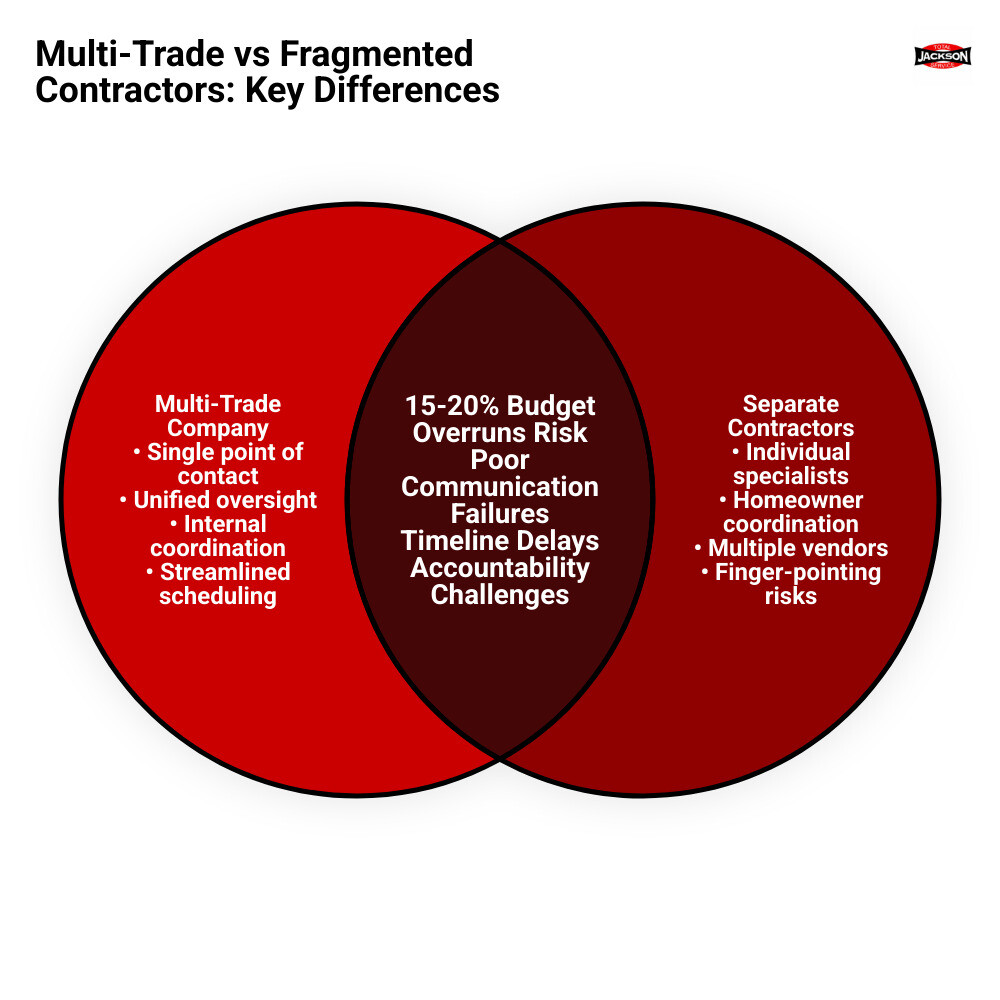
For most Southwest Florida homeowners dealing with HVAC, plumbing, or electrical work, a multi-trade company is the lower-stress, lower-risk option. Research consistently shows that fragmented contractor approaches result in 15-20% budget overruns, and poor communication is behind one in three construction project failures. Those aren’t small risks.
Consider this real-world scenario that plays out regularly: a homeowner hires a roofer and a siding crew separately. The roofer finishes, then the siding crew discovers overlapping work that needs to be torn off and redone. The result? Extra costs and weeks of added delays — all because no single person was responsible for the full picture.
That’s the core tension this guide explores.
Understanding the Difference: Multi-Trade Powerhouse vs. Individual Specialists
When we talk about choosing one multi trade company vs separate contractors, we are comparing two fundamentally different ways of managing a home. On one hand, you have the “Powerhouse” model—a single company that employs licensed professionals across various fields like Home Comfort Services, including HVAC, plumbing, and electrical. On the other hand, you have the “Fragmented” model, where you personally find, vet, hire, and schedule a different specialist for every single task.
In the Powerhouse model, the company takes on the role of the general contractor. They provide the oversight, ensure the plumber isn’t stepping on the electrician’s toes, and make sure the air conditioning tech knows exactly when the new wiring will be ready. In the fragmented model, that “oversight” role falls squarely on your shoulders. You become the project manager, the mediator, and the person responsible when two contractors start pointing fingers at each other over a mistake.
What defines choosing one multi trade company vs separate contractors?
The primary difference lies in how resources are allocated and how the project scope is viewed. A multi-trade company looks at your home as a complete system. If you are renovating a kitchen in Naples or Fort Myers, a multi-trade team understands that the plumbing for the sink, the electrical for the appliances, and the HVAC venting for the range hood all need to work in harmony. They use integrated teams that have worked together on hundreds of projects.
Individual specialists, while often highly skilled in their specific craft, tend to view the job through a narrow lens. An individual electrician wants to get their wires pulled and move on to the next job. They may not realize that the way they routed a conduit will block the plumber’s planned drainage line tomorrow. In Southwest Florida, where building codes are strict and inspections are frequent, these small “silos” of information can lead to failed inspections and costly rework.
The role of project coordination and communication
Communication is the “secret sauce” of any successful home project. Research shows that poor communication causes one-third of all construction project failures. When you hire separate contractors, you create a complex web of information exchange. You have to repeat the same instructions to five different people and hope nothing gets lost in translation.
By choosing one multi trade company vs separate contractors, you can reduce the time you spend on communication management by up to 40%. Instead of five separate phone calls every time a schedule changes, you make one. Multi-trade companies use internal scheduling systems that ensure the transition from one phase to the next is seamless. When the demolition team finishes, the rough-in team is often ready to start immediately, eliminating the “dead time” that plagues projects managed by homeowners.
The Strategic Benefits of a Unified Service Approach
Efficiency isn’t just a buzzword; it’s a measurable advantage. Projects using a multi-trade approach are often completed 15-30% faster than those using the individual contractor method. This is largely due to the elimination of “trade stacking”—a common problem where multiple independent specialists try to work in the same small space at once, leading to accidents, frustration, and lower productivity.
| Feature | Multi-Trade Company | Separate Contractors |
|---|---|---|
| Completion Speed | 15-30% Faster | Standard to Delayed |
| Communication | Single Point of Contact | 3-5x More Touchpoints |
| Accountability | Total (One Company) | Fragmented (The “Blame Game”) |
| Warranty | Unified System Warranty | Multiple Individual Warranties |
| Project Management | Handled by Company | Handled by Homeowner (20-40 hrs) |
A unified approach allows for Air Conditioning Services to be coordinated perfectly with electrical upgrades, ensuring your new high-efficiency system has the dedicated power it needs without a second trip from an outside electrician.
Why choosing one multi trade company vs separate contractors improves accountability
We’ve all heard of the “blame game.” It happens when the painter says the walls are bumpy because the drywaller did a poor job, and the drywaller says the walls are bumpy because the framer left the studs crooked. When you hire separate contractors, you are the one who has to mediate these disputes.
When you work with a multi-trade powerhouse, there is no one else to blame. The company owns the entire process. If a leak occurs where the Electrical Services meet the plumbing lines, one phone call solves it. You don’t have to figure out whose insurance is responsible or who should pay for the repair. A single point of contact means total accountability and a unified warranty that covers the entire scope of work.
Economies of scale and resource management
There is a financial logic to the multi-trade model that often surprises homeowners. While an individual specialist might give a low “sticker price” for one small task, the total cost of a multi-phase project is often lower with a single company. Multi-trade contractors achieve labor cost reductions of approximately 12-18% through optimized worker allocation. They don’t have the same administrative overhead that five separate small businesses do.
Furthermore, larger companies often benefit from bulk material procurement. Because they buy HVAC equipment, copper piping, and electrical components in high volumes, they can often secure better availability for high-demand parts. This consistency in workmanship and material quality ensures that your home doesn’t end up looking like a “patchwork quilt” of different brands and standards.
When Does Hiring Individual Specialized Contractors Make Sense?
Despite the clear benefits of the multi-trade model, there are times when hiring a specialist is the right move. If you have a very small, one-off repair—like a single leaky faucet or a broken light switch—calling a multi-trade company might be more than you need. Individual pros are great for niche, highly specific tasks that don’t require coordination with other systems.
For example, if you need Plumbing Services for a simple water heater replacement and nothing else in your home is being touched, a dedicated local plumber is a perfectly fine choice. This approach offers budget flexibility for homeowners who want to tackle one small task at a time over several years.
Evaluating project complexity when choosing one multi trade company vs separate contractors
The “tipping point” for choosing a multi-trade company is usually when a project involves more than one system. Kitchen and bathroom renovations are the classic examples. These rooms are the most complex parts of your home, requiring precise synchronization between water lines, drainage, lighting, outlets, and ventilation.
Projects using individual contractors for these complex jobs experience 15-20% more change order-related costs. A change order happens when a plan has to be altered mid-stream—often because one contractor discovered something another contractor missed. In a multi-trade environment, these “clashes” are caught during the planning phase, not while your kitchen is torn apart.
Identifying the hidden risks of managing multiple vendors
The biggest hidden cost of choosing one multi trade company vs separate contractors is your own time. Homeowners who manage their own projects spend an average of 20 to 40 hours acting as an unpaid project manager. This includes:
- Vetting multiple licenses and insurance certificates.
- Chasing down no-show contractors.
- Scheduling and waiting for municipal inspectors.
- Resolving disputes between trades.
Beyond time, there is the risk of insurance liability. If a specialist you hired doesn’t have proper workers’ compensation and gets hurt on your property, you could be held liable. Managing the insurance certificates for five different companies is five times the risk of managing just one.
Essential Vetting: How to Choose the Right Partner for Your Southwest Florida Home
Whether you decide on a powerhouse or a specialist, the vetting process in Southwest Florida is unique. Between our intense humidity and the looming threat of hurricane season (June through November), you need a partner who understands local conditions. Always verify licenses through the Florida Department of Business and Professional Regulation (DBPR).
When you are ready to move forward, the first step is a clear Contact with the company to discuss your vision. A reputable multi-trade company will be able to show you a portfolio of integrated projects they’ve completed in areas like Naples, Cape Coral, or Bonita Springs.
Key questions to ask during the hiring process
Don’t be afraid to grill your potential contractor. A professional company will welcome the opportunity to show off their expertise. Ask these specific questions:
- “How do you handle scheduling between different trades?” (Look for an answer that mentions centralized software or dedicated project managers).
- “Do you use your own employees or subcontractors?” (In-house teams usually offer better quality control).
- “Who is my single point of contact if I have a question at 8:00 PM?”
- “How do you handle the ‘seams’ between trades, like where the plumbing meets the electrical?”
- “What is your process for handling unexpected issues found behind walls?”
What to look for in contracts and insurance
A handshake doesn’t cut it in the construction world. Your contract should include a detailed scope of work, a clear payment schedule (avoid anyone asking for more than 30% upfront), and specific start and end dates.
Crucially, check their insurance. They should carry at least $1 million in general liability and have active workers’ compensation. In Florida, you can also ask to be named as an “additional insured” on their certificate for the duration of your project, which provides an extra layer of protection for your assets.
Frequently Asked Questions about Multi-Trade Services
Is it faster to use one company for multiple trades?
Yes, significantly. Because a multi-trade company controls the schedules of all the workers involved, they can overlap phases. For instance, the electrical “rough-in” can begin while the plumbing is being finished, rather than waiting a week for a separate electrical company to have an opening in their calendar. This eliminates the “dead days” where no work is happening at your house.
Who handles the permits in a multi-trade project?
A major benefit of the multi-trade powerhouse is that they handle the administrative burden. Navigating the building departments in Lee or Collier County can be a full-time job. A multi-trade company will pull the master permit and all necessary trade permits (HVAC, plumbing, electrical), schedule the inspections, and meet the inspectors on-site so you don’t have to take time off work.
What happens if there is a conflict between different trades?
In a multi-trade setup, conflicts are resolved internally. If the plumber and electrician disagree on a pipe’s placement, their supervisor or project manager makes a decision based on the best outcome for the total project. You are never stuck in the middle of an argument, and you are never billed extra for the time they spend resolving their internal coordination.
Conclusion
Since 1964, Jackson Total Service has been the premier multi-trade solution for homeowners across Southwest Florida. We understand that your home is your sanctuary, and managing a renovation or major repair shouldn’t feel like a second job. By providing comprehensive HVAC, plumbing, and electrical solutions under one roof, we eliminate the stress of fragmented contracting.
Whether you are in Naples, Marco Island, Fort Myers, or Cape Coral, our team is dedicated to providing seamless, high-quality Home Comfort Services. Why juggle five different phone numbers when you only need one? Experience the peace of mind that comes with total accountability and professional coordination. Give us a call today and let’s discuss how we can make your next home project a success.