


Why Summer Energy Saving Tips for Southwest Florida Homeowners Can Cut Your Bill by Hundreds
If you’re looking for summer energy saving tips for southwest florida homeowners, here’s a quick answer: set your thermostat to 78°F when home, change AC filters monthly, seal air leaks, use ceiling fans counterclockwise, and block sunlight with window coverings — these steps alone can cut your cooling bill by 20% or more.
Quick-Reference: Top Summer Energy Saving Tips for SWFL Homeowners
- Set thermostat to 78°F when home, 82°F when away
- Change AC filters every 30-60 days (not 90 — Florida’s humidity demands more)
- Run ceiling fans counterclockwise to feel up to 4°F cooler
- Close blinds and curtains during peak sun hours to cut heat gain by up to 77%
- Seal gaps around doors, windows, and ductwork to stop 20-30% cooled air loss
- Schedule two professional AC tune-ups per year — spring and fall
- Upgrade to a high-SEER2 system for 20-40% long-term cooling savings
- Unplug idle electronics to eliminate phantom power drain
- Stack FPL rebates + federal tax credits for maximum upgrade savings
- Upgrade attic insulation to R-30 to R-38 to reduce heat seeping through your ceiling
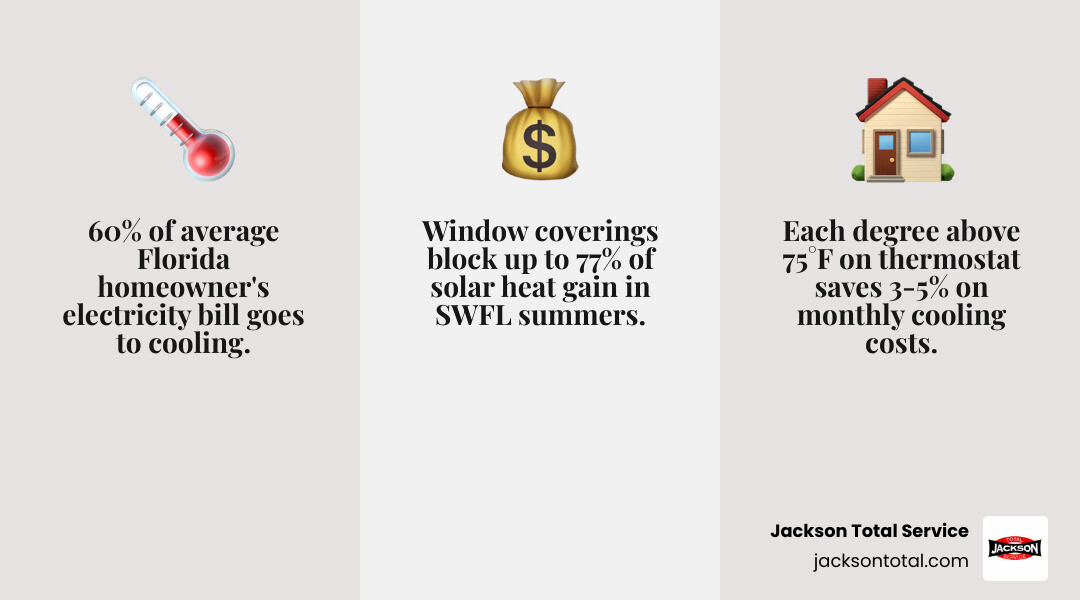
Living in Southwest Florida means your air conditioner isn’t a seasonal luxury — it’s running hard from April through October, and sometimes beyond. Cooling alone accounts for roughly 60% of the average Florida homeowner’s monthly electricity bill, which means even small improvements to how your home manages heat can add up to real savings fast.
Here in Naples, Bonita Springs, Estero, and the surrounding Lee and Collier County communities, summers don’t just bring heat — they bring relentless humidity, salt air, and intense solar exposure that push AC systems to their absolute limits. And with Florida Power & Light rate increases already in effect for 2026 and running through 2029, the pressure on your electric bill is only growing.
The good news? Most of the biggest savings don’t require a major investment. A combination of smart daily habits, basic maintenance, and a few targeted upgrades can make a dramatic difference — and the tips below are built specifically for the SWFL climate, not generic advice written for somewhere with a mild summer.
Master Your Thermostat for Summer Energy Saving Tips for Southwest Florida Homeowners
The thermostat is the steering wheel of your home’s energy consumption. In the “Florida Oven,” it is tempting to crank the dial down to 70°F the moment you walk through the door, but this is one of the most expensive habits a homeowner can have.
Industry experts and the Department of Energy recommend a setting of 78°F while you are at home. We know that might sound a bit warm at first, but here is the financial reality: each degree you raise your thermostat between 75 and 78 degrees can save you 3-5% on your monthly cooling costs. If you go even lower, say below 75°F, each additional degree can increase your energy usage by as much as 8%.
In our humid climate, the AC doesn’t just cool the air; it removes moisture. When you set the temperature too low, the system may struggle to reach the target, running constantly and driving up bills without effectively managing Indoor Air Quality. A balanced setting allows the system to cycle properly, removing humidity so that 78°F actually feels comfortable rather than “clammy.”

Smart Thermostat Benefits for Summer Energy Saving Tips for Southwest Florida Homeowners
If you are still using an old-fashioned manual thermostat, you are likely leaving money on the table. Upgrading to a smart thermostat can save you up to 10-15% annually on cooling costs. These devices are game-changers for Southwest Florida residents for several reasons:
- Adaptive Learning: Modern units learn your schedule and automatically adjust the temperature when you leave for work or head to bed.
- Remote Access: Whether you are at the office in North Naples or vacationing away from Marco Island, you can monitor and adjust your home’s temperature from your smartphone.
- Geo-fencing: Some models use your phone’s location to start cooling the house down the moment you cross the bridge back onto Sanibel Island.
- Energy Reports: You receive monthly data showing exactly when and why your energy use spiked, allowing you to make better choices.
When shopping, look for the Energy Star label to ensure the device meets the highest efficiency standards for 2026.
Strategic Temperature Setbacks
One common myth we hear is that it takes “more energy” to cool a warm house back down than it does to keep it cool all day. In reality, letting your home warm up while you are away is much more efficient. We recommend a “away” setting of 82°F to 85°F.
The key is to avoid extreme swings. Don’t turn the AC off entirely, as this allows humidity to build up, which can lead to mold growth and make it much harder for the system to recover. Instead, use a gradual setback. If you have a smart thermostat, program it to begin the recovery cycle about 30 to 60 minutes before you arrive home. This ensures a cool environment without paying to chill an empty house for eight hours.
Optimize Your Home Envelope to Block the Florida Sun
Think of your home as a giant cooler. If the lid is cracked or the insulation is thin, the ice melts. In Southwest Florida, your “envelope”—the walls, windows, and roof—is under constant assault from UV rays.
Windows are the biggest source of heat gain. In fact, window coverings like blinds, drapes, and high-quality shades can reduce solar heat gain by 33-77%. By simply closing the blinds on the south and west-facing sides of your home during the afternoon, you prevent your living room from turning into a greenhouse.
To supplement your AC, consider Ceiling Fan Installation. While fans don’t actually lower the temperature of the room, they create a “wind-chill effect” on your skin. This allows you to raise the thermostat by about 4 degrees without any loss in comfort. Just remember the golden rule of fans: they cool people, not rooms. If you leave the room, turn the fan off to save electricity. In the summer, ensure your fan is rotating counterclockwise to push a cool breeze directly downward.
Sealing Leaks and Improving Attic Insulation
Even the most efficient AC system can’t overcome a leaky house. Leaky ducts alone can waste 20-30% of your cooled air before it even reaches your vents. This is why we often recommend Duct Cleaning and sealing as a primary defense. Understanding How Duct Cleaning Saves Your Ac From The Humid Hustle is essential for any homeowner in Lee or Collier County.
Beyond the ducts, check your attic. Insulation can settle over time, losing its “R-value” or cooling power. For Florida homes in 2026, the recommended standard is R-30 to R-38 insulation. Improving your attic insulation can save between 15 and 20% on cooling energy use. While you are up there, look for air leaks around plumbing penetrations and light fixtures, and use weatherstripping to seal gaps around exterior doors.
Reflective Roofing and Ventilation
Your roof is the first line of defense against the “Florida Oven.” Dark shingles act like a heat sponge, absorbing up to 90% of solar energy. If you are due for a roof replacement, consider “Cool Roof” technology or metal roofing. Metal roofs can reduce cooling costs by as much as 25% because they reflect solar radiant heat rather than absorbing it.
Proper ventilation is also critical. Without it, your attic can reach 150°F, creating a “blanket” effect that keeps your house hot long after the sun goes down. Solar attic fans are a fantastic 2026 solution; they use the sun’s own energy to pull hot air out of the attic, allowing your home to “breathe” and reducing the workload on your AC.
High-Efficiency Upgrades and 2026 Florida Energy Incentives
If your air conditioner is more than 10 to 12 years old, it is likely costing you significantly more in monthly bills than a new system would. Modern high-efficiency AC units use up to 30% less energy than models from just a decade ago.
As of 2026, new central AC installations in Florida must meet updated SEER2 regulations (typically a minimum of 14.3 SEER2, which is roughly equivalent to the old 15 SEER). If you find yourself asking, “Why Is My Air Conditioner Not Cooling My House,” it might be a sign that the components are simply too worn to maintain efficiency. While Air Conditioning Repair can extend the life of a unit, there comes a point where replacement is the most fiscally responsible move.
Stacking Rebates for Summer Energy Saving Tips for Southwest Florida Homeowners
One of the best things about being a homeowner in 2026 is the availability of “financial stacks”—the ability to combine different incentives to pay for upgrades.
- FPL Rebates: Florida Power & Light offers instant rebates (often around $200) for new energy-efficient AC units and attic insulation ($220+).
- Federal Tax Credits (IRA): Under the Inflation Reduction Act, you can claim a 30% tax credit on eligible high-efficiency heat pumps, capped at $2,000 per year.
- HOMES & HEAR Programs: Florida was allocated over $346 million in federal funding for these programs. Depending on your household income, you could receive thousands of dollars in point-of-sale discounts for weatherization, electrical panel upgrades, and high-efficiency appliances.
By stacking these, some homeowners in areas like Ave Maria or Lehigh Acres are finding that a significant portion of their upgrade costs are covered.
The ROI of Modern HVAC Systems
Upgrading from a 15-year-old unit to a new two-stage or variable-speed air conditioner can save you 20-40% on annual cooling costs.
Unlike older “single-stage” units that are either 100% on or 100% off, variable-speed systems can run at lower speeds for longer periods. This is much more efficient and provides superior dehumidification. In the muggy Southwest Florida climate, better moisture removal means you can stay comfortable at higher thermostat settings, further compounding your savings.
Essential Maintenance: Keeping Your AC Efficient in the Humid Hustle
In Southwest Florida, the environment is actively trying to wear down your AC. Between the intense humidity and the salt air that blows in from the Gulf across Naples and Marco Island, corrosion is a constant threat.
Regular maintenance is the single most important factor in system longevity. A poorly maintained system can run 10-15% less efficiently, while regular tune-ups can improve efficiency by 5-15%. This is why we recommend Maintenance Agreements that include two professional visits per year—one in the spring to prep for the heat, and one in the fall to clear out the summer’s grime. Following a comprehensive Air Conditioning Maintenance In Estero Fl Your Essential Service Checklist ensures no detail is missed.
Professional Tune-Ups and Coil Cleaning
During a professional visit, a technician will deep-clean the evaporator and condenser coils. When these coils are covered in dust or salt grime, they cannot exchange heat effectively, forcing the compressor to work twice as hard. We also check refrigerant levels; remember, AC systems do not “use up” refrigerant. If you are low, you have a leak that needs repair.
For coastal residents, professional cleaning is vital because salt air creates a specific type of “white rust” corrosion. Our guide on how to Dont Let The Humidity Win With This Tropical Duct Cleaning Guide offers more insights into managing these regional challenges.
DIY Maintenance for Coastal Homeowners
While professional service is essential, there are several things you can do yourself to keep costs down:
- Monthly Filter Checks: In Florida, “90-day” filters rarely last that long. Check yours every 30 days. If you can’t see light through it, replace it.
- Clear Vegetation: Keep at least 2-3 feet of clearance around your outdoor condenser unit. Trim back any hibiscus or palms that might block airflow.
- Drain Line Flushing: Pour a cup of vinegar down your AC condensate drain line every few months to prevent algae clogs that can cause the system to shut down or overflow.
- Rinse the Coil: Gently rinse your outdoor unit with a garden hose (low pressure only!) once a month to remove salt spray and dust.
Daily Habits to Reduce Heat and Phantom Power Waste
Sometimes, the best summer energy saving tips for southwest florida homeowners are the ones that cost zero dollars. Your daily habits inside the home contribute to how hard your AC has to work.
“Phantom power” or “vampire energy” refers to the electricity used by devices even when they are turned off. Cable boxes, game consoles, and coffee pots with clocks are the biggest culprits. Unplugging these or using a smart power strip can save you a surprising amount over the course of a year.
| Energy Habit | Peak Hours (High Cost) | Off-Peak Hours (Savings) |
|---|---|---|
| Laundry | 12 PM – 7 PM | After 10 PM or Early AM |
| Dishwasher | Right after dinner | Before bed or overnight |
| Cooking | Oven/Stove at 5 PM | Grilling outside or Slow Cooker |
| Lighting | Incandescent Bulbs | LED Bulbs (85% more efficient) |
Heat-Conscious Cooking and Laundry
Your oven is basically a heater that competes with your AC. During a July afternoon in Fort Myers Beach, using the oven can raise your kitchen temperature by several degrees. Instead, embrace the Florida lifestyle:
- Grill Outdoors: Keep the heat outside where it belongs.
- Slow Cookers & Microwaves: These use significantly less energy and generate almost no ambient heat.
- Cold Water Laundry: Heating water accounts for about 90% of a washing machine’s energy use. Switching to cold water saves money and is gentler on your clothes.
Managing Indoor Humidity
Humidity makes heat feel worse. When the air is wet, your sweat doesn’t evaporate, which is why 78°F in Florida feels different than 78°F in Arizona.
- Use Exhaust Fans: Always run the bathroom fan during and for 15-20 minutes after a shower to pull moisture out of the house.
- Whole-Home Dehumidifiers: If your home always feels “damp,” a whole-home dehumidifier can be integrated into your HVAC system. This allows you to feel perfectly comfortable at 78°F or even 79°F, saving you a fortune on cooling.
- Check Seals: Ensure your dryer is venting properly to the outside so you aren’t pumping hot, moist air back into your laundry room.
Frequently Asked Questions about SWFL Energy Savings
What is the ideal thermostat setting for a Southwest Florida summer?
The sweet spot for most homeowners is 78°F while you are at home and 82°F to 85°F when you are away for more than a few hours. This balances comfort, humidity control, and energy savings.
How often should I change my AC filter in the Florida humidity?
In Southwest Florida, you should check your filter every 30 days. Because our systems run almost continuously during the summer, they pull in more dust and pet dander than systems in cooler climates. Most local homeowners find they need a fresh filter every 45 to 60 days.
Do ceiling fans actually lower the temperature of a room?
No. Ceiling fans do not change the air temperature; they only move air across your skin to help you stay cool via evaporation. Because they don’t lower the temperature, leaving a fan on in an empty room is a waste of electricity.
Conclusion
Managing your energy costs doesn’t have to be a full-time job. By implementing these summer energy saving tips for southwest florida homeowners, you can take control of your utility bills while maintaining a comfortable, healthy home. From mastering your thermostat to taking advantage of the robust 2026 rebates and incentives, the power to save is in your hands.
At Jackson Total Service, we’ve been helping our neighbors in Naples, Bonita Springs, Estero, Marco Island, and throughout Lee and Collier County stay comfortable since 1964. We provide all your comfort solutions—HVAC, plumbing, and electrical—under one roof, so you never have to juggle multiple contractors to keep your home running efficiently.
Whether you need a professional tune-up to beat the summer heat, a high-efficiency AC upgrade to lower your bills, or help sealing up those pesky air leaks, our licensed experts are here to help.
Ready to start saving? Contact Jackson Total Service today to schedule your energy-efficiency assessment and keep your cool all summer long!