



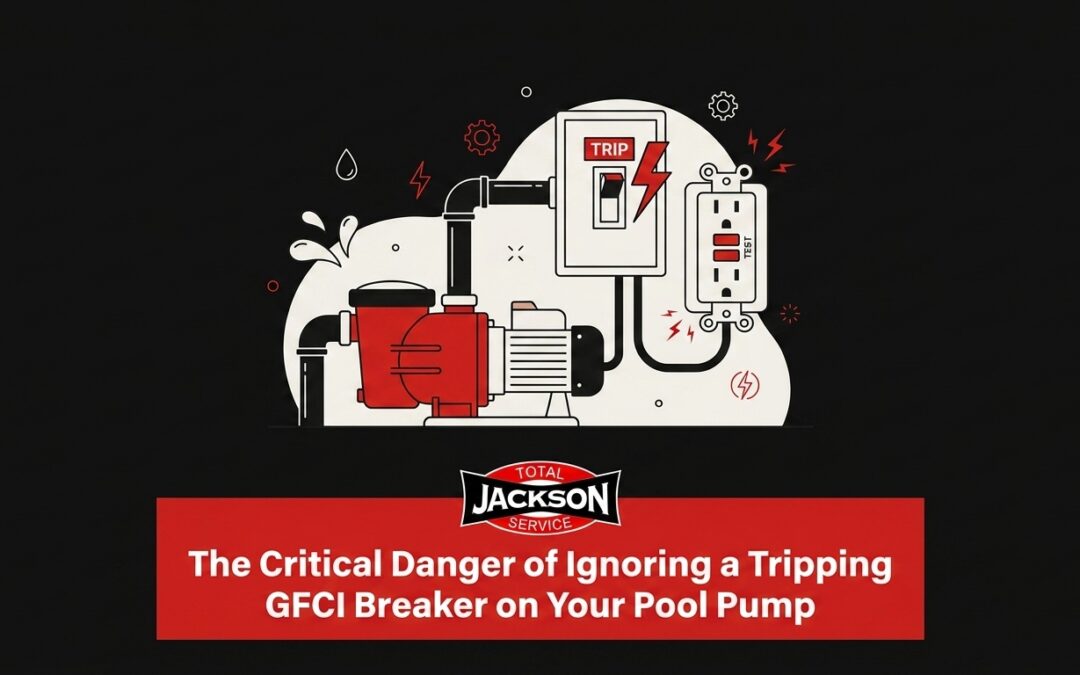
Why That Tripping Pool Pump Breaker Isn’t Just a Late-Summer Nuisance
The heavy rain rolls in, the skies darken, and suddenly you realize your outdoor equipment has gone completely dead. The danger of ignoring a tripping GFCI breaker on your pool pump is something our team at Jackson Total Service sees homeowners overlook all too often, especially when they just want to get the filtration system running again before the busy back-to-school transition. You walk out to the electrical panel, see the switch flipped, and face a critical decision: do you reset it and hope for the best, or do you investigate the underlying cause? In our experience dealing with outdoor electrical systems across Southwest Florida, a tripping breaker is almost never a simple nuisance. It is a vital safety mechanism doing exactly what it was designed to do.
Before you force that switch back into the “on” position, it is critical to understand what is happening inside the equipment. For those who need expert guidance right away, our team provides comprehensive electrical and plumbing services to keep your home safe and fully operational.
The frustration of a pool pump shutting off unexpectedly is completely understandable. You rely on that pump to keep the water clean, circulate chemicals, and prevent algae growth. When August afternoon thunderstorms disrupt your system, the temptation to simply flip the outdoor breaker back on is incredibly strong. You might assume that a nearby lightning strike or a temporary power surge caused a momentary glitch. However, a pattern we see often is that this assumption creates a significant safety hazard.
A tripping Ground Fault Circuit Interrupter (GFCI) breaker is not an annoyance; it is a successful, life-saving event. The breaker has detected a fault that could otherwise result in severe electrical shock. By cutting the power, the system has effectively protected your family and your property. Ignoring this warning sign and repeatedly resetting the breaker is essentially ignoring the early signs of underlying water intrusion.
When water breaches the protective casings of your outdoor equipment, it creates a highly conductive path for electricity to escape its intended circuit. If the breaker did not trip, that rogue electrical current would seek the easiest path to the ground, which could easily be through the pool water itself. Understanding the gravity of this situation is the first step in protecting your home from preventable electrical hazards.
The Anatomy of a GFCI Trip: Detecting Invisible Water Hazards
To truly grasp why a tripping breaker is a serious warning, you have to look past the plastic switch on your panel and understand the advanced mechanics at play. Standard circuit breakers are designed to protect your home’s wiring from overheating and catching fire if too much current flows through them. A GFCI breaker, however, is engineered specifically to protect human life from electrocution.
In our years of servicing local properties, we’ve found that Naples FL pool homes are uniquely vulnerable to these specific electrical faults because the equipment lives outside, constantly exposed to harsh environmental factors. The extreme humidity and heavy tropical rains in the region accelerate the corrosion of outdoor electrical enclosures and motor windings. Over time, the watertight seals that protect the sensitive internal components begin to degrade, allowing microscopic amounts of moisture to enter the system.
Water is an excellent conductor of electricity. When moisture accumulates inside the motor housing or the electrical conduit, it creates a dangerous bridge between the live wiring and the metal casing—or worse, the pool water itself. The GFCI breaker is designed to monitor the flow of electricity going out to the pump and the flow returning from it. If the breaker detects that even a tiny fraction of that electrical current is “leaking” out of the intended path, it reacts instantly.
How Micro-Current Imbalances Trigger the Shutoff
Our electricians frequently explain to customers that the sensitivity of a GFCI breaker is what makes it so effective at saving lives. These devices are engineered to detect current imbalances as small as 4 to 5 milliamps. To put that into perspective, a standard 100-watt light bulb draws about 830 milliamps. The threshold for human safety regarding electrical current is incredibly low; even a 10-milliamp shock can cause severe muscle contractions, and anything above that can be fatal.
- Constant monitoring: The GFCI continuously measures the current leaving the panel and the current returning on the neutral wire.
- Instant detection: If the returning current is even 4 milliamps less than the outgoing current, the device recognizes a ground fault.
- Rapid mechanical response: Within fractions of a second—often as quickly as 1/40th of a second—the internal contacts spring open, shutting off power to the pump to prevent electrocution.
Because outdoor enclosures face constant thermal expansion from the hot sun and contraction from cool rain, they are highly susceptible to developing microscopic cracks. Once moisture finds its way inside, the GFCI detects the resulting micro-current imbalance and immediately shuts the system down to protect you.
The Hidden Mechanical Damage of Repeatedly Resetting the Breaker
The Problem: The psychological trap of the “nuisance trip” is incredibly common. When a breaker trips during August afternoon thunderstorms, homeowners often assume it was just a fluke caused by the weather. The immediate reaction is to walk out to the panel, firmly push the breaker to the “off” position, and then snap it back to “on.” When the pump fires back up, it feels like the problem is solved. However, if the breaker trips again a few minutes or hours later, repeatedly forcing that reset creates a secondary, hidden danger.
The Cause: Every time you force a reset while a ground fault still exists, you are physically degrading the internal components of the GFCI breaker. When the breaker tries to close its contacts to restore power, the existing electrical fault causes the electricity to arc across the tiny gap before the metal pieces even touch. This creates a microscopic, incredibly hot plasma arc that literally burns and pits the metal contacts inside the breaker.
Doing this once or twice is what the breaker is built to handle. Doing it repeatedly over several days destroys the device. The carbon buildup from the arcing increases electrical resistance, generating heat inside your electrical panel. More importantly, a severely degraded GFCI may eventually fail in the “closed” position. This means the internal mechanism fuses together, and the breaker loses its ability to trip at all.
The Solution: The only safe approach is to recognize that the breaker is doing its job, but it cannot protect you if it is destroyed by repeated forced resets. If a GFCI trips more than once, leave it off. Stop trying to force the system to run and focus on pool and spa wiring safety. The electrical fault must be located and repaired before power is safely restored.
How Severe Weather Compromises Pool Pump Motor Seals
Understanding the electrical side of the equation is only half the battle. To fully comprehend why Naples FL pool homes experience these failures, you have to look at the intersection of water dynamics and electrical engineering. A pool pump is a hybrid piece of equipment: the front half is a wet plumbing system moving thousands of gallons of water, and the back half is a dry, high-voltage electrical motor.
The only thing separating the rushing water from the live electrical windings is a series of mechanical seals. We often see late-summer wear and storm severity directly contribute to motor housing seal degradation. The rapid temperature changes—from baking in the intense midday sun to being suddenly cooled by heavy tropical downpours—cause the rubber and ceramic seals to expand and contract violently. Over time, these seals become brittle, crack, and fail.
As a provider handling plumbing, HVAC, and electrical systems, our technicians at Jackson Total Service understand exactly how water dynamics perfectly intersect with electrical motor failure. When a seal fails, water doesn’t just leak onto the concrete pad; it often travels directly down the motor shaft and into the electrical housing.
The Intersection of Plumbing and Electrical Systems
A failing plumbing seal quickly becomes a critical electrical hazard. Once water enters the motor housing, it saturates the copper windings and the insulation that protects them. This creates a direct path for electricity to short out to the metal casing of the motor, instantly triggering the ground fault that trips your breaker.
| Visible Symptom | Plumbing Root Cause | Electrical Consequence |
|---|---|---|
| Puddling under the pump | Failing mechanical shaft seal | Moisture enters the dry motor housing |
| Loud, grinding humming noise | Seized bearings due to rust | Motor struggles, drawing excess current |
| Immediate breaker trip | Water bridging internal contacts | Ground fault detected, power severed |
Before the breaker trips entirely, you might notice early warning signs of a failing motor. If the pump sounds louder than usual, screeches when it starts, or feels unusually hot to the touch, the internal bearings are likely rusting from early moisture intrusion. Catching these plumbing failures early prevents the catastrophic electrical shorts that follow.

The Life-Safety Risks of Compromised Pool Equipment
When you mix compromised electrical equipment with standing water, the consequences escalate from inconvenient to life-threatening. The Consumer Product Safety Commission (CPSC) frequently issues warnings regarding aging pool equipment and the severe electrical hazards they pose. Faulty underwater lighting, ungrounded pumps, and degraded motor housings are leading causes of electrical injuries around residential pools.
The National Electrical Code (NEC) Article 680 strictly mandates GFCI protection on pool pump motors precisely because the shock hazards are so extreme. If a pool pump motor shorts out and the GFCI fails to trip—often because it was damaged by repeated, forced resets—the electrical current can energize the water inside the plumbing lines. Because pool water is highly conductive due to dissolved chemicals and salts, that stray voltage can easily travel back into the pool itself.
The danger is that electrified water often looks completely normal. There are no sparks or visible signs of danger until someone touches a metal handrail or steps into the water. This is why rapid, professional response to severe outdoor electrical issues following major weather events is absolutely non-negotiable.
At Jackson Total Service, we see the reality of these dangers frequently. One homeowner reached out to us in the fall after severe weather caused major electrical issues that both the local utility and cable providers couldn’t—or wouldn’t—repair. Our technicians stepped in to repair the complex electrical faults, ultimately keeping the customer safe and restoring their peace of mind. When August afternoon thunderstorms compromise your system, relying on expert intervention is the only way to ensure your backyard remains a safe environment.
Recognizing When to Stop Resetting and Call a Professional
Establishing clear boundaries against DIY diagnostics is the most important step in outdoor electrical safety. Diagnosing motor wiring, testing insulation resistance, and inspecting live breaker panels are strictly off-limits for anyone without proper licensing and training. The risks of arc flashes, severe shocks, and worsening the damage are simply too high.
The Golden Rule: If a GFCI breaker trips more than once, stop resetting it immediately. Leave the breaker in the “off” position and call for help.
When you contact our experts for Naples FL pool homes, here is exactly what our licensed professionals at Jackson Total Service look for during a diagnostic visit:
- Visual Inspection of the Enclosure: The technician inspects the outdoor panel and conduit for signs of water intrusion, rust, or insect nests that could be causing a short.
- Testing the Motor Windings: Using specialized tools like a megohmmeter (megger), the technician sends a safe test voltage through the motor windings to measure the integrity of the insulation. This reveals if moisture has penetrated the copper coils.
- Evaluating the Breaker Health: The technician tests the GFCI breaker itself to ensure the internal contacts haven’t been burned or pitted by repeated arcing.
- Inspecting the Plumbing Seals: Because the electrical and plumbing systems are linked, the technician checks the mechanical shaft seals for leaks that may be feeding water into the motor.
Only a professional has the tools and training to determine if the issue is a degraded breaker, a burned-out motor, or dangerous water intrusion. Guessing at the cause by watching online videos is not just ineffective; it puts your family at risk. Knowing when to call a professional electrician is the smartest decision a homeowner can make.
Prioritize Your Family’s Safety Over a Running Pool Pump
At the end of the day, a tripping breaker is the final line of defense against electrocution. When August afternoon thunderstorms batter your outdoor equipment, that small plastic switch in your electrical panel is working overtime to monitor for invisible water hazards. By understanding that a tripped GFCI is a warning rather than a nuisance, you take a proactive step in protecting your property as we transition into end-of-season cooling.
Professional diagnostics provide absolute peace of mind. Instead of wondering if the water is safe or if the motor is slowly burning itself out, you get clear, definitive answers from trained experts. We encourage you to prioritize safety and have your outdoor electrical systems evaluated at the first sign of trouble. If your breakers are aging, constantly tripping, or showing signs of weather damage, exploring electrical panel upgrades (which may even qualify for generic energy rebates or federal tax credits depending on your system—always verify current programs with your utility provider) can restore the reliability and safety your family deserves.
Frequently Asked Questions
Why does my pool pump trip the breaker after it rains?
In our experience, heavy rain often penetrates worn weather seals on your outdoor electrical panel or the pool pump motor housing. When moisture makes contact with the live electrical windings inside the motor, it creates a ground fault. The GFCI breaker detects this dangerous current leak instantly and trips to shut off the power, preventing potential electrocution.
What happens if you keep resetting a tripping GFCI?
Repeatedly forcing a GFCI to reset while a fault exists causes severe mechanical damage to the breaker itself. Every time you flip the switch, electricity arcs across the internal contacts, burning and pitting the metal. Over time, this carbon buildup destroys the breaker, and it may eventually fail to trip at all, leaving you completely unprotected from electrical shocks.
Can heavy rain cause a GFCI to trip?
Yes, heavy rain is one of the most common triggers for an outdoor GFCI trip. Even if the main equipment is covered, wind-driven rain can force moisture into microscopic cracks in the conduit, junction boxes, or the breaker panel itself. The breaker is doing its job by sensing the water-induced short circuit and cutting the power.
Is it safe to bypass a GFCI on a pool pump?
No, it is never safe to bypass a GFCI breaker on a pool pump or any outdoor equipment. Bypassing this critical safety device removes the only mechanism designed to detect deadly current leaks. If a fault occurs without a GFCI in place, the pool water or the metal equipment casing could become electrified, resulting in severe injury or death.
How does extreme humidity affect outdoor electrical panels and pool equipment?
Extreme humidity creates constant condensation inside outdoor electrical panels and motor housings. Over time, this trapped moisture accelerates the corrosion of metal contacts, degrades wire insulation, and rusts motor bearings. This slow degradation makes the equipment highly susceptible to sudden electrical shorts and ground faults.