



What an AC Making Strange Noises What They Mean — and Why You Shouldn’t Ignore Them
AC making strange noises what they mean depends on the type of sound. Here’s a quick breakdown before we go deeper:
| Noise | Likely Cause | Urgency |
|---|---|---|
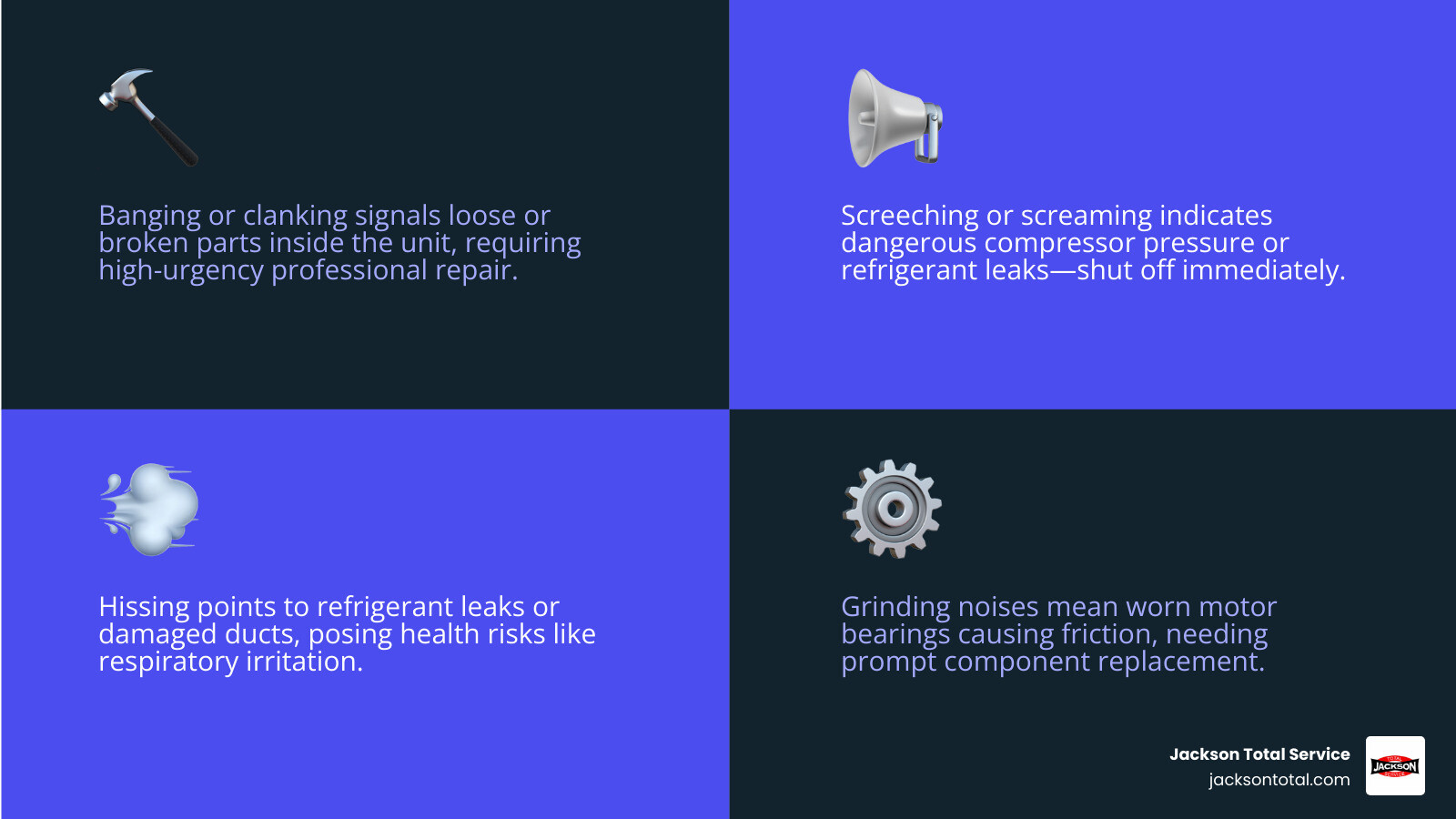
| Banging / Clanking | Loose or broken part inside the unit | High — call a pro |
| Clicking (constant) | Thermostat or relay failure | Medium — get it checked |
| Buzzing | Loose wiring, frozen coils, faulty contactor | Medium to High |
| Screeching / Screaming | High compressor pressure or refrigerant leak | Emergency — shut off now |
| Hissing | Refrigerant leak or damaged duct | Emergency — shut off now |
| Grinding | Worn motor bearings | High — call a pro |
| Rattling | Loose panels, debris in unit | Low to Medium |
| Whistling | Clogged air filter or blocked vent | Low — check filter first |
| Gurgling / Bubbling | Refrigerant leak or clogged condensate drain | Medium to High |
| Chirping | Dry bearings or worn belt | Low — monitor closely |
Modern AC systems are designed to run quietly — typically between 25 and 55 decibels, roughly the level of a quiet conversation. Some newer indoor units run as low as 19 decibels. So when your system starts making sounds you haven’t heard before, that’s your AC trying to tell you something is wrong.
Think of it this way: your air conditioner has a language. A rattle, a screech, a hiss — each one points to a specific problem somewhere inside the system. Some noises are minor. Others are early warnings of a failure that could leave you without cooling in the middle of a Southwest Florida summer. And a few — like screeching or hissing — mean you should shut the system off right now and call for help.
Ignoring unusual sounds rarely makes them go away. More often, a small problem becomes a bigger, more expensive one. A loose part that rattles for a few weeks can eventually damage the compressor. A refrigerant leak that hisses quietly can reduce efficiency, drive up your energy bills, and pose real health risks including headaches, nausea, and respiratory irritation.
The good news is that knowing what each noise means puts you in control. You’ll know when you can handle something simple yourself — like swapping out a dirty filter — and when it’s time to turn the system off and call a professional before more damage is done.
Identifying an AC Making Strange Noises What They Mean for Your Home
When we talk about an ac making strange noises what they mean, we first have to distinguish between the “happy” sounds of a working machine and the “unhappy” sounds of a failing one. It is now April 2026, and with the Southwest Florida heat already ramping up, your AC is likely working overtime.
A healthy system will have a predictable startup sequence: a single click as the thermostat calls for cool air, a steady hum from the outdoor fan, and the gentle “whoosh” of air moving through your vents. However, if that hum turns into a heavy metallic sound, you need to pay attention.
Banging and Clanking: The Heavy Hitters
Banging or clanking sounds are rarely good news. Usually, these indicate that something has come loose or is out of balance.
- Loose Parts: Inside your indoor blower or outdoor condenser, parts like connecting rods, piston pins, or crankshafts can loosen over time. If a part disconnects entirely, it will rattle around inside the housing like a loose marble in a tin can.
- Compressor Failure: In some cases, a banging noise from the outdoor unit suggests the compressor itself is failing. The compressor is the “heart” of your system, and if internal components break, they can hit the outer casing, creating a loud, rhythmic thud.
- Unbalanced Fan Blades: Both your indoor blower fan and outdoor condenser fan can become unbalanced. If a blade is bent or loose, it may hit other components as it spins.
If you are experiencing these heavy mechanical sounds, it is often best to refer to an Air Conditioning Troubleshooting guide or call a professional immediately. For our neighbors in Lee County, checking out an AC Problems Fort Myers FL Guide can help narrow down if the sound is coming from the indoor air handler or the outdoor unit.
Why is my ac making strange noises what they mean when it clicks?
Clicking is a sound we hear every day, but its frequency tells the real story.
- Normal Startup: A single click when the unit turns on or off is completely normal. This is just the electrical relay engaging to start the cooling cycle.
- Thermostat Malfunction: If you hear constant clicking coming from your wall-mounted thermostat, it might be struggling to send the correct electrical signal to the HVAC system. This could be a sign of a dying thermostat or a short in the wiring.
- Relay Switches and Capacitors: If the clicking is coming from the outdoor unit but the system won’t start, you likely have a faulty capacitor or a failing contactor relay. These components are responsible for “kickstarting” the motor. When they fail, they click repeatedly but can’t provide the power needed to get the fan or compressor moving.
If your system is stuck in a clicking loop, you likely need Air Conditioning Repair to replace the electrical components before they cause a total system shutdown.
Understanding buzzing and humming sounds
Buzzing and humming are often electrical in nature, but they can also point to physical restrictions.
- Loose Wiring: If electrical connections are loose, they can vibrate at a high frequency, creating a buzzing sound. This is a fire hazard and should be addressed by a technician who can tighten those connections.
- Contactor Issues: The contactor is an outdoor component that closes to allow electricity to flow to the compressor. If it becomes pitted or worn, it may hum or buzz loudly.
- Frozen Coils: This is a common issue in humid areas like Naples and Fort Myers. If your air filter is clogged or your refrigerant is low, the indoor evaporator coils can freeze into a block of ice. This restricts airflow and causes the blower motor to strain, often resulting in a loud buzzing or vibrating sound.
If you’re in Collier County and asking, “My AC Is Making a Weird Buzzing Sound? Who Should I Call for AC Repair and Service in North Naples?“, the answer is always a licensed HVAC professional who can safely handle electrical diagnostics.
High-Urgency Sounds: When to Shut Down Your System Immediately

There are certain sounds that act as a “red alert” for your home. If you hear these, don’t wait to see if they go away. Shut the power off at the thermostat and the breaker immediately.
Is your ac making strange noises what they mean if it’s screaming?
A high-pitched screeching or “screaming” sound is perhaps the most alarming noise an AC can make. It usually indicates one of two very serious problems:
- High Compressor Pressure: If the pressure inside your compressor reaches dangerous levels, a safety sensor should shut the unit down. However, if the sensor fails, the internal pressure can cause a high-pitched scream. This is a major emergency that can lead to an explosion of the compressor housing.
- Refrigerant Leak: A high-pressure refrigerant leak can sound like a whistle or a scream as the gas escapes through a small crack in the coils or lines.
Because refrigerant is a hazardous chemical, exposure can lead to nausea, headaches, and respiratory issues. If you hear this sound in North Naples, don’t hesitate—get a North Naples AC Crisis? Get 24-Hour Emergency Repair Now! service visit scheduled. Similarly, if you are on the coast and find that My Air Conditioner Stopped Working Completely? I Need AC Repair on Pine Island, FL!, it may have been preceded by these high-pressure warning signs.
Grinding and metal-on-metal sounds
If your AC sounds like it’s a giant blender full of rocks, you are likely hearing grinding. This almost always points to the motor bearings.
Most AC units have motors in the indoor blower and the outdoor condenser fan. These motors have bearings that allow the shaft to spin smoothly. Over time, the lubrication in these bearings can dry out or the bearings themselves can wear down. When this happens, you get metal-on-metal friction.
If you catch this early, a technician might be able to lubricate the parts or replace just the bearings. If you ignore it, the friction will eventually cause the motor to burn out entirely, requiring a much more expensive Air Conditioning Repair Naples FL or a full motor replacement.
Troubleshooting Minor Rattles and Whistles in Southwest Florida
Not every noise requires a midnight emergency call. Some sounds are “nuisance” noises that can be fixed with a little bit of detective work.
Rattling: The “Loose Screw” Syndrome
Rattling is often caused by something simple:
- Loose Panels: The vibration of the unit can loosen the screws on the exterior metal panels. A quick turn of a screwdriver can often solve this.
- Debris: In Southwest Florida, we deal with plenty of twigs, leaves, and even small pebbles getting into the outdoor unit. If a twig gets caught in the fan blades, it will create a persistent rattling or flapping sound.
- Ductwork: Sometimes the rattling isn’t the AC at all, but the metal ducts in your attic or crawlspace expanding and contracting.
Whistling: Airflow Struggles
If your AC is whistling, it’s usually “gasping” for air.
- Clogged Filters: A dirty filter blocks the return air, forcing the system to pull air through tiny gaps, which creates a whistling sound. This is often the answer to “Why Is My Air Conditioner Not Cooling My House?“
- Blocked Vents: Ensure that furniture or curtains aren’t blocking your supply or return vents.
- Duct Leaks: A whistle can also mean conditioned air is escaping through a small hole in your ductwork. If you are AC Not Cooling Near Cape Coral, FL, checking your ducts for leaks is a great first step.
Gurgling, bubbling, and chirping
These sounds are more subtle but still important:
- Gurgling/Bubbling: This usually sounds like someone drinking through a straw. It often points to a refrigerant leak where air bubbles have entered the line, or a clogged condensate drain line. In our humid climate, algae and gunk can easily clog the drain line, causing water to back up and gurgle.
- Chirping: A high-pitched “chirp” at startup is often just a fan belt that is slightly worn or needs lubrication. While not an emergency, it’s an indication that maintenance is due. You can find more specific tips in our Air Conditioning Troubleshooting archives.
The Importance of Regular Maintenance for System Longevity
The best way to stop an ac making strange noises what they mean is to prevent the noises from starting in the first place. Because we live in Southwest Florida, our systems face unique challenges: high humidity, salty air (especially in places like Sanibel and Marco Island), and year-round operation.
Regular maintenance is like an oil change for your car. During a professional tune-up, we:
- Lubricate Moving Parts: This prevents the grinding and chirping sounds caused by dry bearings.
- Tighten Electrical Connections: This eliminates buzzing and prevents electrical shorts.
- Clean the Coils: Cleaning the evaporator and condenser coils prevents the system from freezing and reduces the strain that leads to buzzing.
- Check Refrigerant Levels: We ensure there are no leaks (the cause of hissing and bubbling).
For residents in Estero, following an Air Conditioning Maintenance in Estero, FL: Your Essential Service Checklist ensures your system stays quiet and efficient for years to come. Our comprehensive Air Conditioning Services are designed to catch these small “audio clues” before they turn into major breakdowns.
Frequently Asked Questions about AC Noises
Is it safe to run my AC if it’s making a loud noise?
It depends on the noise, but generally, the answer is “no.” While a light rattle from a loose panel is safe for a day or two, sounds like banging, screeching, grinding, or hissing are red flags. Running a system with these noises can lead to catastrophic failure, permanent compressor damage, or even electrical fires. When in doubt, shut it down.
Why does my AC make a gurgling or bubbling sound?
This sound is almost always related to fluids. It could be refrigerant gas escaping through a leak in the liquid line, or it could be water struggling to move through a clogged condensate drain. Since Southwest Florida ACs remove gallons of water from the air daily, a clogged drain can quickly lead to water damage in your home.
Can I fix a noisy air conditioner myself?
You can safely handle “Level 1” troubleshooting:
- Changing a dirty air filter.
- Clearing leaves and debris from the outdoor unit.
- Tightening visible screws on the exterior cabinet.
- Checking that vents are open.
However, for anything involving the electrical system, the refrigerant lines, or the internal motor, you must call a professional. AC systems are complex, high-voltage machines that require specialized tools and EPA certifications to repair safely.
Conclusion
Your home should be a sanctuary of cool, quiet comfort. When your air conditioner starts communicating through clangs, bangs, and hisses, it’s inviting you to take action. Understanding an ac making strange noises what they mean is the first step in protecting one of your home’s most valuable investments.
Since 1964, Jackson Total Service has been the trusted name for home comfort in Southwest Florida. Whether you are in Naples, Fort Myers, Cape Coral, or any of our surrounding communities, we provide all your comfort solutions in one place. From HVAC and plumbing to electrical expertise, our team is ready to bring the quiet back to your home.
If your AC is trying to tell you something, don’t wait for it to stop talking and start breaking. Contact us today for expert Air Conditioning Services and ensure your family stays cool all year long.