


Why the Recommended Duct Cleaning Schedule for Humid Climates Is Different From the Rest of the Country
The recommended duct cleaning schedule for humid climates is not the same as the national standard — and if you live in Southwest Florida, that difference matters a lot.
Most households across the U.S. can wait 3 to 5 years between professional duct cleanings. But in high-humidity regions like Naples, Fort Myers, or Estero, that timeline shrinks significantly. Here is a quick look at what experts recommend:
| Household Type | Standard Climate | Humid Climate (SW Florida) |
|---|---|---|
| Average home, no special conditions | Every 3-5 years | Every 2 years |
| Homes with pets or allergies | Every 2-3 years | Every 1-2 years |
| Mold confirmed in ducts | Immediately | Immediately |
| Post-renovation | Right after | Right after |
| Allergy or asthma sufferers | Every 2 years | Annually |
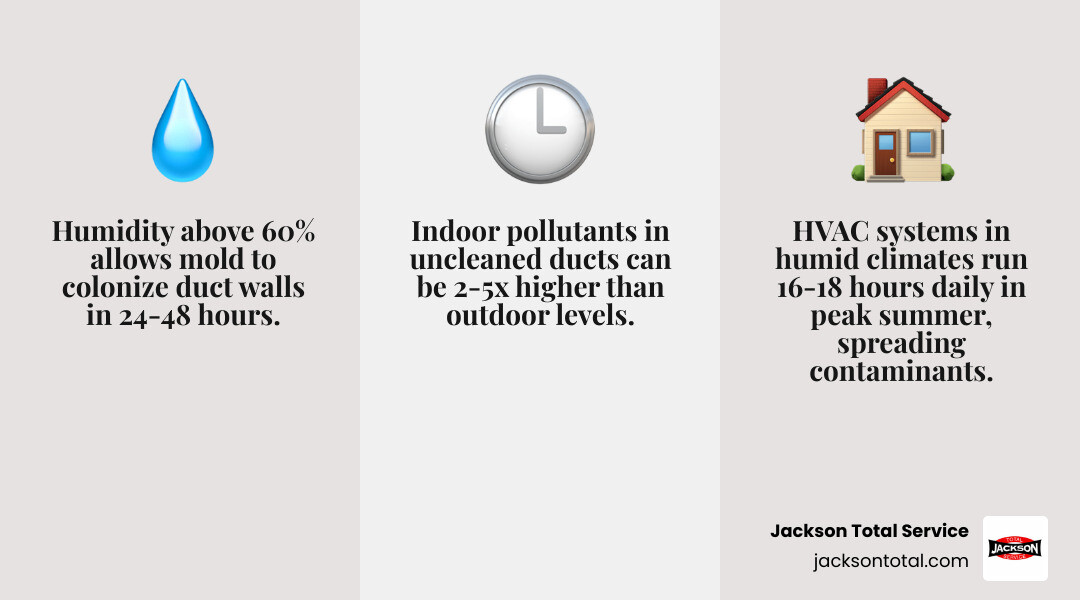
Why the tighter schedule? Because humidity changes everything inside your ductwork. Georgia’s annual average humidity hovers around 70% — and Southwest Florida often runs even higher. When moisture levels stay elevated, dust stops floating freely and starts sticking to duct walls. That creates a surface where mold, mildew, and bacteria can take hold within as little as 24 to 48 hours under the right conditions.
Meanwhile, your HVAC system runs far longer here than it does in cooler states — sometimes 16 to 18 hours a day during peak summer months. More runtime means more air pushed through those ducts, and more opportunity for contaminants to spread through every room in your home.
Americans spend roughly 90% of their time indoors, and indoor pollutant concentrations can already run 2 to 5 times higher than outdoor levels. Add uncleaned ducts in a tropical climate to that equation, and the air your family breathes every day becomes a real concern.
This guide breaks down exactly how often you should schedule duct cleaning in Southwest Florida, what warning signs to watch for, and what a professional service actually does that a DIY approach simply cannot.
Why Humidity Demands a Stricter Duct Maintenance Routine
In a dry climate, dust is just dust. It’s light, flaky, and usually blows right through the system or gets caught easily by a standard filter. But in Southwest Florida, humidity turns that dust into something much more stubborn. High moisture levels make dust particles “sticky,” causing them to adhere to the interior walls of your ductwork rather than circulating through.
Once this layer of organic material—skin cells, lint, and outdoor pollutants—is glued to your ducts, it becomes a literal buffet for mold spores and bacterial colonies. In our region, Indoor Air Quality Services are essential because mold can begin to colonize within 48 hours if your indoor relative humidity exceeds 60%.
This buildup doesn’t just sit there; it creates significant airflow restriction. When your ducts are lined with “sticky dust,” your blower motor has to work significantly harder to push air into your living spaces. This extra strain directly impacts your evaporator coils. If airflow is restricted, the coils can become too cold, leading to ice buildup and eventual system failure.
Furthermore, our Air Conditioning Services often reveal that clogged condensate drains are a primary culprit for duct moisture. When a drain line backs up, that standing water increases the humidity inside the air handler, which then travels directly into the ductwork. Staying on top of AC Maintenance in Estero, FL ensures these drains stay clear, but if the moisture has already entered the ducts, a professional cleaning is the only way to remove the resulting mildew and biological growth.
The Recommended Duct Cleaning Schedule for Humid Climates
For homeowners in Lee and Collier Counties, the “once every five years” rule simply doesn’t apply. Because our systems run for roughly 2,800 hours annually—compared to just 1,200 hours in milder northern climates—the wear and tear and debris accumulation happen more than twice as fast.
We generally suggest a two-year interval for Duct Cleaning Naples, FL and Duct Cleaning Fort Myers, FL. This biennial schedule accounts for the near-constant operation of high-use systems during our long, sweltering summers.
How Pets and Allergies Impact the Recommended Duct Cleaning Schedule for Humid Climates
If you share your home with furry family members, your recommended duct cleaning schedule for humid climates should likely move to an annual or 18-month cycle. Pet dander and shedding fur provide even more “glue” for the humidity to work with.
For those with asthma or chronic respiratory issues, dirty ducts act as a continuous distribution system for triggers. In the spring, Southwest Florida sees massive spikes in oak and pine pollen. This pollen enters the home on clothing and through open doors, eventually settling in the ducts. When the AC kicks on, it recirculates that pollen, leading to morning headaches, congestion, and sinus inflammation. Regular cleaning removes these accumulated allergens, providing significant relief for sensitive individuals.
Why Seasonal Transitions Dictate the Recommended Duct Cleaning Schedule for Humid Climates
Timing your service can also maximize its effectiveness. Many of our clients prefer scheduling during the “shoulder” seasons—spring and fall.
- Spring Cleaning: Scheduling in March or April removes the dust and pollen that settled during the milder winter months before the heavy humidity of summer arrives.
- Fall Preparation: Scheduling in October or November, after the peak cooling season, clears out the massive amounts of debris accumulated during the 18-hour-a-day summer run cycles.
Cleaning during these off-peak periods ensures your system is at maximum efficiency when you need it most. It also allows the ducts to dry more thoroughly during the cleaning process when the outdoor humidity is slightly lower than the July peaks.
Signs Your Tropical Home Needs Immediate Duct Attention

Sometimes, you shouldn’t wait for your two-year appointment. Your home will often tell you when the air quality is dipping. One of the most common indicators is the “dirty sock” smell—a musty, damp odor that hits you the moment the AC cycles on. This is a clear sign of microbial growth within the system or the ducts.
Other red flags include:
- Visible Debris: If you see “poof” of dust coming from the vents when the fan starts, or if there is a dark ring of dust on the ceiling around the vent covers.
- Unexplained Allergy Spikes: If you feel better at work or outdoors than you do inside your own home, your ducts may be the culprit.
- Weak Airflow: If some rooms feel warmer than others or the air coming from the vents feels “thin,” you may have a blockage or need to ask, Do My Air Ducts Have Leaks or Need Cleaning? Naples.
- Recent Renovations: Construction dust is fine and abrasive; it can bypass standard filters and coat your entire duct network in a single afternoon.
If you notice any of these signs, it is time to move up your cleaning date to protect both your health and your HVAC equipment.
Professional vs. DIY: Navigating High-Moisture Challenges
It can be tempting to try a DIY approach by sticking a shop-vac hose down your vents, but in a humid climate, this can actually do more harm than good. DIY vacuums lack the power to remove “sticky” tropical dust and often simply stir up spores, sending them into your living air space.
When you choose professional Duct Cleaning Services, we utilize specialized, high-powered equipment that creates negative pressure throughout the entire system. This ensures that once a particle is loosened, it is sucked directly out of the home and into a containment unit, often utilizing vacuums with up to 16,000 CFM (cubic feet per minute) of suction.
Our professional process includes:
- Camera Inspections: We use video tools to see deep into the turns of your ductwork to identify mold or structural breaches.
- Rotary Brushes and Air Whips: These tools physically agitate the sticky debris that a standard vacuum can’t move.
- Sanitization Agents: We use EPA-approved treatments specifically designed to kill mold spores and bacteria in high-moisture environments.
- System Integrity Check: We ensure that the cleaning process hasn’t compromised any seals, helping you maintain the Jackson Total Service Homepage standard of excellence.
Professional cleaning is about more than just removing dust; it’s about reset-ting the biological clock of your home’s air system.
Frequently Asked Questions about Duct Maintenance in Humid Regions
What is the ideal indoor humidity level to prevent mold?
The EPA recommends keeping indoor relative humidity (RH) between 30% and 50%. In Southwest Florida, we often aim for a maximum of 45-50%. Anything above 60% is the “danger zone” where mold and dust mites begin to thrive. If your AC can’t keep the humidity down, you may need a whole-house dehumidifier.
Can dirty ducts increase my monthly energy bills?
Absolutely. Research shows that dirty ducts can increase energy consumption by as much as 15-20%. When airflow is restricted by debris, your system has to run longer cycles to reach the temperature set on your thermostat. This not only raises your bill but also shortens the lifespan of your expensive HVAC equipment.
How long does a professional duct cleaning service take?
For a standard home in Cape Coral or Fort Myers, a thorough professional cleaning usually takes between 3 to 5 hours. This depends on the number of vents, the size of the property, and the level of debris accumulation. We take the time to ensure every branch of the ductwork is addressed, not just the main trunk line.
Conclusion: Breathe Easier in Southwest Florida
Living in paradise shouldn’t mean compromising on the air you breathe. While the recommended duct cleaning schedule for humid climates is more demanding than in other parts of the country, it is a small investment in your family’s health and your home’s efficiency.
At Jackson Total Service, we’ve been helping our neighbors in Naples, Marco Island, and throughout Lee and Collier Counties stay comfortable since 1964. By combining duct cleaning with our comprehensive Home Comfort Services, you can ensure that your HVAC system remains a source of cool, clean relief rather than a hidden source of allergens.
Don’t wait for the “dirty sock” smell to take over your living room. Check out the Jackson Total Service Blog for more tips on tropical home maintenance, or contact us today to schedule your professional Duct Cleaning. We’ll help you win the battle against humidity so you can get back to enjoying the Florida lifestyle.