


How the Inflation Reduction Act Saves Florida Homeowners Money on Energy Upgrades
The inflation reduction act benefits for Florida homeowners are real, substantial, and available right now — and most homeowners in Southwest Florida are leaving serious money on the table by not taking full advantage of them.
Here is a quick summary of what is available:
| Benefit | What You Get |
|---|---|
| 25C Energy Efficient Home Improvement Credit | 30% of qualifying upgrade costs, up to $3,200 per year |
| Heat Pump Tax Credit | Up to $2,000 per year (included in the $3,200 cap) |
| Insulation & Air-Sealing Credit | Up to $1,200 per year |
| HOMES Rebate Program | Up to $8,000 for whole-home energy efficiency upgrades |
| HEAR Rebate Program | Up to $14,000 for low- and moderate-income households |
| Florida Energy Saver Program | $346 million in federal funding allocated for Florida residents |
| Solar & Renewable Energy Credit | 30% of installation costs, no annual cap |
These incentives apply to common home upgrades — insulation, HVAC systems, heat pumps, water heaters, and more — all things that matter enormously in Florida’s hot, humid climate. In 2023 alone, more than 300,000 Floridians claimed over $845 million in IRA-related tax credits on their federal returns. That is nearly $1 billion staying in the pockets of Florida families.
For homeowners in Naples, Bonita Springs, Estero, and Marco Island, the opportunity is especially strong. Southwest Florida’s long cooling season means energy costs are a year-round concern — and the right upgrades, paired with the right incentives, can meaningfully reduce your utility bills while improving your home’s comfort and resilience.
This guide breaks down every major program, how to qualify, and how to stack multiple incentives for maximum savings.
Maximizing the Inflation Reduction Act Benefits for Florida Homeowners

The Inflation Reduction Act (IRA) represents the largest federal investment in clean energy and climate action in U.S. history. For residents of Southwest Florida, this legislation is a game-changer. By transitioning to high-efficiency systems, homeowners can lower their monthly electricity bills while taking advantage of historic federal funding.
Florida’s unique geographical position makes climate resilience and energy conservation top priorities. Our region relies heavily on air conditioning to combat extreme humidity and heat. Because imported natural gas supplies roughly 78% of Florida’s energy market, and utility rates among the state’s largest investor-owned utilities have climbed significantly in recent years, reducing home energy use is the most effective way to lower your bills.
Fortunately, Florida is set to receive $346 million in federal funding specifically for home energy rebates through the state-administered Florida Energy Saver Program. This program, overseen by the Florida Department of Agriculture and Consumer Services (FDACS), is rolling out in structured stages to help families upgrade their appliances, seal their homes, and install highly efficient heat pumps.
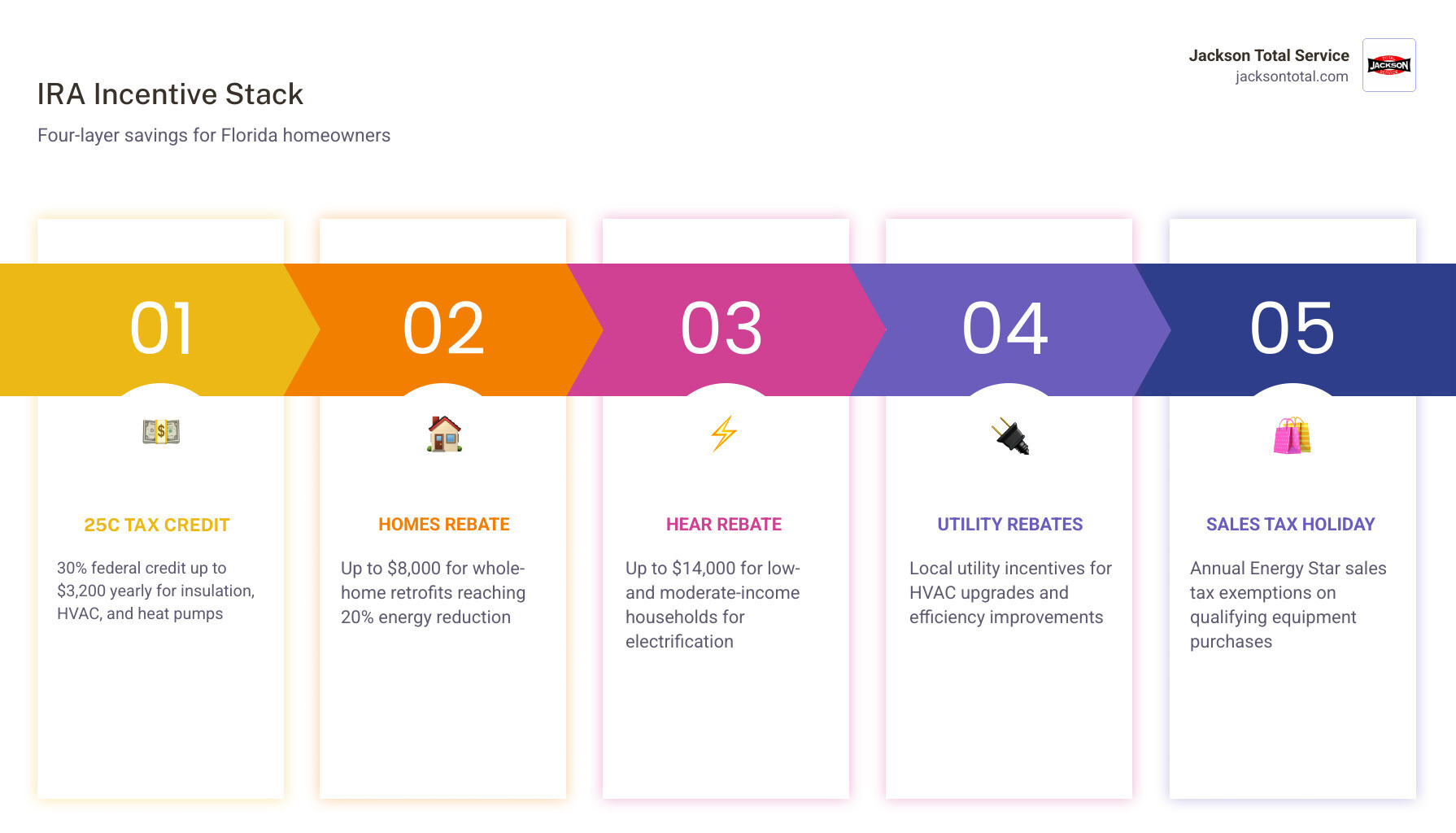
By combining these state rebates with federal tax credits, local utility incentives, and state-level tax holidays, you can create a powerful “incentive stack” that slashes the net cost of home comfort improvements.
Understanding the 25C Energy Efficient Home Improvement Tax Credit
The cornerstone of the IRA’s tax incentives for residential properties is the Section 25C Energy Efficient Home Improvement Credit. Under this provision, homeowners can claim a federal tax credit of up to 30% of the cost of qualifying energy efficiency upgrades.
Unlike previous iterations of home energy tax credits, which had a low lifetime limit, the 25C credit resets annually. This means you can strategically plan your home improvements over several years to maximize your tax savings. For example, you could upgrade your home’s insulation and seal your ducts this year, and then replace your older air conditioning system with a high-efficiency heat pump next year—claiming the maximum tax credit for both tax years.
It is important to understand that these are non-refundable tax credits. A non-refundable credit can reduce your federal tax liability (the amount of tax you owe the government) down to zero, but it will not result in a refund check for any excess credit value beyond your tax liability. Furthermore, any unused portion of the 25C credit cannot be carried forward to future tax years. To make the most of this credit, you must have sufficient tax liability in the year the equipment is installed. You will claim these savings using IRS Form 5695 when filing your federal tax returns.
The 25C credit has an overall maximum annual limit of $3,200, which is broken down into specific categories:
- Up to $2,000 per year for qualifying heat pumps, heat pump water heaters, and biomass stoves.
- Up to $1,200 per year for other energy-efficient improvements, including insulation, air sealing, energy-efficient exterior doors and windows, and electrical panel upgrades.
How the 25C Tax Credit Unlocks Inflation Reduction Act Benefits for Florida Homeowners
When it comes to air conditioning and heating in Southwest Florida, choosing the right equipment is critical. Under the 25C tax credit, heat pumps receive a significantly higher credit limit ($2,000) than standard central air conditioners ($600). This policy-driven preference is designed to encourage homeowners to transition to heat pumps, which are incredibly efficient at both cooling and heating.
To qualify for the 25C tax credit, your new equipment must meet strict performance criteria. The IRS categorizes Florida as part of Climate Zone 2, which has specific efficiency standards established by the Consortium for Energy Efficiency (CEE). To earn the credit, the installed systems must meet or exceed the CEE Highest Tier (excluding any advanced tiers):
- Split-System Air Source Heat Pumps: Must achieve $\ge$ 17 SEER2, $\ge$ 9.5 EER2, and $\ge$ 8.1 HSPF2.
- Mini-Split (Ductless) Heat Pumps: Must achieve $\ge$ 16 SEER2, $\ge$ 9.0 EER2, and $\ge$ 9.5 HSPF2.
- Central Split Air Conditioners: Must achieve $\ge$ 17 SEER2 and $\ge$ 12 EER2 to qualify for the $600 credit.
If you are planning an HVAC upgrade in Naples or Fort Myers, working with a licensed provider of air conditioning services ensures that your new system is fully certified with an AHRI (Air-Conditioning, Heating, and Refrigeration Institute) reference number matching these federal requirements.
Insulation and Weatherization Incentives
Many homeowners do not realize that their air conditioner is working twice as hard as it needs to because of poor insulation and air leaks. In Southwest Florida, attic temperatures can easily soar past 140°F, radiating heat directly down into your living spaces.
The 25C credit covers 30% of the product cost (excluding labor) for qualifying insulation and weatherization materials, up to a maximum annual limit of $1,200. Eligible products include:
- Bulk insulation: Spray foam, fiberglass batts, rolls, blow-in loose-fill fibers, rigid foam boards, and pour-in-place insulation.
- Air-sealing products: Weather stripping, caulking, house wrap, and spray foam used to seal gaps around windows, doors, and pipes.
- Duct sealing: Sealing leaky ductwork to prevent conditioned air from escaping into your attic.
- Home Energy Audits: You can claim a credit of up to $150 for a professional home energy audit that identifies where your home is losing energy.
Pro-Tip: Sequence your upgrades! Performing insulation and air-sealing improvements before replacing your HVAC system can lower your home’s cooling load. This often allows you to install a smaller, less expensive heat pump system that still keeps your home perfectly comfortable.
Florida Energy Saver Program: HOMES and HEAR Rebates
In addition to federal tax credits, the IRA funded two major state-administered rebate programs: the Whole-Home Energy Savings (HOMES) Program (Section 50121) and the High-Efficiency Electric Home Rebates (HEAR) Program (Section 50122). Together, these programs form the core of the Florida Energy Saver Program, supported by a $346 million federal allocation.
Administered by the Florida Department of Agriculture and Consumer Services, these programs are designed to provide point-of-sale discounts (upfront rebates) rather than post-purchase tax savings. This makes energy-efficient upgrades accessible to households that might not have the upfront capital or enough federal tax liability to benefit from tax credits.
Whole-Home Energy Savings (HOMES) Program
The HOMES program rewards homeowners based on verified energy savings. Instead of focusing on a single appliance, it looks at the overall energy performance of the home. To qualify for a HOMES rebate, your home improvements must achieve a minimum energy consumption reduction of at least 20%.
- Energy Savings of 20% to 34%: Homeowners can receive a rebate of up to 50% of the project cost, capped at $2,000 (or up to $4,000 for low- to moderate-income households).
- Energy Savings of 35% or More: Homeowners can receive a rebate of up to 50% of the project cost, capped at $4,000 (or up to $8,000 for low- to moderate-income households).
These savings are calculated using approved energy modeling software before and after the retrofits are completed. Common projects include combining duct sealing, attic insulation, and high-efficiency HVAC installations.
High-Efficiency Electric Home Rebates (HEAR) for Electrification
The HEAR program is specifically structured to assist low- and moderate-income (LMI) households with the transition to clean, electric appliances. Eligibility is based on your household income relative to your county’s Area Median Income (AMI):
- Low-Income: Households earning less than 80% of the Area Median Income qualify for 100% of the cost of the upgrades, up to specified caps.
- Moderate-Income: Households earning between 80% and 150% of the Area Median Income qualify for 50% of the cost of the upgrades, up to specified caps.
Under the HEAR program, qualifying Southwest Florida families can access up to $14,000 total in upfront electrification rebates, including:
- Up to $8,000 for a high-efficiency heat pump for space heating and cooling.
- Up to $4,000 for an electrical panel upgrade (necessary if your current panel cannot handle the load of new electric appliances).
- Up to $2,500 for electrical wiring upgrades.
- Up to $1,600 for insulation, air sealing, and ventilation.
- Up to $1,250 for a heat pump water heater.
How to Stack Federal, State, and Utility Incentives in Southwest Florida
To get the absolute most out of your home improvement projects, you should aim to “stack” multiple layers of incentives. While the federal government prevents you from claiming both a federal tax credit (25C) and an IRA rebate (HOMES/HEAR) for the exact same piece of equipment, you can combine federal incentives with local utility rebates, manufacturer discounts, and state sales tax exemptions.
Here is a look at how these layers can stack up for a typical Southwest Florida homeowner:
| Incentive Layer | Source | What It Covers | Potential Savings |
|---|---|---|---|
| Layer 1: Federal Credit | IRS (Section 25C) | Heat pump, AC, insulation, panels | Up to $3,200 annually |
| Layer 2: Utility Rebates | FPL / Duke Energy | High-efficiency AC/heat pump, duct sealing | $150 to $1,200+ |
| Layer 3: Sales Tax Holiday | State of Florida | Energy Star certified appliances | Saves 6% to 7.5% |
| Layer 4: Manufacturer Rebates | Equipment Brands | Promotional system upgrades | Varies seasonally |
Combining 25C Tax Credits with Florida Utility Rebates
Major electric utilities serving Lee and Collier counties offer attractive rebates for energy-efficient upgrades. To qualify, you must use a utility-approved contractor and submit your paperwork within the utility’s specified window (typically 60 to 90 days post-installation).
- Florida Power & Light (FPL): Offers rebates ranging from $150 to $1,200 for qualifying high-efficiency AC and heat pump installations. FPL also provides an additional $200 to $400 for certified duct system testing and repair, which helps stop cooled air from leaking into your attic.
- Duke Energy Florida: Offers rebates between $200 and $1,000 depending on the system size (tonnage) and SEER2 rating of the new equipment.
By choosing a qualifying heat pump, you can claim up to a $2,000 federal tax credit and stack an FPL or Duke Energy rebate on top of it, instantly driving down your net investment. When you need expert help navigating these system requirements, our professional air conditioning services ensure your installation meets both federal tax guidelines and local utility rebate standards.
Leveraging Sales Tax Holidays and Manufacturer Rebates
The State of Florida frequently runs Energy Star Sales Tax Exemption periods. During these designated sales tax holidays, qualifying Energy Star certified appliances—including central air conditioners, heat pumps, and water heaters—are completely exempt from the state’s 6% sales tax, as well as local county surtaxes (which range from 0.5% to 1.5% in Lee and Collier counties). On a major system installation, timing your purchase to coincide with these sales tax holidays can save you hundreds of dollars upfront.
Additionally, top HVAC manufacturers offer seasonal instant rebates on their most efficient systems. When you combine a manufacturer’s promotional rebate with a Florida sales tax holiday, a local utility rebate, and the federal 25C tax credit, your total savings can easily exceed 30% of the project cost.
Claiming Your Credits: Documentation and Best Practices
The IRS and local utility companies require strict documentation to verify that your upgrades meet all efficiency guidelines. To protect yourself in the event of an audit and ensure your credits are approved, you must keep meticulous records.
Required Documentation to Keep:
- Itemized Contractor Invoices: Your invoice must clearly separate the cost of the equipment, labor, and any auxiliary work (like ductwork or electrical modifications). This is especially important for insulation claims, where only the material cost qualifies for the 30% credit.
- Manufacturer’s Certification Statement: A signed document from the manufacturer certifying that the specific model number meets the CEE efficiency requirements for the tax credit.
- AHRI Certificate: This certificate proves that the outdoor unit, indoor coil, and furnace/blower motor are certified to perform at the rated SEER2, EER2, and HSPF2 levels as a matched system.
- Utility Rebate Confirmation: Copy of the submitted and approved rebate application from FPL or Duke Energy.
Keep all of these documents on file for at least seven years alongside your tax returns.
Step-by-Step Guide to IRS Form 5695
When tax season arrives, you will use IRS Form 5695 (Residential Energy Credits) to claim your 25C tax credits.
- Download Form 5695: Ensure you are using the correct version for the tax year in which the equipment was installed and placed in service (for example, tax year 2026).
- Complete Part II (Nonbusiness Energy Property Credit): This is where you will input the costs of your qualified energy-efficient improvements.
- Line 19a: Enter the cost of qualified insulation and air-sealing materials.
- Line 22a: Enter the cost of qualified heat pumps or heat pump water heaters (subject to the $2,000 cap).
- Line 22b: Enter the cost of qualified central air conditioners (subject to the $600 cap).
- Calculate Your Credit: Apply the 30% calculation to your eligible expenses, keeping the individual category limits and the overall $3,200 annual cap in mind.
- Transfer to Form 1040: Carry the final credit amount over to your main tax return to reduce your tax liability.
Note: Always consult with a certified tax professional to verify your personal eligibility and ensure your tax filings are accurate.
Avoiding Common Mistakes When Claiming Inflation Reduction Act Benefits for Florida Homeowners
Many homeowners miss out on savings due to simple, avoidable errors. Be sure to watch out for these common pitfalls:
- Choosing Standard AC Over a Heat Pump: While a standard central AC is eligible for a $600 credit, a heat pump qualifies for up to $2,000. In Southwest Florida’s climate, the long-term energy savings of a heat pump combined with the larger tax credit often make it the more financially sound choice.
- Failing to Verify SEER2 Ratings: Never assume a “high-efficiency” system automatically qualifies. Always double-check the CEE Highest Tier list and obtain the AHRI certificate before the installation begins.
- Accepting Bundled Invoices: If your contractor provides a single, unitemized price for a complete project (such as ductwork, electrical, and HVAC combined), the IRS may disallow the tax credit. Insist on itemized pricing.
- Missing Utility Deadlines: FPL and Duke Energy have strict filing windows. If you wait too long after installation to submit your utility rebate paperwork, you will lose those savings entirely.
- Double-Dipping Incompatible Rebates: You cannot claim both a HEAR point-of-sale rebate and a 25C federal tax credit for the exact same equipment installation.
Frequently Asked Questions About Florida IRA Benefits
Can I combine the 25C tax credit with the HOMES or HEAR rebates for the same upgrade?
No, you cannot “double-dip” by claiming both a federal tax credit and a state-administered IRA rebate (HOMES or HEAR) for the exact same piece of equipment. However, you can use them for different parts of a larger home project. For example, you could use a HEAR rebate to cover the cost of a new heat pump water heater, and then claim the 25C tax credit for your attic insulation upgrades.
What are the income limits for the HEAR rebate program in Florida?
The HEAR program is reserved for low- to moderate-income households. Low-income households (earning under 80% of their county’s Area Median Income) can receive up to 100% of their installation costs covered, up to the program caps. Moderate-income households (earning between 80% and 150% of the AMI) can receive up to 50% of the costs covered. Households earning above 150% of the AMI are not eligible for HEAR rebates but can still utilize the HOMES rebates and the 25C tax credits.
Does the 25C tax credit apply to rental properties or second homes?
The 25C Energy Efficient Home Improvement Credit can only be claimed for upgrades made to your primary residence. It cannot be claimed for rental properties that you own but do not live in, nor does it apply to new construction homes. However, the Residential Clean Energy Credit (Section 25D), which covers solar panels and battery storage, can be used on second homes and vacation properties.
Conclusion
Navigating the various tax credits, utility rebates, and state programs can feel overwhelming, but the financial rewards make it incredibly worthwhile. By upgrading your home’s HVAC system, sealing your ducts, and improving your insulation, you can significantly lower your monthly electric bills while enjoying a more comfortable, resilient home.
Since 1964, Jackson Total Service has been the trusted name for home comfort in Southwest Florida. As a family-owned business, we provide complete, all-in-one comfort solutions—covering HVAC, plumbing, and electrical services—throughout Naples, Bonita Springs, Estero, Marco Island, and the surrounding areas. Our highly trained, licensed technicians are here to help you select qualified systems, maximize your savings, and keep your home running efficiently for years to come.
Ready to upgrade your home comfort and claim your share of these historic incentives? Contact us today to schedule a consultation or learn more about our professional air conditioning services!