



Why Florida Energy Incentive Programs for Homeowners Are Worth Your Attention Right Now
Florida energy incentive programs for homeowners represent one of the biggest opportunities to cut utility costs and upgrade your home’s comfort — and right now, there’s more money on the table than ever before.
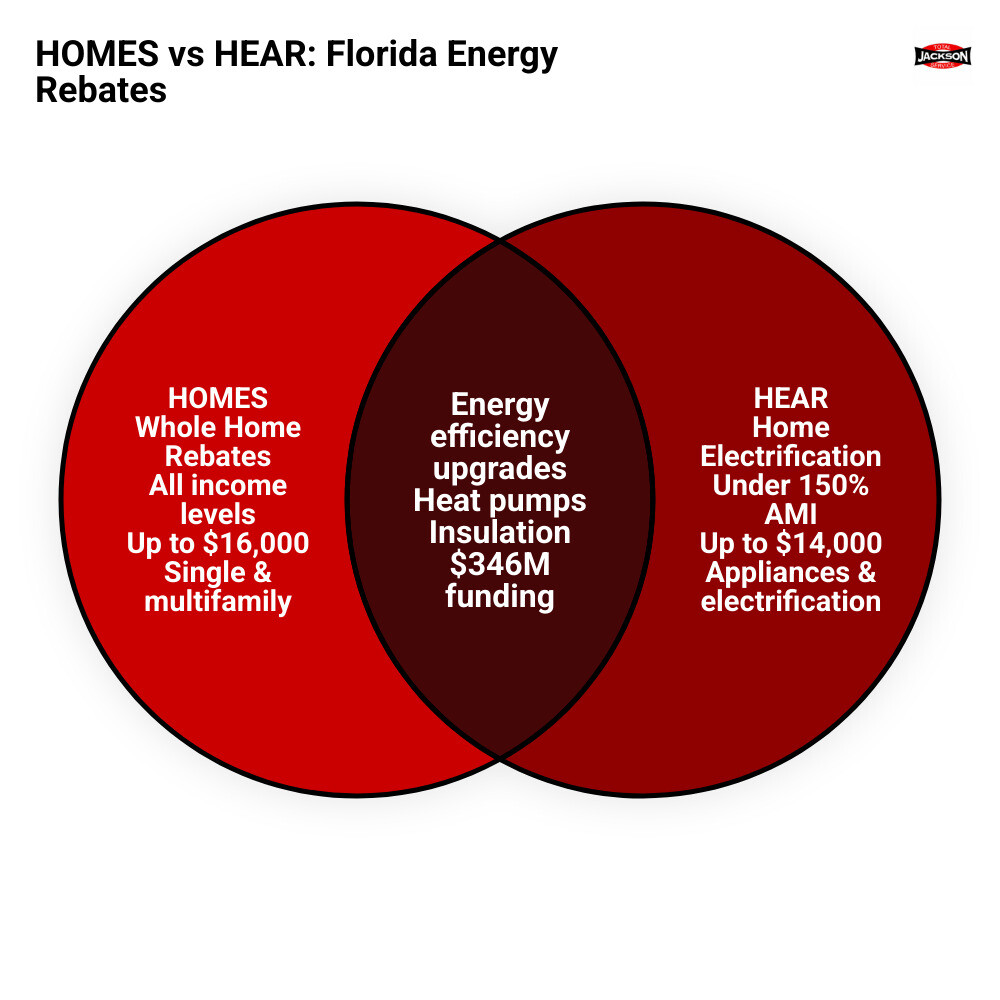
Florida has been allocated approximately $346 million in federal funding to help residents reduce energy costs through efficiency upgrades, retrofits, and high-efficiency appliances. That money flows through two major state programs — HOMES and HEAR — plus rebates from utilities like FPL, Duke Energy, and Florida Public Utilities, and federal tax credits under the Inflation Reduction Act.
Here’s a quick look at the main programs available to Florida homeowners:
| Program | Who It’s For | Max Benefit |
|---|---|---|
| HOMES (Whole Home Rebates) | All income levels; single-family & multifamily | Up to $16,000 for low-income households |
| HEAR (Home Electrification & Appliance Rebates) | Households under 150% Area Median Income | Up to $14,000 per household |
| FPL Rebates | FPL electric customers | Instant rebates on A/C and insulation |
| Duke Energy Rebates | Duke Energy customers | Up to $1,000 for HVAC upgrades |
| Florida Public Utilities (FPU) Rebates | FPU electric customers | Up to $500 for HVAC upgrades |
| Federal IRA Tax Credits | Most U.S. homeowners | 30% credit on eligible upgrades |
For Southwest Florida homeowners in Naples, Bonita Springs, Estero, and surrounding areas, stacking these programs together can mean thousands of dollars back on upgrades like heat pump systems, insulation, panel upgrades, and more.
In this guide, we’ll walk you through every major program — what it covers, who qualifies, how to apply, and how to combine incentives for maximum savings.
Navigating Florida Energy Incentive Programs for Homeowners

Navigating the landscape of energy efficiency can feel like a full-time job. Between state-administered funds and utility-specific perks, the options are vast. In Florida, the Florida Department of Agriculture and Consumer Services (FDACS) Office of Energy is the primary body managing the massive $346 million allocation from the Inflation Reduction Act.
For those of us living in Southwest Florida, where the humidity can make a summer afternoon feel like a steam room, these programs aren’t just about saving a few bucks; they are about making our homes more resilient. High-efficiency retrofits help your systems work smarter, not harder, which is vital when your AC is running nearly year-round. If you are looking to optimize your system before the peak heat hits, exploring air conditioning services is a great first step toward qualifying for these incentives.
State-Level Florida Energy Incentive Programs for Homeowners
The state’s two-pronged approach focuses on “Whole Home” savings and “Electrification.”
- Whole Home Rebates (HOMES): This program is all about performance. It provides discounts for efficiency upgrades predicted to save at least 20% of a home’s energy use. If you achieve 35% or more in savings, the rebates can reach staggering amounts.
- Home Electrification and Appliance Rebates (HEAR): This is a point-of-sale discount program designed to help you swap out old, gas-guzzling or inefficient electric appliances for high-efficiency heat pump technology.
| Feature | HOMES Program | HEAR Program |
|---|---|---|
| Primary Goal | Overall Energy Reduction (20%+) | Electrification & High-Efficiency Appliances |
| Income Limit | None (but LMI get higher amounts) | Under 150% Area Median Income (AMI) |
| Max Rebate | Up to $16,000 (LMI) | Up to $14,000 |
| Typical Upgrades | Insulation, HVAC, Air Sealing | Heat Pumps, Electric Stoves, Wiring |
Qualifying Upgrades for Florida Energy Incentive Programs for Homeowners
What exactly can you get “paid” to upgrade? The list is extensive because the goal is to modernize the entire Florida grid, one home at a time.
- Heat Pump HVAC Systems: These are the gold standard for Florida cooling and heating.
- Heat Pump Water Heaters: Far more efficient than traditional electric tanks.
- Weatherization: This includes air sealing and high-quality insulation to keep the cool air in and the Naples humidity out.
- Electric Load Service Centers: Often, to support new high-efficiency equipment, you need to upgrade your electrical panel.
- Electric Stoves and Wiring: Moving toward induction cooktops or heat pump clothes dryers.
If your home is older, a panel upgrade is often the prerequisite for any of these energy-saving technologies. Our team provides comprehensive electrical services to ensure your home’s “brain” can handle its new high-efficiency “muscles.”
Maximizing Savings with Utility-Specific Rebates
While the state programs are exciting, don’t overlook your local utility provider. Companies like FPL and Duke Energy offer “instant” or “direct” rebates that are often much faster to process than state-wide grants.
FPL, for instance, offers an instant $200 rebate when you purchase a new energy-efficient air conditioner through a participating contractor. They also provide a $220 rebate for ceiling insulation upgrades. If you are in Estero or Bonita Springs and dealing with an aging electrical system, you might also be looking for the top electricians for panel upgrades in Estero FL to ensure your home is ready for these high-efficiency units.
Utility Rebate Requirements and Efficiency Standards
To get the cash, you have to meet the standards. Most utility companies have moved away from the old SEER (Seasonal Energy Efficiency Ratio) ratings to the newer, more stringent SEER2 standards.
- FPU (Florida Public Utilities): Requires a minimum 15.0 SEER rating for HVAC upgrades, with rebates ranging from $250 to $500.
- Duke Energy: Offers tiers of savings. For example, replacing a strip heat system with a heat pump that meets 16.0 SEER & 9.0 HSPF (or 15.2 SEER2 & 7.5 HSPF2) can net you a $600 rebate. If you go even higher—to 16.8 SEER—that rebate can jump to $1,000.
Keeping your system maintained is the best way to ensure it stays within these efficiency brackets. We recommend checking out our AC Maintenance in Estero FL: Your Essential Service Checklist to keep your unit running at peak performance.
Additional Utility Perks and Assessments
Many utilities offer “Home Energy Checks” or assessments. These are often free or heavily subsidized and are a requirement for many rebate programs.
FPL also offers the On Call® program, which can save you over $90 a year just by allowing the utility to occasionally cycle off your AC or water heater during peak demand periods. They even offer specialized programs like SolarTogether®, which allows you to benefit from solar energy without actually installing panels on your roof—perfect for many of our Naples condo owners.
Upgrading your insulation is another “low-hanging fruit” for energy savings. A well-insulated attic can keep your home significantly cooler, reducing the load on your AC. Before you start DIY-ing your electrical or HVAC connections, remember why Florida homeowners shouldn’t play electrical roulette—professional installation is usually a requirement for rebate eligibility.
Federal Tax Credits and the Inflation Reduction Act
The Inflation Reduction Act (IRA) changed the game for federal tax credits. Unlike a rebate, which is often a point-of-sale discount or a check in the mail, a tax credit is applied when you file your federal income taxes.
The Energy Efficient Home Improvement Credit allows homeowners to claim up to 30% of the cost of eligible upgrades, with annual caps. For example:
- Heat Pumps and Heat Pump Water Heaters: Up to $2,000 per year.
- Insulation and Windows: Up to $1,200 per year.
- Home Energy Audits: 30% of the cost, up to $150.
You’ll use IRS Form 5695 to claim these. Additionally, if you are worried about the frequent storms we get in Southwest Florida, you might be considering a whole-home generator or battery storage. While you’re at it, read up on the shocking truth about why your home needs surge protection to protect those new, expensive energy-efficient appliances from Florida’s lightning strikes.
How to Apply and Avoid Common Pitfalls
The biggest mistake homeowners make is “acting first and asking later.” Many florida energy incentive programs for homeowners require pre-approval or a pre-installation energy assessment to qualify.
Common pitfalls include:
- Using Unlicensed Contractors: Most programs require the work to be done by a “qualified contractor” who is licensed and insured.
- Missing Deadlines: FPU, for example, requires applications to be submitted within one year of installation for HVAC, but only 90 days for appliances.
- Incorrect SEER2 Ratings: If your new unit is even 0.1 points below the requirement, the rebate will be denied.
For a deeper dive into common maintenance and efficiency questions, our helpful tips section can help you stay on the right track.
Step-by-Step Application Guide for Florida Energy Incentive Programs for Homeowners
Ready to start? Follow these steps to ensure you don’t leave money on the table:
- Register Interest: Visit the Florida Energy Saver portal (administered by FDACS) to sign up for updates on the HEAR and HOMES programs.
- Get an Assessment: Schedule a Home Energy Check with your utility provider (FPL, Duke, etc.). This creates the “baseline” needed to prove energy savings.
- Find a Qualified Contractor: Ensure your contractor understands the specific SEER2 and HSPF2 requirements for the rebates you are targeting.
- Model Your Savings: For the HOMES program, your contractor will need to model the predicted energy savings (20% or 35%) before work begins.
- Submit Documentation: Keep every receipt, AHRI certificate, and invoice.
If you are planning a major overhaul, including new wiring, our electrical installation Naples FL complete guide provides a roadmap for what to expect during the process.
Frequently Asked Questions about Florida Energy Incentives
Can I combine utility rebates with federal tax credits?
Yes! In most cases, you can “stack” incentives. For example, you could receive an instant $200 rebate from FPL for a new AC, and then claim a 30% tax credit on your federal return for the remaining cost. However, state-managed rebates (like HEAR) may have specific rules about combining with other federal grants, so always check the latest FDACS guidelines.
What is the maximum rebate amount for low-income households in Florida?
Under the HOMES program, low-income households (earning less than 80% of the Area Median Income) can receive up to $16,000 for retrofits that save 35% or more energy. Under the HEAR program, the cap is $14,000 per household, which can cover 100% of the project costs for eligible low-income residents.
When do the HEAR and HOMES programs officially launch for all residents?
As of April 2026, the programs are rolling out in stages. The HEAR program (electrification) typically pilots first, followed by a statewide launch. The HOMES program (performance-based) follows. Homeowners are encouraged to register on the Florida Energy Saver portal to receive an email notification the moment applications open for their specific region.
Conclusion
Upgrading your Florida home doesn’t have to be a financial burden. By leveraging florida energy incentive programs for homeowners, you can transform your living space into a high-efficiency sanctuary that costs less to run and stays cooler in the Southwest Florida sun.
At Jackson Total Service, we’ve been helping our neighbors in Naples, Fort Myers, and Cape Coral stay comfortable since 1964. We understand the unique demands our climate puts on your HVAC, plumbing, and electrical systems. Whether you need a high-efficiency AC installation to qualify for FPL rebates or a panel upgrade to support a new heat pump water heater, we provide all your comfort solutions in one place.
Don’t let these incentives pass you by. Contact us today to schedule an assessment and see how we can help you maximize your savings while improving your home’s performance. For more information on how we can help with your cooling needs, explore our air conditioning services and start your journey toward a more efficient home today.