



How Do You Light a Towering Royal Palm Without Blinding the Neighborhood?
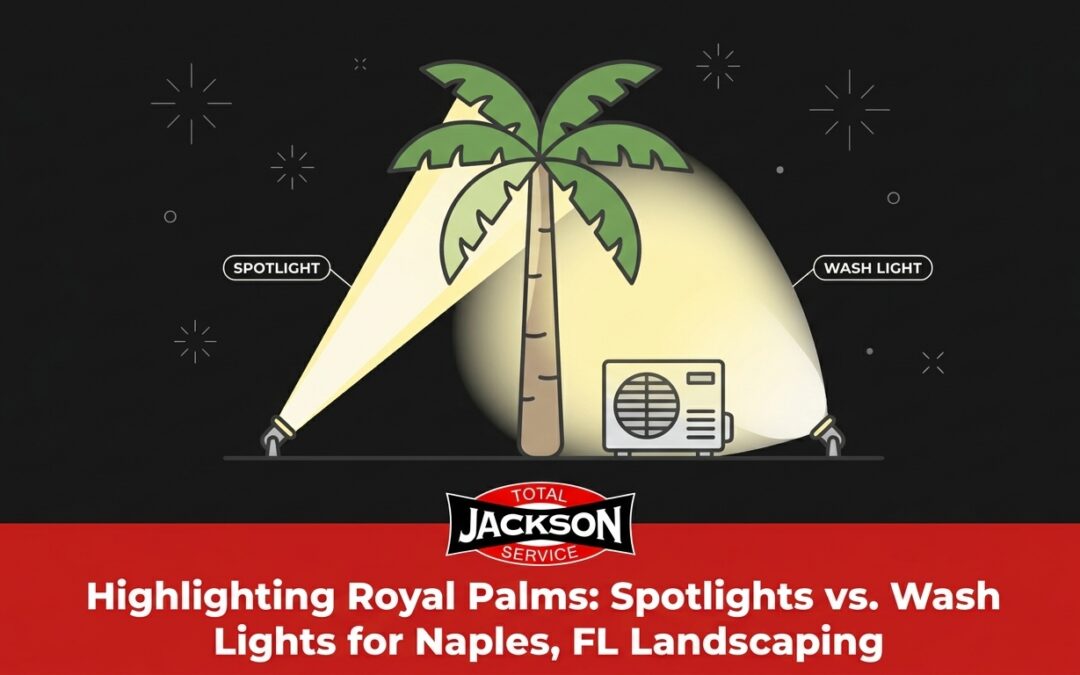
How do you capture the majestic height of a mature tree at night without turning your neighbor’s second-story bedroom into a stadium? If you are exploring Highlighting Royal Palms: Spotlights vs. Wash Lights for Naples Landscaping, you already know that these towering, iconic trees require a highly specific approach. Pointing a generic, overly bright fixture upward usually results in harsh neighborhood glare instead of a resort-style aesthetic. The core decision comes down to choosing between narrow-beam spotlights that pierce the dark to hit the high canopy, wider wash lights that feature the smooth trunk, or a strategic combination of both.
Whether you are designing a brand-new layout or upgrading an existing system, investing in professional lighting installation ensures your property looks stunning and operates safely.
Preparing for the Seasonal Shift
As we move into early fall (preparing outdoor living spaces for shorter days), the runtime of your outdoor illumination increases significantly. A poorly aimed fixture might go unnoticed when the sun sets at 8:30 p.m., but when darkness falls before dinner, those lighting mistakes become glaringly obvious. The goal is to extend your outdoor living hours seamlessly, creating a welcoming ambiance that highlights the architectural beauty of your landscaping without causing light trespass across property lines.
The Unique Challenge of 80-Foot Royal Palms
Lighting a mature Royal Palm is fundamentally different from illuminating a standard oak, maple, or even a smaller Pygmy Date Palm. The sheer scale and growth habits of these trees present specific technical hurdles that require specialized equipment and precise calculations to overcome.
Understanding the Scale and Structure
Mature Royal Palms can easily reach heights of 50 to 80 feet. Unlike broad shade trees that feature wide, dense canopies starting just 10 or 15 feet off the ground, a Royal Palm presents a long, smooth, vertical trunk topped with a concentrated burst of vibrant green fronds at the very peak. Standard tree lighting techniques usually rely on hitting a wide canopy from multiple angles. If you apply that same technique to a towering palm, the light simply shoots past the narrow trunk and disappears into the night sky—or worse, directly into a neighbor’s window.
The Physics of Beam Spread
To successfully illuminate these giants, you have to understand the concept of beam spread. Beam spread dictates how wide the cone of light expands as it travels away from the fixture. A wide beam spreads its energy over a large area very quickly, meaning it loses its “punch” or intensity before it can travel very high. A narrow beam concentrates that same energy into a tight column, allowing it to travel much farther before dissipating.
When deciding how to light your property, you need a landscape lighting installation strategy that balances these factors. You have to decide whether your primary goal is to emphasize the smooth, cement-like texture of the massive trunk, or to draw the eye all the way up to the swaying fronds against the night sky. Most successful designs require managing both aspects carefully.
Spotlights: Precision and Power for the Canopy
When your primary objective is to reach the top of a towering tree, spotlights are the tool of choice. In the context of architectural and landscape illumination, spotlights are defined by their highly focused optics.
How Narrow Beams Pierce the Dark
Spotlights typically utilize a narrow beam spread ranging from 15 to 24 degrees. Because the light is tightly corralled by the fixture’s internal optics, it does not spill out to the sides. This concentration allows the light to travel 40, 60, or even 80 feet upward with enough remaining intensity to beautifully illuminate the fronds of a Royal Palm. If you are upgrading to low-voltage landscape lighting, modern LED spotlights offer incredible punch while consuming a fraction of the electricity of older halogen bulbs.
Applying Spotlights to Tall Palms
Using spotlights effectively requires a methodical approach to fixture placement and aiming:
- Determine the focal point: Identify exactly which part of the canopy you want to highlight. For Royal Palms, this is usually the crown shaft (the smooth green section just below the fronds) and the lower fronds themselves.
- Select the correct beam angle: For trees exceeding 50 feet, a 15-degree spot is often necessary to ensure the light reaches the top without widening too much along the way.
- Position for the vertical reach: Place the fixture close enough to the trunk to maintain a steep upward angle, but far enough back that the beam can expand just enough to cover the canopy width by the time it reaches the top.
- Check for lateral spill: Walk around the property to ensure the tight beam is entirely intercepted by the palm fronds and is not shooting past them into the distance.
The Pros: Spotlights offer incredible vertical reach, create a dramatic and intense focal point at the canopy, and significantly reduce lateral light pollution because the beam is so contained.
The Cons: Because the beam is so tight, it often misses the lower trunk entirely. If used alone, this can create an unnatural “floating canopy” effect where the top of the tree is brightly lit but the massive trunk supporting it is completely lost in the shadows.
Wash Lights: Broad Illumination for the Trunk
While spotlights handle the extreme heights, wash lights serve an entirely different purpose. These fixtures are designed to cast a wide, soft net of illumination over a larger surface area, making them ideal for grounding the tree visually.
The Mechanics of Wide Beam Spreads
Wash lights typically feature beam spreads of 60 degrees or wider. Instead of a tight column of light, they produce a broad V-shape. Because the light energy is distributed over such a wide area, it lacks the intensity to travel very far vertically. However, it excels at highlighting textures and creating a soft, ambient glow near the ground.
Applying Wash Lights Safely
When dealing with towering palms, wash lights are used to highlight the massive, textured base and the smooth gray trunk. However, because the beam is so wide, they require extreme caution during placement.
- Position for trunk coverage: Place the wash light slightly further back from the base than you would a spotlight, aiming it at a shallower angle to graze the bark.
- Monitor the spill: Pay close attention to where the edges of the 60-degree beam land. The light will continue to spread outward as it goes up.
- Limit the upward angle: Never point a wide wash light straight up into the sky. The light that misses the trunk will spread outward uncontrollably.
The Pros: Wash lights provide a softer, more ambient light that beautifully highlights the bark texture near the base. They visually anchor the tree to the ground, preventing the floating canopy effect.
The Cons: The risk of light trespass is exceptionally high. In dense neighborhoods featuring Naples two-story residential properties, a poorly aimed wash light will almost certainly spill unwanted light into second-floor bedroom windows or balconies.
Head-to-Head Comparison: Spotlights vs. Wash Lights
To help you make the best design decision for your property, here is a clear breakdown of how these two distinct fixture types perform when applied to towering landscape features.
| Feature | Spotlights (Narrow Beam) | Wash Lights (Wide Beam) |
|---|---|---|
| Beam Spread | 15 to 24 degrees (Tight and focused) | 60+ degrees (Broad and expansive) |
| Primary Target Area | The high canopy, fronds, and crown shaft | The lower trunk, base, and surrounding ground |
| Vertical Reach | Excellent (Easily reaches 50-80 feet) | Poor (Loses intensity rapidly over distance) |
| Glare Risk | Low (If aimed correctly at the dense fronds) | High (Wide spread easily hits nearby windows) |
| Ideal Application | Mature, towering Royal Palms over 40 feet | Smaller accent palms, hedges, and architectural walls |
| Visual Effect | Dramatic, high-contrast focal points | Soft, ambient, grounding illumination |

Defeating Glare: Shields, Louvers, and Strategic Aiming
One of the most persistent issues in upscale residential communities is light pollution. Achieving a beautiful nighttime aesthetic should never come at the expense of your neighbors’ comfort or your own ability to sleep.
The Problem: Second-Story Light Trespass
In communities characterized by Naples two-story residential properties, homes are often built relatively close together. When illuminating an 80-foot palm tree, the light source must be pointed upward. If that beam is too wide or aimed at the wrong angle, the light that misses the tree continues traveling until it hits the side of a neighboring house, often shining directly into second-story bedroom windows.
The Cause: Uncontrolled Optics and Poor Placement
This unwanted glare is almost always caused by using the wrong fixture for the job (like using a wash light to try and hit a high canopy) or failing to control the light leaving the fixture. The Illuminating Engineering Society (IES) provides strict guidelines on residential glare, emphasizing that light must be contained to the intended target area to protect nighttime livability.
The Solution: Physical Glare Control
To illuminate towering palms responsibly, professional installers utilize specific hardware and geometric strategies. If you are considering LED landscape lighting in Naples, ensure your system incorporates these essential glare-defeating tools:
- Physical Glare Shields: These are metal shrouds or “hats” that attach to the top of the fixture. They physically block the light from spilling backward or sideways, directing it only where you want it.
- Hex Louvers: A honeycomb-shaped metal insert placed inside the fixture, right over the lens. Hex louvers cut out peripheral glare, ensuring that you only see the light hitting the tree, not the blinding source of the bulb itself.
- Strategic Distance Placement: Moving the fixture slightly further away from the trunk allows for a shallower aiming angle. This means any light that misses the canopy travels up into the sky, rather than horizontally into a neighbor’s window.
Surviving the Florida Elements: Weatherproofing Requirements
Designing the perfect lighting layout is only half the battle; ensuring that system survives the harsh Southwest Florida environment is equally important. Standard fixtures purchased from a local big-box store are simply not engineered for this climate.
Battling the Rain and Humidity
With Naples experiencing heavy summer downpours, over 50 inches of annual rain, and near-constant high humidity, outdoor electrical systems take a beating. Ground-level uplights sit in the splash zone, constantly subjected to pooling water, mud, and intense moisture. If a fixture is not completely sealed, water will eventually find its way inside, leading to blown bulbs, corroded sockets, and tripped electrical breakers.
The Necessity of High IP Ratings
To survive these conditions, fixtures used for highlighting towering trees must carry a high Ingress Protection (IP) rating. An IP67 rating, for example, means the fixture is completely dust-tight and can withstand temporary submersion in water. This level of watertight engineering is mandatory to prevent electrical shorts during torrential downpours. Furthermore, fixtures must be constructed from heavy-cast brass or specialized composites to prevent the rapid corrosion that destroys cheap aluminum housings in humid coastal environments.
The Hidden Danger: Electrical Load and Panel Safety
Adding high-reach, high-lumen lighting to illuminate multiple 80-foot Royal Palms requires a significant amount of electrical power. While low-voltage LED systems are highly efficient, adding dozens of powerful fixtures across a large property still places a new, continuous load on your home’s main electrical panel.
The Risks of Overloading Circuits
A typical pattern we see is homeowners or standard landscaping crews plugging massive lighting transformers into existing exterior outlets without verifying what else is on that circuit. This can easily overload the breaker, leading to nuisance tripping or, worse, overheating wires hidden inside your walls. Improperly wired outdoor systems can cause dangerous sparking, short circuits, and complete panel failures.
The Value of Licensed Electricians
This is where working with a multi-trade powerhouse truly matters. Ensuring that your home’s main electrical panel can safely handle the new lighting load without overloading existing circuits is a job for a licensed professional.
One local homeowner experienced the importance of this firsthand during the fall, shortly after Hurricane Ian. Sparks began shooting directly from their electrical panel on a Sunday due to outdoor electrical issues. Because they reached out to a fully equipped, multi-trade team, a licensed electrician was dispatched and arrived in less than an hour. The technician quickly diagnosed the overload, safely resolved the dangerous sparking, and ensured the entire system was integrated properly and running efficiently. When dealing with outdoor power, having a licensed electrician manage the panel integration protects your home and your family.
Frequently Asked Questions
What is the difference between wash lights and spotlights for trees?
The primary difference lies in the beam spread and how the light travels. Spotlights use a narrow beam (usually 15-24 degrees) to push light high into the canopy of tall trees. Wash lights use a wide beam (60 degrees or more) to cast a broad, soft glow over the lower trunk and surrounding ground.
How do you light a tall palm tree without glare?
Preventing glare requires controlling the light source with specific hardware. You must use narrow-beam spotlights aimed precisely at the fronds, combined with physical glare shields and internal hex louvers. These accessories block peripheral light from spilling into neighboring windows or blinding people walking by.
How many lumens do you need to light a mature Royal Palm?
Lighting an 80-foot tree requires significant output, often demanding fixtures that produce between 800 and 1,200 lumens. However, because you are using a narrow beam, the focus of the light (measured in candela) is just as important as the total lumen output to ensure the light actually reaches the canopy.
What is the best distance from the trunk to place an uplight?
The ideal distance depends on the height of the tree and the width of the canopy, but generally, fixtures should be placed 2 to 4 feet away from the base. This distance allows the beam to spread just enough to cover the fronds without creating a harsh hotspot on the lower trunk.
Can I use both spotlights and wash lights on the same tree?
Yes, combining both fixtures often yields the most professional and aesthetically pleasing result. A spotlight can be used to reach the high canopy and fronds, while a lower-output wash light can be used to softly illuminate the base and trunk, ensuring the entire tree is featured evenly.
Achieving the Perfect Balance
Illuminating mature Royal Palms is an art that requires precise technical execution. By understanding the distinct roles of narrow-beam spotlights and wide-beam wash lights, you can highlight the majestic height of your trees without creating unwanted neighborhood glare. When you are ready to achieve the perfect illumination without light pollution, trust a team that brings both landscape design expertise and licensed electrical safety to every project, ensuring your outdoor spaces look incredible and operate flawlessly.