


The Hidden Cost of Gulf Breezes on Your HVAC System
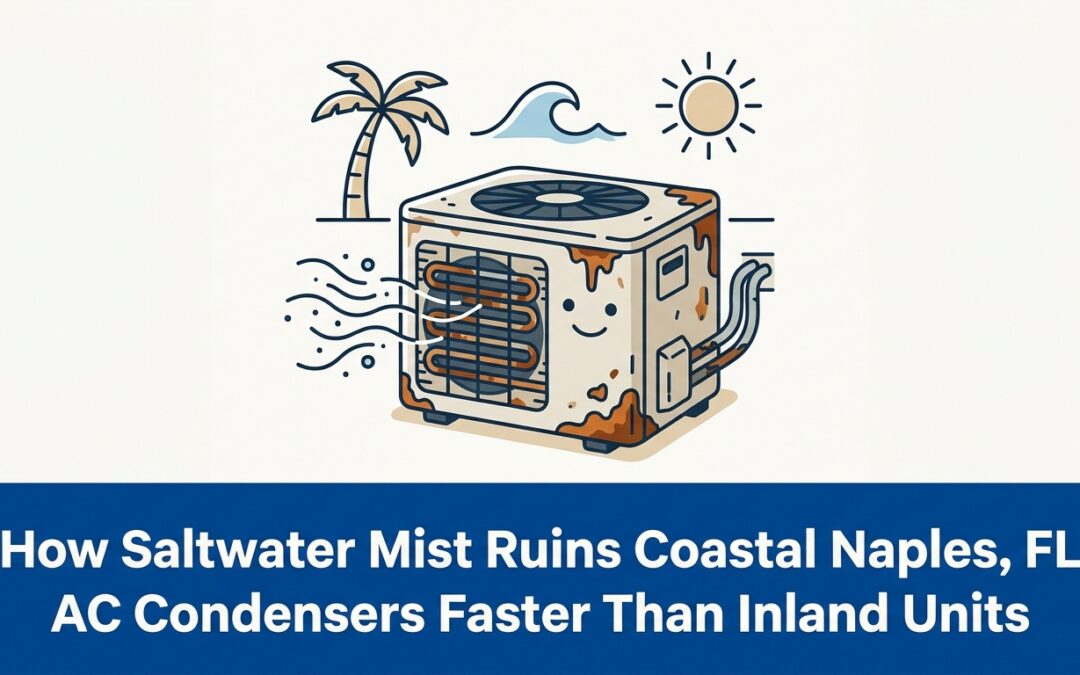
Nearly 50% of an air conditioner’s expected lifespan can vanish if it sits unprotected near the coast, which explains exactly how saltwater mist ruins coastal Naples AC condensers faster than inland units. When you look at the data, the numbers are striking. A standard outdoor condenser that might easily last 12 to 15 years in a dry, landlocked state often struggles to survive past year seven when exposed to constant coastal breezes. The core issue is not the wind itself, but the invisible payload it carries: microscopic salt particles that settle onto every exposed surface of your outdoor equipment.
This creates a concrete problem for homeowners living west of US-41 in Naples. As the saltwater mist continuously coats the unit, it rapidly degrades the delicate aluminum condenser fins that are responsible for releasing heat from your home. Once these fins begin to oxidize and crumble, the system loses its ability to cool efficiently, driving up energy bills and putting immense strain on the compressor. Ultimately, this forces a critical decision point: you must choose between investing in specialized protective treatments early on, or replacing a prematurely failing standard unit with a resilient, coastal-rated system.
If you are already seeing a chalky white residue building up on your outdoor unit, it is time to look into specialized coastal HVAC services before the structural damage compromises your entire cooling system.
The True Function of Your Condenser Fins
To understand why this damage is so catastrophic, you have to look at how your air conditioner actually works. The outdoor unit, or condenser, has one primary job: to take the heat absorbed from inside your house and release it into the outdoor air. It does this by pumping hot refrigerant through a series of copper tubes.
However, copper tubes alone do not provide enough surface area to release that heat quickly. That is why the tubes are woven through thousands of paper-thin aluminum fins. These fins act like a massive radiator, catching the air pulled through by the fan and transferring the heat away. Because these fins must be incredibly thin to work efficiently, they are also incredibly fragile. When Gulf breezes coat these thin strips of metal in corrosive salt, their structural integrity is compromised almost immediately.
Why Location Matters: The US-41 Dividing Line in Naples
Not all air conditioners in Southwest Florida face the same environmental threats. Prevailing winds coming off the Gulf of Mexico continuously push saltwater mist inland, creating distinct microclimates within the city. The highest concentration of airborne salt, and consequently the fastest oxidation rates, occur in specific coastal zones.
Our deep local experience tracking AC unit lifespans and corrosion rates specifically west of US-41 shows a stark contrast between coastal and inland degradation. This major roadway acts as a practical dividing line for HVAC longevity. Homes situated west of this boundary sit directly in the path of the heaviest, most concentrated salt spray. By the time those same Gulf breezes travel a few miles further east toward I-75, a significant portion of the heavy salt particulate has already settled out of the air.
If you live in this high-exposure zone, standard maintenance advice simply will not protect your investment. You need specialized strategies, so do not hesitate to contact our local team to evaluate your system’s current defenses.
Comparing the Lifespan Expectations
The difference in environmental stress translates directly into dollars and cents. Here is a look at how location impacts standard, untreated HVAC equipment:
| Location Zone | Salt Exposure Level | Average Untreated Lifespan | Primary Threat |
|---|---|---|---|
| West of US-41 (Direct Coastal) | Extreme (Constant Mist) | 5 to 7 Years | Rapid galvanic corrosion, crumbling fins |
| Between US-41 and I-75 | Moderate (Wind-blown salt) | 8 to 10 Years | Gradual surface oxidation, efficiency loss |
| East of I-75 (Inland) | Low (Trace amounts) | 10 to 15 Years | Standard wear and tear, algae in drains |
As the data shows, a generic bi-annual tune-up that works perfectly well for a home out in Golden Gate Estates is entirely insufficient for a beachfront property in Park Shore. The coastal unit requires aggressive, specialized intervention to survive.
The Science of Salt Air and Aluminum Condenser Fins
The destruction of your air conditioner is not just a matter of metal getting old; it is a highly active chemical process known as galvanic corrosion. Galvanic corrosion occurs when two dissimilar metals are brought into electrical contact underwater or in the presence of a conductive liquid (an electrolyte). In the case of your standard air conditioner, those two dissimilar metals are the aluminum fins and the copper tubing.
When these two metals sit next to each other in a dry environment, nothing happens. They are perfectly stable. However, when you introduce saltwater mist into the equation, the salt acts as a powerful catalyst. It strips away the aluminum’s natural protective oxide layer and creates a conductive bridge between the aluminum and the copper.
The Chemical Chain Reaction
Once that bridge is formed, the aluminum essentially sacrifices itself to the copper. The electrons flow from the softer metal (aluminum) to the harder metal (copper). As the aluminum loses its electrons, it physically breaks down, turning into aluminum oxide—a white, powdery substance that easily flakes away in the wind.
ASHRAE (The American Society of Heating, Refrigerating and Air-Conditioning Engineers) provides strict guidelines regarding HVAC corrosion in coastal environments. Their research confirms that year-round coastal exposure significantly accelerates this exact chemical reaction. Because the salt spray is continuous, the chemical reaction never stops. Standard units are simply not built with the metallurgical defenses required to halt this process once it begins.

How Florida’s Humidity Acts as an Aggressive Electrolyte
Salt air alone is certainly damaging, but salt needs moisture to complete the chemical reaction that destroys metal. This is where the specific climate of Southwest Florida creates a perfect storm for rapid oxidation, unlike drier coastal climates such as Southern California. In a dry coastal environment, the salt dust settles on the unit, but without water, the galvanic corrosion process remains relatively dormant.
In Naples, the year-round high humidity provides a constant, perfect electrolyte environment. During the summer, humidity levels regularly hover between 70% and 90%. Furthermore, as your air conditioner runs, the outdoor condenser coils experience temperature fluctuations that cause condensation to form directly on the metal.
The Compounding Effect of the Dew Point
When the airborne salt mixes with the heavy atmospheric moisture and the natural condensation of the unit, it creates a highly concentrated saltwater bath that coats the aluminum fins every single day. Because the moisture rarely dissipates fully in our subtropical climate, the corrosion process never enters a dormant phase.
This continuous wet cycle is exactly why units west of US-41 in Naples degrade so much faster than identical units placed in drier climates. The chemical reaction is being fueled 24 hours a day, 7 days a week, 365 days a year. Understanding this humidity factor is crucial because it highlights why simply wiping down the outside of the cabinet does nothing to stop the internal destruction.
Identifying Early Warning Signs of Coastal AC Degradation
Catching salt damage early is the key to saving your equipment. If you wait until the system stops cooling, the structural damage is usually too severe to repair. Homeowners west of US-41 in Naples should inspect their outdoor units regularly, looking for the specific visual markers of galvanic corrosion.
Unlike iron, which turns a highly visible reddish-brown when it rusts, aluminum corrodes differently. It turns white, which can easily be mistaken for dust or hard water stains. Knowing exactly what to look for can save you thousands of dollars in premature replacement costs.
The Checklist of Coastal Corrosion Symptoms
- White, powdery residue: This is the earliest sign. You will notice a chalky substance forming on the thin metal fins surrounding the unit. This is aluminum oxide, the byproduct of the metal breaking down.
- Pitting and bubbling on the cabinet: Look at the painted metal casing of the condenser. If the paint is bubbling or peeling, salt has penetrated the factory coating and is attacking the steel beneath.
- Brittle or flaking fins: Lightly brush your finger against the fins (be careful, they can be sharp). If they feel excessively brittle, easily bend, or flake off like dry leaves, the structural integrity is already failing.
- Reduced cooling efficiency: As the fins deteriorate, they block the airflow needed to release heat. Your system will run longer cycles, struggle to reach the set temperature, and consume significantly more electricity.
- Strange noises from the fan motor: Salt air also attacks the internal bearings of the condenser fan motor. A grinding or squealing noise often indicates that the protective lubricants have been compromised by salt intrusion.
Do not ignore these early signs. The degradation curve accelerates drastically once the protective factory coating fails. What starts as a light dusting of white powder can turn into entirely crumbled fins within a single cooling season.
Standard vs. Coastal Maintenance: Why Inland Rules Don’t Apply
For most of the country, standard HVAC maintenance involves changing the filter, checking the refrigerant charge, and lightly rinsing the outdoor coil with a garden hose. If you rely on this generic protocol while living under year-round coastal exposure, your system will fail prematurely. The aggressive nature of galvanic corrosion requires equally aggressive maintenance protocols.
Standard bi-annual checkups are often not enough for heavily exposed units. When a unit sits directly in the path of Gulf winds, salt accumulates much faster than a twice-a-year cleaning can manage. Furthermore, the techniques used to clean standard inland units can actually be destructive to coastal systems.
The Danger of Generic Cleaners and High Pressure
Many standard coil cleaning chemicals are highly alkaline. On a healthy, inland unit, these foaming cleaners do a great job of pushing out dirt and grass clippings. However, on a coastal unit where the aluminum fins are already weakened by salt, these harsh chemicals can actually accelerate the corrosion, eating away the remaining healthy metal.
Similarly, using high water pressure to blast away salt deposits is a critical mistake. Oxidized fins are incredibly fragile. A strong blast from a hose will flatten the fins against the copper tubing, permanently suffocating the unit and blocking all airflow.
Proper coastal maintenance requires specialized, pH-neutral coil rinses designed specifically to dissolve salt deposits without reacting with the aluminum. Technicians must use low-pressure application methods and apply anti-corrosion treatments that leave a micro-thin protective barrier behind after the cleaning is complete.
Strategic Defenses: Protective Coatings and Resilient Replacements
When facing the relentless assault of saltwater mist, you eventually reach a decision point: do you treat your current unit to extend its life, or is it time to invest in a coastal-specific replacement? Making the most cost-effective choice depends entirely on the age of your equipment and the current extent of the oxidation.
If your system is relatively new (under three years old) and showing only early signs of surface oxidation, aftermarket coastal coatings are highly effective. These specialized clear coats are carefully sprayed over the fins and copper tubing, creating a barrier that prevents the salt and moisture from completing the galvanic circuit. While these coatings cannot reverse existing damage, they can significantly slow down future degradation, buying you several more years of reliable operation.
When Replacement is the Only Option
However, coatings have limits. If the fins are already crumbling, flaking away, or severely flattened, applying a coating is a waste of money. The structural damage is permanent, and the system’s efficiency is already permanently compromised. At this stage, a standard unit located west of US-41 in Naples is living on borrowed time.
When replacement becomes necessary, do not install another standard inland unit. Coastal-specific replacement units are engineered differently from the factory. They feature:
- Epoxy-coated fins: The aluminum is treated with protective resins before the unit is even assembled, ensuring 100% coverage.
- All-aluminum coils: Some manufacturers eliminate the dissimilar metal problem entirely by using aluminum tubing instead of copper, completely removing the potential for galvanic corrosion.
- Weather-resistant cabinets: Upgraded stainless steel hardware and thicker powder-coated paint jobs prevent the outer shell from rusting out prematurely.
Investing in a coastal-rated system upfront ensures that your new equipment is prepared for the harsh reality of Gulf breezes from day one.
Frequently Asked Questions About Coastal AC Care
Why do AC units rust so fast in Florida?
AC units rust exceptionally fast in Florida due to the combination of coastal salt air and high relative humidity. The saltwater mist provides the corrosive chloride ions, while the year-round high humidity provides the constant moisture necessary to act as an electrolyte. This continuous wet, salty environment fuels rapid galvanic corrosion on the metal components, never allowing the chemical reaction a chance to dry out and go dormant.
How do I protect my AC condenser from salt air?
Protecting your AC condenser requires a combination of specialized coatings and an aggressive maintenance schedule. If the unit is new, having a professional apply a specialized anti-corrosion clear coat to the coils can create a vital barrier against the salt. Additionally, you must schedule frequent, low-pressure cleanings using pH-neutral salt-dissolving solutions to prevent buildup before it eats through the factory finishes.
What is the lifespan of an AC unit near the ocean?
An unprotected standard AC unit located directly near the ocean typically lasts between 5 to 7 years, representing a lifespan reduction of up to 50% compared to inland units. The exact lifespan depends heavily on the unit’s direct exposure to prevailing sea breezes and how diligently specialized coastal maintenance is performed. Units equipped with factory coastal coatings and maintained properly can often extend this lifespan closer to the 10-to-12-year mark.
Does salt water ruin air conditioners?
Yes, saltwater mist actively ruins air conditioners through a process called galvanic corrosion. When salt and moisture coat the dissimilar metals inside the condenser (specifically the aluminum fins and copper tubing), it triggers a chemical reaction that causes the aluminum to rapidly break down and turn into a crumbly white powder. Once these fins deteriorate, the system loses its ability to release heat and will eventually suffer a catastrophic compressor failure.
Can I wash the salt off my AC unit myself?
While lightly rinsing the exterior cabinet with a gentle garden hose can help remove surface salt, deep-cleaning the delicate condenser fins yourself is highly risky. Oxidized aluminum fins are incredibly brittle, and using too much water pressure will instantly bend and flatten them, permanently restricting airflow. Furthermore, plain water does not effectively neutralize heavy salt deposits; proper cleaning requires specialized, non-acidic chemical treatments applied by a professional.
Secure Your Coastal Comfort with Expert Care
Understanding the chemistry of salt air and how it interacts with the metals in your HVAC system is the first critical step to protecting your investment. For homes west of US-41 in Naples, ignoring the Gulf breezes is simply not an option. The environment demands a proactive approach, shifting away from generic inland maintenance toward targeted, scientific defense strategies.
What ultimately provides peace of mind is having a clear, actionable plan to prevent premature equipment failure before the hottest days of the year arrive. Whether that means applying protective coatings to a newer system, establishing a rigorous salt-neutralizing maintenance schedule, or upgrading to a resilient, coastal-rated unit, taking action now will save you from unexpected breakdowns later. Reach out to a local professional to schedule a thorough inspection of your outdoor condenser and ensure your home remains comfortable all year long.