



Is LED Landscape Lighting Worth the Extra Cost in Naples & Collier County?
Is led landscape lighting worth the extra cost? For most homeowners in Naples and Collier County, the answer is a clear yes — and the numbers back it up.
Here’s a quick summary before we dive deeper:
| Factor | LED Landscape Lighting | Halogen Landscape Lighting |
|---|---|---|
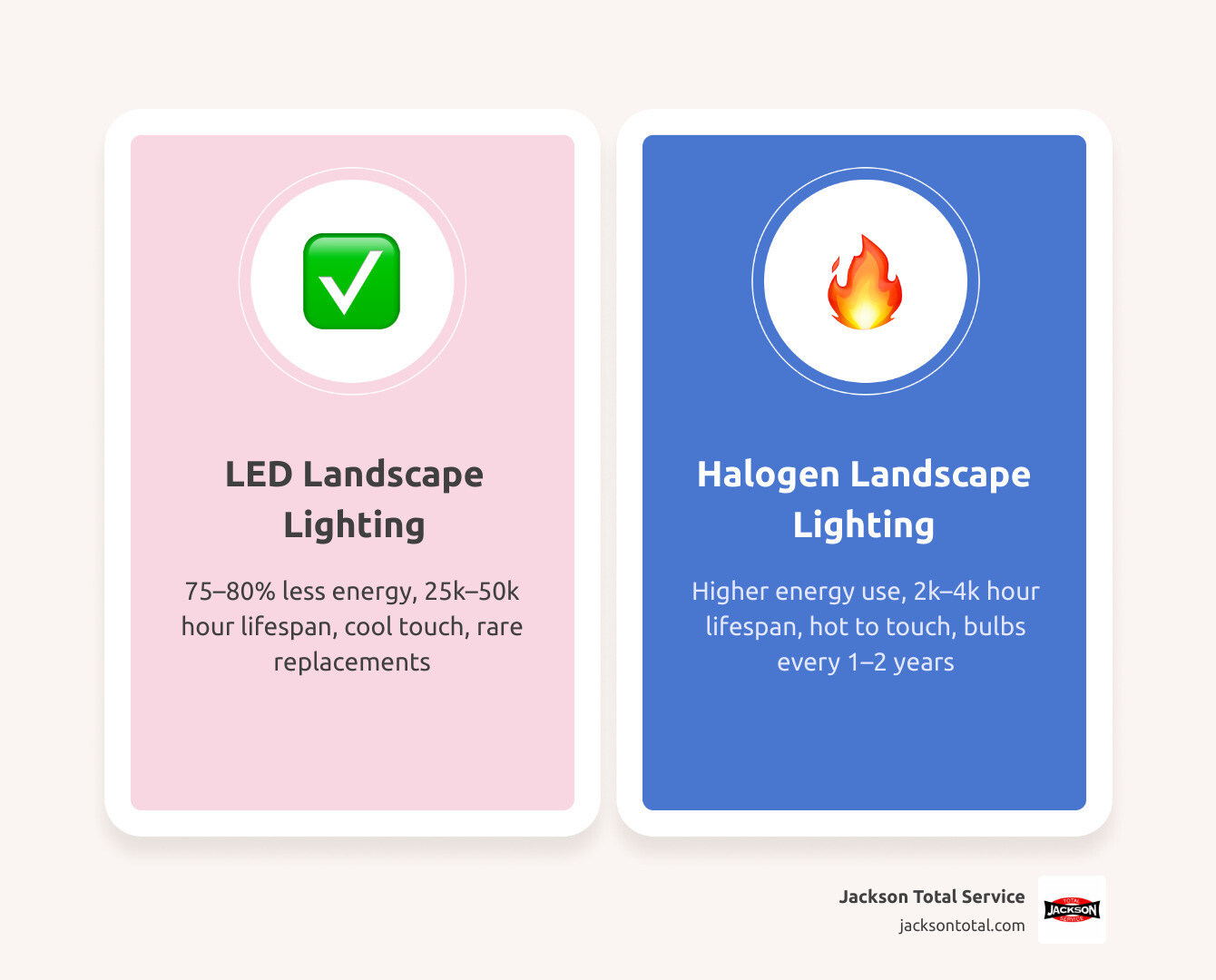
| Energy use | 75–80% less than halogen | Higher baseline consumption |
| Lifespan | 25,000–50,000 hours | 2,000–4,000 hours |
| Bulb replacement | Rarely needed | Every 1–2 years |
| Heat output | Cool to the touch | Extremely hot |
| Payback period | Typically 3–5 years | N/A |
| Long-term value | High | Lower over time |
Southwest Florida homeowners face a specific challenge: outdoor lighting needs to look beautiful, hold up against heat, humidity, and salt air, and stay affordable to run year-round. A halogen system might cost less to install, but the ongoing energy bills and frequent bulb replacements add up fast — especially when lights run nightly across a larger property.
One real-world example illustrates this well. A homeowner who swapped 18 halogen pathway and accent lights for LED equivalents cut their system’s total energy draw from 630 watts down to 126 watts. Their combined energy and maintenance savings came to roughly $690 per year, and they recovered the full cost of the upgrade in just over two years.
For Naples and Collier County homeowners weighing this decision, the long-term math is hard to argue with.
Comparing the Upfront Investment: Is LED landscape lighting worth the extra cost?
When you first look at the price tag for a professional Landscape Lighting installation, you will notice that LED fixtures carry a higher initial price point than traditional halogen options. Usually, LED fixtures can be two to four times more expensive upfront. However, looking only at the “sticker price” is a bit like buying a car based only on the down payment without checking the gas mileage or how often it needs a new engine.
The difference in investment comes down to the technology inside. A halogen bulb is a glass envelope with a filament that burns at high temperatures. An LED (Light Emitting Diode) is solid-state technology—essentially a microchip that produces light. Because LEDs are more complex to manufacture, the initial fixture price is higher. But that investment covers high-quality drivers, better seals, and more robust housing materials that are designed to last for decades, not just a season or two.
Why LED landscape lighting is worth the extra cost for durability
In the lighting world, “solid-state” is a fancy way of saying there are no moving parts or fragile filaments to break. In the windy, humid environment of Naples and Marco Island, this is a game-changer. Halogen filaments are incredibly sensitive to vibration and temperature swings. If a heavy Florida thunderstorm shakes a fixture or a lawnmower bumps it, a halogen filament can easily snap.
LEDs are much more resilient. Furthermore, because they produce very little heat, manufacturers can use thicker, more durable seals and gaskets. In a halogen fixture, the intense heat eventually causes the rubber seals to become brittle and crack, allowing moisture to seep in. LEDs stay cool, keeping those seals flexible and ensuring the internal components stay dry even during our most intense summer downpours. When you consider that a high-quality LED system can last 15 to 25 years with minimal intervention, the question of whether is led landscape lighting worth the extra cost becomes a matter of long-term peace of mind.
Performance and Durability in the Florida Climate

Living in Southwest Florida means our outdoor equipment has to be “Florida Tough.” From the salt air in Old Naples to the intense humidity in Ave Maria, the environment is constantly trying to corrode, melt, or short-circuit your home’s exterior systems. LED landscape lighting excels here in ways that traditional lighting simply cannot.
One of the biggest advantages is heat output. Halogen bulbs operate at temperatures as high as 3,000 degrees Celsius internally. This heat is not just a waste of energy; it’s a safety hazard for your landscaping. If a halogen fixture is placed too close to a delicate shrub or a bed of mulch, it can actually singe the leaves or even pose a fire risk during the dry season. LEDs, conversely, are cool to the touch. This makes them the recommended choice for any fixture placed within 18 inches of living plants.
Color temperature is another area where modern LEDs shine. In the past, people avoided LEDs because they produced a “cold,” bluish light. In May 2026, that is no longer the case. We can now offer:
- 2700K Ambiance: This provides a warm, golden glow that perfectly mimics the classic look of halogen—ideal for creating a cozy, welcoming atmosphere on a patio.
- 3000K Clarity: A slightly crisper white that is perfect for highlighting the architectural details of a home or the vibrant greens of a manicured lawn.
Furthermore, LEDs are directional. While a halogen bulb throws light in every direction (requiring reflectors to aim it), an LED emits light in a specific direction. This means less “light pollution” and more focused beauty on your home’s best features. It also simplifies the installation process. Because LEDs use so much less power, we don’t have to worry as much about “voltage drop”—a common issue in halogen systems where the lights at the end of a long wire run appear dimmer than the ones closest to the transformer. When learning How to Choose the Best Landscape Lighting Installation in Fort Myers FL, ensuring your system has consistent brightness across the entire property is a top priority.
Long-Term Savings and Property Value
While the beauty of a well-lit home is the immediate reward, the financial benefits of LED systems are what truly make them a wise investment. When we talk about 80% energy efficiency, we aren’t just throwing around numbers. A typical halogen pathway light might consume 35 to 50 watts. A comparable LED fixture provides the same amount of light using only 5 to 7 watts.
Across a standard Naples estate with 15 to 20 fixtures, those savings are massive. Most homeowners notice only a $20–$30 yearly increase in their electric bill when running a full LED system nightly, whereas a halogen system could cost hundreds of dollars more per year to operate.
Then there is the “maintenance tax.” With halogen systems, you can expect to replace bulbs every 12 to 24 months. If you have 20 lights, that’s 20 bulbs to buy and 20 times you or a professional has to open up a fixture. Over a decade, that can add $1,500 to $3,000 in just bulb and labor costs. With LEDs, you essentially eliminate this chore for the next 15+ years.
Beyond the monthly bills, consider your home’s equity. Well-executed landscape lighting can increase the value of a property by up to 20%. If your home in Collier County is valued at $750,000, a professional lighting system isn’t just a luxury—it’s a strategic upgrade that could potentially add six figures to your property’s market appeal. Buyers in the Naples market are savvy; they look for “move-in ready” homes with low-maintenance, energy-efficient systems already in place.
Calculating if LED landscape lighting is worth the extra cost for your home
To determine the ROI for your specific property, we look at the “payback period.” This is the point where your savings on energy and maintenance have completely covered the extra upfront cost of the LED fixtures.
For most residential installations in our area, this happens within 3 to 5 years. If you plan on staying in your home longer than that, the system literally pays for itself and then starts putting money back into your pocket every month through lower utility bills. Additionally, LED systems are highly scalable. Because they draw so little power, you can often add more lights to your existing transformer later on without needing to upgrade your entire electrical infrastructure.
Frequently Asked Questions about Outdoor Lighting
How long do LED landscape lights last compared to halogen?
The difference is staggering. A standard halogen bulb is rated for about 2,000 to 4,000 hours. If you run your lights for 6 hours every night, you’ll be changing those bulbs every year or two. Quality LED fixtures are rated for 25,000 to 50,000 hours. Under that same 6-hour nightly schedule, your LED lights could last over 20 years. That is an entire generation of maintenance-free evenings.
Do LED lights attract fewer insects in Southwest Florida?
Yes! Insects are primarily attracted to two things: UV radiation and heat. Halogen bulbs emit a significant amount of both. LEDs emit very little heat and can be selected with color temperatures that produce minimal UV light. By choosing a “warmer” LED (under 3000K), you can significantly reduce the number of pests swarming around your doorways and patios.
Can I retrofit my existing halogen system to LED?
In many cases, yes. If your existing fixtures are in good physical shape, we can often perform an “LED retrofit” by replacing the halogen bulbs with LED “drop-in” lamps. However, we must first verify that your existing transformer is compatible with the lower wattage of LEDs. Some older transformers require a minimum “load” to function correctly. Our licensed electricians can audit your current system and let you know if a simple bulb swap or a full fixture upgrade is the better path for long-term reliability.
Conclusion
At Jackson Total Service, we have been serving the Southwest Florida community since 1964. We’ve seen lighting technology evolve from simple incandescent bulbs to the high-tech, smart-controlled LED systems of today. We know that for our neighbors in Naples, Marco Island, and throughout Collier County, a home is more than just a building—it’s an investment and a sanctuary.
When you ask, “is led landscape lighting worth the extra cost?”, we look at it through the lens of our decades of experience. Between the massive energy savings, the elimination of annoying bulb changes, and the sheer beauty of a system that won’t fade or flicker, the value is undeniable.
Whether you are looking to secure your property with motion-sensing floodlights or want to create a resort-style oasis in your backyard, our team of licensed electricians is here to help. We provide professional design and installation that takes the guesswork out of the process, ensuring your home looks its best for years to come. Ready to see your home in a new light? Reach out to us today to discuss your next Landscape Lighting project.