



The Hidden Electrical Danger Looming Over Your Pool Pad
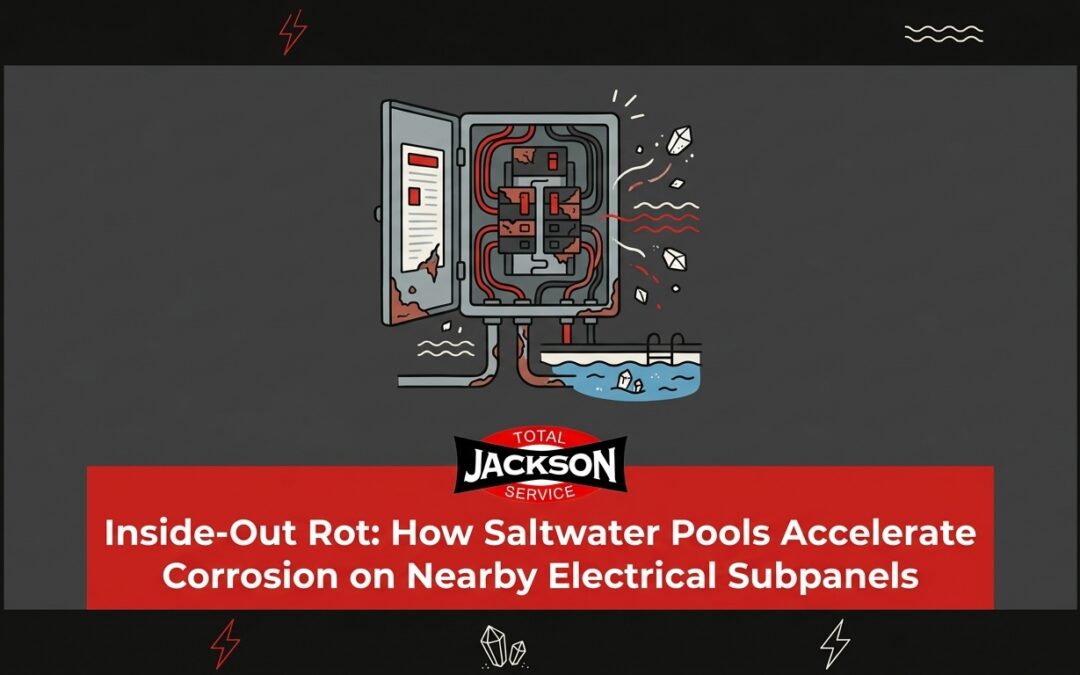
That pristine backyard oasis might look perfect, but understanding how saltwater pools accelerate corrosion on nearby electrical subpanels is critical to keeping your home safe. You notice the water feels great, but what you cannot see is the invisible salt vapor quietly attacking the electrical equipment sitting just a few feet away. In our decades of experience at Jackson Total Service inspecting and upgrading outdoor systems for Naples pool homes, our electricians frequently find that these critical electrical boxes rot from the inside out much faster than anyone anticipates. The ambient salt vapor emitted by modern chlorinators acts as a silent, aggressive destroyer of electrical infrastructure.
Homeowners upgrading to saltwater pools often overlook the impact of this constant off-gassing on nearby electrical equipment. Before a catastrophic short occurs, every homeowner with a saltwater setup faces a vital decision: proactively relocating the subpanel or upgrading to a salt-resistant enclosure. For a broader look at upgrading your system’s overall capacity, you can review our guide on electrical panel capacity and home safety.
Why Coastal Air and Chlorinators Create a Destructive Micro-Climate
The environment surrounding your mechanical pad is not just typical outdoor air; it is a highly localized, highly reactive micro-climate. When a saltwater chlorinator operates, it constantly off-gasses microscopic salt vapor into the immediate vicinity. Here in Naples, our technicians know firsthand that this vapor does not simply blow away. Instead, it lingers, creating a concentrated zone of corrosive moisture right where your most sensitive outdoor equipment lives.
The Humidity Multiplier
This localized off-gassing becomes exceptionally destructive when combined with our regional weather patterns. Naples, FL already experiences a high baseline of coastal salt air coming off the Gulf. As we transition into early fall, our team at Jackson Total Service sees how the lingering September high humidity acts as a heavy, stagnant blanket. The thick, humid air traps the chlorinator’s salt vapor within a tight radius—usually within 10 feet of the pool equipment.
This trapped vapor creates an incredibly harsh, highly conductive environment. Normal atmospheric moisture is challenging enough for outdoor metals, but when that moisture is saturated with salt, it aggressively attacks exposed components. The longer this micro-climate is allowed to envelop your electrical subpanels, the faster the chemical breakdown occurs, turning a standard mechanical pad into a perfect storm for rapid metal degradation.
The Illusion of Protection: Weatherproof vs. Vapor-Proof Enclosures
During our routine early fall electrical tune-ups, we find most homeowners assume that because an electrical panel is installed outside, it is completely sealed against the elements. Unfortunately, this is a dangerous misconception. The standard for residential outdoor electrical panels is a NEMA 3R rating. While NEMA 3R is excellent at shedding falling rain, sleet, and large debris, it is intentionally designed to breathe. These enclosures feature small vents and weep holes to allow heat to dissipate and to prevent normal condensation from pooling inside the box.
Why “Weatherproof” Fails Against Vapor
Because NEMA 3R enclosures are vented, they freely allow ambient air to circulate through the internal compartment. When that ambient air is loaded with salt vapor from your pool chlorinator, the salt is drawn directly across your critical electrical connections. This leads to a phenomenon our electricians call “inside-out rot.” From the driveway, the gray metal exterior of the electrical box might look perfectly fine, but the internal components are actively degrading. By the time you see rust on the outside seams of a NEMA 3R box in Naples pool homes, our crews often find the inside is completely compromised.
To truly protect electrical infrastructure in this micro-climate, the baseline standard must be elevated to a NEMA 4X rating. These enclosures are non-metallic (typically fiberglass or heavy-duty polycarbonate) and, most importantly, they are completely vapor-proof.
| Feature | NEMA 3R (Standard Outdoor) | NEMA 4X (Salt-Resistant) |
|---|---|---|
| Primary Protection | Falling rain, sleet, and dirt | Windblown dust, direct water jets, and corrosive agents |
| Airflow Design | Vented to allow heat and condensation to escape | Sealed and vapor-proof to lock out ambient air |
| Material Construction | Typically painted or galvanized steel | Non-metallic (fiberglass, polycarbonate, or stainless steel) |
| Saltwater Vulnerability | High: Allows salt vapor to reach internal connections | Low: Completely blocks airborne salt and moisture |

The Science of Galvanic Corrosion in Outdoor Subpanels
To understand why this inside-out rot happens so quickly, we have to look at the chemistry occurring inside the electrical box. Galvanic corrosion is an electrochemical process where one metal corrodes preferentially when it is in direct electrical contact with a different type of metal, provided there is an electrolyte present to bridge the gap between them.
The Electrolyte Bridge
Inside a standard outdoor subpanel, you will almost always find dissimilar metals. The main busbars are typically made of copper, while the heavy-duty lugs and incoming feeder wires are often made of aluminum. In a dry, climate-controlled environment, these two metals can coexist safely when properly installed with anti-oxidant compounds. However, as our service crews transition from summer emergency calls to early fall prep, we frequently see how the lingering September humidity combined with salt vapor acts as the perfect, highly conductive electrolyte.
When this salty, humid air coats the inside of the panel, it bridges the microscopic gaps between the copper and aluminum. The salt water facilitates a rapid transfer of electrons from the more active metal (aluminum) to the less active metal (copper). The aluminum begins to pit, oxidize, and physically break down. As the metal degrades, the electrical connection loosens. Loose connections create electrical resistance, resistance creates immense heat, and heat eventually leads to arcing, melted insulation, and total system failure.
A Multi-System Threat: When Pool Vapor Reaches Your HVAC Disconnect
The destructive reach of a saltwater chlorinator rarely stops at the pool equipment. On most residential properties, space is at a premium, meaning pool pumps, chlorinators, and home air conditioning condensers are frequently installed side-by-side on the exact same mechanical pad. The corrosive salt vapor does not discriminate between systems—it infiltrates the HVAC electrical disconnect switch just as easily as it infiltrates the pool subpanel.
Protecting the Mechanical Pad
At Jackson Total Service, leveraging our 60-year family legacy and multi-trade field experience in both HVAC and electrical systems gives us a unique vantage point on this issue. We frequently find severely rusted AC disconnects sitting directly adjacent to saltwater chlorinators. Because our technicians service both systems, we consistently observe how this localized corrosion destroys both critical home systems simultaneously.
It is absolutely essential to inspect all electrical boxes within a 10-foot radius of the pool equipment, not just the ones directly wired to the pump. The ambient vapor drifts and settles on everything nearby. If you are noticing rust on your mechanical pad, it is worth understanding how saltwater mist ruins nearby AC condensers as well.
Recognizing the Warning Signs of Internal Panel Rot
Because the most dangerous corrosion happens inside the box, homeowners must be vigilant in spotting the secondary warning signs of electrical degradation. Waiting until a complete power failure occurs often means the damage has already spread to the wiring itself, resulting in much more extensive repairs.
Visual and Operational Red Flags
Look for these critical indicators that your outdoor electrical equipment is suffering from salt vapor intrusion:
- Visible exterior rust: Check the bottom seams, the hinges, and the conduit connections. If the paint is bubbling or flaking off the metal, moisture and salt have already compromised the housing.
- Operational anomalies: Flickering pool lights, intermittent pump failures, or breakers that frequently trip without any obvious explanation are classic signs of loose, corroded internal connections.
- Audible buzzing sounds: A faint buzzing or crackling noise emanating from the electrical panel indicates arcing—electricity jumping across a compromised connection. This is an immediate fire hazard.
- Visible sparking: Any sparking at the panel when equipment turns on means the internal busbars are actively failing.
During a particularly busy fall season, Jackson Total Service responded to a local property experiencing severe electrical issues that the regional utility and cable providers couldn’t resolve. The customer was dealing with unpredictable power drops and sparking at their outdoor equipment. Our technicians, Jeff and Tim, quickly diagnosed the root cause as severe internal corrosion. They repaired the compromised connections and secured the system, ultimately keeping the customer safe and sane. This underscores why you must never attempt to open a suspect panel yourself. Always trust a licensed professional to handle pool and spa wiring safety.
Permanent Solutions: Relocation and Non-Metallic Enclosure Upgrades
Once you identify that your electrical equipment is in the crosshairs of your saltwater chlorinator, the decision point becomes clear: you must remove the vulnerability before the system fails. Fortunately, there are permanent, code-compliant solutions to secure your outdoor infrastructure.
Professional Upgrade Options
The most direct solution our master electricians recommend is upgrading existing NEMA 3R panels to NEMA 4X non-metallic enclosures. By swapping the vented steel boxes for sealed, vapor-proof fiberglass or polycarbonate housings, you effectively lock out the ambient salt vapor. This ensures the internal copper and aluminum connections remain dry and secure, regardless of how much salt the chlorinator off-gasses.
The second solution is physical relocation. If the layout of your property allows it, relocating the electrical subpanel and HVAC disconnects further away from the chlorinator’s off-gassing zone removes them from the micro-climate entirely. Moving the panels outside that critical 10-foot radius drastically reduces their exposure to concentrated salt vapor.
What you must absolutely avoid is attempting a DIY fix. Our electrical team often sees well-meaning homeowners try to run a bead of silicone caulk around the door of a standard NEMA 3R box to “seal” it against the salt. This is a severe code violation. Worse, it traps existing moisture inside the box, preventing the intended heat dissipation and actually accelerating the inside-out rot. Securing your home requires professional electrical panel upgrades performed by a licensed electrician who understands local codes and coastal environmental challenges.
Frequently Asked Questions About Saltwater Pool Electrical Safety
How does salt vapor affect electrical panels?
Salt vapor acts as a highly conductive electrolyte when it combines with ambient humidity. As this vapor enters vented electrical panels, it coats the internal components and accelerates galvanic corrosion on dissimilar metals, like copper and aluminum. This chemical reaction causes inside-out rot, eventually destroying the electrical connections and creating a severe fire hazard.
Can a saltwater pool damage my AC unit?
Yes, if the AC condenser or its electrical disconnect is installed near the pool’s chlorinator, it is highly vulnerable. The ambient salt vapor degrades the delicate metal fins on the condenser coil and corrodes the internal components of the disconnect switch. Protecting the HVAC system requires non-metallic enclosures or physical separation from the pool equipment.
What type of electrical panel is needed for a saltwater pool?
Standard NEMA 3R panels are insufficient for this environment because they are vented and allow corrosive vapor to enter. NEMA 4X non-metallic enclosures are strongly recommended for saltwater pool setups. These specialized boxes provide a completely vapor-proof barrier against corrosive off-gassing, keeping internal connections safe.
Does a saltwater pool rust nearby metal?
Yes, the constant off-gassing of ambient salt vapor will accelerate rust on any nearby metal, including patio furniture, pool ladders, and outdoor electrical boxes. This destructive effect is highly localized, typically at its worst within a 10-foot radius of the chlorinator equipment.
How do you protect outdoor electrical equipment from salt water?
The most effective method is to upgrade all nearby electrical boxes to salt-resistant, vapor-proof NEMA 4X enclosures. Alternatively, you can relocate sensitive electrical equipment completely away from the chlorinator’s off-gassing zone. In either case, you should have a licensed professional inspect the connections annually to catch early signs of corrosion.
Secure Your Outdoor Electrical Infrastructure Today
Understanding the invisible threat of salt vapor is the crucial first step in protecting your home’s electrical and mechanical systems. The harsh reality of Naples pool homes is that waiting for visible exterior rust often means the internal components of your subpanel are already dangerously compromised. Don’t leave your family’s safety to chance or rely on enclosures that were never designed for a saltwater micro-climate. Consult with the local, licensed experts at Jackson Total Service to evaluate your pool pad’s electrical safety, upgrade your vulnerable panels, and secure your outdoor infrastructure for years to come.