



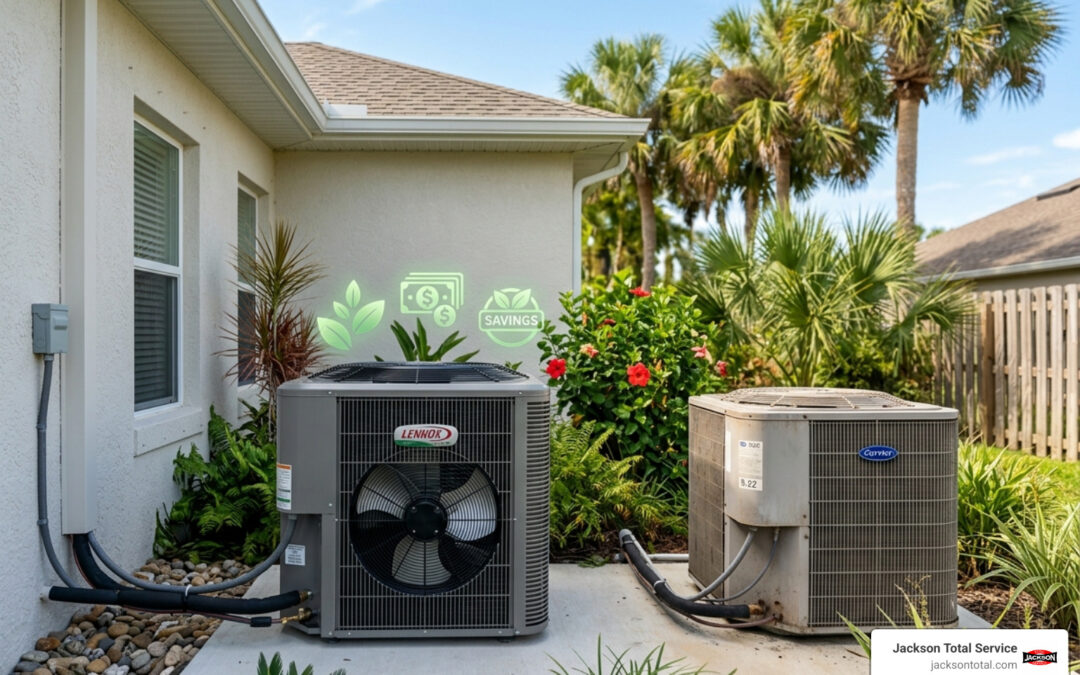
Why How Much Does a High SEER AC Save in Florida Is a Question Worth Answering Before You Buy
How much does a high seer ac save in florida depends on your current unit’s age, your home’s size, and how many hours your system runs — but for most Southwest Florida homeowners, the answer is significant. Here’s a quick snapshot:
| Upgrade Scenario | Est. Annual Savings | Efficiency Gain |
|---|---|---|
| 10 SEER → 16 SEER2 (3-ton) | ~$656/year | ~38% |
| 14 SEER → 18 SEER2 (1,800 sq ft) | $200–$500/year | ~20–25% |
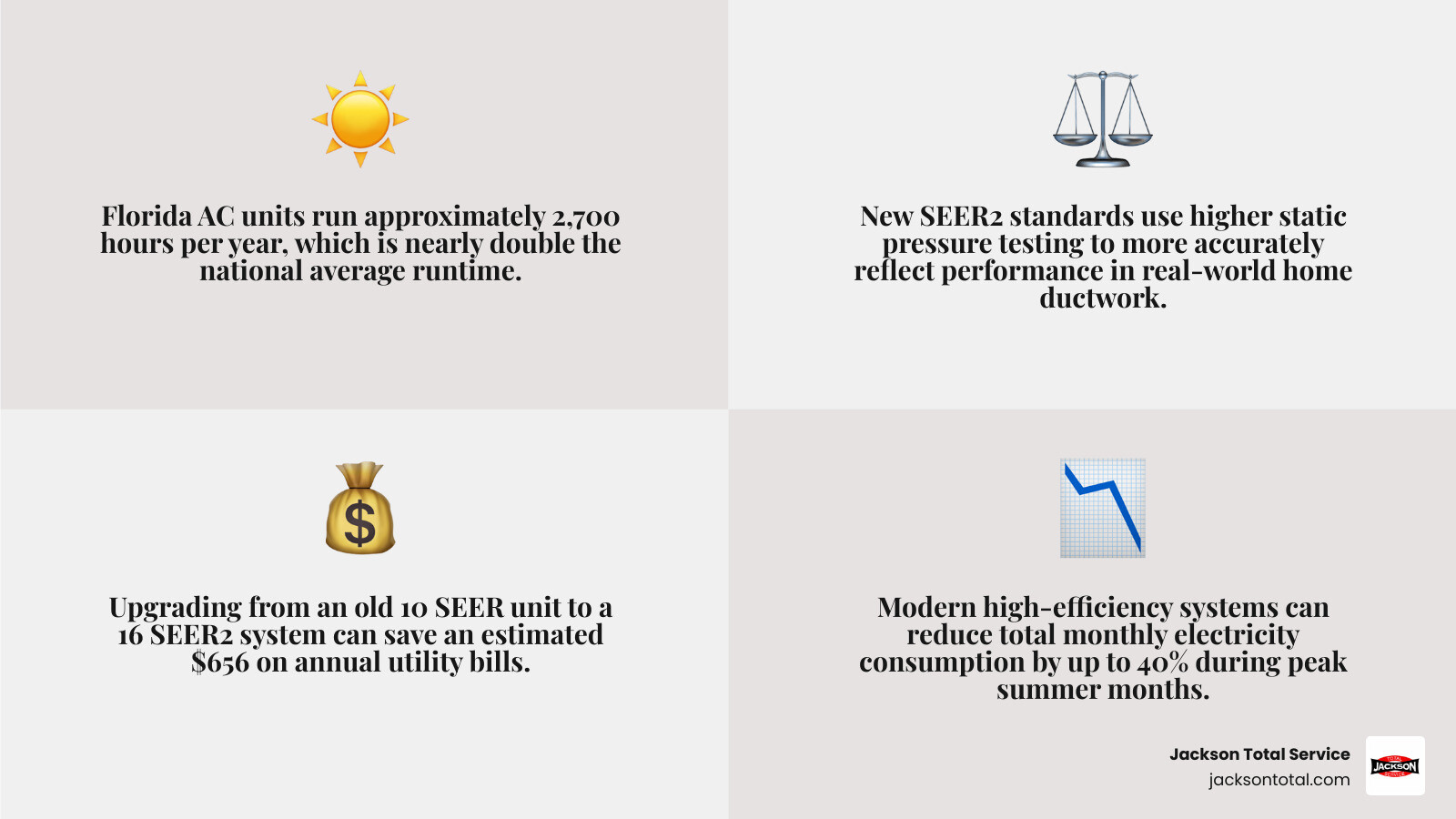
| 10-year-old unit → modern SEER2 | up to 40% bill reduction | up to 40% |
| 9 SEER → 18 SEER2 (3-ton, 15 years) | ~$5,469 total | ~52% |
Florida is not like the rest of the country when it comes to air conditioning. While a typical U.S. home runs its AC around 1,000 to 1,500 hours per year, systems in Naples, Bonita Springs, and the greater Southwest Florida area log closer to 2,700 hours annually. That’s nearly double — and it changes the math on every efficiency decision you make.
Florida households already consume about 40% more electricity than the national average, with cooling alone accounting for more than 27% of total home energy use. When your AC runs almost year-round, even a modest jump in SEER rating translates into real, recurring savings on every utility bill.
But there’s more to the story than just the monthly dollar amount. The right high-efficiency system also controls humidity better, runs quieter, and lasts longer — all of which matter in a climate as demanding as Southwest Florida’s. There are also situations where chasing the highest SEER number doesn’t deliver the return you’d expect, and understanding that nuance can save you from a costly mistake.
This guide breaks it all down in plain language so you can make a confident, informed decision for your home.
Understanding SEER2 and Florida’s Efficiency Standards in 2026
If you’ve been shopping for a new air conditioner lately, you’ve likely seen the term “SEER2” popping up everywhere. But what happened to the original SEER? As of early 2023, the Department of Energy (DOE) updated the way efficiency is measured to better reflect real-world conditions.
SEER stands for Seasonal Energy Efficiency Ratio. It is essentially the “miles per gallon” for your air conditioner. The higher the number, the less electricity the unit uses to cool your home. However, the old SEER test was performed under laboratory conditions that didn’t account for the “static pressure” found in actual home ductwork.
The new SEER2 standard uses the “M1” testing procedure, which increases external static pressure by a factor of five. This is crucial for us here in Southwest Florida because many of our homes have complex duct systems that create significant resistance. By testing at 0.5 inches of water column (instead of the old 0.1), SEER2 provides a much more accurate prediction of how a unit will perform once it’s actually installed in your Naples or Fort Myers home.
As we move through 2026, it’s important to know the legal minimums. In Florida, the current minimum standard for a new split-system air conditioner is 14.3 SEER2 (which is roughly equivalent to the old 15 SEER). If you are looking at Air Conditioning Services/, you won’t find anything lower than this because it is the baseline for our region.
How Much Does a High SEER AC Save in Florida?
The financial impact of a high-efficiency system is amplified in the Sunshine State because of our relentless heat. When we talk about how much does a high seer ac save in florida, we have to look at the total runtime. While a homeowner in Ohio might only use their AC for three months, we use ours for ten or eleven.
In Southwest Florida, our systems typically run for about 2,700 hours per year. This high usage means that every point of efficiency gained results in a bigger dollar-amount reduction on your FPL or LCEC bill.
| Efficiency Rating | Est. Annual Cooling Bill (3-Ton) | Annual Savings vs. 14.3 SEER2 |
|---|---|---|
| 14.3 SEER2 (Standard) | $1,094 | Baseline |
| 16 SEER2 (High Efficiency) | $914 | $180 |
| 18 SEER2 (Ultra High) | $869 | $225 |
| 20+ SEER2 (Elite) | $674 | $420 |
Note: Estimates based on $0.19/kWh and 2,700 annual cooling hours.
When you consider that an air conditioner in Naples or Cape Coral has a lifespan of about 10 to 15 years, those annual savings add up. A unit that saves you $200 a year will put $3,000 back in your pocket over its lifetime. This is why we often suggest that homeowners looking for Air Conditioning Service Naples Fl/ look beyond the initial purchase price and focus on the total cost of ownership.
Calculating how much does a high seer ac save in florida homes
To get a more personalized estimate, you need to understand three variables: tonnage, BTUs, and kWh costs.
- Tonnage: This is the cooling capacity. One ton equals 12,000 BTUs (British Thermal Units) per hour. A typical 1,800-square-foot Florida home usually requires a 3-ton system.
- kWh Costs: This is what your utility company charges you per kilowatt-hour.
- SEER2 Rating: The ratio of cooling output to energy consumed.
The math is simple: every one-point increase in SEER2 generally equates to a 5–7% reduction in cooling electricity use. If you are upgrading from an old 10 SEER unit to a modern 16 SEER2 system, you are looking at a roughly 38% to 40% reduction in the cooling portion of your power bill. If you’re currently dealing with Air Conditioning Repair Estero Fl/ on an aging, inefficient unit, the savings from an upgrade might actually cover a significant portion of the monthly payment on a new system.
Real-world examples: how much does a high seer ac save in florida during summer peaks
Let’s look at a real-world scenario. A homeowner in Sarasota or Naples with a 10-year-old unit might be seeing monthly summer electric bills of $350. In a typical Florida home, about 50% of that bill is just for air conditioning ($175).
By upgrading to an 18 SEER2 system, that $175 cooling cost could drop by 40%, bringing it down to $105. That is a $70 savings every single month during the peak of summer. Over a full year of Florida weather, those savings often range between $400 and $600 for a standard-sized home. When our team provides Air Conditioning Services Fort Myers Fl/, we always perform a Manual J load calculation to ensure the system is sized perfectly, as an oversized unit will “short-cycle” and waste all those potential energy savings.
Beyond the Bill: Humidity Control and Comfort Benefits
While the question of how much does a high seer ac save in florida is usually about money, the “hidden” benefits are often what homeowners appreciate most. High-SEER systems (typically 18 SEER2 and above) almost always feature variable-speed or multi-stage compressors.
Standard, low-SEER units are either “on” or “off.” They blast cold air at 100% capacity until the thermostat is satisfied, then they shut down. In Florida’s humidity, this is a problem. Why? Because an AC unit only removes humidity while it is running. When a standard unit reaches the target temperature quickly and shuts off, the humidity levels in your home begin to rise immediately.
Variable-speed systems are different. They can adjust their output to as low as 25% or 30% capacity. They run for longer cycles at lower speeds, which allows them to constantly pull moisture out of the air. This superior dehumidification means you can often set your thermostat 2 or 3 degrees higher and feel just as comfortable, because dry air at 76 degrees feels cooler than humid air at 73 degrees. This is a massive boost to your Indoor Air Quality/ and helps prevent mold growth.
Additionally, these systems are whisper-quiet. While an old condenser might sound like a jet engine starting up in your backyard (around 75 decibels), a high-efficiency variable-speed unit can operate as quietly as 55 decibels—about the same as a quiet conversation.
Critical Factors That Impact Your Real-World ROI
You could buy the most efficient air conditioner on the market, but if your home isn’t prepared for it, you’ll never see those savings. Here are the three factors that can make or break your ROI:
- Ductwork Integrity: According to ENERGY STAR, the average home loses 20% to 30% of its conditioned air through leaks in the ductwork. If you are pumping 18 SEER2 air into a leaky attic, you are effectively paying for a high-efficiency system but receiving 12 SEER performance.
- Proper Sizing: Bigger isn’t better. If a technician suggests a unit based solely on square footage without performing a Manual J calculation, be wary. An oversized unit won’t run long enough to dehumidify, and an undersized unit will run 24/7 without ever cooling the home.
- The Refrigerant Transition: As of 2025 and 2026, the industry has shifted away from R-410A. New systems now use A2L refrigerants like R-32 or R-454B. These are more environmentally friendly and often more efficient, but they require specialized tools and training to install correctly.
We recommend looking into Maintenance Agreements/ to keep these advanced components—like inverter boards and sensors—in top shape. High-efficiency systems are like luxury cars; they perform beautifully, but they need regular “tune-ups” to maintain that performance.
Long-term value: how much does a high seer ac save in florida over 15 years?
When we look at a 15-year horizon, the “payback period” for a mid-to-high range unit (like a 16 or 17 SEER2) in Florida is usually around 4 to 6 years. After that point, the system is essentially paying you back in the form of lower utility bills.
For ultra-high 20+ SEER2 systems, the payback period might be longer—sometimes 8 to 10 years. However, these units often come with longer warranties and advanced inverter technology that reduces wear and tear on the compressor. To protect these expensive internal electronics, we always suggest installing high-quality surge protection. Power fluctuations are common in Southwest Florida, and a single surge can fry an inverter board that is costly to replace. If you’re in the market for Air Conditioning Services Bonita Springs Fl/, make sure surge protection is part of the conversation.
Frequently Asked Questions about Florida AC Efficiency
What is the difference between SEER and SEER2 for my Naples home?
SEER2 is the new, more accurate way of measuring efficiency. Because it tests systems under higher pressure (simulating real-world ductwork), the numbers are usually about 4.5% lower than the old SEER ratings. For example, a unit that was once called a 15 SEER is now rated as a 14.3 SEER2. It’s the same level of efficiency, just a more honest way of measuring it.
Is a 20 SEER2 unit always better than a 16 SEER2 model?
“Better” depends on your goals. A 20 SEER2 unit will save more money on electricity and provide the best humidity control. However, it also has a higher upfront cost. If you plan on moving in two years, you won’t recoup that investment. But if this is your “forever home” in North Naples or Marco Island, the 20 SEER2 is a fantastic investment in both comfort and long-term savings.
How do the 2026 refrigerant changes affect my new AC purchase?
By 2026, all new systems installed in Florida must use the newer, low-GWP (Global Warming Potential) refrigerants like R-32 or R-454B. These refrigerants are more efficient at carrying heat, which helps the system reach those high SEER2 ratings. While R-410A will still be available for repairs on older systems for many years, buying a new R-32 or R-454B system now ensures your unit is compatible with the latest industry standards.
Conclusion
Deciding how much does a high seer ac save in florida isn’t just about crunching numbers; it’s about choosing the right level of comfort for your family. While the energy savings are undeniable—often reaching 40% or more when upgrading from an older unit—the improvements in humidity control and noise reduction are what truly transform a Florida home.
At Jackson Total Service, we’ve been the Southwest Florida comfort experts since 1964. We understand the unique challenges of our climate, from the salt air in Sanibel Island to the intense heat in Lehigh Acres. Whether you need a high-efficiency AC installation, expert plumbing repair, or electrical upgrades, we offer all comfort solutions in one place. We’re proud to serve our neighbors in Naples, Fort Myers, Cape Coral, and throughout Lee and Collier counties with 24-hour emergency support and a legacy of dependability.
Ready to see exactly how much a high-efficiency system could save you? Contact us today for a professional evaluation of your home’s cooling needs.