


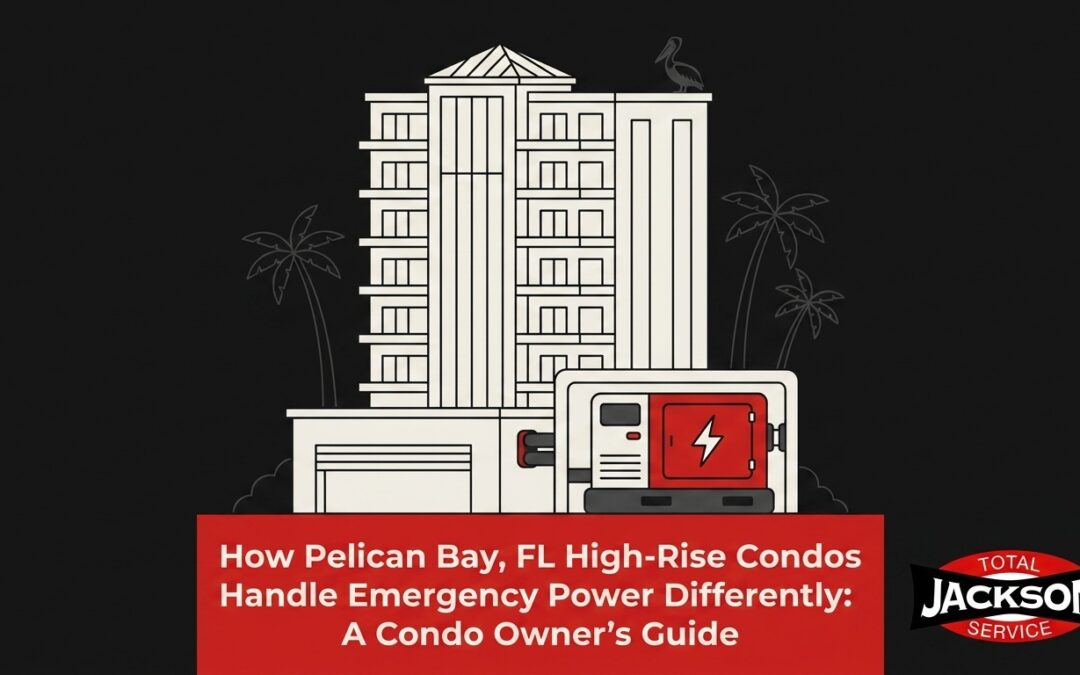
The Hidden Reality of Grid Outages in Luxury High-Rises
When the grid goes dark, figuring out how Pelican Bay’s high-rise condos handle emergency power differently becomes a sudden, urgent priority for residents. You might look out from your balcony and see single-family homes firing up portable gas generators, but high-rise living operates under a completely different set of rules. The transition from grid power to backup power in a luxury tower is highly regulated, and assuming your building has full coverage can leave you in an uncomfortable situation when severe weather strikes. Before making any decisions about your property, we highly recommend reviewing our complete resource on Southwest Florida electrical and home systems.
The high-rise vulnerability: Living in a luxury high-rise offers incredible views and amenities, but it also creates a unique vulnerability during an extended power outage. Ground-level homes benefit from natural shade and cross-ventilation, whereas high-rise condos with floor-to-ceiling windows can quickly trap heat. During the peak of the August hurricane season, this trapped heat turns a comfortable living space into a stifling environment in a matter of hours.
Most condo owners face a critical decision point: relying entirely on the building’s commercial generator or investing in compliant, supplemental power for their specific unit. Making the right choice requires understanding exactly where your building’s responsibility ends and your personal responsibility begins. Without proactive planning, you risk losing essential indoor comfort and risking damage to your property during the most volatile weather months of the year.
What a Building’s Commercial Generator Actually Powers
Florida Building Code, specifically the High-Velocity Hurricane Zone requirements, mandates strict emergency power protocols for high-rise structures. These massive commercial generators are designed to protect the structural integrity of the building and ensure safe evacuation, not to keep individual units comfortable. Understanding this distinction is the first step in preparing your Pelican Bay luxury high-rises for storm season.
The life-safety priority: The power generated by the building’s backup system is heavily restricted. It is wired directly to life-safety systems. This includes elevators, hallway egress lighting, fire suppression systems, alarms, and common-area water pumps. The local codes mandate that these systems remain operational for a specific duration to allow emergency personnel access and ensure residents can safely navigate the building.
What this means for your individual unit is a critical gap in coverage. In almost all cases, in-unit central HVAC systems, individual domestic water pressure, refrigeration, and standard wall outlets are completely excluded from the building’s backup power grid. Extending common-area power to individual luxury units is technically prohibitive and often violates local ordinances. If you want to understand the legal boundaries surrounding these systems, reviewing Collier County generator regulations is essential for condo owners.
Life-Safety vs. In-Unit Comfort
To clarify exactly what you can expect during a grid failure, here is a breakdown of how power is distributed in a typical luxury high-rise.
| System Category | Powered by Building Generator? | Impact on Condo Owners |
|---|---|---|
| Elevators & Stairwell Lighting | Yes (Life-Safety) | Safe evacuation and building navigation remain possible. |
| Fire Alarms & Sprinklers | Yes (Life-Safety) | Building-wide safety monitoring remains active. |
| In-Unit Central AC | No | Rapid temperature increases inside the unit. |
| Refrigerators & Freezers | No | Food spoilage risk within 4 to 24 hours. |
| In-Unit Wall Outlets | No | Inability to charge medical devices or run portable fans. |

The Impact of Losing In-Unit Power During Late-Summer Storms
Losing power in a Naples high-rise is vastly different from losing power in a traditional home. The hot-humid subtropical climate creates immediate challenges when climate control fails. High-rise buildings are heavily insulated and feature expansive glass windows. Without the central air conditioning actively circulating and dehumidifying the air, these units essentially become solar ovens.
The rapid rise in humidity: During the August hurricane season, outdoor humidity frequently sits near maximum capacity. When your HVAC system stops running, that moisture infiltrates the condo. Because HVAC and plumbing systems are deeply interconnected, the loss of domestic water pressure combined with stagnant, humid air creates the perfect breeding ground for rapid mold growth. Within just a few days, luxury finishes, cabinetry, and drywall can suffer irreversible moisture damage.
The stress of losing climate control is severe. Our team at Jackson Total Service saw this firsthand late last summer when a Pelican Bay homeowner’s air conditioning failed unexpectedly during the intense August heat. Because the condo trapped heat so quickly, the indoor temperature spiked to dangerous levels within hours. We dispatched one of our HVAC technicians in less than two hours, successfully restoring the cooling system before the extreme humidity could cause permanent damage to the interior. This rapid response highlights exactly why maintaining in-unit power for cooling is a necessity, not a luxury.
Why Traditional Portable Generators Fail HOA and County Compliance
If you are accustomed to single-family home ownership, your first instinct during an outage might be to purchase a portable gas generator. However, for residents of Pelican Bay luxury high-rises, this is neither legal nor safe. Strict regulations govern what can and cannot be operated on a high-rise balcony, and traditional combustion engines fail on every compliance metric.
The carbon monoxide threat: Operating a gas-powered generator on a balcony or near open windows poses a severe carbon monoxide risk. High-rise balconies are often recessed or shielded by windbreaks, meaning the deadly exhaust gases do not dissipate safely. Instead, they are drawn directly back into your unit or your neighbors’ units. Because of this fatal risk, HOA restrictions universally ban combustion engines anywhere above the ground floor.
Beyond the safety hazards, Collier County enforces strict noise ordinances in dense residential areas. Traditional portable generators operate at decibel levels that shatter these limits, leading to immediate fines and mandatory shutdowns by association management. As a Naples-based company with decades of experience navigating these specific high-rise regulations, our team constantly guides owners away from these non-compliant solutions. Even if you could legally operate one, the logistics of running central AC on a portable generator are highly complex and typically require more starting wattage than balcony-sized units can provide.
HOA-Compliant Supplemental Power Solutions for Condo Owners
Since traditional gas generators are banned, condo owners must look to modern, zero-emission alternatives to maintain critical power. The industry has advanced significantly, offering robust solutions that meet strict Pelican Bay luxury high-rises regulations while providing peace of mind during extended grid failures.
Embracing battery technology: High-capacity battery backup systems and portable power stations are the standard for high-rise compliance. These units produce zero emissions, operate completely silently, and require no flammable fuel storage. They can be safely kept inside a closet or utility room and deployed instantly when the grid fails.
Choosing the Right Battery Backup
Selecting the correct system requires a strategic approach. You are not trying to power the entire condo; you are trying to sustain life-safety and comfort essentials. Here is how to evaluate your needs:
- Identify critical loads: Determine exactly what must stay running. This usually includes the kitchen refrigerator (to prevent food spoilage), critical medical devices like CPAP machines, and high-efficiency portable fans to maintain airflow.
- Calculate wattage requirements: Check the running wattage and the starting (surge) wattage of your critical appliances. A refrigerator requires significantly more power the moment its compressor kicks on than it does while running continuously.
- Evaluate recharge capabilities: During an extended outage, a battery system will eventually deplete. Look for power stations that allow for solar panel integration. While you cannot mount permanent panels on a condo exterior, some portable, foldable solar arrays are permitted on private balconies for daytime recharging.
- Consult a professional: Before investing in a heavy-duty battery system that ties into your unit’s wiring, professional evaluation is mandatory. You must ensure the system meets your condo association’s specific electrical guidelines.
It is important to set realistic expectations. A portable power station will not run a 3-ton central AC unit. However, properly sized, it will keep your food safe, your medical devices running, and fans circulating air until the building’s main power is restored.
Assessing Your Condo’s Electrical Infrastructure Before the Storm
Before integrating any backup power solutions, you must ensure your condo’s existing electrical infrastructure is healthy. The transition between grid power, building generator power, and eventual grid restoration creates significant electrical stress. Evaluating your unit’s electrical panel is a critical step in hurricane preparedness.
The danger of post-storm surges: When the main power grid comes back online after an extended outage, it rarely returns smoothly. Massive electrical surges can travel through the building’s wiring, potentially damaging sensitive electronics, HVAC compressors, and smart appliances inside your unit. If your electrical panel is outdated or overloaded, it may fail to trip properly, leading to severe fire hazards.
Our electricians see these infrastructure failures frequently across Naples. A week and a half after Hurricane Ian, one of our local customers noticed sparks coming from their electrical panel on a Sunday afternoon. Our dispatch team responded immediately and had a licensed Jackson Total Service electrician at the condo in less than an hour to safely resolve the hazard. This situation underscores why prompt, professional multi-trade service is vital—electrical issues in a high-rise often impact HVAC and plumbing operations simultaneously.
Pre-Storm Safety Checks
Taking proactive steps during the calm before the August hurricane season can prevent catastrophic failures later. At Jackson Total Service, we leverage our multi-trade expertise across HVAC, plumbing, and electrical systems to ensure your entire unit is resilient.
- Panel capacity verification: Ensure your breaker box can handle modern electrical loads. Understanding electrical panel capacity requirements is the first step in determining if your condo needs an upgrade before installing backup systems.
- Whole-unit surge protection: Rather than relying on cheap power strips, consider having a professional install a surge protector directly at the panel to shield all incoming voltage.
- Comprehensive system audits: Reviewing your electrical safety preparation before hurricanes ensures that your HVAC disconnects, GFCI outlets, and main breakers are all functioning perfectly before the severe weather arrives.
Frequently Asked Questions: How Pelican Bay’s High-Rise Condos Handle Emergency Power Differently
What does a condo building generator actually power?
A high-rise building generator primarily powers life-safety systems mandated by the Florida Building Code. This includes elevators, hallway egress lighting, fire alarms, and common-area water pumps. It typically does not provide power to individual unit HVAC systems, refrigerators, or wall outlets.
Can I run my high-rise AC during a power outage?
The short answer is usually no, unless you have a specialized, HOA-approved battery backup system specifically wired for your HVAC. Because Pelican Bay luxury high-rises rely on the building’s commercial generator for common areas, individual central AC units lose power when the main grid goes down. Owners must rely on portable, battery-powered fans or advanced UPS systems for temporary relief.
What backup power is allowed on a condo balcony in Florida?
Only zero-emission, silent power sources are permitted on high-rise balconies. Traditional gas or propane generators are strictly banned due to fatal carbon monoxide risks and severe noise ordinance violations. High-capacity battery power stations and portable solar panels are the only compliant options for supplemental balcony power.
Are condos required to have generators in Florida?
Yes, high-rise condominiums in Florida are required by building codes to have emergency generators, but only to support life-safety infrastructure. There is no legal requirement for the building to provide backup power for resident comfort, climate control, or in-unit appliance operation during an outage.
How can I keep my refrigerator running in an apartment without a gas generator?
You can keep a refrigerator running by using a high-capacity indoor battery power station. These lithium-ion or LiFePO4 units operate silently and safely indoors without emitting exhaust. By calculating your refrigerator’s starting wattage, you can purchase a properly sized battery unit to preserve your food for several days.
Securing Your Condo’s Comfort and Compliance for the Next Storm Season
Understanding how Pelican Bay’s high-rise condos handle emergency power differently is the key to protecting your property and your peace of mind. The building’s commercial generator will ensure you can safely evacuate and navigate the hallways, but it will not keep your unit cool or your food cold during the August hurricane season. Protecting your in-unit comfort requires proactive, HOA-compliant planning.
Do not wait until the grid goes down to discover the limits of your building’s emergency power. Consult with our local professionals at Jackson Total Service who understand the intricate, multi-trade requirements of high-rise living. Schedule an infrastructure inspection today to evaluate your electrical panel and discuss safe, compliant backup power options that will keep your luxury condo secure through any storm.