



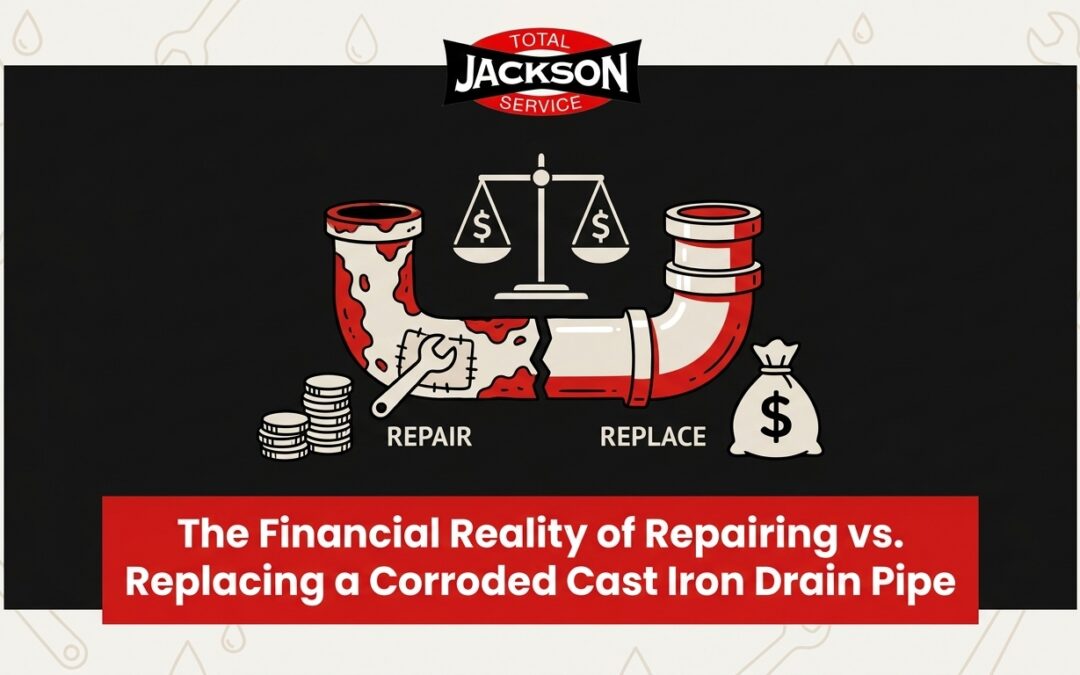
Facing a Failing Drain Pipe Under Your Concrete Slab?
Are you currently dealing with slow drains, foul odors, or a confirmed under-slab leak, forcing you to weigh the financial reality of repairing vs. replacing a corroded cast iron drain pipe? At Jackson Total Service, we know firsthand that discovering a localized leak or a severe blockage beneath a concrete slab foundation is one of the most stressful experiences a homeowner can face. The structural integrity of your home suddenly feels compromised, and the path forward is rarely simple. You are immediately confronted with a major dilemma: do you endure the physical disruption of trenching the slab to patch a single failing section, or do you invest in the long-term stability of a full PVC repipe?
For comprehensive insights on maintaining your home’s core systems, explore our Southwest Florida plumbing guide.
Evaluating this critical decision requires looking far past raw initial estimates. In our decades of serving the community, we have found that a localized leak in an aging cast iron drain pipe located beneath a Naples, FL concrete slab foundation is rarely an isolated incident. Spot repairs might seem like the path of least resistance, but our plumbing team frequently sees them lead to a cycle of compounding costs, repeated property disruption, and endless frustration. To make an informed choice, you must understand how these aging systems degrade, what a spot repair actually entails, and why we strongly recommend a full system replacement to provide the most secure financial and structural outcome.
The Compounding Failure Rate of Aging Cast Iron Systems
To understand why a single leak is usually a symptom of a much larger problem, it helps to look at the lifespan of the materials beneath your home. Cast iron pipes installed prior to the 1980s have generally reached or exceeded their expected 50-year lifespan. When inspecting older Naples slab-on-grade homes with original plumbing, our technicians routinely find that these systems are actively decaying from both the inside out and the outside in.
When a cast iron system begins to fail, the deterioration follows a predictable pattern. Just as addressing a minor appliance issue promptly—like one local homeowner our team assisted last summer when a water heater relief valve required swift replacement and future maintenance recommendations—catching cast iron decay early prevents catastrophic system-wide failure. The degradation process typically unfolds in several stages:
- Internal Scaling and Snagging: Over decades of use, the interior walls of cast iron pipes rust and flake. This creates a rough, jagged surface known as scaling, which catches paper and debris, leading to recurring major sewer line blockages that affect multiple fixtures at once.
- Channeling: Constant water flow slowly carves a trench into the bottom of the horizontal pipe. Eventually, the bottom of the pipe rots away entirely, allowing raw sewage to seep directly into the soil beneath your foundation.
- Structural Collapse: As the pipe walls thin out, the weight of the soil and the concrete slab above causes the brittle pipe to crack, crush, or completely collapse.
Because this decay happens uniformly across the entire plumbing network, the structural integrity of the whole system is likely compromised even if only one section is currently leaking. Patching one weak point often increases water pressure and stress on the next weakest link in the decaying system. Recognizing these symptoms early is critical for spotting hidden slab leaks before they cause extensive water damage to your living spaces.
Why Coastal Soil Conditions Accelerate Decay
The environment directly beneath your home plays a massive role in how quickly cast iron deteriorates. Our crews have seen exactly how Southwest Florida’s unique coastal geography creates a perfect storm for metal corrosion.
- High Moisture and Salinity: High humidity and a naturally high water table expose the exterior of the buried pipes to constant moisture, speeding up exterior rust and corrosion.
- Shifting Sandy Soils: Sandy coastal soils are prone to shifting, settling, and minor washouts during heavy rainy seasons.
- Foundation Stress: Water table fluctuations cause micro-shifts in the concrete slab foundation. Because aging cast iron is rigid and brittle, it cannot flex with these minor ground movements. The resulting friction and pressure exert immense stress on the pipe joints, causing them to snap.
Spot Trenching and Localized Repairs: The Illusion of a Quick Fix
When a plumber identifies a specific leak under the slab, the immediate instinct is often to dig down and fix that exact spot. However, evaluating the true cost of cast iron failure requires measuring the repeated structural disruption this method causes. Spot trenching is a highly invasive process that turns your living space into a construction zone.
To reach a single leaking pipe segment, technicians must use jackhammers to break through the interior concrete slab. This process generates tremendous amounts of concrete dust, requires extensive plastic sheeting for containment, and creates deafening noise. The immediate collateral damage is severe: ruined continuous flooring, destroyed carpets, and significant drywall patching required just to access the plumbing trench.
Our team recently helped a local homeowner who experienced this firsthand during a winter cold spell when a localized pipe leak severely flooded a bedroom closet carpet. While our professional technicians quickly located the leak, replaced the failing pipe segment, and patched the wall, the event perfectly illustrates the immediate, messy collateral damage a single leak causes. While a localized fix is sometimes necessary—such as needing same-day leak repair in North Naples for an acute emergency—our experience shows it rarely solves the underlying decay of a 50-year-old system.
The financial reality is that a spot repair only addresses a tiny fraction of the failing network. You are paying for the massive disruption of tearing up your home to fix three feet of pipe, leaving dozens of feet of equally rotten pipe completely untouched. Homeowners who choose spot repairs often face the exact same disruptive, messy process just months or years later in a different room, multiplying the costs of concrete pouring and flooring replacement every single time.
Full PVC Repiping: Securing Long-Term Structural Integrity
Instead of chasing leaks around your house and repeatedly tearing up your floors, committing to the long-term stability of a full PVC repipe offers a definitive, permanent solution. A full repipe bypasses the decaying cast iron system entirely, replacing it with modern, durable materials designed to withstand the harsh conditions beneath a slab.
Choosing a full replacement shifts your home from a state of constant vulnerability to one of structural security. Here is why our experts recommend modern PVC as the superior choice for older homes:
- Immunity to Corrosion: Unlike metal, PVC piping does not rust, scale, or corrode. It is completely unaffected by the high moisture and salinity of coastal soils.
- Smooth Interior Walls: PVC features a perfectly smooth interior that resists buildup, virtually eliminating the risk of snagging debris and recurring blockages.
- Flexibility and Resilience: Modern PVC has a slight flexibility that allows it to absorb minor soil shifting and foundation settling without snapping or cracking.
- Singular Disruption Event: While a full repipe is a major project, it is a one-and-done disruption. You endure the construction process once, restore your floors once, and gain peace of mind for decades.
By bypassing the decaying system entirely, you eliminate the risk of compounding failures. The investment acts as a proactive measure to protect the home’s overall property value, ensuring that your foundation and expensive interior finishes won’t need to be repeatedly torn up.
Comparing the True Costs: The Financial Reality of Repairing vs. Replacing a Corroded Cast Iron Drain Pipe
To make the best decision for your property, it helps to view the options side-by-side. When you look beyond the initial plumbing estimate and factor in collateral damage, the long-term value of a full replacement becomes clear to the homeowners we work with.
| Consideration | Spot Trenching (Repair) | Full PVC Repipe (Replacement) |
|---|---|---|
| Root Cause Resolution | Addresses only a localized symptom; leaves decaying pipe in place. | Solves the root cause permanently by bypassing the old system. |
| Future Leak Risk | High risk of future failures in untouched sections of the old pipe. | Virtually eliminates the risk of aging pipe failures. |
| Disruption to Home | Repeated disruption to daily life, flooring, and concrete over years. | Singular, planned disruption event with a clear timeline. |
| Collateral Damage | Compounds the costs of repeatedly replacing tile or hardwood floors. | Flooring and concrete are restored once, permanently. |
| Property Value Impact | An aging cast iron system remains a documented liability for buyers. | A fully updated PVC system is a major, highly attractive asset. |

Looking Beyond the Plumbing: The Multi-Trade Perspective
One of the biggest mistakes we see homeowners make when evaluating a slab leak is treating it strictly as a plumbing problem. Fixing a pipe under a slab is rarely just a plumbing job—it is a major structural event that involves heavy concrete demolition, concrete pouring, extensive flooring restoration, and drywall repair.
This is where working with a team that understands the holistic impact on the home becomes vital. Leveraging our 60-year family legacy and multi-trade expertise at Jackson Total Service means you receive trusted, transparent guidance over quick, unreliable patch jobs. A standard plumber might only look at the broken pipe, patch it, and leave you to figure out how to rebuild your living room floor. As a multi-trade expert, we evaluate the collateral damage and the integrity of the surrounding foundation alongside the plumbing fix.
If your home features continuous hardwood or large-format tile that has been discontinued, tearing up a three-foot section for a spot repair might force you to replace the flooring in the entire house anyway just to achieve a match. Seeking transparent, comprehensive guidance ensures you understand these cascading impacts before the jackhammers start, preventing you from settling for quick patch jobs that ignore the bigger picture.
Why Early Fall is the Strategic Time for Major Slab Work
If your cast iron system is showing signs of failure—such as frequent backups or slow drains—waiting for a catastrophic break is the worst possible strategy. Plumbing emergencies do not respect your schedule, and a major under-slab blowout can render a home uninhabitable until the repairs are complete.
Timing your structural repairs strategically gives you control over the disruption. Our team always advises that September and early fall provide the ideal window to complete disruptive slab work. The intense summer heat is beginning to break, making extensive labor more efficient, and the ground conditions are often more predictable.
More importantly, resolving these major structural issues during the early fall ensures your home is fully restored, clean, and functional before the busy winter holiday hosting season begins. You do not want to be dealing with open trenches in your living room, or a completely backed-up sewer line, when family arrives for Thanksgiving dinner. Proactive scheduling turns a potential holiday disaster into a controlled, manageable upgrade.
Make a Confident Decision for Your Home’s Future
While a spot repair might seem appealing initially because it feels like a smaller step, the reality of compounding failures makes a full PVC repipe the wiser choice for older homes. Chasing leaks through a decaying 50-year-old system only guarantees that you will be tearing up your floors and concrete again in the near future.
By understanding the financial reality of repairing vs. replacing a corroded cast iron drain pipe, you can focus on the ultimate goal: avoiding repeated structural disruption and protecting your home’s long-term integrity. A complete replacement bypasses the rot, neutralizes the threat of coastal soil conditions, and restores your peace of mind.
If you suspect your under-slab plumbing is failing, do not wait for a total collapse. Get a comprehensive, multi-trade evaluation from our team to make an informed, confident decision. Whether you need a full assessment or emergency leak repair in Naples, taking proactive steps today protects your property value for decades to come.
Frequently Asked Questions
Is patching cast iron a permanent fix?
No, patching a cast iron pipe is almost always a temporary solution. Because cast iron decays uniformly over decades, we find that the pipe section immediately next to the patch is likely just as brittle and prone to failure. Fixing one spot often increases the pressure on the rest of the aging system, leading to new leaks shortly after the repair.
Why do cast iron pipes fail under concrete slabs?
Cast iron pipes fail under slabs due to a combination of internal corrosion and external environmental stress. Inside the pipe, constant moisture and sewer gases cause the metal to rust, scale, and thin out over time. Externally, shifting sandy soils, foundation settling, and high water tables exert immense physical pressure on the brittle pipes until they crack or collapse.
What is the disruption involved in replacing cast iron with PVC?
Replacing cast iron with PVC under a slab requires trenching through the concrete foundation to access and bypass the old pipes. This process involves removing flooring, jackhammering concrete, excavating dirt, and eventually repouring concrete and installing new floors. While highly disruptive, a full repipe is a singular event, unlike spot repairs which require this invasive process repeatedly.
How long do cast iron drain pipes last in Florida?
In Florida’s humid, coastal environment, cast iron drain pipes typically last around 40 to 50 years. The high salinity in the air, high water tables, and shifting sandy soils accelerate the corrosion process compared to drier, inland climates. If your home was built before the 1980s and still has original cast iron, the system is likely at or past the end of its functional lifespan.
Can trenchless pipe repair work for cast iron under a slab?
Trenchless pipe lining can sometimes be an option, but it depends entirely on the structural integrity of the existing cast iron. If the pipe has already collapsed, lost its bottom due to channeling, or is severely crushed by the foundation, trenchless lining cannot be performed. A thorough camera inspection is required to determine if the host pipe is stable enough to accept a liner.
What are the first signs that my cast iron pipes are failing?
The earliest signs of cast iron failure include persistently slow drains across multiple fixtures, frequent toilet backups, and foul sewer odors lingering in the home. You may also notice gurgling sounds coming from the drains when water is running elsewhere. In more advanced stages, you might find unexplained warm spots on the floor, damp carpets, or sudden foundation cracks.