



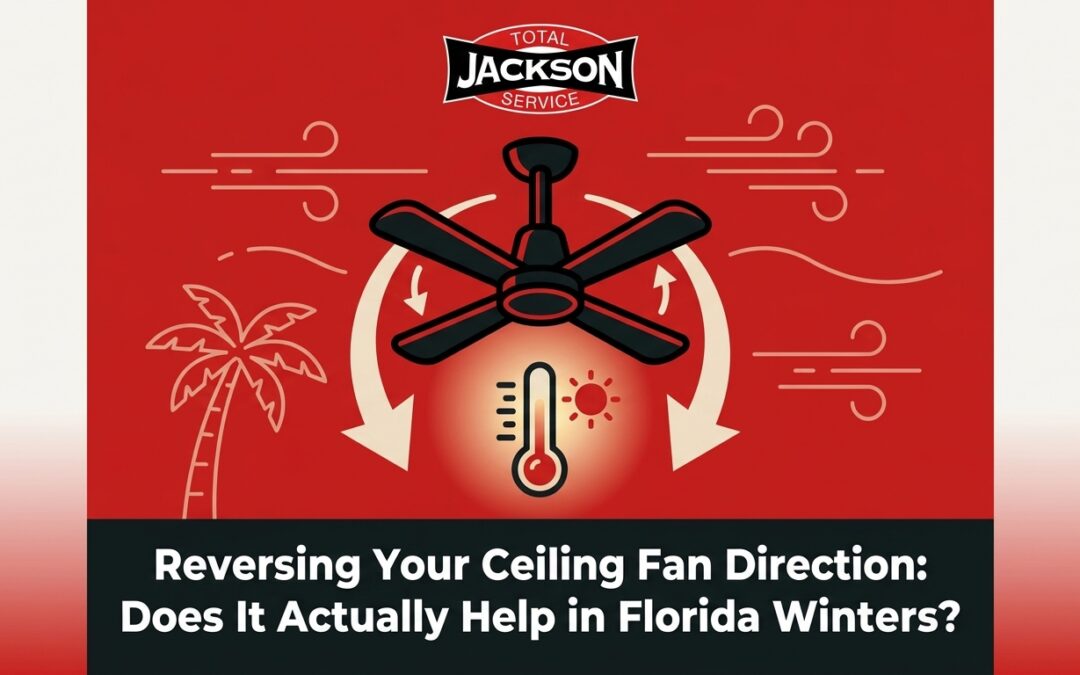
Is the Ceiling Fan Winter Switch Myth Worth Your Time?
Have you ever found yourself staring up at your living room fixture in late fall, wondering about the real value of reversing your ceiling fan direction: does it actually help in Florida winters? You are not alone in asking this question. Every October, as the temperatures finally begin to dip, our team at Jackson Total Service fields this exact question from Naples homeowners. Home improvement shows and online articles start reminding people to flip the small directional switch on their fan motors. The idea is that changing the blade rotation will push trapped warm air down from the ceiling, keeping you cozier without overworking your heating system. But before you drag a heavy stepladder out of the garage to reach a vaulted ceiling, we always ask our customers whether this common advice actually makes sense for homes built primarily for cooling.
For more comprehensive information on optimizing your home’s airflow, you can explore this complete ceiling fan installation guide.
The debate around the ceiling fan winter switch myth often ignores regional climate realities. In northern states where furnaces run continuously for months, trapped heat at the ceiling is a significant source of energy waste. However, in our decades of servicing Southwest Florida homes, we see that the dynamics change entirely. The decision point for most local homeowners is simple: does this northern-climate trick actually apply to homes optimized for air conditioning, or is it a waste of time? While the physics behind thermal destratification are absolutely real, the practical application in a mild environment is often misunderstood. By breaking down how updrafts work and comparing that to the reality of brief cold snaps, we can help you make a definitive choice about whether the effort offers any actual comfort payoff.
Understanding the Physics: How Updrafts and Thermal Destratification Work
To understand why the winter switch is so heavily promoted, we often explain the science of indoor airflow to our clients. The process relies on a physical principle known as thermal destratification. In any enclosed space, air naturally separates into temperature layers. Because warm air is less dense than cold air, it rises. Over time, the warmest air in your home gets trapped against the ceiling, while the cooler, heavier air settles near the floor where you actually sit and sleep. Thermal destratification is simply the mechanical process of mixing that air to eliminate those temperature layers, creating a uniform temperature from floor to ceiling.
Here is exactly how a ceiling fan achieves this when placed in winter mode:
- The directional change: Standard summer operation spins the blades counterclockwise. This creates a direct downdraft, pushing a column of air straight down to create a wind-chill effect on your skin. In winter mode, the switch reverses the motor so the blades spin clockwise.
- Creating the updraft: When the blades spin clockwise on a low speed, they pull cooler air up from the center of the room toward the ceiling.
- Displacing the trapped heat: As the cooler air is pulled upward, it collides with the warm air trapped at the ceiling. Because the warm air has nowhere else to go, it is forced outward toward the walls.
- Gentle circulation: The warm air travels down the walls and back into the lower living space. Because the fan is running on low speed and pulling air up rather than pushing it down, it mixes the temperature layers without creating a drafty breeze that would make you feel cold.
The science is sound, and in a heavily heated room, this cycle can push degrees of wasted warmth back down to the floor. However, our HVAC technicians note that the effectiveness of this physical process depends entirely on how much heat is actually trapped at the ceiling—which is where regional climate factors come into play.

The Southwest Florida Climate: Do Mild Winters Change the Rules?
The rules of indoor heating change dramatically depending on your zip code. Heavy northern winters feature near-freezing temperatures for months on end, requiring furnaces to pump massive volumes of hot air into the home continuously. In those environments, the volume of heat trapped at the ceiling is substantial. Contrast that with the realities of the Southwest Florida climate. When our team helps homeowners tackle October pre-winter prep for Naples cold snaps, we remind them that they are generally preparing for brief, mild temperature dips rather than prolonged freezes.
The local homes we work in every day are architecturally optimized for cooling. They often feature high vaulted ceilings, open floor plans, tile flooring, and specific airflow patterns designed to vent heat away from living spaces. Because average lows rarely dip below the 50s for more than a few days at a time, your heat pump simply does not run long enough or hot enough to create a massive reservoir of trapped warmth at the ceiling. The accumulation of stratified heat is minimal.
Furthermore, running a fan—even on reverse—requires electricity. Because the thermal destratification effect is significantly less critical in a mild environment, the energy used by the fan motor often cancels out any fractional savings on your heating bill. For homes in our region, the lack of prolonged, intense heating system usage means that the traditional rules of the winter fan switch simply do not yield the same dramatic results as they do up north. The updraft is happening, but there just is not enough trapped heat to make a noticeable difference in how the room feels.
Effort vs. Reward: Should You Climb the Ladder This October?
If the physics work but the climate minimizes the impact, the decision ultimately comes down to practical effort versus actual reward. Reversing a fan direction is not always as simple as flipping a switch at eye level. Many modern homes in the region feature great rooms with ceiling fixtures mounted ten to fifteen feet in the air. Accessing the motor housing requires a tall A-frame ladder, careful balance, and physical exertion.
Before you decide to make the switch, consider the practical realities our electricians see in the field. If you are considering upgrading your fixtures entirely instead of maintaining older models, you might also look into ceiling fan installation deals to improve both aesthetics and efficiency.
| Consideration | The Reality in Mild Climates |
|---|---|
| Physical Effort | Requires climbing a stepladder, often on uneven tile or high vaulted ceilings, just to reach the motor housing switch. |
| Energy Savings | Generally negligible. The heating system runs so infrequently during brief cold snaps that heat redistribution offers almost no financial return. |
| Dust Disturbance | Reversing blade direction often dislodges months of settled dust from the top of the blades, showering the room and requiring immediate cleaning. |
| Mechanical Risk | Interacting with older fan motors or changing their long-established rotation can sometimes unbalance the fixture or reveal mounting issues. |
The definitive answer: For most Southwest Florida homes, we recommend leaving the fan off entirely during a cold snap, as it is just as effective as reversing it. If you feel chilly, simply turning the fan off stops the wind-chill effect. The physical effort and risk of climbing a ladder for a few days of 50-degree weather rarely justify the negligible comfort reward.
More Effective Pre-Winter Maintenance for Your Home
Instead of focusing on minor fan adjustments, your fall maintenance routine should pivot to actionable, high-value alternatives that actually impact your comfort and efficiency. At Jackson Total Service, as a 60-year multi-trade family business combining electrical mechanics and HVAC dynamics, we know that the most effective approach to home comfort is always holistic. Proper winter preparation means ensuring your primary heating equipment is ready to perform efficiently without wasting electricity. (As a bonus, upgrading to high-efficiency equipment during fall maintenance may even qualify you for generic federal tax credits or utility incentive programs—always verify current programs with your utility provider or a tax professional).
When handling property management needs or preparing a large residential home for fall, focusing on the core HVAC system yields the best results. For example, our expert technicians like Paul and Lisa have consistently provided excellent service for over 15 years by prioritizing comprehensive system health over temporary fixes. We understand firsthand that reliable heating comes from a well-calibrated heat pump, not a ceiling fan updraft.
Here are the most effective steps our team recommends to prepare your home for cooler weather:
- Schedule a heat pump inspection: Heat pumps work by reversing the flow of refrigerant to extract heat from the outside air. Ensuring the reversing valve, coils, and refrigerant levels are optimized is critical before the first cold snap.
- Check thermostat efficiency: Verify that your thermostat is accurately reading the room temperature. A miscalibrated thermostat can cause your system to short-cycle or overwork.
- Test the emergency heat strips: If your heat pump fails or temperatures drop unusually low, the system relies on electric heat strips. Professional maintenance ensures these strips are functioning safely, as relying on them unnecessarily will cause a massive spike in your electricity usage.
- Evaluate airflow dynamics: Ensure that return vents are unblocked by furniture or rugs and that air filters are replaced. Clean filters allow the heat pump to distribute warm air naturally without extra strain.
By shifting your focus from the ceiling fan switch to comprehensive heat pump maintenance, you ensure that your home remains comfortable and energy-efficient regardless of how unpredictable the winter weather becomes.
What About High Ceilings and Wobbling Fans?
A secondary issue our electricians frequently encounter arises when homeowners decide to interact with their ceiling fixtures during seasonal checks. Sometimes, simply changing the fan’s direction or adjusting its speed reveals underlying balance issues that were previously unnoticed. A fan that spins smoothly counterclockwise might suddenly develop a rhythmic tick, a sway, or a severe wobble when switched to a clockwise updraft.
High ceilings amplify these wobbling issues significantly. Because fixtures in vaulted rooms require longer downrods to lower the blades to an effective height, the structural stress on the mounting bracket increases. A slight imbalance at the motor housing translates into a wide, sweeping wobble at the end of a long downrod. This is not just an aesthetic annoyance; it is a structural concern. Continuous wobbling puts excessive wear on the mounting hardware, the electrical box, and the ceiling drywall itself.
If you notice your fixture swaying aggressively, our team stresses the importance of addressing the root cause rather than just ignoring it. You can learn more about the mechanics behind this issue by reading about why your new ceiling fan wobbles on high speed. While minor balancing kits can sometimes resolve slight variations in blade weight, a severe wobble—especially on a high ceiling—warrants a professional electrical inspection. Ensuring your fan is securely mounted and perfectly balanced guarantees quiet operation and protects your home’s structural integrity.
Frequently Asked Questions About Florida Ceiling Fan Direction in Winter
Should ceiling fans run in winter in Florida?
Running them is entirely optional during the winter months. They can help circulate stagnant air if the house has been closed up, but they are not strictly necessary for heating in mild climates. If the air movement makes you feel chilled, we usually advise simply turning the fan off.
Which way should a ceiling fan turn in winter?
If you choose to run it, the fan should turn clockwise on a low speed. This rotation creates a gentle updraft that pulls cool air up and pushes trapped warm air down the walls. However, the overall impact on room temperature is minimal in homes already optimized for cooling.
Does reversing a ceiling fan actually heat a room?
No, fans do not change the temperature of the room in any way. They do not generate heat; they only redistribute existing warm air that has settled at the ceiling. Your heat pump is still responsible for actually raising the temperature of the air inside the home.
Should you reverse ceiling fans in winter in Florida?
It depends on your ceiling height and personal comfort preference, but for most brief cold snaps, we find the effort often outweighs the benefit. Climbing a ladder to switch the direction for just a few days of cooler weather rarely provides enough warmth to justify the hassle.
Does a ceiling fan’s winter setting save energy in mild climates?
Energy savings from reversing a fan in a mild climate are negligible. Any minor reduction in heating demand is often offset by the electricity used to run the fan motor. Proper heat pump maintenance and smart thermostat management are far more effective ways to save energy.
Keep Your Home Comfortable Through Every Florida Season
While the winter switch is a scientifically sound concept based on thermal destratification, our decades of experience confirm it is largely unnecessary for the mild, brief winters experienced in Southwest Florida. Your home is built to stay cool, and the minimal heat trapped at the ceiling simply does not justify the effort of climbing a ladder to reverse your fan blades. Instead, true winter comfort comes from ensuring your primary heating equipment is properly maintained and ready to operate efficiently when those cold snaps finally arrive.
Focusing on holistic home maintenance, from heat pump tune-ups to ensuring your electrical fixtures are safely balanced, provides peace of mind year-round. If you need professional assistance optimizing your home’s fixtures or upgrading your current setup, reach out to our experts for ceiling fan installation service in Naples to ensure your home remains comfortable, safe, and efficient through every season.