


Why Hard Water Is Silently Destroying Your Appliances in Southwest Florida
How hard water shortens appliance lifespan is something most homeowners don’t think about until an appliance breaks down years too soon. The culprit isn’t age or poor maintenance — it’s the minerals hiding in your water supply.
Here’s a quick summary of how hard water damages your appliances:
| Appliance | Lifespan With Soft Water | Lifespan With Hard Water |
|---|---|---|
| Electric water heater | 13 years | 6.5 years |
| Gas water heater | 11 years | 5.5 years |
| Washing machine | 11 years | 7.7 years |
| Dishwasher | 10 years | 7 years |
| Faucets | 9 years | 5.4 years |
| Toilet | 6.5 years | 2 years |
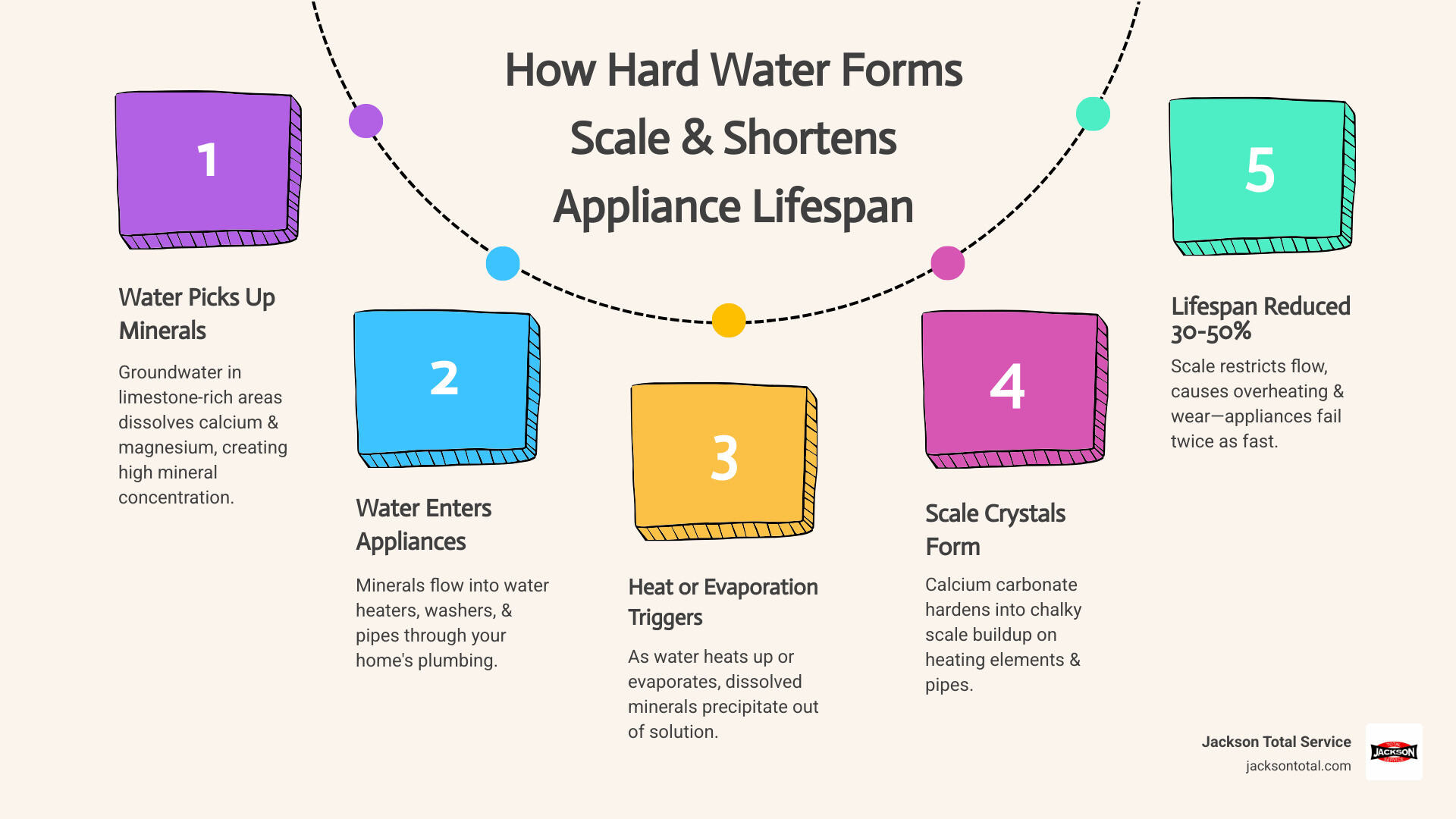
Hard water is water that carries high levels of dissolved calcium and magnesium. In Southwest Florida, groundwater travels through limestone-rich rock formations, picking up these minerals along the way. Once that water flows into your home, those minerals don’t just pass through — they stick.
When hard water heats up or evaporates inside your appliances and pipes, the dissolved minerals crystallize into a hard, chalky coating called scale. That scale builds up layer by layer inside heating elements, pumps, valves, and pipes. Over time, it forces your appliances to work harder, use more energy, and wear out far faster than they should.
According to research from the Water Quality Association (WQA), appliances running on hard water can wear out nearly twice as fast as the same appliances running on soft water. That’s not a small difference — that’s replacing your water heater at year six instead of year thirteen.
In April 2026, with appliance and energy costs continuing to rise across Southwest Florida, the hidden damage from hard water is a problem no homeowner can afford to ignore.
What is Hard Water and How Does It Create Scale?
To understand how your plumbing is being attacked, we first have to look at the chemistry of our local water. In cities like Naples, Fort Myers, and Cape Coral, our water comes from underground aquifers. As this water moves through the earth, it dissolves rocks. Specifically, it eats away at limestone and chalk, which are primarily made of calcium carbonate and magnesium.
By the time that water reaches your kitchen sink, it has a high mineral concentration. While these minerals aren’t “dirty” or “toxic”—in fact, they are the same minerals found in many health supplements—they are a nightmare for mechanical systems.
The Science of Scale Formation
The real trouble begins with heat-induced precipitation. When hard water is heated inside an appliance, the chemical bonds of the dissolved minerals change. The calcium and magnesium “precipitate” out of the liquid, turning into solid crystals. This is the white, chalky residue you see on your showerhead, but inside your appliances, it’s much more aggressive.
This scale creates three major problems for your plumbing system:
- Flow Restriction: As scale builds up inside your pipes, the interior diameter of the pipe narrows. It’s like cholesterol in a human artery; the water has less room to move.
- Pressure Drop: Because the pipes are narrowed, your home experiences a significant drop in water pressure. You might notice your morning shower feels more like a drizzle than a downpour.
- Thermal Insulation: This is the “silent killer” for water heaters. Scale is a fantastic insulator. When it coats a heating element, it prevents heat from reaching the water efficiently. If you are experiencing these issues, you may need professional Water Heater Repair to clear out the sediment before the unit fails entirely.
How Hard Water Shortens Appliance Lifespan in Your Home

When we talk about how hard water shortens appliance lifespan, we aren’t just talking about a few months of lost time. We are talking about a massive 30-50% reduction in the functional life of your most expensive home investments.
In our decades of serving Southwest Florida since 1964, we have seen brand-new appliances forced into premature replacement because homeowners didn’t realize their water was “hard.” The internal component wear is relentless. Minerals act like liquid sandpaper, grinding away at rubber seals, gaskets, and moving parts.
The Hidden Dangers of Mineral Abrasion
Every time your dishwasher or washing machine runs, these microscopic mineral crystals are circulating through the system. They cause:
- Seal Degradation: Rubber seals that are meant to keep water inside the machine become brittle and cracked as minerals embed themselves in the material. This leads to the “mystery leaks” that ruin kitchen floors.
- Valve Failure: Solenoid valves, which open and close to let water in, can become stuck or “crusted” open or shut due to scale buildup.
- Warranty Voiding: This is a shocking fact for many homeowners. Many manufacturers actually include clauses in their warranties stating that damage caused by scale or mineral buildup is not covered. If you don’t treat your water, you might be left footing the bill for a total replacement even if the machine is only two years old.
The Impact on Water Heaters: How Hard Water Shortens Appliance Lifespan
Your water heater is the hardest-working appliance in your home, and unfortunately, it is the primary target for hard water damage. Whether you have an electric or gas unit, the results are the same: efficiency loss and early death.
In electric water heaters, the scale attaches directly to the heating elements. Research has shown that these elements can fail in as little as 19 months in areas with extreme hard water. Without the “insulation” of scale, those same elements could last 15 years.
In gas units, the scale settles at the bottom of the tank, creating a thick layer of sediment between the burner and the water. This forces the burner to run longer and hotter to reach the desired temperature, which can lead to the metal tank overheating and eventually cracking. This process increases energy consumption by up to 25%. For a deeper dive into maintaining these systems, check out our Water Heater Repair Fort Myers Complete Guide.
Laundry and Kitchen Woes: How Hard Water Shortens Appliance Lifespan
If you’ve noticed your clothes feeling stiff or your glasses looking “etched” and cloudy, you’re seeing the effects of a chemical reaction between hard water minerals and your detergents.
Washing Machines
When minerals like calcium meet laundry soap, they create “curd”—a sticky, greyish scum. This curd doesn’t just stick to your clothes; it gums up the inner workings of your washing machine. You’ll find yourself using up to 70% more detergent just to get a lather, and that extra soap further strains the drain pump and motor.
Dishwashers
The dishwasher suffers a similar fate. Scale clogs the tiny holes in the spray arms, meaning your dishes don’t get hit with enough water pressure to get clean. The high heat of the drying cycle then “bakes” the minerals onto your plates and silverware, leading to that permanent cloudy look that no amount of scrubbing can fix.
Signs You Have a Hard Water Problem in Southwest Florida
Living in places like Estero, Bonita Springs, or Marco Island means you likely have hard water, but how can you be sure? Look for these “red flags” in your daily routine:
- Soap Scum Everywhere: If you find yourself scrubbing a white, sticky film off your shower doors and bathtub every week, that’s not just old soap—it’s mineral curd.
- The “Itch” Factor: Hard water leaves a film on your skin that traps bacteria and natural oils, leading to dry, itchy skin and limp, dull hair.
- Clogged Aerators: If the water coming out of your kitchen faucet is spraying in odd directions, unscrew the small screen (aerator) at the tip. If it’s filled with white, pebble-like rocks, you have a scale problem.
- Toilet Tank Staining: Open the lid to your toilet tank. If you see rusty or white rings and a layer of “sand” at the bottom, your water is carrying a heavy mineral load.
- Faded Clothing: Your favorite dark shirts will look grey and “dusty” after just a few washes in hard water.
- High Utility Bills: If your electric or gas bill is creeping up but your usage hasn’t changed, your water heater might be struggling to work through a layer of rock.
If these signs sound familiar, it’s time to look into professional Water Conditioning to save your plumbing and your sanity.
Protecting Your Investment: Solutions for Hard Water Damage
While the damage caused by hard water is serious, it is also entirely preventable. There are two ways to handle the problem: short-term maintenance and long-term prevention.
Short-Term Home Remedies
If you aren’t ready for a full system, you can temporarily mitigate damage with these steps:
- Vinegar Flushes: Run a gallon of white distilled vinegar through an empty cycle of your dishwasher and washing machine every quarter. The acid in the vinegar helps dissolve light scale buildup.
- Water Heater Flushing: We recommend flushing your water heater once a year to remove the “sand” and sediment that settles at the bottom.
The Long-Term Solution: Professional Water Softeners
To truly stop the damage, you need to remove the minerals before they ever enter your appliances. This is done through a process called ion exchange.
A salt-based water softener uses resin beads that act like a magnet for calcium and magnesium. As hard water passes through the resin tank, the “hard” minerals are swapped for a tiny amount of sodium (the “sodium swap”). The result is soft water that won’t create scale, won’t ruin your clothes, and won’t kill your water heater.
While some people look at salt-free “conditioners,” it is important to note that these systems do not actually remove the minerals. They simply “crystallize” them so they are less likely to stick. For the maximum protection of your appliance warranties and lifespans, a point-of-entry salt-based system is the industry gold standard.
Frequently Asked Questions about Hard Water Damage
Can hard water really void my appliance manufacturer warranty?
Yes, it absolutely can. Many manufacturers consider hard water damage to be a result of “improper environmental conditions” or “lack of maintenance.” If a technician opens up your failed dishwasher and finds the pump is seized with calcium, the manufacturer may deny your claim, leaving you to pay for the repair out of pocket.
Why are salt-based softeners more effective than salt-free conditioners for protection?
Salt-based softeners are the only systems that actually remove the calcium and magnesium from the water. Salt-free systems are “conditioners” that change the form of the minerals but leave them in the water. While conditioners help reduce scale on flat surfaces, they are often less effective at protecting the high-heat elements inside water heaters where scale forms the fastest.
How much can I save on energy and detergents by switching to soft water?
The savings are substantial. Research shows that soft water allows you to use up to 70% less detergent and soap. Furthermore, by keeping your water heater’s heating elements clean, you can reduce your water-heating energy costs by nearly 30%. Over a decade, these savings often pay for the water softening system itself.
Conclusion
Your home is likely your biggest investment, and the appliances inside it make your life comfortable. Don’t let the “liquid rock” in Southwest Florida’s groundwater steal years of life from your water heater, laundry machine, and dishwasher.
At Jackson Total Service, we’ve been the trusted name for home comfort in Naples, Fort Myers, and the surrounding areas for over 60 years. We understand the unique challenges of our local water supply, and we are here to help you protect your home. From expert plumbing repairs to advanced water treatment, we provide all your comfort solutions in one place.
Don’t wait for your water heater to start rumbling or your dishwasher to leave your plates spotted. Schedule your professional Water Conditioning consultation today and give your appliances the long, efficient life they deserve. We serve all of Collier and Lee Counties, including Marco Island, Bonita Springs, and Sanibel Island. Let us help you stop the scale before your appliances fail!