



Is a Maintenance Agreement Worth It for Your Home?
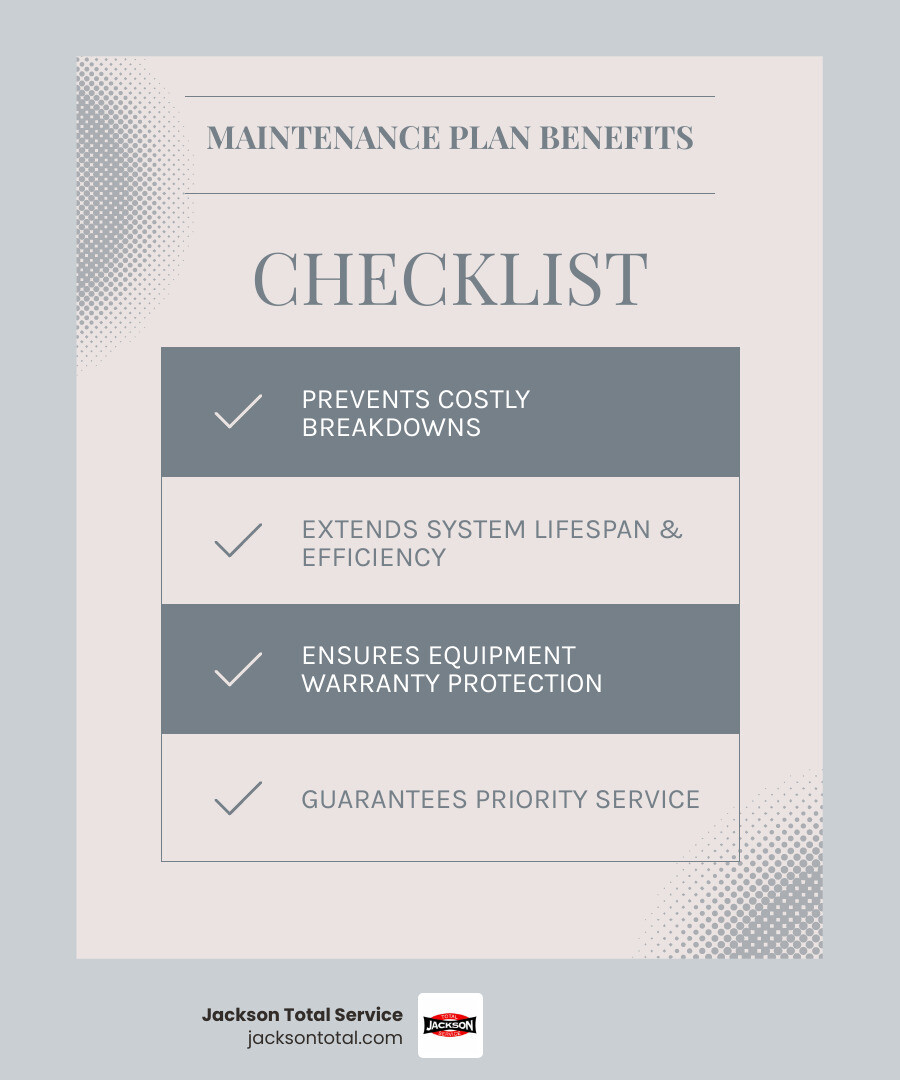
Is a maintenance agreement worth it for your home? For most homeowners — especially in Southwest Florida — the answer is yes. Regular preventative care helps you avoid surprise breakdowns, keeps your systems running efficiently, and protects the warranties on your equipment.
Here’s a quick summary to help you decide:
- You likely benefit most if your HVAC, plumbing, or electrical systems are more than five years old
- Key advantages include catching small problems early, priority scheduling, and avoiding peak-season repair delays
- Main trade-off is paying for scheduled service even in years when nothing goes wrong
- Cost context is important — service agreements typically run less per year than a single emergency repair call
- Bottom line — for homes in high-humidity climates like Southwest Florida, where systems work harder and wear faster, a maintenance plan is one of the smarter investments you can make
Think of it the way you think about oil changes for your car. You don’t wait for the engine to fail. You service it on a schedule because prevention is always cheaper than repair. Your home’s systems work the same way.
The sections below walk through exactly what these agreements cover, how they compare to home warranties, and how to know if one is right for your situation.
Is a maintenance agreement worth it for your home in Southwest Florida?
Living in Southwest Florida—whether you are in the heart of Naples, the bustling streets of Fort Myers, or the quiet reaches of Ave Maria—means your home is constantly under siege from the elements. Between the salt air, the relentless heat, and the oppressive humidity, your air conditioner, plumbing, and electrical systems work significantly harder than those in other parts of the country.
When we ask, “is a maintenance agreement worth it for your home,” we have to look at the “hidden” costs of neglect. A maintenance agreement is essentially a partnership between you and a service provider like us. At Jackson Total Service, we’ve seen that systems receiving regular check-ups can last significantly longer. In fact, some well-maintained installations have been known to last 17 years and counting, whereas neglected systems in our climate often fail much sooner.
One of the biggest perks of a Maintenance Agreement is priority scheduling. Imagine it’s a sweltering July afternoon in Cape Coral and your AC stops blowing cold air. You and every other homeowner in Lee County are calling for service at the same time. With an agreement, you move to the front of the line. We prioritize our member families because they’ve committed to the health of their homes.
Furthermore, there is the matter of efficiency. A system that is clogged with dust or struggling with a worn-out capacitor uses more electricity to achieve the same result. By keeping components clean and calibrated, you ensure your utility bills stay as low as possible. It’s about peace of mind—knowing that when you flip the switch or turn the tap, everything will work exactly as it should.

Comparing Maintenance Agreements and Home Warranties
It is very common for homeowners to confuse maintenance agreements with home warranties, but they serve two completely different purposes. Understanding the distinction is key to deciding which protection is right for your property.
| Feature | Maintenance Agreement | Home Warranty |
|---|---|---|
| Primary Goal | Prevention and Longevity | Financial Protection against Failure |
| Service Type | Scheduled tune-ups, cleanings, and inspections | On-call repairs and replacements |
| Timing | Proactive (done before things break) | Reactive (done after things break) |
| Typical Coverage | Labor for inspections, parts discounts, priority service | Cost of replacement or major repair (minus deductible) |
| Impact on Lifespan | Extends the life of the system | Does not affect lifespan; only replaces the unit |
A home warranty is like an insurance policy. You pay a premium, and if your refrigerator or water heater dies, the warranty company helps cover the replacement. However, many homeowners are surprised to find that home warranties often have “fine print” requiring proof of professional maintenance. If a system fails because it was never cleaned or serviced, the warranty claim might be denied.
A maintenance agreement, on the other hand, is a service contract focused on the “health” of your home. It includes the labor and expertise needed to perform multi-point inspections. We aren’t just waiting for things to break; we are actively preventing the breakdown. For older homes in places like Bonita Springs or Estero, a maintenance agreement is often the better value because it addresses the wear and tear that leads to frequent, annoying repairs.
How the Florida Climate Dictates Your Service Needs
In Southwest Florida, the climate isn’t just a backdrop; it’s a major factor in your home’s mechanical health. As of April 2026, we are seeing even more extreme seasonal shifts that put a premium on moisture control.
Florida’s average relative humidity hovers around 75 percent. Indoors, if your AC isn’t performing perfectly, that humidity can creep up. Why does this matter? Dust mites and mold thrive once humidity levels cross the 50 percent threshold. A well-maintained HVAC system acts as a giant dehumidifier for your home. If the evaporator coils are dirty or the refrigerant levels are off, the system loses its ability to pull moisture from the air, leading to that “sticky” feeling and potential respiratory issues for your family.
Our maintenance visits specifically target these climate-related threats. We don’t just check the air temperature; we look at the entire “breathing” system of your home. More info about HVAC services can help you understand how we tackle these local challenges.
Why is a maintenance agreement worth it for your home during the humid summer?
The summer months in places like Marco Island and Golden Gate are the ultimate “stress test” for your home. During this time, your AC might run for 12 to 18 hours a day. This constant operation leads to a massive buildup of condensation.
One of the most frequent (and preventable) emergency calls we receive in the summer is for clogged condensate drains. When the humidity is high, your system pulls gallons of water out of the air. If the drain line is restricted by algae or debris, that water has nowhere to go but back into your home—potentially damaging your ceilings or floors.
Part of a professional maintenance agreement includes clearing these lines and adding algaecide treatments to prevent blockages. This ensures your system maintains its full cooling capacity and prevents the “overflow” disasters that are so common in our region. By reducing allergens and ensuring peak performance, you aren’t just saving money; you’re protecting the air your family breathes.
Balancing Professional Service with DIY Tasks
We often get asked: “Can’t I just do this myself?” It’s a fair question. There are certainly things a homeowner in Lehigh Acres or Sanibel Island should do to help their systems.
The DIY Checklist:
- Change your filters: This is the single most important thing you can do. A dirty filter restricts airflow and can eventually burn out your blower motor.
- Visual inspections: Keep an eye out for frayed wires on your outdoor unit or water pooling around your water heater.
- Clear debris: Ensure that grass, leaves, and shrubs are at least two feet away from your outdoor AC condenser.
However, a DIY approach only goes so far. Professional technicians use specialized tools to check motor amperages, refrigerant pressures, and electrical connections that the average homeowner simply shouldn’t touch. Furthermore, keeping a professional service history is often a requirement to keep your manufacturer’s warranty valid. If your compressor fails in year eight of a ten-year warranty, the manufacturer will want to see receipts proving the system was maintained. Without them, you could be on the hook for a very expensive part.
Deciding if a maintenance agreement is worth it for your home based on system age
The age of your equipment is a major factor in the value of an agreement.
For New Systems (0-5 Years):
In a brand-new home in a community like Ave Maria, you might think you don’t need an agreement. However, this is the best time to start. Maintaining a system from day one prevents the “grime” buildup that eventually leads to inefficiency. It also ensures you meet the strict maintenance requirements of your manufacturer’s warranty.
For Mid-Life Systems (6-10 Years):
This is when components like capacitors, contactors, and fan motors start to show their age. A maintenance agreement is incredibly valuable here because we can catch a “weak” capacitor before it fails and leaves you without cooling on a Saturday night.
For Older Systems (10+ Years):
If your system is a “senior citizen,” regular check-ups are vital for safety. We check safety sensors, heat exchangers (for those rare chilly Florida nights), and electrical panels for signs of scorching or wear. At this stage, the agreement is about squeezing every last bit of life out of your investment safely.
Frequently Asked Questions about Home Maintenance Plans
What services are typically included in a standard agreement?
While every plan is a bit different, a comprehensive agreement like ours typically covers two precision tune-ups per year. This includes cleaning the condenser coils, checking refrigerant levels, testing all electrical components, clearing condensate drains, and sanitizing the evaporator coil. We also perform a safety check on your electrical connections and can include plumbing inspections to check for leaks or water heater sediment buildup.
Can regular maintenance help reduce my monthly utility bills?
Absolutely. A system that is struggling against dirty coils or low refrigerant has to run longer to reach the temperature set on your thermostat. This extra “run time” shows up directly on your FPL or LCEC bill. By restoring the system to peak efficiency, you reduce the energy required to cool your home, often saving enough on your monthly bills to offset the cost of the agreement itself.
Is a maintenance agreement necessary for a brand-new home?
Yes, primarily for two reasons: warranty protection and habit-building. Most manufacturers (like Carrier, Trane, or Rheem) explicitly state in their warranty terms that the equipment must be professionally maintained. Additionally, starting maintenance early prevents the accumulation of dust and salt spray that can lead to premature corrosion in our coastal environment.
Conclusion
At the end of the day, your home is likely your largest investment. In the unique and sometimes harsh environment of Southwest Florida, taking a proactive approach to home care is simply common sense. Since 1964, Jackson Total Service has been helping families from North Naples to Pine Island stay comfortable by providing all-in-one solutions for HVAC, plumbing, and electrical needs.
So, is a maintenance agreement worth it for your home? If you value your time, your comfort, and your hard-earned money, the answer is a resounding yes. By partnering with us, you move from a state of “worrying” about when the next thing will break to a state of “knowing” that your home is in expert hands.
Whether you need a quick check-up for your AC, a flush for your water heater, or a safety inspection for your electrical panel, we are here to help. Don’t wait for an emergency to find out who your favorite contractor is. Join our family today and experience the peace of mind that comes with professional, local care.
Ready to protect your home? Visit https://jacksontotal.com/maintenance-agreements/ to learn more about our comprehensive plans.