


Why Southwest Florida’s Climate Is Harder on Your Home Systems Than Almost Anywhere Else
How southwest florida climate affects your ac plumbing and electrical systems is something every homeowner in the region needs to understand — because the combination of heat, humidity, salt air, and storm season creates stress on your home that most other parts of the country simply don’t experience.
Here’s a quick summary of the key climate impacts:
| Climate Factor | Systems Affected | Primary Risk |
|---|---|---|
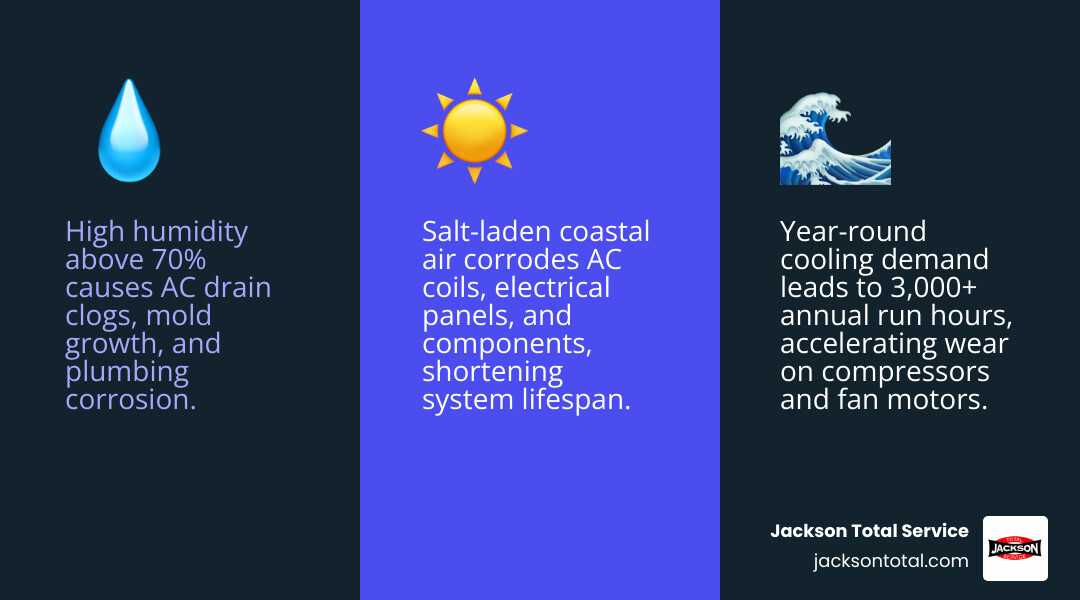
| High humidity (often above 70%) | AC, plumbing, electrical | Mold growth, drain clogs, corrosion |
| Salt-laden coastal air | AC outdoor units, electrical panels | Accelerated metal corrosion, component failure |
| Year-round cooling demand | AC compressors, capacitors, fan motors | Faster wear, shorter system lifespan |
| Storm season power surges | AC electronics, electrical panels | Capacitor and circuit board damage |
| Poor insulation and duct leaks | AC efficiency | Up to 30% cooling power wasted |
| Mild winter temperature swings | Heat pumps, reversing valves | Hidden failures exposed during mode changes |
Step outside in Southwest Florida on a July afternoon and you feel it immediately — the air is heavy, wet, and relentless. Your AC isn’t just cooling your home. It’s pulling gallons of moisture out of the air every single day. Your plumbing is working against algae-prone condensate lines and humidity-driven drain clogs. And your electrical components — especially anything outdoors — are fighting a slow but steady battle against salt air corrosion and the voltage spikes that follow every major storm.
Unlike homes in drier or cooler climates, Southwest Florida homes give their systems almost no break. AC systems here can log more than 3,000 hours of run time per year. That’s not a seasonal challenge — it’s a year-round one. And when you factor in the coast’s corrosive air, Florida’s lightning-heavy storm season, and the humidity that never really lets up, the wear on your AC, plumbing, and electrical systems adds up faster than most homeowners expect.
How Southwest Florida Climate Affects Your AC Plumbing and Electrical Systems

Living in paradise comes with a price, and that price is paid by your home’s infrastructure. In places like Naples and Fort Myers, the environment is aggressive. Heat transfer isn’t just a scientific concept; it’s the reason your walls feel warm to the touch and your cooling system struggles to keep up.
The primary issue is that how southwest florida climate affects your ac plumbing and electrical is cumulative. The salt-laden air from the Gulf of Mexico doesn’t just stay at the beach; it travels inland, settling on metal surfaces and starting the oxidation process. This affects everything from the delicate aluminum fins on your AC condenser to the copper wiring in your outdoor electrical disconnects.
Because we face year-round cooling demands, these systems never get a “rest” period. In the North, a furnace might sit idle all summer, and an AC unit sits idle all winter. In Southwest Florida, we might switch from cooling to heating and back to cooling in the same 24-hour period. This constant cycling requires robust Air Conditioning Services, reliable Plumbing Services, and safe Electrical Services to ensure your home remains a sanctuary.
How Southwest Florida climate affects your AC plumbing and electrical moisture levels
Humidity is the silent enemy of the Florida home. While the temperature might be 90°F, the humidity levels often hover between 60% and 90%. For a home to feel comfortable and remain healthy, indoor moisture levels should ideally stay below 60%. When humidity spikes, your AC has to work twice as hard—not to lower the temperature, but to wring the water out of the air.
If you find yourself asking, Why Is My Air Conditioner Not Cooling My House, the answer is often that the system is overwhelmed by latent heat (moisture). High humidity makes the air feel “heavy” and “sticky,” and if your system isn’t properly sized or maintained, it will fail to reach the 35–55% humidity sweet spot that prevents mold growth and keeps your family comfortable.
Protecting your home when Southwest Florida climate affects your AC plumbing and electrical components
To combat the corrosive nature of our climate, protection is key. For coastal homes in Marco Island or Bonita Springs, we recommend AC units with factory-applied protective coatings on the coils. These coatings act as a shield against salt air, extending the lifespan of the metal components that would otherwise succumb to “coil rot” within a few short years.
Electrical systems also require specialized care. High humidity can cause oxidation on breaker contacts and wire terminations. Regular Electrical Repair and inspections can identify these “hot spots” before they lead to a complete power failure or a fire hazard. By treating these systems with climate-specific protections, you’re not just repairing your home; you’re fortifying it.
The Humidity Factor: Why Your AC and Plumbing Work Overtime
In Southwest Florida, your air conditioner is essentially a giant dehumidifier. As warm, moist air passes over the cold evaporator coils, the water vapor condenses into liquid. This water has to go somewhere, and that’s where your plumbing and AC systems intersect.
A standard AC unit can produce several gallons of water per day during a typical August stretch in Cape Coral. This constant flow through the condensate drain line creates a perfect environment for algae and “sludge” to grow. When these lines clog, the water backs up, potentially causing thousands of dollars in water damage to your ceilings and floors. This is why specialized Plumbing Repair and Leak Repairs are so vital for maintaining the secondary systems that support your cooling.
Managing indoor air quality in Naples
If you notice musty odors when your AC kicks on, you’re likely smelling the effects of high humidity. In Naples, the damp air can cause organic growth inside ductwork or on the blower motor. Furthermore, the high run times in Florida mean that a standard “90-day” air filter often becomes restricted and filthy in just 30 days. Restricted filters force the system to work harder, increasing energy bills and reducing the air quality your family breathes. Utilizing Air Conditioning Troubleshooting Naples can help identify if your IAQ issues are related to filtration or something deeper like a refrigerant leak.
Preventing condensate backups in Fort Myers
In Fort Myers, we frequently see systems shut down entirely because of a tripped float switch. This is actually a safety feature—it stops the AC from running when the drain line is clogged to prevent a flood. However, the root cause is almost always algae growth fueled by the humid climate. Regular maintenance and professional Air Conditioning Troubleshooting Fort Myers are necessary to keep these lines clear and ensure your system doesn’t leave you in the heat on a Sunday afternoon.
Coastal Corrosion and Electrical Vulnerabilities
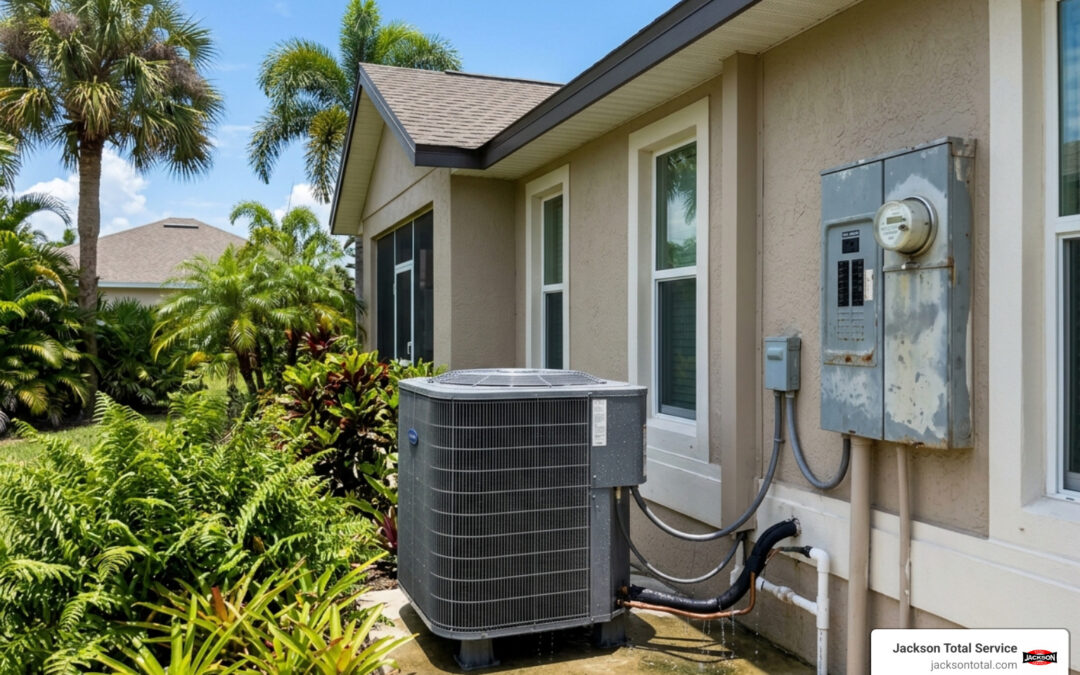
If you live in a coastal area like Fort Myers Beach or Sanibel Island, you are in a “corrosive zone.” The salt air is highly conductive and chemically aggressive. It doesn’t just eat away at the metal fins of your AC; it penetrates electrical enclosures, leading to premature Electrical Services needs.
We often find that capacitors—the small cylindrical components that give your motors the “jolt” they need to start—fail much faster here. The heat causes them to leak or bulge, and the salt air can corrode the terminals, leading to a system that hums but won’t start.
Why coastal air accelerates system wear
Oxidation happens at an accelerated rate when salt and moisture combine. The thin metal fins on your outdoor unit are designed to dissipate heat. When they corrode, they turn into a brittle white powder, reducing the surface area available for cooling. This forces the compressor to run hotter and longer, eventually leading to a “burnout.”
According to our Ac Problems Fort Myers Fl Guide, refrigerant leaks are also more common in coastal homes. The salt air can cause “pitting” in the copper lines, allowing the refrigerant to escape. Since an AC doesn’t “use up” refrigerant, a low charge always indicates a leak that was likely caused by the environment.
Surge protection for the storm season
Southwest Florida is the lightning capital of the U.S. Even if a bolt doesn’t hit your house directly, a nearby strike can cause a massive voltage fluctuation. These surges are devastating to modern AC units, which rely on delicate circuit boards and microprocessors.
If your Air Conditioner Not Working after a thunderstorm, a fried circuit board or a blown capacitor is the likely culprit. We strongly recommend whole-home surge protection. While a dedicated HVAC surge protector costs between $150 and $400, it can prevent a compressor replacement that could cost thousands.
Storm Season and Year-Round System Strain
During hurricane season, the risks to your home systems multiply. High winds can turn landscaping debris into projectiles that dent your condenser coils, while heavy rains can overwhelm your home’s drainage. For homes with well pumps or basement-level plumbing, power outages can lead to a loss of water pressure or even sewage backups, requiring an Emergency Plumber to restore sanitation.
Maximizing efficiency during peak heat
When the outdoor temperature exceeds 90°F, your home’s “envelope” is tested. Poor insulation in the attic or leaky ductwork can waste up to 30% of your cooling power. In the peak of summer, these leaks act as “thermal highways,” allowing hot attic air to mix with your expensive conditioned air.
Proper sizing is also critical. If you are wondering Why Is My Air Conditioner Not Cooling My House Fort Myers, it may be that the unit was sized based on square footage alone, rather than a proper Manual J load calculation. An oversized unit will cool the house too fast and shut off before it removes the humidity, leaving you feeling “cold and clammy.”
Winter mode changes and heat pump stress
Winter in Southwest Florida is mild, but the variability is actually harder on your HVAC than a steady cold. We often see a “cool by day, heat by night” pattern. This forces the heat pump’s reversing valve to switch positions frequently.
During a rare cold snap, your heat pump may enter a “defrost cycle” to melt ice off the outdoor coils. If your system has a hidden weakness—like a failing auxiliary heat strip or a marginal capacitor—it will be exposed during these mode changes. Regular Air Conditioning Repair and maintenance before the winter months can ensure these components are ready for the switch.
Frequently Asked Questions about SWFL Home Systems
Why does my AC run more in Southwest Florida than in other states?
In Florida, your AC runs for two reasons: to lower the temperature and to remove humidity. Because our humidity levels stay high even at night, your system may run 3,000+ hours a year compared to 1,000 hours in a northern state. This constant operation is why how southwest florida climate affects your ac plumbing and electrical is a more significant concern for local residents.
How does high humidity lead to plumbing issues?
High humidity encourages the growth of algae and biofilm in your AC’s condensate drain lines. Since these lines are technically part of your home’s drainage system, a clog here is a plumbing failure that can lead to water leaks, mold, and even structural damage if the water overflows into your walls.
Can salt air cause my electrical breakers to trip?
Yes. Salt air is corrosive and can lead to “pitting” on the contacts of your breakers or the terminals of your outdoor disconnect. This creates electrical resistance, which generates heat. If a breaker gets too hot due to a poor, corroded connection, it will trip to prevent a fire—even if the actual electrical load is normal.
Conclusion
Since 1964, Jackson Total Service has been the trusted name for homeowners navigating the unique challenges of the Southwest Florida environment. We understand that how southwest florida climate affects your ac plumbing and electrical systems requires more than just a “quick fix”—it requires a comprehensive approach to home comfort.
Whether you are in Naples, Fort Myers, or the coastal reaches of Marco Island, our team provides the professional inspections and comprehensive maintenance needed to stay ahead of the heat, humidity, and salt air. Don’t wait for a mid-summer breakdown or a storm-season surge to take action. Schedule your Southwest Florida home comfort services today and let us put our decades of local experience to work for your home.