



Why Every Southwest Florida Home Needs to Understand How a Surge Protector for Your Entire Home Works
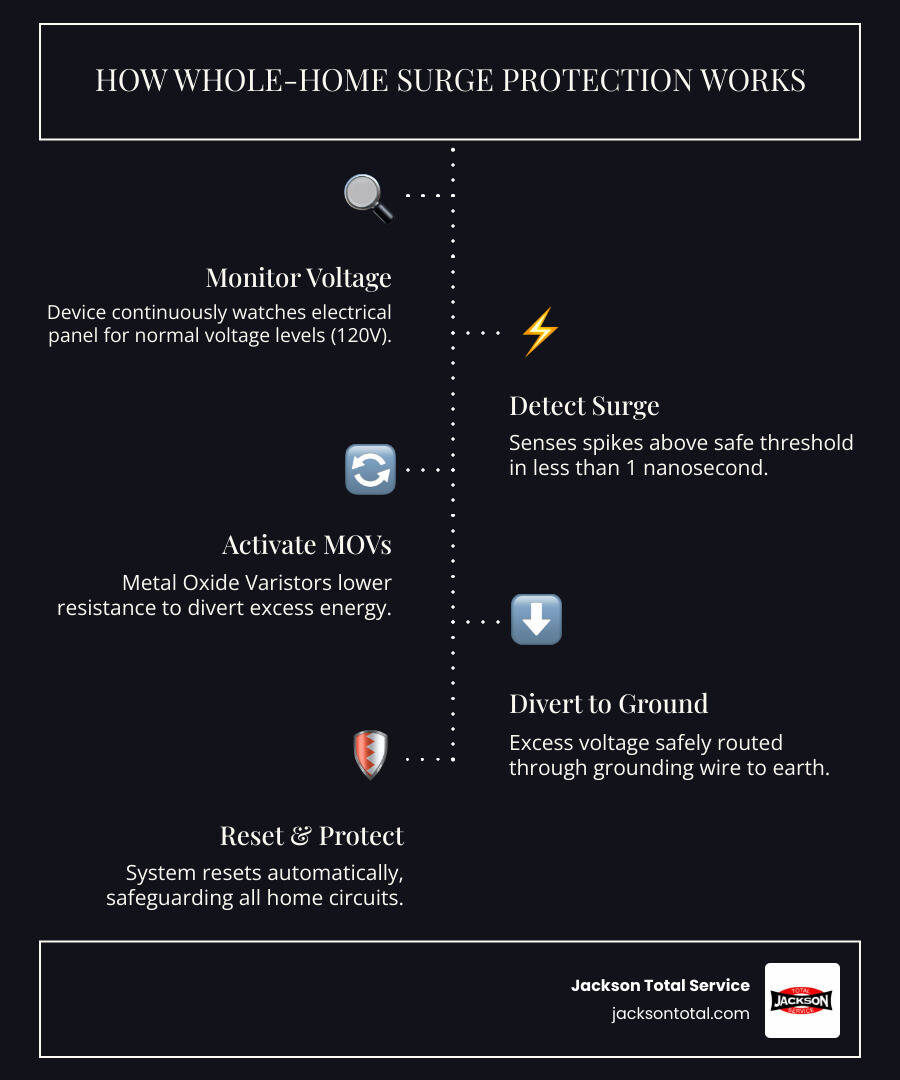
A surge protector for your entire home how it works comes down to one core idea: a device installed at your main electrical panel that detects excess voltage and diverts it safely into the ground before it can reach your appliances, wiring, or electronics. Here is a quick breakdown:
- Voltage is monitored continuously at your electrical panel
- A surge is detected in nanoseconds when voltage spikes above safe levels
- Excess electricity is diverted to the ground wire, away from your circuits
- Your appliances and electronics are protected automatically, with no action needed from you
Southwest Florida homeowners face some of the most frequent lightning activity in the entire country. And while lightning is the threat most people picture, it is actually far from the only one. Internal surges from everyday appliances like your air conditioner, refrigerator, and washer cycle on and off dozens of times a day, sending small voltage spikes through your home’s wiring. Over time, those micro-surges quietly degrade your electronics and appliances, even when you never notice a flicker.
A standard power strip does not protect your hardwired systems, your HVAC, or anything not plugged directly into it. A whole-home surge protective device, installed at your electrical panel, guards every circuit in the house at once.
I’m worried about lightning in Naples. What is a surge protector for your entire home and how it works?
Living in Naples or Marco Island, you know that a summer afternoon without a thunderstorm is a rare gift. Florida sees roughly 1.45 million lightning strikes per year, making our region a “surge-attracting magnet.” When we talk about a surge protector for your entire home how it works, we are describing a sophisticated gatekeeper for your electrical system.
Unlike a simple power strip that sits behind your TV, a whole-home Surge Protective Device (SPD) is typically a Type 2 protector installed directly into your main electrical service panel. It acts as a pressure relief valve for electricity. When a massive spike of energy—whether from a lightning strike or a utility grid fluctuation—tries to enter your home, the SPD senses it in less than a nanosecond.
The “magic” happens through components called Metal Oxide Varistors (MOVs). These semiconductors have a variable resistance. Under normal conditions (around 120V), they have high resistance and let electricity flow through your home as usual. But the moment voltage spikes, their resistance drops instantly, creating a low-resistance path that shunts the excess energy away from your expensive electronics and into your home’s grounding system. This is a critical part of the Electrical Services we provide to ensure your home remains a safe haven during Florida’s volatile storm season.
Understanding the Components: How a Surge Protector for Your Entire Home Works
To truly grasp the “how,” we have to look under the hood. The primary defender in most whole-home systems is the Metal Oxide Varistor (MOV). Think of the MOV as a highly sensitive sentry. It is designed to handle specific voltage thresholds. If the voltage remains within a safe range, the MOV stays “closed.”
However, if a surge occurs, the MOV “opens” a gateway to the ground wire. Some advanced units also utilize Silicon Avalanche Diodes (SADs) or Gas Discharge Tubes for even faster response times and higher energy dissipation. Additionally, quality units include thermal fuses. These are safety backups that disconnect the protector if it becomes too hot from absorbing a massive surge, preventing the device itself from becoming a fire hazard.
The Grounding Process: How a Surge Protector for Your Entire Home Works
The most important part of the surge protection equation isn’t actually the device—it’s your home’s grounding system. If the excess electricity has nowhere to go, even the best surge protector is useless.
When the SPD detects a spike above the 120V threshold (usually clamping at around 400V to 600V), it redirects that energy to the grounding bus bar in your panel. From there, the energy travels down a heavy-gauge copper wire to a grounding rod driven deep into the earth outside your home. This process safely disperses thousands of amps into the soil. If your home has aging or improper grounding, you may need an Electrical Repair to ensure your surge protection actually has a “drain” to send the excess power into.
Common Causes of Power Surges in Southwest Florida
When most people in Fort Myers or Bonita Springs think of power surges, they picture a massive bolt of lightning hitting a transformer. While that is a very real (and terrifying) threat, it is only part of the story. In fact, research shows that internal surges account for 60% to 80% of all surges that occur in a typical home.
Understanding the source of these surges helps highlight why a whole-home solution is so much more effective than a few power strips. For more on keeping your home safe, check out our Helpful Electrical Tips for Fort Myers.
External Threats to Your Grid
External surges are the “big ones.” A single lightning strike can carry between 5,000 and 30,000 amps, with some super-bolts exceeding 100,000 amps. Even if lightning doesn’t hit your house directly, a strike near a power line miles away can send a massive wave of electricity through the grid and into your outlets.
Other external causes include:
- Utility Grid Switching: When the power company reroutes electricity to balance the load, it can cause “blips” and spikes.
- Transformer Failures: A blown transformer down the street can send a final, destructive surge before the lights go out.
- Downed Power Lines: Storms or accidents that knock down lines can cause immediate, high-voltage fluctuations.
Internal Fluctuations from Daily Use
These are the “silent killers” of electronics. Every time your AC compressor kicks on to fight the Florida heat, or your refrigerator motor starts a cooling cycle, it creates a small surge. These “micro-surges” don’t usually blow a fuse or fry a TV instantly, but they cause cumulative damage.
Think of it like high blood pressure for your electronics. Over months and years, these tiny spikes wear down sensitive microprocessors and circuit boards in your smart fridge, computer, and HVAC control boards. A whole-home surge protector catches these internal spikes before they can circulate through your home’s wiring.
Comparing Type 1, Type 2, and Type 3 Surge Protective Devices (SPDs)
Not all surge protectors are created equal. To get the best defense, we recommend a “layered” approach. This involves using different types of devices at different points in your electrical system. For a deeper look at how we handle these installations, see our Electrical Installation Fort Myers Fl Guide.
| SPD Type | Installation Location | Primary Goal |
|---|---|---|
| Type 1 | Between utility pole and main breaker | Protects against external surges (Lightning/Grid) |
| Type 2 | Inside or next to the main service panel | Protects the entire home’s circuits and wiring |
| Type 3 | At the wall outlet (Power strips) | Protects specific, sensitive electronics |
Type 1: The First Line of Defense
Type 1 SPDs are installed at the “service entrance”—essentially where the power lines meet your house. These are heavy-duty units designed to handle the massive currents associated with direct lightning strikes or utility malfunctions. They stop the “big” surges before they even enter your home’s internal wiring.
Type 2: The Whole-Home Standard
This is what most homeowners mean when they ask about a surge protector for your entire home how it works. Type 2 devices are installed at your main electrical panel. They are the most common and versatile option, protecting all the branch circuits in your home.
The 2020 National Electrical Code (NEC) now requires SPDs (specifically Type 1 or Type 2) at the main service panel for all new homes and panel replacements. This mandate recognizes that modern homes are packed with sensitive electronics that need more than just a standard circuit breaker. For Naples residents, our Electrical Installation Naples Fl Complete Guide covers exactly how these requirements affect your home upgrades.
Why Professional Installation is Required for Whole-Home Systems
While you might be a whiz at DIY projects, installing a whole-home surge protector is not a Saturday afternoon hobby. It involves working inside the main service panel, which carries enough current to be fatal if mishandled.
At Jackson Total Service, we’ve been serving Southwest Florida since 1964, and our licensed electricians ensure every installation meets the highest safety standards, including UL 1449. If you’re in Estero, you can find more information in our Electrical Installation Estero Fl Guide.
Compliance with the National Electrical Code (NEC)
As mentioned, the 2020 NEC mandate has changed the game. If you are replacing an old panel or building a new home in Ave Maria or Cape Coral, surge protection isn’t just a good idea—it’s the law. A professional installation ensures that your device is sized correctly for your home’s load and that it is wired in a way that complies with all local and national safety codes. Our Electricians in Naples stay up-to-date on these shifting regulations so you don’t have to.
Ensuring Proper Grounding and Safety
A surge protector is only as good as its connection to the ground. A professional electrician will test your home’s grounding system to ensure it can actually handle a 30,000-amp surge. We check the bus bars, the neutral connections, and the exterior grounding rod. If your grounding is insufficient, the surge protector could actually fail to protect your home or, in rare cases, cause energy to “back up” into your electronics.
Frequently Asked Questions about Surge Protection
Do I still need power strips if I have a whole-home protector?
Yes! We always recommend a layered protection strategy. Think of the whole-home protector as your home’s “perimeter fence” and a Type 3 power strip as the “lock on the bedroom door.” While the panel-mounted unit stops 90% of the energy from a large surge, a tiny bit of “let-through voltage” can still reach your most sensitive devices, like gaming consoles or high-end PCs. Using both ensures total peace of mind. For more safety advice, check out our Helpful Electrical Tips for Naples.
How long do whole-home surge protectors last?
Most quality surge protectors have a lifespan of 5 to 10 years. However, in a high-lightning area like Southwest Florida, that lifespan can be shorter. Every time the MOVs inside the device absorb a surge, they degrade slightly.
Most modern units have indicator lights (usually green for “active” and red for “replace”). We recommend checking these lights once a month or after any major storm. If the light is out, your “bodyguard” has retired, and it’s time for a replacement.
What are the benefits of installing a whole-home system?
The benefits go far beyond just saving your TV.
- Appliance Longevity: By filtering out micro-surges, you extend the life of your AC, fridge, and washer.
- Fire Risk Reduction: Massive surges can melt wiring insulation, leading to electrical fires. SPDs prevent this.
- Insurance Savings: Some insurance providers offer discounts for homes with whole-house surge protection.
- Equipment Coverage: Many manufacturers of high-quality SPDs offer supplemental warranties—some up to $75,000—to cover any connected equipment damaged while the protector was active.
Conclusion
In Southwest Florida, power surges aren’t a matter of “if,” but “when.” From the massive lightning strikes over the Gulf to the daily cycling of your air conditioner, your home’s electrical system is under constant stress. Understanding a surge protector for your entire home how it works is the first step toward securing your investment and your family’s safety.
Whether you are in Naples, Fort Myers, or Pine Island, don’t leave your expensive appliances and sensitive electronics to chance. A professionally installed whole-home surge protector is a “set-it-and-forget-it” insurance policy that pays for itself the very first time the lights flicker during a storm.
Ready to shield your home from the next big Florida storm? Contact Jackson Total Service for Professional Electrical Services today, and let our experienced team provide the “total” protection your home deserves.