




Does Your Home Really Need Surge Protection? Here’s the Quick Answer
Do I need surge protection for my home — and the short answer is yes, especially in Southwest Florida where lightning, storms, and grid fluctuations are part of everyday life.
Here’s a fast breakdown of what you need to know:
- Most homes need surge protection — not just from lightning, but from everyday appliances cycling on and off
- 80% of damaging power surges start inside your own home, not from outside
- The average home experiences over 150 surges per month — most too small to notice, but damaging over time
- Hardwired appliances like HVAC systems, refrigerators, and washers cannot be protected by a simple power strip
- Since 2020, the National Electrical Code (NEC) has required surge protective devices in new residential panels
- A layered approach — whole-home protection at the panel plus point-of-use protectors — gives you the best defense
Read on to understand exactly what’s at risk, what the code requires, and what kind of protection actually works.
Power surges are easy to overlook. They happen in microseconds. Most of the time, you won’t even notice them. But here’s the thing — your appliances do.
Every time your air conditioner kicks on, your refrigerator compressor cycles, or your dryer starts up, it creates a small voltage spike inside your home’s electrical system. These mini-surges don’t kill your TV overnight. Instead, they slowly wear down the sensitive circuit boards inside your devices, month after month, until one day something just stops working — and you have no idea why.
In Southwest Florida, the risk is even higher. Between hurricane season, frequent thunderstorms, and the stress that power restoration puts on the grid after an outage, homeowners here face more electrical disturbances than most people in the country. Your home’s electronics — from smart appliances to your HVAC system — are taking hits you can’t see.
This guide from Jackson Total Service breaks down everything you need to know about surge protection: what causes surges, what protects against them, what the code requires, and what the warning signs look like before something goes wrong.
The Shocking Truth: Do I need surge protection for my home?
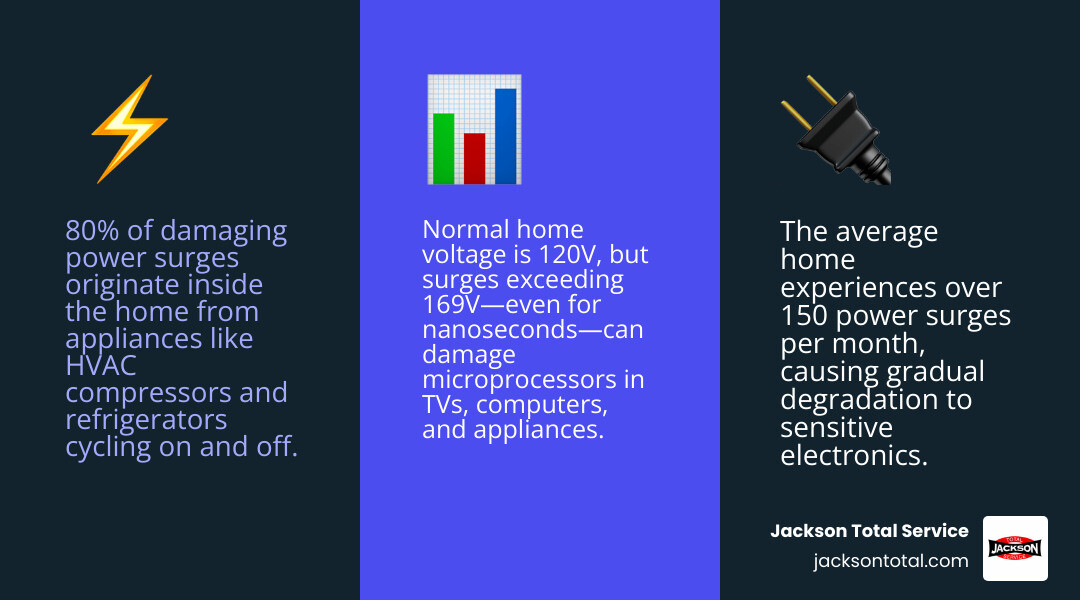
When we talk about electricity in a standard American home in April 2026, we usually talk about 120 volts. However, “120V” is more of an average than a constant. In reality, voltage fluctuates between 0 and 169 volts without causing immediate alarm. The danger begins when the voltage exceeds that 169V threshold. Even a surge lasting only a few nanoseconds can be enough to fry the delicate microprocessors found in almost everything we own today.
Think about your home for a second. It’s likely filled with thousands of dollars in technology. From your smart refrigerator in the kitchen to that 4K home theater system in the living room, every one of these devices relies on sensitive circuit boards. When a surge hits, it’s like a tidal wave hitting a garden hose; the pressure is simply too much for the components to handle.
While a massive surge might cause a “catastrophic failure” (where the device smokes or pops and never turns on again), the more common issue is cumulative degradation. This is the “death by a thousand cuts” scenario. Small, repeated surges wear down the internal components of your electronics, shortening their lifespan significantly. If you’ve ever had a microwave or a computer monitor die after only two or three years for no apparent reason, you likely experienced the results of unprotected power surges. If you suspect your home has already suffered from these silent killers, seeking professional Electrical Repair is the first step toward stabilizing your system.
Internal vs. External Surges: Where the Real Danger Lies
Most people think of lightning when they hear the words “power surge.” While lightning is a major factor here in Naples and Fort Myers, it actually causes less than 5% of all surges. The real “shocking truth” is that approximately 80% of damaging power surges actually originate inside your home’s electrical systems.
How does this happen? It’s called appliance cycling. Every time a high-powered device like your HVAC compressor, refrigerator motor, or dishwasher kicks on or off, it sends a small spike of electricity back through the rest of your home’s wiring. Research shows that the average home can experience more than 150 of these internal surges per month.
These internal fluctuations are constant. Because they happen so frequently, they are actually more dangerous over the long term than the rare lightning strike. They slowly eat away at the “health” of your electronics. If you find yourself constantly resetting breakers when your AC turns on, you might need to look into Circuit Breaker Troubleshooting to see if your system is being overloaded by these internal spikes.
Do I need surge protection for my home if I have a newer electrical panel?
You might think that because your home was built recently, you’re already covered. It is true that the National Electrical Code (NEC) has required surge protective devices (SPDs) in new residential panels since 2020. In fact, 42 of 50 US states (86%) have adopted NEC 2020 or higher standards.
However, even if you have a newer panel, it’s important to verify that the SPD is actually installed and functioning. Modern circuit boards are more sensitive than those made twenty years ago. Even with a new panel, the internal surges from your appliances can still bypass the main breaker and head straight for your computer or smart TV. Having a professional check your panel ensures that your “defense” is actually active and properly grounded.
Whole-Home Surge Protectors vs. Power Strips
Many homeowners ask us, “Can’t I just use those $20 power strips from the big-box store?” The answer is that power strips are only one piece of the puzzle. To truly protect your home, you need a layered defense strategy.
| Feature | Whole-Home SPD (Type 2) | Plug-In Power Strip (Type 3) |
|---|---|---|
| Installation Point | Main Electrical Panel | Individual Wall Outlet |
| Protects Hardwired Items? | Yes (HVAC, Oven, Lights) | No |
| Internal Surge Protection | Yes, redirects to ground | Minimal |
| External Surge Protection | Excellent (Utility spikes) | Low-level only |
| Lifespan | 5–10 Years | 3–5 Years |
The biggest limitation of power strips is that they cannot protect hardwired appliances. Your central air conditioner, your electric water heater, and your built-in oven are all directly connected to your home’s wiring. You can’t plug an HVAC system into a power strip. A whole-home surge protector acts as a “bouncer” at the front door of your home, stopping surges at the panel before they can travel through the walls to your expensive equipment. For residents in our area, following an Electrical Installation Naples Fl Complete Guide can help you understand how these systems integrate with your specific home layout.
National Electrical Code and Florida Safety Standards
Electrical safety isn’t just a suggestion; it’s a matter of code. NEC Article 242 specifically addresses surge protection for dwelling unit services. The goal is to ensure that every home has a baseline level of protection against transient voltages.
A critical part of this protection is the grounding system. A surge protector works by “dumping” excess voltage into the ground. If your home’s grounding is old, corroded, or improperly installed, even the most expensive surge protector won’t work. This is why we always emphasize Tag/Electrical Safety Tips — the system is only as strong as its weakest link.
Why Florida homeowners ask: Do I need surge protection for my home during hurricane season?
Southwest Florida is often called the “lightning capital” of the United States. During hurricane season and our intense summer afternoon storms, the grid is under constant stress. But it’s not just the lightning strikes that cause trouble.
One of the most dangerous times for your electronics is when the power comes back on after an outage. When the utility company restores power to a neighborhood, it often results in a massive “restoration spike” as thousands of AC units and appliances all try to pull power at the exact same moment. This utility switching can send thousands of volts through your lines. Without a whole-home protector, your HVAC system’s circuit board could be fried the second the lights flicker back on.
Signs Your Electrical System is Struggling
How do you know if you’re already a victim of power surges? Your home usually tries to tell you. Look for these warning signs:
- Flickering or Dimming Lights: If your lights flicker when the refrigerator or AC kicks on, it’s a sign that those appliances are causing significant voltage fluctuations.
- Frequent Breaker Trips: If you find yourself constantly walking to the garage to flip a switch, your system is struggling to handle the load and the resulting surges. If this is happening in Lee County, you might need Electrical Repair Fort Myers Fl to diagnose the root cause.
- Burnt Smells or Discoloration: If you see any charring or “toasted” looks on your outlets, a surge has likely already occurred. This is a fire hazard and needs immediate attention.
- “Ghost” Resets: If your digital clock on the oven or microwave is always flashing 12:00, but you didn’t have a power outage, it’s likely that a small surge caused the device to reboot.
Frequently Asked Questions about Home Surge Protection
How long do whole-home surge protective devices last?
Most surge protectors use components called Metal Oxide Varistors (MOVs). Think of an MOV like a sponge — it can only absorb so much “water” (excess voltage) before it’s full. Every time a surge is diverted, the MOV degrades slightly. Typically, a whole-home SPD will last between 5 and 10 years, depending on how many surges it has blocked. Most modern units have indicator lights; if the light turns red or goes out, it means the “sponge” is full and the device needs to be replaced.
Can surge protectors handle direct lightning strikes?
This is a common myth. To be honest, almost nothing can stop a direct lightning strike. Lightning contains millions of volts and can jump across open air. However, surge protectors are excellent at handling indirect strikes — for example, if lightning hits a transformer down the street or a tree near a power line. For the best protection during a severe Southwest Florida storm, we still recommend unplugging your most sensitive gear, like high-end computers, even if you have protection installed.
What is the best joule rating for home protection?
When choosing a whole-home device, you’ll see ratings like kA (kiloamps) and VPR (Voltage Protection Rating). For most residential homes in places like Estero or Bonita Springs, a Type 2 SPD rated between 40kA and 80kA is the standard. You also want a low VPR — ideally 600V or less. This ensures the device “claps down” on the surge quickly before it reaches a dangerous level for your appliances.
Conclusion
At the end of the day, your home’s electrical system is the heartbeat of your daily life. From keeping you cool in the Florida heat to keeping your food fresh and your devices charged, you rely on steady, clean power.
Jackson Total Service has been providing Southwest Florida with reliable comfort solutions since 1964. We understand the unique challenges of our local climate and the stress it puts on your home. Whether you are in Naples, Marco Island, or Cape Coral, our team of licensed experts is here to ensure your home is safe, compliant, and protected from the “shocking truth” of power surges.
Don’t wait for a major storm or a fried HVAC board to think about protection. Investing in a whole-home surge protector is one of the most cost-effective ways to safeguard your home’s future. For more information on how we can help you secure your home, explore our full range of Electrical Services today.