


Why the Best AC, Plumbing, and Electrical Setup for Southwest Florida Is Unlike Anywhere Else in the Country
Finding the best AC plumbing and electrical setup for Southwest Florida is not as simple as picking popular brands or copying what works in other states. Southwest Florida’s combination of intense heat, humidity that regularly climbs above 90%, coastal salt air, and hurricane season creates a home environment that pushes every system harder than almost anywhere else in the country.
Quick Answer: Best AC, Plumbing & Electrical Setup for SWFL Homes
| System | Best Setup for SWFL |
|---|---|
| AC | High-SEER2 (15+) central system or ductless mini-split with dehumidification capability and coastal-grade coil coatings |
| Plumbing | Corrosion-resistant piping, tankless or high-efficiency water heater, whole-home water treatment or softener |
| Electrical | Updated panel with surge protection, GFCI/AFCI breakers, generator or transfer switch for storm readiness |
| All Systems | Sized correctly using Manual J calculations, permitted through Lee or Collier County, maintained at least annually |
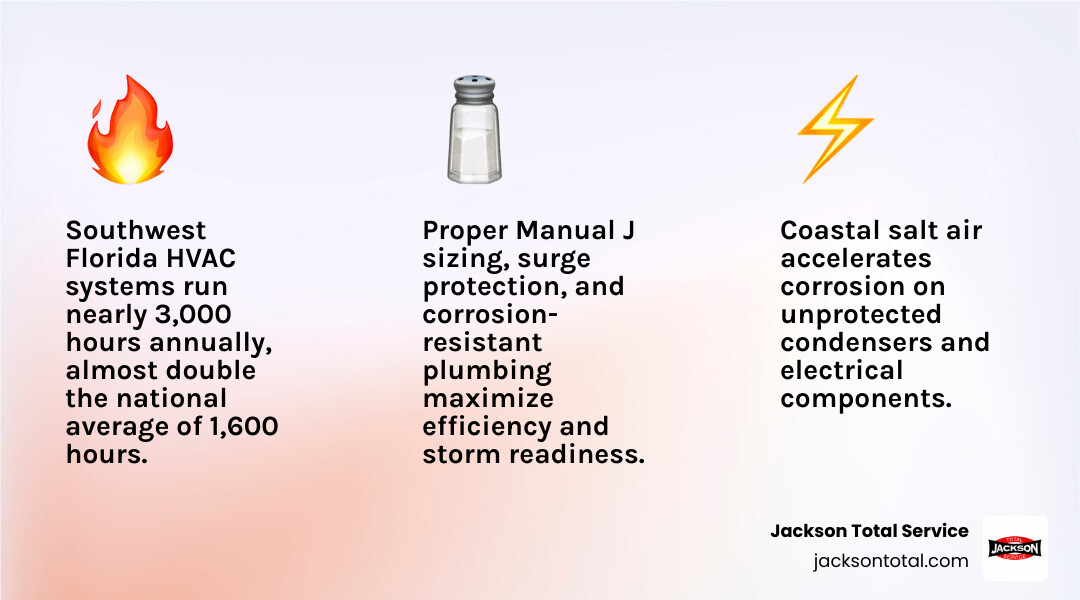
Consider what your home systems are actually up against here. HVAC units in Southwest Florida run up to 3,000 hours per year — nearly double the national average of 1,600 hours. That kind of workload ages equipment fast. An aging AC unit that has lost even a fraction of its efficiency can push your monthly utility bill up by as much as 40% during a typical July. And that’s before factoring in what salt air does to unprotected outdoor components, or what a single surge from a summer storm can do to an electrical system without proper protection.
Plumbing faces its own regional pressures too — from hard water mineral buildup to the high humidity that accelerates pipe corrosion in poorly ventilated spaces.
The good news is that when your AC, plumbing, and electrical systems are designed and installed correctly for this specific climate, they work together to keep your home comfortable, safe, and efficient year-round. Jackson Total Service has been helping Southwest Florida homeowners — across Naples, Bonita Springs, Estero, Marco Island, and surrounding Lee and Collier County communities — build exactly that kind of reliable home setup since 1964.
This guide walks you through everything you need to know to get it right.
Designing the Best AC Plumbing and Electrical Setup for Southwest Florida
When we talk about the best AC plumbing and electrical setup for Southwest Florida, we are not talking about three separate projects. We are talking about an integrated ecosystem. Your high-efficiency air conditioner relies on a robust electrical panel to power its variable-speed compressor. Meanwhile, your AC’s condensate drain line connects directly to your home’s wastewater plumbing. If your plumbing backs up, your AC could shut down—or worse, flood your home.
Designing this setup correctly requires a scientific, data-driven approach. It begins with professional engineering calculations rather than outdated rules of thumb.
Sizing Your Comfort: Manual J and SEER2
The foundation of a great HVAC system is the Manual J load calculation. Many contractors still estimate system size based solely on square footage, but this shortcut is a major mistake in Florida. An oversized system will quickly cool the air but shut off before it can pull humidity out of the room. This “short-cycling” leaves your home feeling cold and sticky, while driving up your energy bills and encouraging mold growth. A true Manual J calculation factors in your home’s insulation levels, attic ventilation, window types, and sun orientation to find the exact tonnage you need.
Once the size is established, we look at efficiency. As of our current year of 2026, the Department of Energy enforces strict SEER2 (Seasonal Energy Efficiency Ratio 2) standards. In the southern region, split-system air conditioners must meet a minimum of 15.2 SEER2. Upgrading from an old, degraded 10-SEER unit to a modern 18-SEER2 system can slash your cooling energy consumption by 30% to 40%.
Furthermore, 2026 marks a major environmental transition. New air conditioning installations are now required to use low-GWP (Global Warming Potential) refrigerants, such as R-32 or R-454B. This transition makes professional installation and system matching more critical than ever. Replacing only the outdoor condenser while leaving an old indoor air handler reduces system efficiency by up to 15% and can void your manufacturer warranty.
To keep these complex, modern systems running smoothly, you need comprehensive Air Conditioning Services to handle the installation, paired with trusted Plumbing Services for condensate lines and Electrical Services to safely handle the power distribution.
Choosing the Best AC Plumbing and Electrical Setup for Southwest Florida Homes
Every property has its own architectural personality, which means the ideal climate control layout varies from home to home.
For traditional layouts with existing ductwork, a high-efficiency central split system is usually the most practical choice. However, we are seeing a massive rise in ductless mini-split systems across Southwest Florida. Mini-splits are perfect for:
- Florida rooms, enclosed lanais, and garage workshops.
- Homes with vaulted ceilings or limited attic space where running ductwork is impractical.
- Multi-story homes where the upstairs master bedroom is consistently hotter than the downstairs living room.
Because mini-splits allow you to cool individual zones independently, they offer incredible energy savings. Regardless of whether you choose central air or mini-splits, managing indoor air quality (IAQ) is vital. Because we keep our homes sealed tightly against the Florida heat, indoor air can trap dust, pollen, and mold spores. Integrating whole-home dehumidifiers, high-MERV air filters, and UV germicidal lights into your HVAC system ensures your air stays clean and dry.
If you are looking to upgrade your home’s climate control, you can find localized expertise through Air Conditioning Services Naples FL or Air Conditioning Services Fort Myers FL to design the perfect configuration for your neighborhood.
Implementing the Best AC Plumbing and Electrical Setup for Southwest Florida Coastal Properties
If you live close to the water in places like Cape Coral, Fort Myers Beach, or Sanibel Island, your home faces a highly corrosive environment.

Salt air is incredibly destructive to raw metal. Unprotected aluminum fins on a standard outdoor condenser unit can begin to pit, degrade, and lose heat-transfer efficiency within just 24 months of exposure if your home is within five miles of the Gulf.
To protect your investment, coastal properties require specialized equipment specifications:
- Epoxy and Anti-Corrosive Coatings: Outdoor coils should feature marine-grade epoxy coatings (often referred to as “Blue Fin” or specialized factory coatings). These barriers prevent salt spray from eating away at the delicate aluminum and copper.
- Elevated Hurricane-Rated Pads: Heavy rains and coastal storm surges can quickly flood low-lying yards. Condensers must be secured to elevated, heavy-duty concrete or composite pads using hurricane anchors designed to withstand high-velocity winds.
- Elevated Condenser Stands: In high-risk flood zones, elevating the entire outdoor unit several feet off the ground on a sturdy aluminum stand keeps it safe from rising waters.
For homeowners dealing with these harsh coastal conditions, securing expert help from a provider specializing in the Best AC Repair Cape Coral FL or utilizing coastal-specific Air Conditioning Services Cape Coral FL is the best way to ensure your outdoor equipment survives the elements.
Protecting Your Plumbing and Electrical Infrastructure in SWFL
While your air conditioner keeps you cool, your plumbing and electrical systems keep your home running safely. In Southwest Florida, protecting these systems from environmental threats is a top priority.
High-Efficiency Water Heating and Plumbing Solutions
The water in Southwest Florida is notoriously hard, packed with calcium and magnesium that can quickly destroy your plumbing infrastructure. Over time, scale builds up inside your pipes, clogs faucet aerators, and coats the heating elements in your water heater, forcing it to work harder and fail prematurely.
To protect your home, we recommend a multi-layered plumbing setup:
- Whole-Home Water Softeners and Reverse Osmosis (RO) Systems: A water softener neutralizes hard minerals, while a whole-home reverse osmosis system filters out impurities, protecting your pipes and providing bottled-water quality from every tap.
- Tankless Water Heaters: Traditional tank-style water heaters store hot water constantly, wasting standby energy and remaining vulnerable to scale buildup. Tankless water heaters heat water on demand. They are highly efficient, take up minimal wall space, and last up to twice as long as standard tanks when properly maintained.
- Corrosion-Resistant Piping: Older copper pipes can pit and leak when exposed to certain water chemistry or humid environments. Modern PEX (cross-linked polyethylene) piping is highly flexible, scale-resistant, and immune to the chemical corrosion that plagues metal pipes.
Whether you need to clear a stubborn clog or upgrade your water heating system, partnering with a reliable Plumber in Naples FL for professional Plumbing Repair, Water Heater Repair, or specialized Plumbing Repair in Naples FL will keep your freshwater flowing and your drains clear.
Robust Electrical Systems and Storm Readiness
Southwest Florida is the lightning capital of the country, and our summer tropical storms can knock out utility power for days. Protecting your home’s electrical system is not just about convenience; it’s about safety.
A robust electrical setup starts at your main breaker panel. Many older homes in our area still run on 100-amp or 150-amp panels. With the addition of modern variable-speed AC units, tankless water heaters, and electric vehicle chargers, these panels can quickly become overloaded. Upgrading to a modern 200-amp panel ensures you have the capacity to run your appliances safely.
To protect your electronics from lightning strikes and grid fluctuations, we install whole-home surge protection directly at the electrical panel. This system clamps down on massive voltage spikes before they can travel through your house and fry your AC compressor, refrigerator, or computers.
For storm backup, you have two main options:
- Standby Whole-Home Generators: These systems run on natural gas or liquid propane and turn on automatically within seconds of a power outage, keeping your AC running and your food cold.
- Portable Generator Transfer Switches: A transfer switch is a safe, code-compliant way to connect a portable generator directly to your breaker panel, allowing you to power select circuits without running dangerous extension cords through open windows.
To explore your options for storm-proofing your home, read our Electrical Installation Naples FL Complete Guide, check out our services for Generators, or schedule an Electrical Repair with our team. If you are located further north, our technicians also provide expert Electrical Repair Fort Myers FL and local Ceiling Fan Installation to keep air moving during warm afternoons.
Key Signs It Is Time to Upgrade Your SWFL Home Systems
Because our local climate is so demanding, home systems in Southwest Florida age faster than they would in other parts of the country. Knowing when to repair a system and when to replace it can save you thousands of dollars in emergency service calls and high utility bills.
Here are the key warning signs that your home systems are reaching the end of their reliable lifespans:
- Air Conditioning: If your unit is over 10 years old, requires frequent refrigerant top-offs, struggles to keep indoor humidity below 55%, or causes your electric bills to climb steadily, it is likely time for an upgrade.
- Plumbing: Low water pressure, rust-colored water, frequent drain backups, or damp spots on your drywall or flooring indicate deteriorating pipes or a failing water heater.
- Electrical: Flickering lights, breakers that trip constantly, outlets that feel warm to the touch, or a panel that hums when major appliances turn on are serious fire hazards that require immediate attention.
To help you evaluate your home, we have put together this quick-reference comparison:
| System | Repair Indicator | Replacement Indicator |
|---|---|---|
| Air Conditioning | Minor component failure (e.g., bad capacitor); system is under 8 years old; consistent cooling performance. | Compressor failure; system is over 10–12 years old; uses obsolete R-22 refrigerant; frequent leaks. |
| Plumbing | Single isolated pipe leak; minor faucet drip; water heater requires a new heating element or anode rod. | Widespread pipe corrosion; frequent slab leaks; water heater tank is leaking from the bottom. |
| Electrical | Loose wire connection; single broken outlet; individual breaker needs replacement. | Outdated panel brand; panel is maxed out with no room for new circuits; widespread flickering lights. |
If you notice any of these red flags, do not wait for a complete system failure. Scheduling a professional assessment for Air Conditioning Repair, Plumbing Repair Bonita Springs FL, or Electrical Repair Bonita Springs FL can help you make an informed decision before an emergency occurs.
Frequently Asked Questions About Southwest Florida Home Systems
Do I need a permit for AC, plumbing, or electrical replacements in Southwest Florida?
Yes. Both Lee and Collier County building departments strictly enforce the Florida Building Code. Replacing an air conditioner, water heater, electrical panel, or installing a standby generator requires a municipal permit.
These permits ensure that the work is performed safely, meets local wind-load requirements (crucial for outdoor equipment during hurricanes), and complies with electrical safety standards. Once the installation is complete, a county inspector will visit your home to verify that everything is up to code.
How does the coastal salt air affect my outdoor HVAC and electrical components?
Salt air carries tiny moisture droplets laden with salt, which settle on outdoor metal surfaces. This salt acts as an electrolyte, accelerating galvanic corrosion between different metals (such as the copper tubes and aluminum fins in your AC condenser).
As the metal corrodes, it pits and degrades, reducing the system’s ability to release heat and causing your compressor to run hotter and consume more electricity. Regular maintenance, including rinsing the coils with fresh water and applying protective coatings, is essential to combat this damage.
How often should I schedule maintenance for my home systems in SWFL?
Because your AC runs almost year-round in Florida, we highly recommend scheduling professional maintenance at least twice a year—once in the spring before the summer heat hits, and once in the autumn.
Plumbing systems and electrical panels should receive a comprehensive safety inspection at least once a year to check for hidden leaks, scale buildup, loose electrical connections, and proper surge protector operation. Additionally, scheduling a professional Duct Cleaning every few years helps keep your indoor air fresh and free of dust and allergens.
Conclusion
Building the best AC plumbing and electrical setup for Southwest Florida requires an understanding of how our local environment impacts home infrastructure. From sizing your air conditioner with a precise Manual J calculation to protecting your electronics from lightning with whole-home surge protection, taking a proactive, integrated approach is the key to long-term comfort, safety, and energy savings.
At Jackson Total Service, we have been providing complete, integrated home comfort solutions to our neighbors across Naples, Bonita Springs, Estero, Marco Island, and the surrounding communities since 1964. By offering expert HVAC, plumbing, and electrical services under one roof, we eliminate the hassle of managing multiple contractors. Whether you need a simple repair, a storm-ready upgrade, or 24-hour emergency support, our licensed, background-checked technicians are here to help.
Don’t wait for the next summer storm or heatwave to test your home’s limits. Schedule your comprehensive home comfort consultation today and let our family keep your family comfortable.