


Why Does the House Feel Cold But Clammy?
Are you wondering why your thermostat reads 70 degrees, yet you are still sweating, and whether evaluating Variable-Speed vs. Single-Stage ACs for Managing 90-Percent Humidity Days is the secret to finally getting comfortable? You are not alone in this frustration. When the air inside your home feels heavy, sticky, and damp despite the air conditioner running constantly, you are experiencing a fundamental mismatch between temperature control and moisture removal. Dropping the temperature on your thermostat is simply not the same mechanical process as extracting heavy moisture from the indoor air.
If you are tired of shivering in a damp house, explore our HVAC services or contact us for an AC consultation to find a permanent solution.
The core problem lies in how traditional air conditioning systems operate. Many homeowners assume that if the air coming out of the vents is cold, the system is doing its job perfectly. However, comfort is a two-part equation: sensible cooling (lowering the actual temperature) and latent cooling (wringing the water vapor out of the air). When you are dealing with 90-percent relative humidity, the latent heat load becomes the dominant factor in your overall comfort. A standard system often cools the air so quickly that it shuts off before it has a chance to address the moisture, leaving you trapped in a cold but clammy environment. Solving this specific issue requires evaluating whether an equipment upgrade is the right path forward.
The Physics of Dehumidification: Latent vs. Sensible Cooling
To understand why your home feels damp, you have to look at the mechanical differences between dropping the temperature and actually removing moisture from the environment. Air conditioners do not create cold air; they remove heat and humidity from the existing indoor air and pump it outside.
Understanding Sensible Cooling
Sensible cooling is the process of lowering the ambient temperature of a room. This is the metric your thermostat reads. When the thermostat detects that the room has reached the target temperature, it signals the air conditioner to stop cooling. This process happens relatively quickly, especially if the air conditioning unit has a high cooling capacity.
Understanding Latent Cooling
Latent cooling, on the other hand, is the process of changing the state of the moisture in the air from a vapor into a liquid so it can be drained away. This is the true engine of dehumidification. Think of a glass of ice water sitting on a table during peak summer high-humidity days. Condensation forms on the outside of the glass because the cold surface extracts moisture from the warm, humid air around it.
Your air conditioner’s indoor evaporator coil works on the exact same principle. However, there is a mechanical reality that cannot be bypassed: an AC evaporator coil takes roughly 10 to 15 minutes of continuous, uninterrupted operation just to get cold enough to start extracting that moisture effectively. During severe weather, the latent heat load—the sheer volume of water vapor in your home—can account for more than half of your total cooling requirement. Continuous airflow over a sufficiently cold coil is the only mechanical way to wring that moisture out. If the system stops running before that 15-minute mark, the dehumidification process never truly begins.
How Single-Stage ACs Fall Short When Moisture Spikes
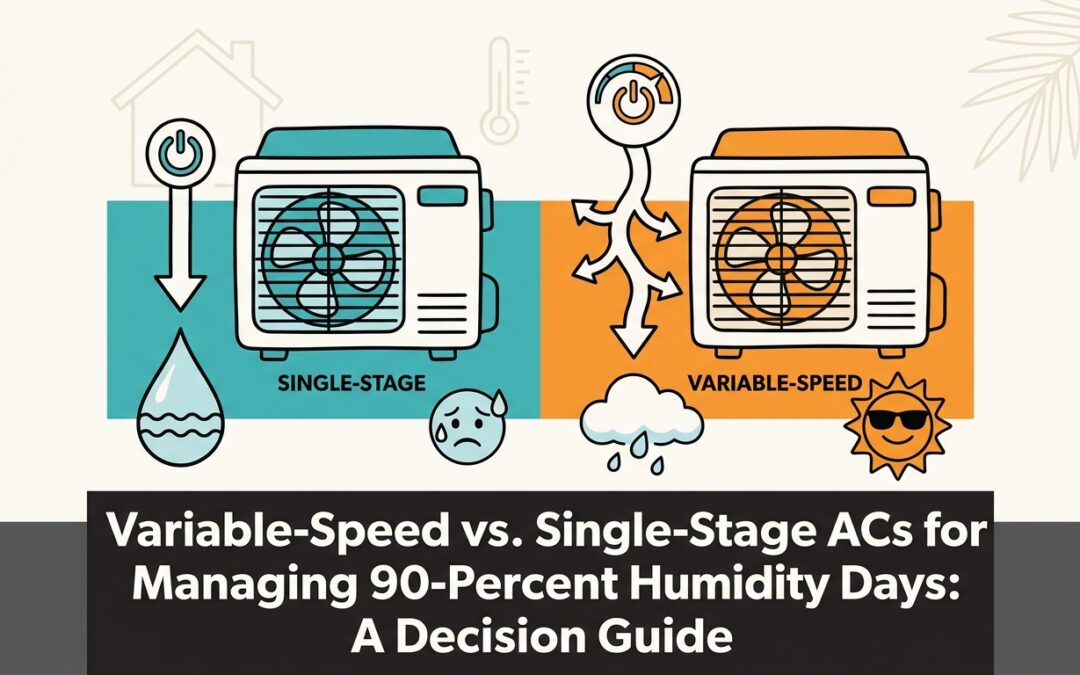
The Problem: A traditional single-stage compressor only operates at one speed: 100 percent capacity. When the thermostat calls for cooling, the system blasts cold air at full power until the target temperature is reached, and then it shuts off completely. This all-or-nothing approach is highly inefficient for managing indoor moisture.
The Cause: Because a single-stage unit pushes out maximum cooling capacity the entire time it runs, it often satisfies the thermostat’s temperature setting very quickly. In extreme high-humidity coastal or southern climates, outdoor dew points frequently exceed 70 degrees, creating a massive moisture load indoors. The single-stage system blasts the house with cold air, dropping the sensible temperature in just eight to ten minutes. Because the thermostat is satisfied, the system shuts down prematurely. The evaporator coil never gets the 15 minutes of continuous runtime required to start pulling condensation out of the air. The system short-cycles, turning on and off rapidly throughout the day.
The Solution: This short-cycling behavior leaves the heavy moisture suspended in the indoor air, creating the dreaded “cold but clammy” sensation. Furthermore, the constant starting and stopping creates significant mechanical wear and tear on the compressor and blower motor. Overcoming 90-percent relative humidity requires a mechanical solution that prioritizes continuous airflow over rapid temperature drops, which is exactly where advanced compressor technology steps in.
The Variable-Speed Advantage for Moisture Removal
Variable-speed compressors completely change the physics of indoor climate control. Instead of operating solely at 100 percent capacity, these advanced systems can ramp their output up and down in micro-increments, matching the exact real-time demands of your home.
Here is exactly how a variable-speed system manages peak summer high-humidity days:
- Detecting the load: Advanced thermostats paired with variable-speed systems monitor both the sensible temperature and the indoor relative humidity. When humidity spikes, the system registers the need for latent cooling.
- Ramping down capacity: Instead of blasting cold air at full power, the variable-speed compressor ramps down to run at capacities as low as 25 to 30 percent. The indoor blower motor slows down to match this lower output.
- Extending the cooling cycle: By running at a much lower speed, the system avoids overcooling the space. Instead of satisfying the thermostat in 10 minutes and shutting off, the system might run continuously for 45 minutes or more at a gentle, whisper-quiet pace.
- Continuous moisture extraction: Because the system operates continuously, the evaporator coil remains cold for extended periods. This prolonged coil contact time allows the system to wring out heavy indoor moisture steadily, draining gallons of water out of your home’s air without freezing you out of the living room.
Many variable-speed systems also feature dedicated dehumidification modes. In this mode, the system prioritizes moisture removal over temperature drops, slowing the airflow over the coil specifically to maximize condensation extraction.
Side-by-Side Comparison: Variable-Speed vs. Single-Stage Systems
When deciding how to manage 90-percent relative humidity indoors, looking at a direct comparison of the two technologies helps clarify the long-term impact on your daily comfort and utility bills.
| Feature | Single-Stage AC | Variable-Speed AC |
|---|---|---|
| Moisture Removal | Intermittent and poor. Short-cycles prevent the coil from extracting heavy humidity. | Continuous and excellent. Long run times at low speeds wring out maximum moisture. |
| Energy Efficiency | Lower SEER ratings. Consumes massive energy during constant on/off start-ups. | High SEER ratings. Uses very little electricity to maintain steady, low-speed operation. |
| Noise Levels | Loud start-ups and noticeable air blasts every time the system cycles on. | Whisper-quiet. Often operates so silently you won’t even notice it is running. |
| Upfront Investment | Standard replacement cost. Focuses strictly on basic temperature control. | Premium comfort upgrade. Higher initial cost, but solves complex humidity issues. |

The Crucial Role of Professional Sizing and Configuration
Purchasing top-tier hardware is completely useless without expert configuration. Bridging the gap between the equipment in the box and the actual performance in your home requires rigorous mathematical sizing and setup.
The Danger of Oversizing: A common misconception is that a bigger air conditioner will handle humidity better. The opposite is true. If a variable-speed unit is oversized for your home’s square footage and thermal envelope, it will still cool the house too quickly. Even at its lowest operating speed, an oversized system will short-cycle, completely defeating the purpose of the variable-speed technology and failing to dehumidify the air.
Configuring Blower Speeds: Proper moisture removal requires precise airflow management. Technicians must configure the indoor blower motor speeds specifically for latent cooling. This involves adjusting the cubic feet per minute (CFM) of air moving across the coil per ton of cooling capacity. If the air moves too fast, the moisture doesn’t have time to condense; if it moves too slow, the coil can freeze.
Environmental Factors: Harsh environments demand specialized setups. For example, homes dealing with extreme humidity often face other elemental challenges, such as the wear and tear seen on coastal AC condensers. Protecting the outdoor equipment while optimizing the indoor air handler requires deep local expertise. Working with a team that has specific local expertise in configuring and sizing AC systems for extreme humidity control proves that expert setup—not just swapping boxes—is the true differentiator. Unlocking the full potential of a variable-speed unit requires precision engineering during installation.
Making the Decision: Is a Variable-Speed Upgrade Justified?
Deciding whether to invest in a variable-speed system comes down to evaluating your specific pain points and long-term goals. Use this framework to determine if the upgrade makes sense for your home:
- Assess your current comfort levels: Pay attention to your physical environment. If your home consistently feels sticky, if your floors feel slick, or if you find yourself lowering the thermostat to 68 degrees just to stop sweating during 90-percent relative humidity days, the upgrade is highly beneficial.
- Evaluate long-term plans: Factor in the lifespan of the equipment. If you plan to stay in your home for the next decade, the ongoing energy savings from running a variable-speed compressor at lower capacities will offset a significant portion of the initial investment.
- Consider the health benefits: Maintaining proper indoor humidity (ideally between 40 and 50 percent) is vital for indoor air quality. Continuous dehumidification prevents the excessive moisture buildup that fuels mold, mildew, and dust mite proliferation in ductwork and living spaces.
- Weigh the upfront cost: A variable-speed system requires a higher initial investment than a basic single-stage unit. However, this cost is an investment in eliminating the clammy feeling permanently, protecting your home’s interior from moisture damage, and achieving precise climate control.
Frequently Asked Questions
Why does my house feel cold and clammy with the AC on?
Your house feels cold and clammy because the air conditioner is lowering the temperature without running long enough to remove the moisture from the air. This usually happens when a single-stage system is oversized or when outdoor humidity is exceptionally high. The system blasts cold air, satisfies the thermostat quickly, and shuts off before the evaporator coil has time to extract the suspended water vapor.
Does a variable speed AC dehumidify better than a standard unit?
Yes, a variable-speed AC dehumidifies significantly better than a standard unit. Because it can ramp down its cooling capacity to 25 or 30 percent, it can run continuously without overcooling your home. This extended, steady runtime allows the indoor coil to stay cold and extract moisture from the air for hours at a time, rather than shutting off after ten minutes.
How does a single stage AC work in high humidity?
A single-stage AC works poorly in high humidity because it only has one speed: 100 percent maximum capacity. It cools the indoor air rapidly, which drops the sensible temperature but leaves the heavy moisture behind. Because it turns on and off frequently (short-cycling), it never achieves the continuous airflow needed to effectively wring water vapor out of the environment.
Is a variable speed AC worth the extra money for comfort?
A variable-speed AC is highly worth the extra investment if you struggle with damp, sticky indoor air or uneven temperatures. The technology eliminates the drastic temperature swings and loud start-ups associated with traditional units. By constantly adjusting to your home’s exact needs, it provides a level of precise, quiet comfort and moisture control that standard systems simply cannot match.
How long does an AC need to run to actually remove humidity?
An AC needs to run continuously for at least 10 to 15 minutes before the indoor evaporator coil gets cold enough to begin extracting moisture from the air. Any cycle shorter than 15 minutes is almost entirely sensible cooling (temperature drop) with virtually no latent cooling (dehumidification). Longer cycles of 30 to 45 minutes are ideal for heavy moisture removal.
Can a smart thermostat improve my single-stage AC’s dehumidification?
A smart thermostat can slightly improve a single-stage AC’s dehumidification by allowing you to set humidity thresholds, but it cannot change the mechanical limits of the compressor. The thermostat can force the single-stage unit to run longer to remove moisture, but this will result in overcooling the house, making it uncomfortably cold just to get the humidity down.
Ready to Fix the Clammy Feeling?
Living with high indoor humidity is uncomfortable, inefficient, and entirely preventable with the right technology and proper sizing. If you are ready to stop shivering in a damp house and want to explore the exact variable-speed solutions that will keep your home perfectly balanced, contact us for an AC consultation today.