



Why Skipping AC Maintenance in Humidity Is a Risk No Southwest Florida Homeowner Can Afford
What happens if you skip AC maintenance in humidity is something many Naples and Southwest Florida homeowners only discover the hard way — usually when the system stops cooling on the most sweltering afternoon of the year.
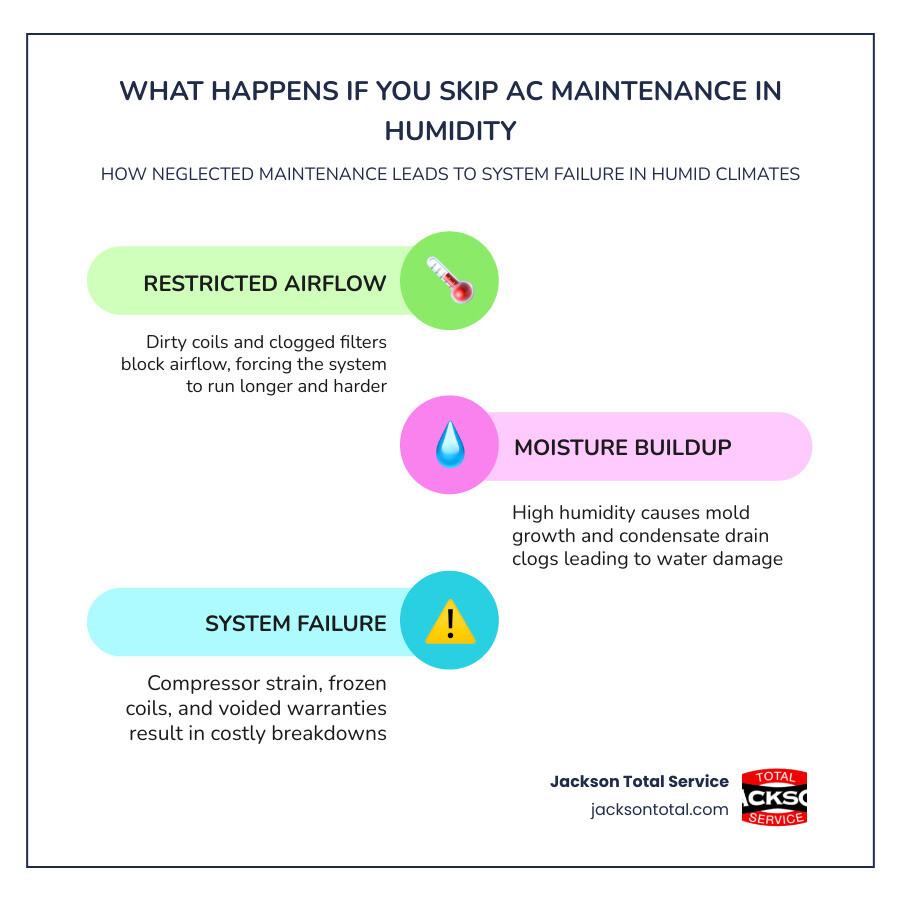
Here is a quick summary of what you risk when maintenance gets skipped in a humid climate:
- Higher energy bills – Dirty coils and clogged filters force your system to run longer and work harder, increasing energy use by 15-30%
- Mold and mildew growth – High humidity combined with neglected coils and drain lines creates ideal conditions for mold to spread through your ductwork
- Frozen evaporator coils – Restricted airflow from dirty filters causes ice buildup even in 90-degree heat
- Water damage – Clogged condensate drain lines overflow, leading to leaks that damage ceilings and floors
- Compressor failure – The most expensive AC repair, often triggered by compressor overwork in humid conditions
- Poor indoor air quality – Mold spores, bacteria, and allergens circulate through your home with every cycle
- Voided manufacturer warranty – Most warranties require documented annual professional maintenance to remain valid
- Shorter system lifespan – Neglected systems in humid climates can fail years earlier than well-maintained ones
Southwest Florida’s climate is not like the rest of the country. Naples, Bonita Springs, Estero, and Marco Island sit in one of the most humid regions in the United States. Your AC does not just cool the air — it works constantly to pull moisture out of it. That dual burden puts enormous strain on every component in your system. When routine maintenance gets skipped, that strain compounds quickly, and the consequences are faster and more severe here than they would be in a drier climate.
Jackson Total Service has been keeping Southwest Florida homes comfortable since 1964, and the team sees the same preventable problems every summer — problems that start small and turn costly when maintenance gets pushed off one season too long.
Handy what happens if you skip ac maintenance in humidity terms:
The Science of Latent Heat: Why Your AC Works Double-Time in Southwest Florida
To understand why skipping maintenance is so dangerous in Southwest Florida, we have to look at how air conditioners actually work in our tropical climate. An air conditioner has two jobs: lowering the temperature (known as sensible cooling) and removing moisture from the air (known as latent cooling).
In a dry climate, the AC mostly focuses on sensible cooling. But in places like Fort Myers, Cape Coral, and Naples, the latent heat load is massive. When warm, humid air passes over the freezing cold evaporator coil inside your air handler, the moisture in the air condenses into liquid water, dripping down into a drain pan. This process is exactly like the condensation that forms on the outside of an iced tea glass on a hot July afternoon.
Because our air is incredibly heavy with water vapor, your AC must remove gallons of water from your indoor air every single day just to keep you comfortable. This places a continuous physical load on the blower motor, the refrigerant loop, and the compressor. When you schedule routine care, technicians ensure that these components are clean and calibrated to handle this heavy lifting. Without that attention, the system quickly loses its ability to manage both the heat and the moisture. To dive deeper into how our local weather shapes your system’s needs, check out Why Your AC Needs Extra Love in Humid Climates.
What Happens If You Skip AC Maintenance in Humidity

When you choose to skip your seasonal AC tune-up, your system does not fail overnight. Instead, it enters a slow, quiet decline. In Southwest Florida, this decline is accelerated by our near-constant humidity.
As dust, pollen, and pet dander mix with the high moisture levels inside your system, they form a sticky, insulating layer over your AC’s critical components. This grime acts like a blanket, trapping heat and preventing the refrigerant from absorbing warmth from your home. To learn more about this compounding process, read The Ultimate Guide to Humidity and AC Maintenance Needs.
If you ignore regular tune-ups, several mechanical and structural failures are highly likely to occur.
Frozen Evaporator Coils and Restricted Airflow
It sounds impossible that an air conditioner could freeze solid when it is 95 degrees outside in Estero or Sanibel Island, but frozen evaporator coils are incredibly common when maintenance is neglected.
Your evaporator coil needs a steady, unrestricted flow of warm indoor air to keep the refrigerant inside it from dropping below freezing. If your air filter is clogged with dust, or if the coil itself is coated in a layer of grime, that crucial airflow is restricted.
Because the humid air cannot pass over the coil fast enough, the moisture that condenses on the cold metal surface does not drip away. Instead, it freezes. This thin layer of ice restricts airflow even further, causing a rapid chain reaction. Within hours, your entire indoor coil can become a solid block of ice, choking off your airflow completely and leaving you with a warm breeze coming from your vents. For an in-depth look at why tropical heat makes this a constant battle, see The Heat Is On: Why Tropical Cooling Is a Full-Time Job for Your HVAC.
Clogged Condensate Drain Lines and Water Damage
All the water your AC pulls out of the air has to go somewhere. It flows down the evaporator coil into a drain pan and exits your home through a narrow PVC pipe called the condensate drain line.
In Southwest Florida’s humid and warm climate, this drain line is a prime breeding ground for algae, mold, and bacterial slime. Without regular professional flushing, this organic buildup will eventually choke off the pipe entirely.
When the drain line clogs, the water has nowhere to go but back up. It overflows the drain pan, spilling directly into your home. If your air handler is located in an attic or a second-floor closet, this can translate to ruined drywall, collapsed ceilings, warped wood floors, and expensive structural damage. To protect your home from these hidden moisture threats, read our guide on How to Prevent Mold from Plumbing Leaks in Humid Weather.
Indoor Air Quality and Health Hazards of Neglected Systems
Your air conditioning system is the lungs of your home. Every breath of air you take indoors has passed through your AC system multiple times. When you skip maintenance in a humid climate, your AC can transform from an air purifier into a distributor of mold spores, bacteria, and dust.
Maintaining clean coils and clean ductwork is vital for your health, especially if anyone in your household suffers from allergies, asthma, or respiratory conditions. To keep your breathing air safe and clean, refer to The Ultimate Guide to Mold-Free Air Conditioning.
Mold and Mildew Growth in the Ductwork
Mold needs three things to thrive: moisture, warmth, and an organic food source (like dust or drywall). A neglected AC system in Southwest Florida provides all three.
When your system is dirty, dust settles inside the dark, damp ductwork. During our humid summers, moisture can condense inside the ducts if your system is short-cycling or running inefficiently. Once mold takes root in your ductwork, the system blows microscopic mold spores into your living spaces every time the blower turns on. This often manifests as a persistent, musty “dirty sock” odor throughout the house. To understand how professional services protect your home from this issue, read How Duct Cleaning Saves Your AC from the Humid Hustle.
Dust Accumulation and Respiratory Irritation
Over time, skipped maintenance allows heavy dust deposits to bypass weak or poorly fitted filters. This dust settles on the blower fan, the coils, and inside the vents.
As the humidity rises, this dust becomes sticky, making it incredibly difficult to remove without professional tools. It continuously circulates through your home, settling on furniture and irritating your eyes, nose, and throat. If you are noticing more dust than usual or experiencing unexplained allergy symptoms, it is time to check your system. Learn the signs by reading Stop Breathing Dust by Spotting These Duct Warning Signs.
The Financial Fallout: Energy Spikes and Voided Warranties
Skipping AC maintenance is often viewed as a way to save a little money in the short term, but it is actually a cost-shifting strategy that always ends up costing you more. The financial consequences of neglecting your system in a humid climate are immediate, measurable, and often severe. For a breakdown of how timing plays a role in your financial protection, read Beating the Heat and the Clock for Your Florida HVAC.
How Skipping AC Maintenance in Humidity Drives Up Utility Bills
When your AC is dirty and struggling against high humidity, it has to run much longer cycles to achieve the temperature set on your thermostat. This extra runtime translates directly to higher electricity bills. A neglected system can easily consume 15% to 30% more energy than a well-maintained system.
| AC System Status | Cooling Efficiency Loss | Average Energy Bill Increase | Risk of Peak-Summer Breakdown |
|---|---|---|---|
| Well-Maintained | 0% (Optimized) | Baseline | Extremely Low (Under 15%) |
| Neglected (1-2 Years) | 5% to 15% | 10% to 20% Higher | Moderate |
| Severely Neglected (3+ Years) | 30% or More | 25% to 40% Higher | High (Over 85%) |
As the table shows, the decline in efficiency is steady and compounding. The harder your compressor has to work to push refrigerant through dirty coils, the more power it draws, sending your monthly utility bills soaring.
The Risk of Voided Manufacturer Warranties
Many Southwest Florida homeowners do not realize that their AC manufacturer’s warranty comes with strings attached. In 2026, major HVAC manufacturers require documented proof of annual professional maintenance to honor warranty claims on major parts like the compressor or evaporator coil.
If your compressor fails prematurely because it was overworked in our brutal humidity, and you cannot provide service records proving the system was maintained, the manufacturer can legally deny your claim. This turns a covered part replacement into a massive out-of-pocket expense.
Early Warning Signs Your AC is Struggling with Humidity
Your air conditioner will usually try to tell you that it is struggling before it breaks down completely. Paying attention to these early warning signs can save you from a hot, uncomfortable house and a major repair bill. To understand how clean components relate to overall system health, check out Why Your Lungs Will Thank You for Cleaning Your Air Ducts.
Warning Signs of What Happens If You Skip AC Maintenance in Humidity
Keep an eye and an ear out for these common indicators that your system is losing its battle with Southwest Florida’s humidity:
- Sticky Indoor Air: If your home feels cool but clammy, or if the indoor humidity reading on your thermostat is consistently above 55%, your AC is no longer removing moisture effectively.
- Frequent Short-Cycling: If your system turns on and off every few minutes without running a full cooling cycle, it is likely overheating or struggling with sensor drift caused by dust buildup.
- Musty Odors: A damp, musty smell coming from your vents is a clear sign of biological growth inside your drain pan, coils, or ductwork.
- Weak Airflow: If you can barely feel air coming out of your registers, your system may be dealing with a clogged filter, a failing blower motor, or a partially frozen coil.
If you notice any of these signs, acting quickly is the best way to prevent a total system shutdown. For more tips on keeping the humid air at bay, check out Don’t Let the Humidity Win with This Tropical Duct Cleaning Guide.
Frequently Asked Questions About AC Maintenance in Humid Climates
How often should I schedule AC maintenance in Southwest Florida?
Because our cooling systems run for nine to ten months out of the year under intense heat and humidity, we highly recommend scheduling professional maintenance twice a year. A spring tune-up prepares your system for the brutal summer peak, while an autumn check ensures it recovers from the heavy summer strain and operates efficiently through our milder winter months.
Can high humidity cause my AC to break down?
Yes, absolutely. High humidity dramatically increases the workload on your system. The extra moisture forces the AC to run longer cycles, which accelerates mechanical wear on the fan motors, electrical contacts, and the compressor. Additionally, the constant condensation can lead to rapid algae growth in your drain lines, triggering safety switches that shut your system down completely to prevent water damage.
Can I perform AC maintenance myself in a humid climate?
Homeowners should handle basic tasks like replacing air filters every 30 to 60 days and keeping the area around the outdoor condenser unit clear of debris. However, comprehensive maintenance requires professional tools and training. Licensed technicians must handle tasks like measuring refrigerant charges, checking electrical electrical connections, cleaning delicate coils, and clearing clogged drain lines to ensure the system runs safely and efficiently.
Conclusion
What happens if you skip AC maintenance in humidity is a costly lesson that no homeowner in Naples, Marco Island, Bonita Springs, or Estero wants to learn during the peak of summer. From skyrocketing energy bills and frozen coils to mold growth and ruined ceilings, the risks of neglecting your air conditioner in Southwest Florida are simply too high.
At Jackson Total Service, we have spent more than six decades helping our neighbors protect their homes and stay cool. As a family-owned business serving Lee and Collier counties since 1964, we provide complete, reliable home comfort solutions under one roof.
Don’t wait for the humidity to take its toll on your comfort and your wallet. Schedule professional air conditioning services today and let our experienced team keep your system running perfectly all year long.