



What Really Happens to Your Electronics and HVAC During a Power Surge
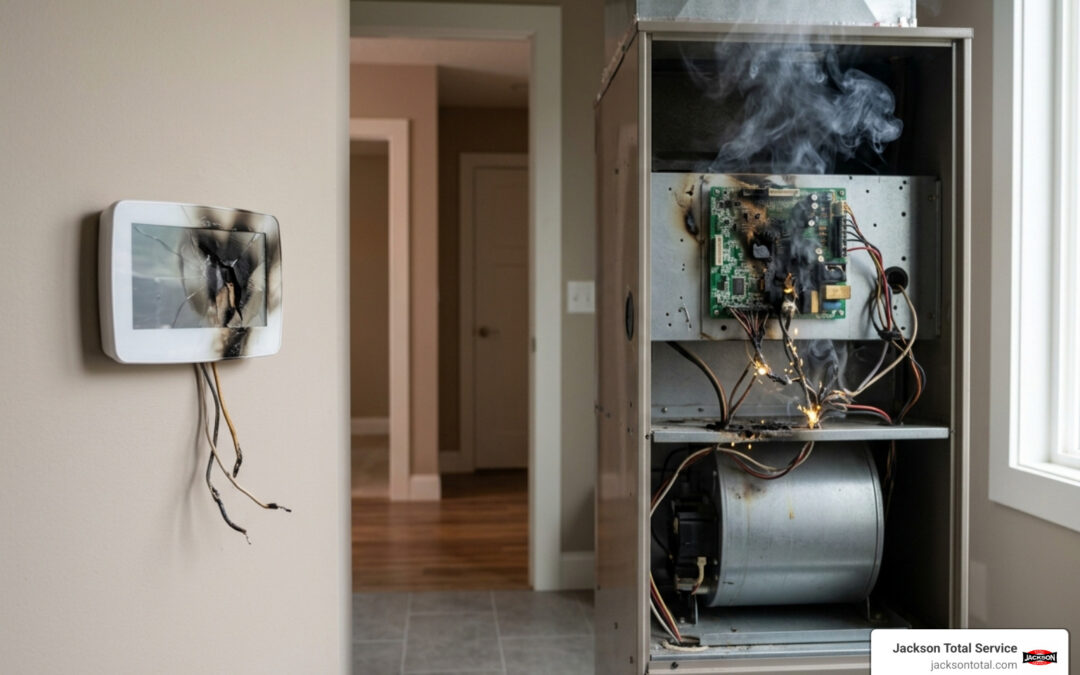
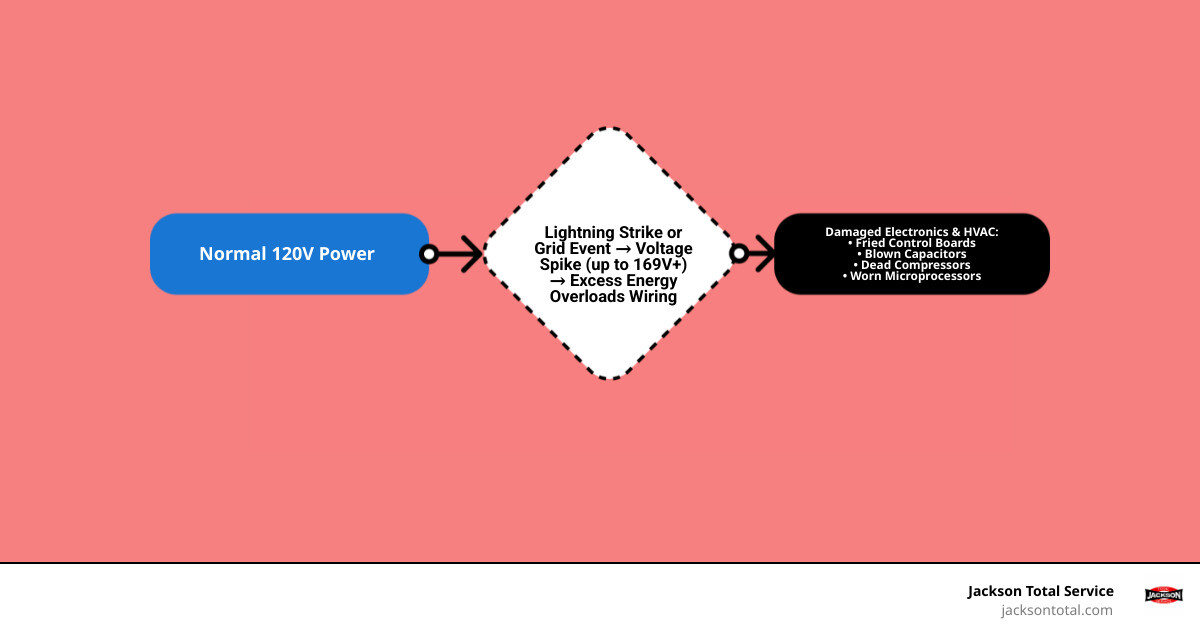
Understanding how power surges damage your electronics and HVAC comes down to one simple idea: your home’s devices are built to handle a steady 120 volts, and when that voltage suddenly spikes — sometimes to 169 volts or higher — the excess energy has nowhere safe to go. It burns through sensitive microprocessors, fries circuit boards, and quietly wears down components you won’t even know are failing until your AC stops working on the hottest day of the year.
Here’s a quick breakdown of what actually happens:
- Immediate destruction – A large spike (often from a nearby lightning strike) can instantly burn out a control board, blow a capacitor, or kill a compressor
- Cumulative wear – Smaller, everyday surges from appliances cycling on and off gradually degrade wiring and sensitive electronics over months or years
- Grid-level events – When power is restored after an outage, the sudden rush of electricity back through the grid is one of the most damaging surge moments your HVAC will ever face
- No component is safe – Thermostats, variable-speed motors, relay switches, and microprocessors in modern smart appliances are all vulnerable
Southwest Florida homeowners face this risk more than most. The region’s frequent thunderstorms, aging grid infrastructure, and near-constant AC use create the perfect conditions for surge damage — both the dramatic kind and the slow, invisible kind.
In 2023 alone, lightning damage triggered over $1.2 billion in insurance claims across more than 70,000 U.S. households. And lightning is only one piece of the puzzle.
This guide walks you through exactly what happens inside your electronics and HVAC when a surge hits, what warning signs to watch for, and how to protect your home before the next storm rolls in off the Gulf.
I’m worried about my AC after a storm: How power surges damage your electronics and HVAC in Fort Myers
Living in Southwest Florida, we are no strangers to the dramatic afternoon thunderstorms that roll through in April 2026. While the rain is welcome, the lightning that accompanies it poses a massive threat to our home comfort systems. If you’ve ever wondered how power surges damage your electronics and HVAC, it helps to think of electricity like water pressure. Your pipes are rated for a certain amount of pressure; if a tidal wave suddenly hits those pipes, they burst.
In your home, that “tidal wave” is a voltage spike. While standard North American outlets provide 120 volts of alternating current, a surge can send 169 volts or significantly more through your wiring in a microsecond. This isn’t just a “glitch.” For homeowners seeking Electrical Repair Fort Myers Fl, the aftermath often involves fried components that simply cannot be “reset.”
There are two main ways this damage manifests:
- Immediate Destruction: This is the “big bang.” A lightning strike or a major transformer failure sends a massive bolt of energy through the system, instantly melting wires and popping capacitors.
- Cumulative Wear: This is more insidious. Small, frequent surges (often caused by the AC itself kicking on) create “electronic rust.” Over time, this degrades the internal circuitry until the device fails prematurely.
If you suspect your system has taken a hit, professional Electrical Repair is the only way to safely diagnose which parts are compromised before a small issue turns into a total system replacement.
How power surges damage your electronics and HVAC components like control boards
Modern HVAC systems are much smarter than the units of twenty years ago, but that intelligence comes at a price. Today’s high-efficiency systems rely on complex circuit boards and sensitive microprocessors to manage everything from fan speeds to humidity levels.
When a surge hits, these microprocessors are the first to go. They are designed to operate within a very narrow voltage range. A spike of electricity generates intense heat, which can literally “cook” the silicon chips and solder joints on a control board. If you are in need of Electrical Repair Lehigh Acres Fl, we often find that the “brain” of the AC unit has been rendered useless by a surge that lasted less than the blink of an eye.
Furthermore, variable-speed motors—which help save you money on your electric bill—contain their own dedicated electronics. These are highly susceptible to voltage fluctuations, and once the sensitive circuitry inside the motor is damaged, the entire motor usually needs to be replaced.
Vulnerable HVAC parts and failure modes
It isn’t just the “brains” of the system that are at risk; the “muscles” take a beating too. Here are the components we most frequently see failing after a surge in areas like Sanibel Island:
- Capacitors: These look like large batteries or canisters. They store energy to help the motor start. A surge can cause them to bulge, leak, or even explode.
- Compressor Motors: The compressor is the heart of your AC. It is also the most expensive part to replace. Surges can damage the motor windings, leading to a “grounded” compressor that won’t start.
- Relay Switches and Contactors: These act as the gatekeepers for electricity. A surge can cause the metal contacts to weld together or carbonize, preventing the unit from turning on or off.
- Thermostats: Especially modern “smart” thermostats, which are essentially small computers mounted on your wall.
Why are my lights flickering in Bonita Springs? Common causes of voltage spikes
Flickering lights are often the first “S.O.S.” signal your home sends. If you’re noticing this in Bonita Springs, it’s a sign that the voltage in your home is inconsistent. While we often blame the weather, the truth is that power surges come from both outside and inside your four walls.
External causes are often the most violent. Lightning strikes are the obvious culprit, but utility grid switching—where the power company reroutes electricity to balance the load—can also cause significant spikes. Furthermore, downed power lines (common during our windy spring months) can cause “brownouts” followed by massive surges when the lines are repaired or the wind shifts. For residents in Estero, these grid-level events are a primary reason to consider professional electrical safeguards.
The danger of internal power surges
Would you believe that up to 80% of power surges actually start inside your home? These are known as internal surges. They happen when high-powered appliances like your refrigerator, dishwasher, or—most commonly—your AC compressor cycle on and off.
When these large motors stop, the leftover electricity that was powering them has to go somewhere. It ends up “splashing” back into the rest of your home’s circuits. While these surges aren’t usually large enough to blow up your TV instantly, they happen dozens of times a day. This constant “micro-stress” shortens the lifespan of every plugged-in device. If you live in North Fort Myers, ensuring your internal wiring is up to the task of handling these modern electrical loads is vital for protecting your investment.
External threats to the local power grid
In coastal areas like Marco Island, the electrical grid faces unique challenges, from salt-air corrosion to high demand during peak tourist seasons.
| Cause | Origin | Severity | Frequency |
|---|---|---|---|
| Lightning | External | Extreme | Low to Moderate |
| Appliance Cycling | Internal | Low to Moderate | Very High (Daily) |
| Grid Switching | External | Moderate | Moderate |
| Faulty Wiring | Internal | Variable | Constant until fixed |
| Downed Lines | External | High | Low (Weather dependent) |
Identifying the warning signs of electrical damage in your home
Sometimes the damage from a surge isn’t a total blackout; it’s a series of “glitches” that suggest your electrical system is struggling. If you are troubleshooting your circuit breaker and finding that it trips frequently without a clear reason, you might be dealing with the aftermath of a surge.
Here are the critical warning signs to watch for in your Southwest Florida home:
- The “Acrid” Smell: If you notice a faint scent of ozone or burning plastic near your electronics or the AC air handler, a component has likely shorted out.
- Flickering or Dimming Lights: This is especially concerning if it happens when a large appliance (like the dryer) isn’t even running. If you’re in North Naples, this could indicate a compromised neutral wire or surge damage in the panel.
- Unresponsive Thermostat: If your thermostat screen is blank or the buttons don’t seem to trigger the AC, the low-voltage transformer or the thermostat’s internal board may have been fried.
- Buzzing or Humming: Unusual sounds coming from your electrical panel or the outdoor condenser unit are a major red flag. In Immokalee, we often find that “buzzing” contactors are the result of voltage-related pitting on the metal parts.
Who in Naples provides whole-home surge protection to prevent appliance failure?
If you want to stop worrying every time the clouds turn grey over the Gulf, you need a professional Electrical Services provider to install a multi-layered defense. Many homeowners think a $20 power strip from a big-box store is enough. Unfortunately, those strips are the “last line of defense,” not the only one.
The most effective way to protect your home is a two-stage approach:
- Type 1 Protection: Installed at the meter or the main service entrance. This stops the massive external surges from the grid before they even enter your house.
- Type 2 Protection: This is the “Whole-Home Surge Protector.” It is installed at your main breaker panel. It monitors the electricity flowing through every circuit in your house—including the one for your AC—and diverts excess voltage safely into the ground.
For residents from Fort Myers Beach to the inland communities, this professional setup is the gold standard for safety.
How power surges damage your electronics and HVAC without multi-level protection
Why don’t standard plug-in strips work for your HVAC? The answer is simple: your AC isn’t plugged into a wall outlet. It is hard-wired directly into your home’s electrical system. This means a standard surge strip has zero ability to protect your most expensive appliance.
Furthermore, many “cheap” surge strips use components that can actually become a fire risk if they are hit by a surge larger than they are rated for. They can melt or ignite, causing more damage than the surge itself. In communities like Ave Maria, where homes are often newer and filled with smart technology, relying on $10 strips is a recipe for disaster.
Another factor to consider is your warranty. Most HVAC manufacturers explicitly state that damage caused by “acts of God” (lightning) or “utility power fluctuations” is not covered. If a surge fries your compressor, you could be looking at a repair bill that costs thousands of dollars out of pocket.
Benefits of a comprehensive surge defense strategy
Investing in a whole-home surge protection system offers benefits that go far beyond just “protecting the AC.”
- 60-80% Mitigation: While no system can stop a direct lightning strike to your roof, a Type 2 protector can mitigate the vast majority of surges that enter through the grid.
- Extended Lifespan: By filtering out the “micro-surges” from your daily appliance use, your electronics stay cooler and last longer. This is especially important for the high-end appliances common in Golden Gate.
- Savings on Repairs: Preventing just one control board failure often pays for the entire surge protection system.
- Peace of Mind: You can sleep through those 2:00 AM Florida thunderstorms knowing your home’s “nervous system” is shielded.
Frequently Asked Questions about Electrical Surges
Does homeowners insurance cover power surge damage?
The answer is: sometimes, but it’s a headache. Most policies cover “sudden and accidental” damage from lightning. However, proving that a component failed due to a surge rather than “normal wear and tear” is notoriously difficult. Insurance companies often require a technician’s report, and even then, you’ll still have to pay your deductible, which might be higher than the cost of the repair itself.
Why shouldn’t I use a standard power strip for my HVAC?
As mentioned, your HVAC is hard-wired. Beyond that, the power requirements for an AC unit are massive. A standard power strip is not designed to handle the amperage an AC draws. Attempting to “rig” a surge protector onto an AC line is a major fire hazard and a violation of electrical codes. You need a dedicated, hard-wired surge arrester specifically designed for HVAC equipment.
What should I do immediately after a major power surge?
- Wait: If the power is out, turn off your AC at the thermostat. When the grid comes back online, there is often a massive “rebound surge” as everyone’s appliances try to start at once. Wait about 20-30 minutes after power is restored before turning your AC back on.
- Visual Inspection: Look for scorch marks on outlets or smells of smoke.
- Check the Breaker: If a breaker has tripped, reset it once. If it trips again immediately, do not try a second time. This indicates a short circuit, and you should call a professional immediately.
- Schedule a Diagnostic: If your AC sounds different or isn’t cooling as well after a storm, have a technician check the capacitors and contactors. Catching a weakened component now prevents a total blowout later.
Conclusion
At Jackson Total Service, we have been providing comfort solutions to Southwest Florida since 1964. We understand the unique electrical challenges faced by homeowners in Naples, Fort Myers, and the surrounding islands. From the salt air of Marco Island to the afternoon heat of Lehigh Acres, your home’s electrical and HVAC systems are under constant stress.
Knowing how power surges damage your electronics and HVAC is the first step toward protecting your home. But knowledge alone isn’t enough—action is required to safeguard your family’s comfort and your financial investment. Don’t wait for a “fried” circuit board to tell you that your home was vulnerable.
Whether you need an emergency repair after a storm or you want to install a proactive whole-home surge protection system, our team is here to help. We offer comprehensive Electrical Services that ensure every wire, breaker, and circuit board in your home is ready to weather the next Florida storm. Give us a call today and let us help you keep your cool, no matter what the weather brings.