



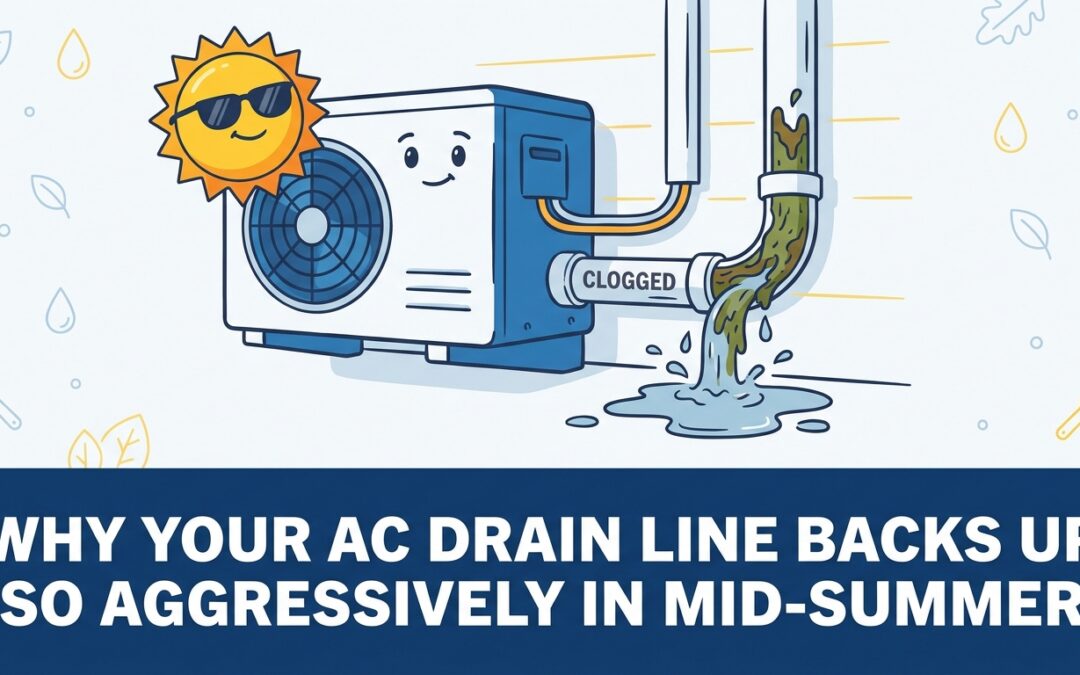
The Hidden Flood: Surviving Mid-Summer AC Drain Pan Overflows
A residential central air conditioner can produce an astonishing 5 to 20 gallons of condensation per day during peak summer operation. If you are wondering why your AC drain line backs up so aggressively in mid-summer, that massive volume of daily water production is the primary culprit. In our years of providing cooling solutions across the local area, our team typically sees this extreme condensation as the number one trigger for sudden summer leaks. As the system works overtime to keep your house cool, it pulls buckets of moisture out of the indoor air, funneling it all through a PVC pipe no wider than a golf ball. When that narrow exit path becomes compromised, the result is a sudden drain pan overflow that can send water pouring through your ceiling or pooling across your floors.
With peak mid-summer humidity forcing your system to extract so much moisture, the resulting damp environment inside your ductwork and drain lines becomes the perfect breeding ground for aggressive algae. If you are already dealing with a flooded floor or a ceiling leak, reaching out for professional AC services is the fastest way to protect your home’s structural integrity.
The Overnight Overflow Phenomenon
A sudden AC drain pan overflow often seems to happen entirely overnight. A pattern we see often during our mid-summer service calls is the sheer speed of this failure. One day the system is running perfectly, and the next morning, the safety switch has shut the entire unit down—or worse, water is actively dripping into your living space. This rapid escalation is exactly what happens in Mid-summer / July when environmental conditions push the equipment to its absolute limits.
The core decision point: When faced with a backed-up line, homeowners must decide whether to simply clear the immediate clog to get the cold air flowing again, or to proactively treat the PVC line to prevent the blockage from rapidly returning. Simply removing the standing water does not address the underlying biological growth that caused the backup in the first place.
Understanding the Peak Humidity Condensation Engine
To fully understand why these blockages happen so violently, you have to look at the physics of your cooling system. Your air conditioner does not just lower the temperature; it conditions the air by removing excessive moisture. High indoor dew points force the AC evaporator coils to extract massive amounts of water from the air circulating through your return vents.
During periods of Peak humidity, this extraction process runs continuously. The warm, damp indoor air blows across the freezing cold metal coils, causing water droplets to form instantly—much like condensation sweating on the outside of an ice-cold glass of water on a hot afternoon.
The Need for a Continuous Exit Path
All of this extracted moisture needs a continuous, unobstructed exit path through the condensate drain line. This PVC pipe is usually routed from your indoor indoor unit (often in an attic or closet) to the outside of your house. Because gravity does most of the work, even a minor restriction in this pipe can cause the water to back up into the primary drain pan.
This constant flow of water acts as a non-stop hydration source for biological growth. The inside of that pipe is never dry. If your system is actively leaking through the ceiling and you cannot stop the flow, you need to contact us for immediate AC repair before the trapped water compromises your drywall.
Mechanical Clogs vs. Biological Blockages
Not all clogs are created equal. In our experience servicing HVAC systems throughout the local area, we’ve found that while a drain line can technically back up at any time of year, the nature of the blockage shifts drastically as the weather heats up. Understanding the difference between a mechanical buildup and a biological bloom is key to keeping the system running.
Comparing the Two Types of Blockages
| Blockage Characteristic | Mechanical Clogs | Biological Blockages |
|---|---|---|
| Primary Composition | Dirt, pet hair, and household dust | Living algae, mold, and thick sludge |
| Speed of Formation | Slow accumulation over several years | Exponential growth in a matter of weeks |
| Typical Season | Year-round, often noticed in spring | Mid-summer / July and August |
| Resistance Level | Easily flushed out with basic pressure | Highly stubborn; clings to PVC walls and regrows |
Mechanical blockages occur when airborne particles bypass your air filter. Over time, tiny amounts of dust, pet dander, and dirt settle into the drain pan and wash into the PVC line. These materials slowly build up like sediment in a riverbed. They are relatively easy to clear because they are not actively attaching themselves to the pipe.
Biological blockages, on the other hand, are living organisms. Algae, mold, and bacterial slime form a cohesive, jelly-like mass inside the pipe. This biological matter is uniquely stubborn and resistant to simple physical clearing methods because it anchors itself to the microscopic pores in the plastic. Even if you push the bulk of it out, the remaining cells will immediately begin to multiply again.
The Perfect Incubator: Why Algae Thrives in July and August
Algae and mold do not just survive in your air conditioning pipes; they thrive in them. These microscopic organisms require three specific elements to multiply rapidly: moisture, darkness, and warmth. During the hottest months of the year, your HVAC system provides an endless supply of all three.
Ideal incubation temperatures for these biological growths fall right between 77 and 86 degrees Fahrenheit. Attics and utility closets naturally hit these exact temperature ranges during peak cooling months. The regional climate’s specific combination of relentless heat and high humidity is the primary catalyst for this biological bloom.
The Hyper-Accelerated Reproduction Cycle
When you combine that ideal heat, total darkness inside the pipe, and 5 to 20 gallons of daily condensation flowing over the roots of the algae, you create a hyper-accelerated reproduction cycle. In Mid-summer / July, a minor patch of algae can multiply into a thick, pipe-blocking sludge in just a few short weeks.
This is why a drain line that was completely clear during a spring tune-up can suddenly back up in the middle of August. The environmental triggers simply were not present earlier in the year to support such aggressive biological expansion.

Immediate Safe Actions for an Overflowing Drain Pan
If you discover a flooded drain pan or notice water pooling around your indoor unit during Peak humidity, taking immediate, safe action is necessary to protect your home. However, it is equally important to avoid aggressive DIY tactics that could permanently damage your equipment.
Here are the safe steps to take when facing an active backup:
- Turn off the thermostat immediately: Switch the system to the “off” position. This stops the compressor and halts the production of new condensation, preventing the flood from getting worse.
- Locate and inspect the drain pan: Find the indoor unit and look at the secondary drain pan underneath it. Check the float switch (a small device clipped to the edge of the pan or pipe). If the switch is tripped upward, it means the safety mechanism successfully shut the system down to prevent further flooding.
- Use a wet/dry vac on the exterior exit: Go outside to where the PVC pipe drips water into your yard. Place the nozzle of a wet/dry vacuum over the end of the pipe. Use a rag to create an airtight seal around the nozzle, and run the vacuum for three to five minutes to safely pull out the immediate blockage.
- Empty the indoor pan: If the pan is still full of standing water, use the vacuum or dry towels to carefully remove the moisture so the float switch can reset.
What Not To Do (The Danger Zone)
Our technicians have seen firsthand the extensive damage caused by improper maintenance, which is why we strongly warn against DIY methods that involve dismantling PVC pipes or pouring harsh, unapproved chemicals down the access port. Pouring pure bleach into the system can degrade the plastic, rust the metal components of the drain pan, and void your manufacturer warranty. Furthermore, if you notice unusual smells coming from your AC vents after pouring household cleaners into the line, you are likely circulating harsh fumes back into your breathable indoor air.
The Crucial Decision: Clearing the Clog vs. Proactive Treatment
Once you have managed to get the water draining again and the immediate crisis has passed, you face a critical decision regarding the long-term health of your system.
Simply vacuuming out the sludge only resets the clock. When dealing with biological blockages driven by Peak humidity, suction alone is never enough. The vacuum removes the bulk of the jelly-like mass, allowing water to flow again, but it leaves microscopic algae spores firmly attached to the inside walls of the PVC pipe.
The Necessity of Proactive Treatment
Because the pipe remains dark, damp, and warm, those remaining spores will immediately begin to regrow. This is why homeowners often find themselves vacuuming out the drain line every two weeks during the hottest part of the year. The blockage hasn’t returned; it simply never left.
Based on countless mid-summer emergency calls, we recommend proactive treatment over simple suction because it is the only way to neutralize the biological growth at its source. Professional seasonal treatments utilize specialized, HVAC-safe biocides and enzymatic cleaners that break down the cellular walls of the algae without damaging the plastic pipes or metal coils. Regular treatments prevent the rapid return of blockages, ensuring the water has a clear path outside for the remainder of the summer.
Mitigating Secondary Water Damage in Your Home
An overflowing AC drain pan is rarely just an air conditioning problem; it is a rapid-onset plumbing emergency that threatens the structural materials of your house.
The risks of an overflowing pan are severe. Drywall acts like a sponge, absorbing the overflowing condensation until it loses its structural integrity. A ceiling leak can easily result in ruined drywall that crashes down into your living room, bringing wet insulation and debris with it. If the unit is located in a closet on the first floor, the continuous flow of water will quickly seep under baseboards, leading to warped flooring and ruined carpets.
The Real Cost of Ignored Maintenance
The cost of repairing secondary water damage far exceeds the cost of standard AC maintenance. Replacing a section of hardwood floor or hiring a drywall contractor to patch a ceiling can be incredibly expensive, whereas keeping the drain line clear is a minor, routine expense.
Professional intervention is a critical step in emergency water-damage prevention. Working with a prompt, reliable local service means you have a team ready to quickly resolve mid-summer AC emergencies before a minor drip turns into a major home restoration project. By understanding the environmental triggers that cause these aggressive Mid-summer / July backups, you can take the necessary steps to keep your home dry, cool, and comfortable all season long.
Frequently Asked Questions
Why does my AC drain line keep clogging in summer?
Your AC drain line keeps clogging in summer because peak humidity forces the system to produce massive amounts of condensation. In our experience working in the local area, we see this constant flow of water, combined with warm attic or closet temperatures, create an ideal incubator for algae. The biological growth multiplies exponentially during these months, repeatedly choking off the narrow PVC pipe.
What causes algae in AC drain lines?
Algae in AC drain lines is caused by the continuous presence of moisture, darkness, and warm temperatures. Airborne spores naturally enter the system through the return air and settle in the damp drain pan. Once they wash into the dark, warm PVC pipe, they have the perfect environment to anchor and grow into a thick sludge.
How do I stop my AC drain pan from overflowing?
You can stop your AC drain pan from overflowing by ensuring the condensate line remains clear of biological buildup. Regularly scheduling professional line treatments prevents algae from taking hold. Additionally, ensuring your float switch is functioning properly will force the system to shut down before the water level breaches the edge of the pan.
How often should I treat my AC drain line?
You should have your AC drain line treated at least once a year during your annual cooling maintenance visit. However, in regions with extreme summer humidity, a secondary mid-summer treatment may be required to keep aggressive biological growth at bay. Consistent monitoring during the hottest months is the best way to prevent sudden backups.
Can I pour bleach down my AC drain line to kill algae?
No, you should not pour bleach down your AC drain line. Bleach is highly corrosive and can degrade the PVC glue, causing the pipes to crack and leak inside your walls. It can also cause severe rusting if it splashes onto the metal evaporator coils or the primary drain pan, potentially voiding your equipment warranty.
Why is my AC float switch shutting off the system?
Your AC float switch is shutting off the system because it detects that water is backing up in the drain pan. This is a critical safety mechanism designed to cut power to the thermostat before the water overflows and damages your home. If the switch trips, it means the primary drain line is clogged and requires immediate clearing.
Protecting Your Home from Summer Overflows
Understanding why your AC drain line backs up so aggressively in mid-summer is the first step in protecting your property from unexpected water damage. By recognizing the role that high humidity and rapid algae growth play, you can move beyond temporary fixes. Proactively treating the system ensures the line stays clear, keeping your home perfectly cool and completely dry when you need it most.