



Why Florida Homeowners Can’t Afford to Skip Surge Protection
Do I need surge protection for my home in Florida? Yes — and for most Southwest Florida homeowners, it’s not even a close call. Here’s the short version:
- Florida law now requires it for new homes and service replacements under NEC Section 230.67 and the Florida Building Code
- Florida leads the nation in lightning strikes, with around 1.2 million cloud-to-ground strikes per year
- Power surges don’t just come from lightning — grid rebalancing after outages, downed lines, and even your own appliances cycling on and off all create damaging voltage spikes
- Plug-in power strips are not enough — hardwired appliances like your HVAC system have zero protection from a standard surge strip
- The 2024 hurricane season alone produced five major hurricanes, creating repeated outage-and-restoration cycles that are especially hard on home electronics
If you live anywhere in Southwest Florida, you already know what a typical summer afternoon looks like: sky darkens, lights flicker, WiFi drops, and your refrigerator makes that uneasy clicking sound. That’s not nothing. Those small, repeated voltage spikes quietly degrade your appliances, your HVAC control boards, and your smart devices — often long before anything visibly fails.
The good news is that whole-home surge protection gives your entire electrical system a first line of defense, and it’s more accessible than most homeowners realize.
Do I need surge protection for my home in Florida to meet building codes?
One of the most common questions we hear at Jackson Total Service is whether these devices are a luxury or a legal requirement. As of April 2026, the answer is increasingly the latter. The National Electrical Code (NEC), specifically Section 230.67, mandates that all new dwelling units and service replacements must have Surge Protective Devices (SPDs) installed.
The Florida Building Code has adopted these NEC standards, meaning if you are building a new home in Naples or Fort Myers, or if you are upgrading an outdated electrical panel, you are likely required by law to install surge protection. The code specifically looks for Type 1 or Type 2 SPDs.
- Type 1 SPD: These are typically installed on the “line side” of your main service disconnect (the street side). They protect against large external surges from the grid or lightning.
- Type 2 SPD: These are the most common for residential Electrical Services. They are installed on the “load side” of the main service disconnect, usually directly inside or right next to your electrical panel.
By ensuring your home meets these codes, you aren’t just following the law; you are significantly reducing the risk of electrical fires, which claim hundreds of lives and cause over $1 billion in property damage annually across the country.
Why the Sunshine State is the “Lightning Capital” of the U.S.
In Southwest Florida, we don’t just get rain; we get atmospheric drama. Florida averages 70 to 100 thunderstorm days per year, earning us the title of the “Lightning Capital” of the United States. With over 1.2 million cloud-to-ground strikes annually, the sheer volume of electrical energy hitting our soil is staggering.
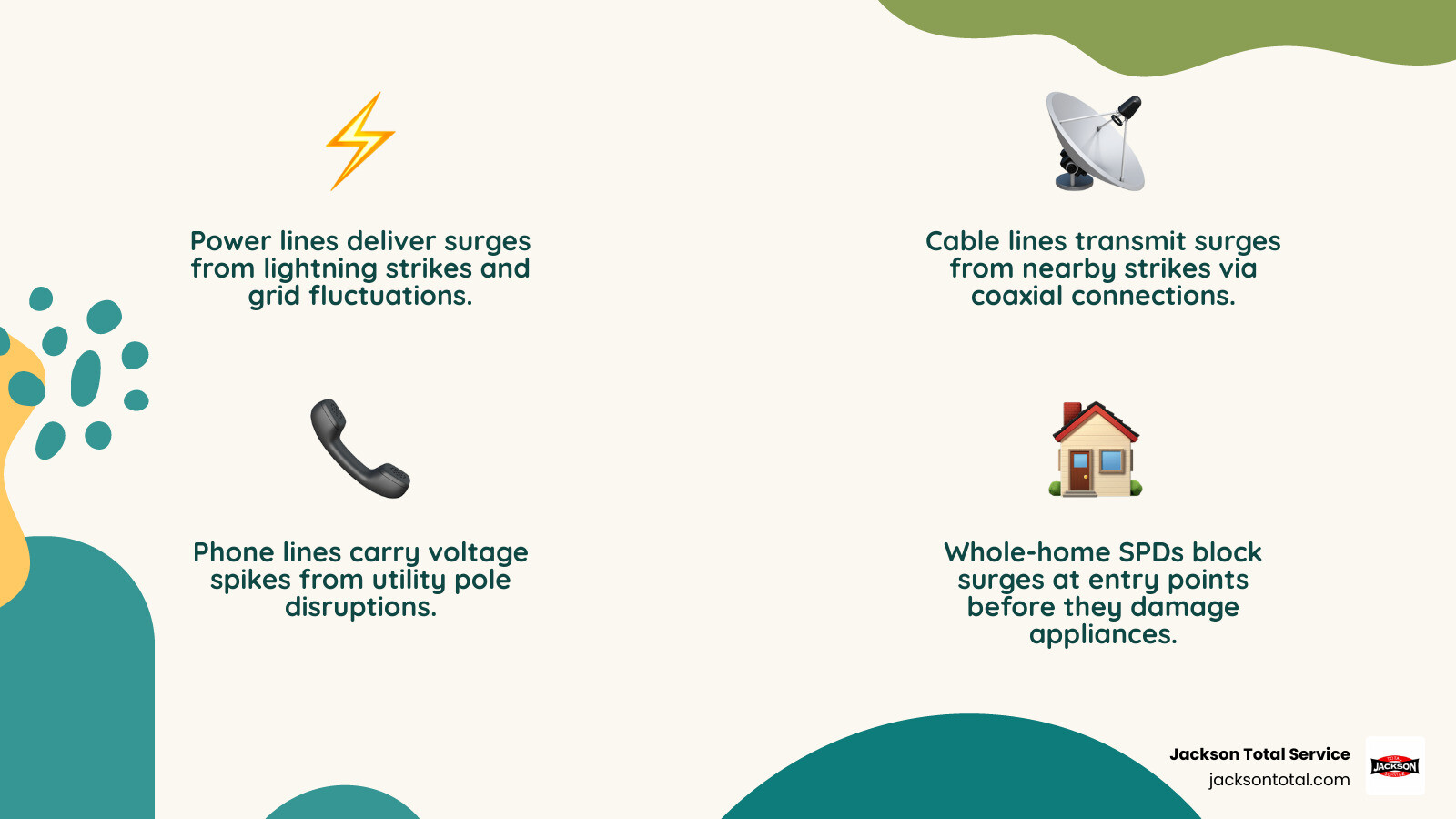
However, a direct strike on your roof isn’t the only threat. In fact, indirect surges are far more common. A lightning strike hitting a utility pole three blocks away in Cape Coral or a transformer in Fort Myers can send a massive wave of high-voltage electricity traveling through the power lines directly into your home.
Furthermore, Florida’s grid faces unique stability issues. Between the 2024 Atlantic hurricane season’s record-breaking storms and the constant demand of millions of air conditioners running simultaneously, our local power grid is under perpetual stress. When power is restored after a blackout—a frequent occurrence during our summer months—the sudden “rush” of electricity often causes a significant spike that can fry sensitive components instantly. If you’ve ever needed an Electrical Repair in Fort Myers, FL, an Electrical Repair in Cape Coral, FL, or an Electrical Repair in North Naples, FL, you know that the aftermath of a storm is often when the real damage reveals itself.
Do I need surge protection for my home in Florida for my HVAC and smart devices?
Modern homes are essentially giant computers. Unlike the mechanical appliances of forty years ago, today’s refrigerators, washers, and dishwashers are packed with sensitive microprocessors and control boards.
Your HVAC system is perhaps the most vulnerable and expensive asset in your home. High-efficiency air conditioners use variable-speed motors and sophisticated control boards that can be ruined by a single voltage fluctuation. Replacing an AC control board can be a massive headache and an unexpected expense that leaves you sweating in the Florida heat.
Smart home devices—including smart thermostats, security cameras, and WiFi routers—are equally delicate. Even “micro-surges” that don’t immediately blow a fuse can cause “electronic rust,” a gradual degradation of the internal circuits that leads to premature failure. Whether you need Electrical Repair in Bonita Springs, FL or are following an Electrical Repair Estero, FL Guide, protecting these high-value systems should be a top priority.
Do I need surge protection for my home in Florida if I already use power strips?
Many homeowners believe they are safe because they have a few $20 power strips from a big-box store. While these are useful for a lamp or a basic alarm clock, they are woefully inadequate for comprehensive protection.
Standard power strips are “Type 3” protectors. They only protect the devices plugged directly into them. They do nothing for your hardwired appliances like your oven, water heater, pool pump, or HVAC system. Furthermore, many surges—about 60% to 80%—actually originate inside your home. When your AC compressor or vacuum motor kicks on, it creates a small surge that travels back through your home’s wiring. A whole-home system intercepts these internal surges at the panel before they can reach other rooms.
For residents in coastal areas like Marco Island or Sanibel Island, the combination of salt air and frequent storms makes a “layered defense” (Whole-home + Point-of-use) the only reliable strategy.
Comparing Whole-Home Systems vs. Plug-In Power Strips
To understand why “playing roulette” with your electronics is a bad idea, it helps to see the technical differences between the two main types of protection.
| Feature | Type 2 Whole-Home SPD | Type 3 Plug-In Strip |
|---|---|---|
| Installation Point | Main Electrical Panel | Wall Outlet |
| Protection Scope | Entire Home (including hardwired) | Only devices plugged into the strip |
| Joule Rating | Extremely High (redirects thousands of amps) | Low to Moderate |
| Internal Surges | Protects all circuits from each other | Cannot stop internal surges |
| Lifespan | Long-term (3-7 years with monitoring) | Short-term (often fails without notice) |
| Code Compliance | Required for new/upgraded services | Not recognized as whole-home protection |
A whole-home system works by monitoring the voltage entering your home. When it detects a spike, it instantly diverts the excess energy into the ground wire, safely moving it away from your electronics. This is why Circuit Breaker Troubleshooting often reveals that homes without surge protection suffer far more frequent breaker trips and component failures.
Financial Incentives and Long-Term Benefits for SW Florida Residents
Investing in surge protection isn’t just about safety; it’s a smart financial move. There are several ways Florida homeowners can recoup their investment:
- Federal Tax Credits: Under current energy and safety incentives, you may be eligible for a federal tax credit of 30% of the installation cost (up to $600) for electrical panel upgrades that include integrated surge protection.
- Insurance Discounts: Many Florida insurance providers offer premium discounts for homes with certified whole-home surge protection. Since the insurance industry pays out over $1 billion annually for lightning-related claims, they are more than happy to reward homeowners who mitigate that risk.
- Appliance Longevity: By eliminating the “death by a thousand cuts” caused by micro-surges, your expensive appliances can last years longer than they would otherwise.
- Resale Value: In a competitive market like Southwest Florida, having a “hardened” electrical system is a major selling point for savvy buyers.
Whether you are looking for the Best Panel Upgrade in Estero, FL or searching for Top Electricians for Panel Upgrades in Estero, FL, ensure you ask about these financial benefits. Residents in Lee County can also look into a Local Panel Upgrade in Pine Island, FL to secure their home’s future.
Frequently Asked Questions about Florida Surge Protection
How long do whole-home surge protectors last?
Most whole-home surge protectors have a lifespan of 3 to 7 years. However, in a high-activity zone like Lehigh Acres or Fort Myers, they may “sacrifice” themselves sooner if they take a particularly large hit. Most modern units have indicator lights—if the light turns red or goes out, the device has done its job and needs replacement. We recommend a post-storm season inspection to ensure your defense is still active. If you notice your status lights are out, it’s time to call for Electrical Repair in Lehigh Acres, FL.
Do they protect against direct lightning strikes?
It is important to be honest: nothing on the residential market can 100% guarantee protection against a direct, millions-of-volts lightning strike to your chimney. However, direct strikes are rare. Most damage comes from indirect strikes—lightning hitting the ground or utility lines nearby. Whole-home SPDs are incredibly effective at stopping these utility-line spikes. For homeowners in Ave Maria, FL, where open spaces can invite more frequent lightning activity, this protection is vital.
Is professional installation required for surge protection?
Yes. Florida law is very clear: work inside the main electrical panel must be performed by a licensed electrical contractor. DIY installation is not only a massive safety risk (you are working with the main power feed for the entire house), but it also voids most manufacturer warranties and can lead to insurance claim denials. A professional ensures that the grounding integrity is perfect—without a solid ground, a surge protector has nowhere to send the excess energy. For safe, compliant work, always hire a professional for Electrical Repair in North Fort Myers, FL.
Conclusion
At Jackson Total Service, we’ve been helping Southwest Florida families stay comfortable and safe since 1964. We understand the unique challenges of our local climate—from the humidity that corrodes electrical connections to the lightning that threatens our peace of mind. Our mission is to provide all your comfort solutions—HVAC, plumbing, and electrical—under one roof, so you don’t have to juggle multiple contractors.
Don’t wait for the next major storm to find out if your electronics are “feeling lucky.” Protect your home, your family, and your investment with a whole-home surge protection system.
Ready to secure your home? Explore our full range of Electrical Services and let us help you stop playing electrical roulette today.