



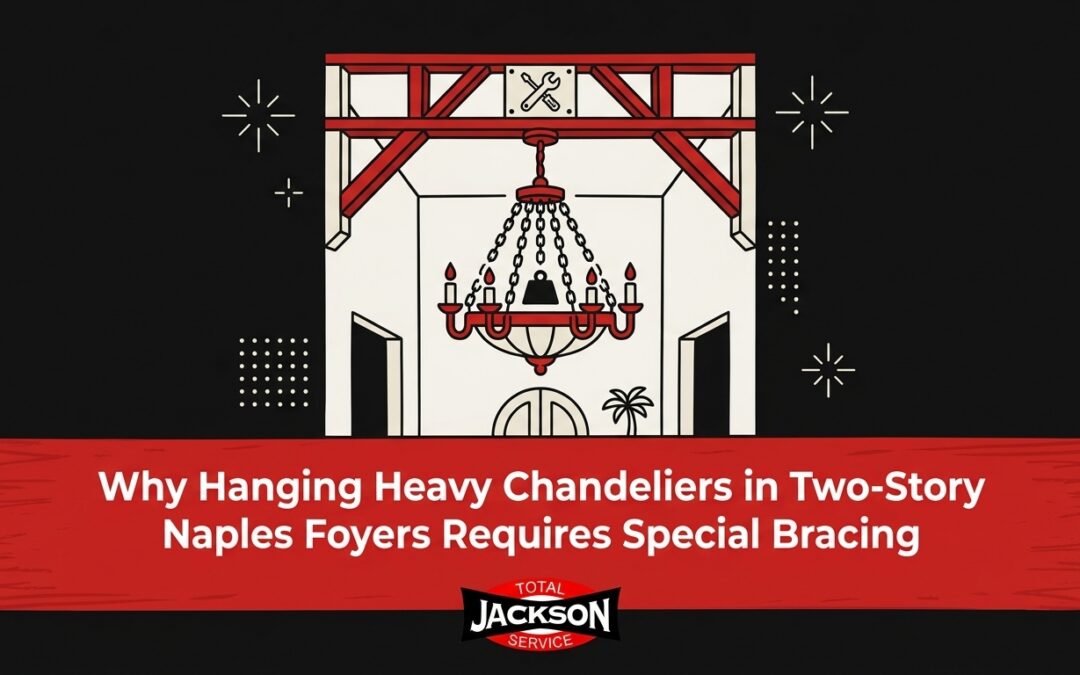
The Hidden Structural Demands Above Your Entryway
You have finally found the perfect statement lighting for your home, but understanding why hanging heavy chandeliers in two-story Naples foyers requires special bracing is what separates a stunning upgrade from a structural disaster. The visual impact of a grand chandelier is undeniable. A beautifully designed fixture draws the eye upward, defines the vertical space, and immediately establishes the architectural tone of the entire house. However, the hidden mechanical reality behind that beauty is far less glamorous. In our 60 years of serving Southwest Florida, the Jackson Total Service team frequently sees the aftermath of underestimating this reality. A fixture weighing 50 to over 150 pounds exerts immense, constant downward force on the ceiling materials and the framing above.
To ensure your new fixture is safely supported from day one, investing in professional lighting installation in Naples is the first crucial step.
Most standard builder-grade electrical boxes are simply not designed to handle this level of continuous stress. When homes are initially constructed, standard ceiling boxes are often installed with the assumption that they will only ever hold a lightweight flush-mount light or a standard smoke detector. Addressing the reality of a heavy, multi-tiered chandelier requires both structural and electrical foresight before any installation begins.
| Installation Factor | Standard Lighting (Under 50 lbs) | Grand Chandeliers (50+ lbs) |
|---|---|---|
| Mounting Hardware | Standard plastic or light-gauge metal box | Heavy-duty steel box with independent joist bracing |
| Structural Support | Nailed to a single side of one ceiling joist | Expandable steel bracket spanning between two joists |
| Access Method | Standard A-frame ladder | Interior scaffolding or motorized chandelier lift |
| Electrical Draw | Minimal impact on existing circuit load | High bulb count requires strict amperage verification |
Without upgrading the hidden support system, the sheer weight of a large entryway fixture will inevitably compromise the ceiling. True safety requires looking past the decorative elements and focusing entirely on the unseen framing that keeps the fixture securely suspended above your family and guests.
Why Standard Ceiling Boxes Fail Under Heavy Loads
The core problem with hanging a heavy fixture on existing hardware is that standard ceiling boxes are typically mounted using two simple nails driven into a single side of a wooden joist. This offset mounting creates a weak point. When our electricians inspect wobbling fixtures in 1990s and early 2000s tract homes, we often find that standard 8-32 mounting screws are on the verge of shearing off entirely under the dynamic stress. When a load exceeds what those nails and the plastic housing can bear, the box begins to twist, pulling away from the wood and relying entirely on the surrounding fragile drywall to hold the weight.
The cause of these failures traces back to the sheer physical stress of gravity acting on an unbraced point. The National Electrical Code (NEC) Section 314.27 explicitly addresses this danger. The rule mandates that any ceiling fixture weighing over 50 pounds must be supported independently of the standard outlet box, unless the box itself is explicitly listed, tested, and marked for the maximum weight of the specific fixture. Ignoring this regulation leads directly to the structural dangers of improperly mounted fixtures, which often go unnoticed until the damage is severe.
The solution is recognizing the physical consequences of overloading standard hardware before a failure occurs. When a standard box is overloaded, homeowners will typically notice the ceiling medallion pulling away from the drywall, spiderweb cracks forming in the paint, or the fixture hanging at a slight angle. If left unaddressed, the plastic box will eventually shatter or the mounting nails will pull out entirely, resulting in a catastrophic drop of the fixture.
The 50-Pound Threshold Explained
Understanding the 50+ pounds threshold is critical for safe installation. This is not just about the weight of the metal frame; it is about dynamic weight.
- Total hanging mass: The true hanging weight includes the central frame, every crystal or glass shade, the heavy-duty hanging chain, and the combined weight of dozens of light bulbs.
- Dynamic stress: Even a slight sway from air currents or cleaning causes the weight to shift, magnifying the stress placed on the mounting hardware.
- Verification: A professional will always verify the fully assembled weight of the fixture prior to lifting it, ensuring the chosen bracing system exceeds the total required capacity.
How High Humidity and Coastal Vibrations Compromise Unbraced Fixtures
In Southwest Florida, the environment plays a massive role in the longevity of your home’s interior structures. Naples’ persistent coastal humidity—where relative humidity levels frequently exceed 75%—can subtly soften or compromise standard drywall integrity over time. Drywall that absorbs ambient moisture loses its rigidity. If a heavy chandelier in one of the many Naples high-ceiling entryway homes is relying even partially on the surrounding drywall to keep a failing standard box in place, the humid climate will accelerate the timeline to failure.
Beyond humidity, the structural framing of coastal homes is subjected to micro-vibrations. As we head into September 2026 and prepare for late-season fall storms, the pressure changes associated with strong winds cause a home’s wooden framing to flex and vibrate. While this flexibility keeps the house standing, it spells trouble for heavy, suspended loads.
The Pendulum Effect: A heavy chandelier acts as a pendulum during atmospheric pressure changes or heavy winds. If the fixture is attached to a standard box nailed to just one side of a joist, these micro-vibrations act like a crowbar, slowly working the mounting nails loose year after year. The constant subtle swaying transfers kinetic energy directly into the weakest point of the ceiling.
Accelerated Material Fatigue: Metal fatigue in standard screws and plastic fatigue in builder-grade boxes happen much faster in environments subject to constant barometric shifts and wind-induced vibrations.
These unique regional factors make flawless independent joist bracing absolutely non-negotiable. The bracing must be completely detached from the vulnerability of the drywall and immune to the backing-out effect that vibrations have on standard nails.
The Mechanics of Independent Joist Bracing
Independent joist bracing is fundamentally different from a simple electrical box swap. It is a structural modification designed to distribute a massive, concentrated load horizontally across the home’s strongest framing members, removing the stress from the ceiling surface entirely.
When our licensed professionals upgrade a ceiling for a fixture weighing 50+ pounds, they follow a strict mechanical process to ensure absolute stability while adhering to strict electrical safety standards. Here is a conceptual overview of how a heavy-duty support system is integrated into a home:
- Locating the Joists: The exact distance between the wooden ceiling joists (typically standard 16-inch or 24-inch on-center gaps) above the foyer is measured. This ensures the bracing hardware will fit perfectly without requiring destructive alterations to the home’s structural framing.
- Inserting the Expandable Bracket: A specialized, heavy-duty steel bracket is inserted through the ceiling opening. This bracket features a ratcheting or threaded mechanism that allows it to expand outward.
- Biting into the Wood: As the bracket expands, steel teeth on either end drive deep into the center mass of two parallel joists. This creates a solid steel bridge that spans the gap, transferring the heavy load evenly across both wooden beams.
- Mounting the Heavy-Fixture Box: A specialized, heavy-fixture-rated electrical box is then bolted directly to the steel bridge—not to the wood, and not to the drywall. The weight of the chandelier hangs from this reinforced steel center point.
This method ensures that the structural integrity of the ceiling joists remains uncompromised, as no large holes are drilled and no framing is cut, while providing a rock-solid foundation for the heaviest luxury fixtures.

Accessing Two-Story Foyers: The Scaffolding Requirement
The geometry of Naples high-ceiling entryway homes presents a significant logistical challenge. Two-story foyers rarely offer a simple, flat square of floor space. They frequently feature sweeping curved staircases, intricate railings, uneven floor transitions, or delicate custom tile work. These architectural details make accessing the 18-to-22-foot ceilings common in modern Naples estates incredibly complex.
Many homeowners assume a tall A-frame ladder is sufficient for the job. However, standard ladders are dangerously unstable for tasks requiring two hands and heavy lifting at extreme heights. When a technician is 18 feet in the air, they cannot safely balance a fragile, 50+ pound crystal fixture in one hand while attempting to strip wires and secure mounting bolts with the other. The shift in center of gravity alone is enough to cause a catastrophic fall.
To mitigate this immense risk, we strictly require our installation crews to use professional interior scaffolding for high-foyer installations. Professional interior scaffolding provides a wide, stable, and perfectly flat working platform. This allows multiple technicians to stand securely at ceiling height, maneuver the heavy fixture safely, and perform intricate wiring without the life-threatening instability of a ladder.
For homeowners looking to avoid scaffolding during future cleaning or bulb replacements, a motorized chandelier lift is often installed simultaneously. These mechanical winch systems are mounted in the attic space above the foyer, allowing the chandelier to be lowered to the floor with the turn of a key, providing a modern, long-term solution for high-ceiling maintenance.
Beyond the Bracket: Electrical Wiring and Panel Requirements
While the structural bracing keeps the fixture from falling, the electrical wiring keeps the home from catching fire. The problem with upgrading to a massive entryway chandelier is that these fixtures often feature a remarkably high number of bulbs. Even with modern LED technology, upgrading to a chandelier with 20 to 40 sockets drawing a combined 300+ watts significantly increases the amperage draw on the foyer’s lighting circuit.
The cause of electrical failure in these scenarios is thermal overload. The existing wiring in the ceiling was likely sized for a single, low-draw light bulb. During our pre-heating-season electrical tune-ups this early fall, we consistently remind homeowners that pushing a high current through older or undersized wiring generates excess heat, which degrades the wire insulation over time and creates a severe fire hazard. The solution is a comprehensive assessment of the home’s electrical capabilities before the fixture is ever wired in.
A professional will always verify that the existing wiring is rated for the increased thermal load. Furthermore, they will assess the home’s main electrical panel to ensure it can support the new lighting without constantly tripping breakers. Safe, reliable electrical panels are critical, especially during the fall when severe weather tests a home’s infrastructure. For example, shortly after Hurricane Ian one fall Sunday, a local homeowner experienced terrifying sparks coming directly from their electrical panel due to compromised, overstressed wiring. A professional team responded quickly, arriving in less than an hour to identify the hazard and safely resolve the electrical issue.
Ensuring your home has adequate electrical panel capacity is the only way to guarantee that your beautiful new fixture operates safely day and night.
Why High-Ceiling Installations Demand Multi-Trade Expertise
Safely hanging a 50+ pound fixture 20 feet in the air is not a simple handyman project. A successful, safe installation is equal parts carpentry, structural engineering, and electrical work. Treating it as just a “lighting swap” ignores the massive physical forces at play.
There are severe risks involved in hiring a contractor who only understands the electrical side of the job. An electrician who lacks structural framing knowledge might perfectly wire the chandelier, but fail to properly install the expandable joist bracket, leaving the homeowner with a perfectly illuminated hazard waiting to crash to the floor. Conversely, a carpenter might secure the box brilliantly but overload the circuit, risking an electrical fire.
This intersection of specialized skills is where Jackson Total Service’s 60-year family legacy in Southwest Florida truly protects homeowners. Since 1964, our team has seen firsthand that highlighting a multi-trade expertise means providing the trusted skill needed to safely handle both the complex structural bracing and the intricate electrical wiring simultaneously.
When trusting a company with major modifications to a luxury home, peace of mind comes from knowing a fully licensed, insured team is handling the scaffolding setup, the joist reinforcement, and the panel load calculations under one roof. A long-standing local reputation ensures that every aspect of the project is executed to the highest standard of safety and craftsmanship.
Frequently Asked Questions About Heavy Fixture Installations
How much weight can a standard ceiling electrical box hold?
Standard boxes are typically rated for a maximum of 50 pounds, provided they are properly secured to the framing. If the box is older—like those we frequently replace in 1980s Pelican Bay builds—made of brittle plastic, or only nailed to one side of a joist, its actual safe holding capacity is often much lower. Exceeding this limit without upgrading the hardware violates safety codes and risks a ceiling collapse.
Do I need special bracing for a heavy chandelier?
Yes, any fixture over 50 pounds requires independent support that attaches directly to the ceiling joists, bypassing the electrical box entirely. This specialized bracing usually takes the form of an expandable steel bracket that bridges two joists, ensuring the immense weight is carried by the home’s structural framing rather than fragile drywall.
How do you support a heavy chandelier in a two-story foyer?
Support is achieved using heavy-duty expandable brackets mounted horizontally between joists, accessed safely via interior scaffolding. Once the steel bracket is locked into the wood framing, a heavy-fixture-rated electrical box is bolted to the bracket, creating a rock-solid anchor point for the chandelier’s main support chain.
Can a standard ladder be used to install a foyer chandelier?
It is highly unsafe. Two-story foyers require scaffolding to provide a stable, flat platform for lifting heavy fixtures and performing intricate wiring. Balancing 50+ pounds while standing near the top of an 18-foot A-frame ladder drastically increases the risk of falls, property damage, and severe injury.
What happens if a heavy fixture is installed without proper bracing?
The weight will eventually pull the standard box through the drywall, leading to severe ceiling damage, electrical hazards, and the fixture falling. Micro-vibrations from the home settling or severe weather will accelerate this process, backing standard nails out of the wood until the connection completely fails.
Ensuring a Safe and Stunning Entryway Upgrade
A beautiful entryway chandelier is a major investment in your home’s aesthetic appeal, but that investment requires invisible, flawless structural support to remain safe. Bypassing standard electrical boxes in favor of independent joist bracing is the only way to ensure the long-term safety of Naples high-ceiling entryway homes. When dealing with extreme heights and heavy loads, taking shortcuts with mounting hardware or relying on unstable ladders is never worth the risk.
Before the busy fall and winter hosting seasons begin this November, ensure your foyer makes the right impression. We highly encourage homeowners to consult with a professional who understands both the structural framing and the electrical demands of high-ceiling projects. Taking the time to focus on hiring a licensed electrician ensures that your stunning new entryway upgrade is as structurally sound as it is beautiful.