



Are Your Home Office Upgrades Pushing Your Bedroom Wiring Past Its Limit?
Are you constantly resetting the breaker and wondering why adding a home office requires a dedicated circuit, not just a power strip, to keep your daily workflow uninterrupted? When you transform a spare bedroom into a remote workspace, plugging in dual monitors, a high-capacity laser printer, and a localized space heater usually leads to an immediate and frustrating power failure. At Jackson Total Service, our electricians frequently see homeowners trying to solve this problem by buying “heavy-duty” power strips, falsely believing that a thicker cord or a strip with more outlets solves the underlying power deficit. However, a standard 15-amp bedroom loop simply wasn’t designed for the continuous, heavy electrical draw of a modern remote workspace. Before you risk adding more expensive technology to an aging circuit, it is critical to understand the actual capacity of your home’s wiring infrastructure.
Understanding your electrical panel capacity and modern home safety is the first step toward a reliable workspace, which is why professional panel upgrades in Estero, FL are often necessary to safely power a new home office.
The Math Behind the Trip: Understanding the Standard 15-Amp Loop
To understand why your home office keeps plunging into darkness, you have to look at the basic math of your home’s electrical system. Breakers do not trip to annoy you; they trip to prevent the wires inside your walls from melting and starting a fire. When you push a standard 15-amp bedroom loop past its physical limits, the breaker performs its essential safety function by cutting the power.
Here is exactly how the math breaks down when our team evaluates a standard bedroom converted into a high-tech office:
- The Absolute Maximum Limit: Standard residential bedrooms are typically wired on 15-amp circuits. In the United States, standard voltage is 120 volts. Multiply 15 amps by 120 volts, and you get an absolute maximum capacity of 1,800 watts for that entire circuit.
- The 80% Continuous Load Rule: The National Electrical Code (NEC) mandates that for safety, a circuit should only carry 80% of its maximum capacity for continuous loads (anything running for three hours or more). For a 15-amp circuit, 80% of 1,800 watts is exactly 1,440 watts. This is your true safe operating limit.
- The Home Office Draw: A modern desktop computer setup draws significant power. A high-end PC might draw 300 to 500 watts. Dual monitors add another 100 watts. A laser printer, when warming up its fuser, can easily spike to 500 watts or more. You are already approaching 1,000 watts just with basic office equipment.
- The Breaking Point: The moment you plug in a localized space heater—which typically draws a massive 1,500 watts entirely on its own—you instantly exceed both the 1,440-watt continuous limit and the 1,800-watt absolute maximum. The breaker has no choice but to trip.
The hidden variable: Keep in mind that a standard 15-amp bedroom loop often shares power with other rooms. The lights in the hallway, the television in the adjacent guest room, or the alarm clock on the nightstand might all be pulling from that exact same 1,800-watt pool. When we walk homeowners through this math, it becomes completely clear why standard residential wiring fails under the pressure of professional-grade equipment.
| Home Office Device | Estimated Wattage Draw | Impact on 15-Amp Circuit (1,440W Safe Limit) |
|---|---|---|
| Desktop PC & Dual Monitors | 400 – 600 Watts | Consumes ~40% of safe capacity |
| Laser Printer (Printing Mode) | 300 – 500 Watts | Consumes ~30% of safe capacity |
| Desk Lamps & Accessories | 50 – 100 Watts | Consumes ~5% of safe capacity |
| Localized Space Heater | 1,500 Watts | Exceeds 100% of safe capacity instantly |

The Power Strip Myth: Why Adding Plugs Doesn’t Add Capacity
In our decades of serving Naples and the surrounding communities, the most common mistake our technicians see remote workers make is attempting to solve an amperage deficit with a power strip. It is easy to assume that if a power strip has six heavy-duty outlets, it must be capable of safely running six heavy-duty devices. This is a dangerous misconception that puts your expensive equipment and your home at risk.
The Difference Between Outlets and Amperage
A power strip is nothing more than an extension cord with multiple physical connection points. It does absolutely nothing to increase the actual electrical capacity coming from your breaker panel. If your wall outlet is on a standard 15-amp bedroom loop with a safe limit of 1,440 watts, plugging in a power strip means all six devices are now fighting for that same 1,440 watts. You have added physical plugs, but you have not added a single drop of electrical capacity.
The Dangers of Daisy-Chaining
When one power strip isn’t long enough, or doesn’t have enough ports, homeowners sometimes plug one power strip directly into another—a practice known as daisy-chaining. This is a severe fire hazard. Every connection point adds electrical resistance. When high-draw devices like laser printers pull current through multiple connected strips, the resistance generates intense heat. Over time, this heat degrades the plastic insulation around the wires, eventually leading to electrical arcing and potential wall fires.
Surge Protectors vs. Basic Power Strips
Many people use the terms interchangeably, but understanding why a power strip is not a surge protector is vital for protecting your livelihood. A basic power strip only provides extra outlets. A high-quality surge protector includes internal components (like metal oxide varistors) designed to absorb voltage spikes before they reach your computer motherboard. However, even the most expensive surge protector in the world cannot stop a breaker from tripping if you exceed the circuit’s wattage limit. It protects against surges coming in, but it does not expand the power going out.
Why DIY Electrical Fixes Always Fail
Faced with constantly tripping breakers, some homeowners attempt to swap out their 15-amp breaker for a 20-amp breaker in the panel, thinking this will solve the problem. As licensed professionals, we must warn you that this is highly dangerous and illegal in most jurisdictions. The wire inside your wall is sized specifically for 15 amps (usually 14-gauge wire). If you force 20 amps through a 14-gauge wire, the wire will overheat and catch fire before the breaker ever trips. Only a licensed professional can safely increase your electrical capacity by running properly sized wiring for a new circuit.
Seasonal Shifts and Climate Stress on Naples Electrical Systems
Electrical overloads do not happen in a vacuum; they are heavily influenced by environmental factors and seasonal behavior changes. The way you use your home office shifts dramatically as the weather changes, and the local climate puts its own unique stress on your home’s infrastructure.
The early fall transition: The most common time for our team to receive calls about home office circuit failures is during the September early-fall transition when localized space heaters are often introduced. Spare bedrooms are notoriously poorly insulated, and as the weather shifts, remote workers get chilly sitting at a desk all day. Plugging a 1,500-watt space heater into the same circuit running a desktop PC and dual monitors is the leading trigger for tripped 15-amp bedroom breakers. The circuit simply cannot handle the sudden, massive thermal load alongside the continuous digital load.
The Naples climate factor: Living in Southwest Florida adds another layer of extreme stress to your electrical system. The Naples area experiences intense lightning storms and requires continuous, heavy AC loads for most of the year. When your home’s electrical panel is already working overtime to keep the air conditioning running, an overloaded home office circuit becomes highly vulnerable. A nearby lightning strike causes a massive power surge. If your office equipment is sitting on an overloaded, poorly grounded circuit, that surge can easily bypass cheap power strips and fry thousands of dollars worth of technology in a fraction of a second.
The danger of panel stress is very real. One local customer experienced this firsthand on a Sunday, just a week and a half after Hurricane Ian. Sparks began shooting directly from their electrical panel due to severe system stress and storm aftermath. They reached out for emergency help, and our Jackson Total Service team dispatched an electrician who arrived in less than an hour to efficiently repair the panel, completely resolving the hazard. When severe weather and heavy electrical loads combine, having properly balanced, dedicated circuits is your first line of defense against catastrophic failure.
What Exactly Is a Dedicated Circuit? (And Why Your Office Needs One)
If power strips and surge protectors cannot solve an amperage deficit, what is the actual solution? The answer is installing a dedicated circuit designed specifically for your workspace.
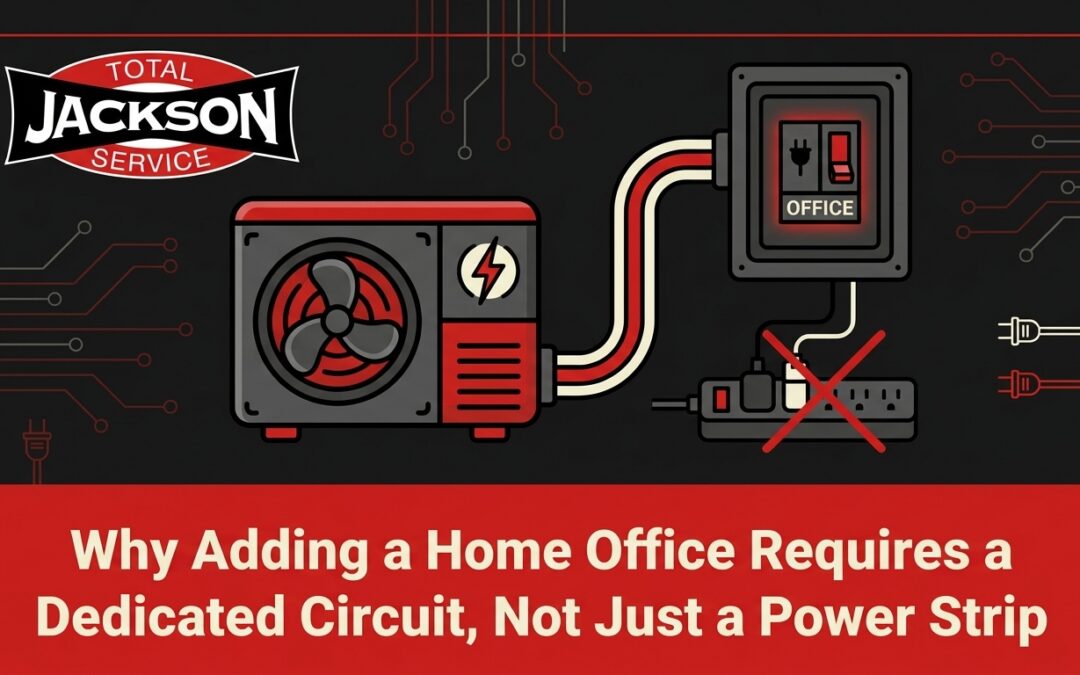
A dedicated circuit provides its own exclusive breaker in your electrical panel and a single, uninterrupted run of wire directly to a specific outlet, ensuring that high-amperage home office equipment is isolated from the rest of the home’s electrical load. Because it does not share power with hallway lights, guest room televisions, or bathroom outlets, a dedicated circuit prevents the overloads that power strips simply cannot stop.
Here is why a dedicated circuit is the ultimate upgrade for a remote workspace:
- Total Load Isolation: When your laser printer spools up to print a 50-page document, it draws a massive spike of power. On a dedicated circuit, this spike is isolated. It will not cause your computer monitors to flicker, and it will not trip the breaker for the rest of the bedroom.
- Proper Grounding and Surge Protection: Modern electronics require robust grounding to function safely. A newly installed dedicated circuit ensures that the grounding path is perfectly intact, providing superior protection against the intense lightning strikes common in our region. This clean grounding path allows your surge protectors to actually do their job.
- Customized Amperage: Instead of being locked into a standard 15-amp bedroom loop, a professional electrician can install a 20-amp dedicated circuit using thicker 12-gauge wire. This raises your safe continuous load limit from 1,440 watts up to 1,920 watts—giving you plenty of overhead for specialized office equipment.
Drawing on our 60-year family legacy of serving the Naples community at Jackson Total Service, we understand exactly how older local homes were wired compared to modern demands. Decades ago, spare bedrooms were wired with the expectation that they would power a bedside lamp and a clock radio. Today, they are expected to serve as fully functioning corporate hubs. Evaluating your home’s unique wiring history and upgrading it to meet today’s demands is a standard part of any comprehensive panel upgrade service in Cape Coral and the surrounding areas.
Comprehensive FAQ: Home Office Electrical Safety
Why does my home office keep tripping the breaker?
You are exceeding the 1,800-watt maximum capacity of the standard bedroom circuit. A tripped breaker is a safety mechanism designed to prevent the wires inside your walls from overheating and catching fire. This overload is most often caused by adding high-draw devices like laser printers, or heating and cooling devices, to a circuit that is already running computer equipment.
Can a power strip handle a space heater and a computer?
No, you should never plug a space heater and a computer into the same power strip. A typical space heater draws up to 1,500 watts entirely on its own, which consumes almost the entire safe capacity of a standard room circuit. Plugging both into a power strip creates a severe fire hazard, risks melting the power strip, and guarantees a tripped breaker.
What is a dedicated circuit?
A dedicated circuit is an electrical line that has its own exclusive circuit breaker in your electrical panel and serves only one specific outlet or appliance. It does not share power with any other lights, outlets, or rooms in the house. This isolation ensures that high-draw equipment receives a stable, uninterrupted flow of power without overloading shared wiring.
How many amps does a home office use?
Power usage varies heavily by equipment, but a robust dual-monitor setup, a powerful PC, and a laser printer can easily draw 5 to 8 amps continuously. Because a standard bedroom circuit only provides 15 amps total (and safely sustains only 12 amps continuously), a modern home office leaves very little overhead for lighting or other electronics.
Is it safe to plug a computer and printer into a power strip?
It is generally safe for the devices themselves if the power strip is a high-quality, properly rated surge protector. However, laser printers have extremely high peak electrical draws when warming up their fusers. While the surge protector might protect the devices from voltage spikes, it does absolutely nothing to prevent the wall circuit itself from overloading and tripping the breaker.
Why do standard bedroom circuits fail under modern remote work loads?
Standard residential bedroom circuits were designed decades ago for low-draw items like table lamps, alarm clocks, and small televisions. They were never engineered for the continuous, heavy 8-hour electrical draw of modern workstations. The wiring infrastructure simply lacks the physical capacity to support corporate-level technology.
How does lightning in Southwest Florida affect overloaded office circuits?
Southwest Florida experiences intense, frequent lightning strikes that send massive voltage spikes through the electrical grid. If your home office equipment is sitting on an overloaded, poorly grounded standard circuit, it is highly vulnerable to these surges. A dedicated circuit provides a clean, robust grounding path that helps direct these dangerous surges safely away from your expensive electronics.
Secure Your Remote Workspace with Professional Electrical Solutions
Relying on a plastic power strip to handle the electrical demands of a modern remote workspace is a gamble you cannot afford to take. The math is undeniable: standard 15-amp bedroom loops simply cannot support the continuous draw of dual monitors, high-capacity printers, and seasonal space heaters safely. Abandoning the false security of power strips for a professionally installed dedicated circuit is the only permanent, safe solution for your home office.
Stop resetting breakers in the dark and start protecting your expensive technology. By isolating your heavy-draw equipment on its own dedicated line, you eliminate the risk of continuous trips, protect your home from hidden electrical fires, and ensure your workflow is never interrupted by a power failure again. Reach out to the licensed electrical experts at Jackson Total Service today to schedule an inspection and secure your workspace with a dedicated circuit installation.