



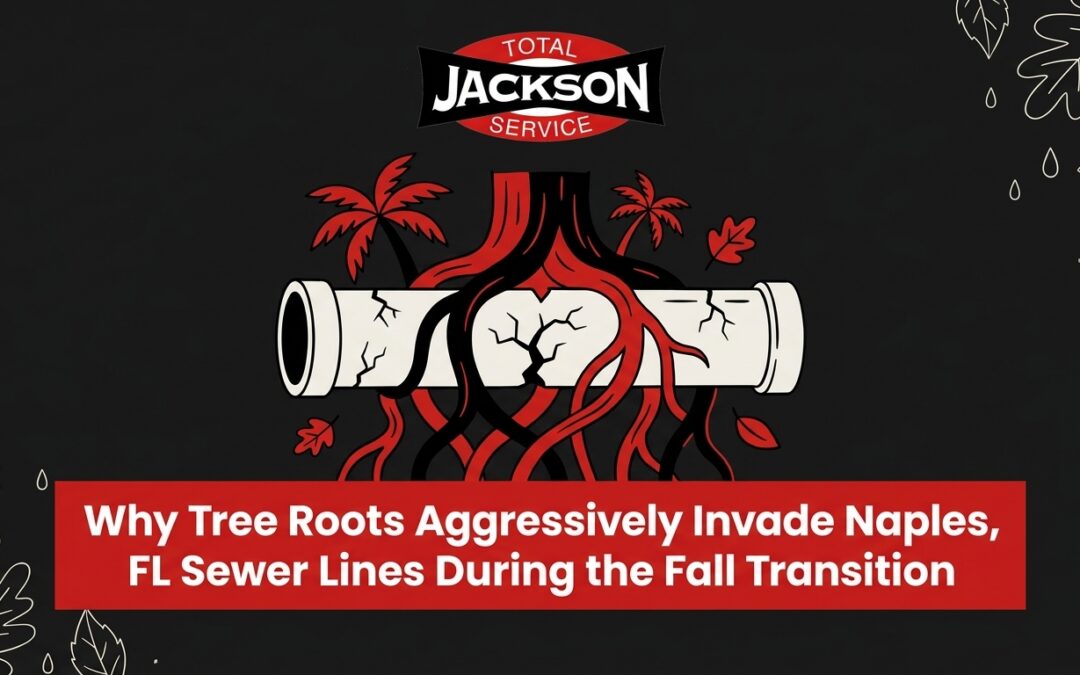
The Hidden Threat Beneath Your Lawn This September
At Jackson Total Service, we field countless calls every September from homeowners who flush the toilet, only to hear the shower drain gurgle in response. Or perhaps you notice a foul odor lingering near the guest bathroom, even though everything appears clean. These small annoyances are rarely just random clogs. Understanding why tree roots aggressively invade Naples sewer lines during the fall transition is the key to preventing a minor drainage issue from turning into a major plumbing emergency.
As Southwest Florida shifts out of its heavy summer rainy season in September, our team regularly sees how the local environment undergoes an abrupt meteorological change. The daily afternoon thunderstorms stop, and the sandy topsoil begins to dry out rapidly. Massive local tree root systems, accustomed to abundant surface water, instinctively hunt for alternative moisture sources to survive the dry season. This biological drive leads them straight toward the consistent, nutrient-rich moisture found inside residential plumbing.
If your home relies on older plumbing infrastructure, your underground pipes are highly vulnerable to this seasonal invasion. Recognizing the early symptoms of root intrusion is critical before a complete line blockage requires immediate intervention. Catching these warning signs early allows you to schedule professional emergency leak and pipe repair in Naples before the roots cause irreversible structural damage to your sewer system.
How the Southwest Florida Fall Transition Triggers Root Growth
To understand why your plumbing is at such high risk during the fall, you have to look at the severe contrast in Southwest Florida’s seasonal weather patterns. Between June and August, the soil in Naples is heavily saturated. Trees do not have to work hard to find water; their roots stay relatively close to the surface, absorbing the daily rainfall.
However, when September arrives and the rainy season tapers off, surface moisture evaporates quickly from the sandy, well-draining soil. Mature trees respond to this sudden drought stress by rapidly expanding their root networks deeper and wider in a desperate search for hydration. Underground sewer pipes create a constant micro-environment of condensation and warmth, acting as an irresistible magnet for thirsty flora.
When you experience slow drains in September, our plumbers know it is rarely a coincidence. It is often a direct biological response to the weather. The trees in your yard are simply doing what they must to survive the dry season, and your sewer line happens to be the most reliable water source available.
The Shift from Surface Saturation to Deep Moisture Seeking
The mechanics of this seasonal shift are dramatic. Here is how our experts observe the transition affecting root behavior:
| Seasonal Phase | Soil Condition | Root Behavior | Threat Level to Plumbing |
|---|---|---|---|
| Summer (June-August) | Heavily saturated from daily storms | Shallow, passive absorption near the surface | Low |
| Early Fall (September) | Rapid surface drying, moisture drops | Aggressive downward expansion seeking water | Very High |
| Winter (Dry Season) | Deeply dry topsoil | Established inside pipes, expanding rapidly | Severe (Blockages Occur) |

Why Older Naples Neighborhoods Are Highly Vulnerable
The biological drive of trees is only half of the equation; the other half is the specific infrastructure of your home. When our plumbing crews visit older established Naples neighborhoods, we see firsthand how susceptible they are to this September post-rainy season transition. These areas often feature magnificent, mature canopy trees that were planted decades ago—right alongside the original plumbing lines.
Homes built before the 1980s typically rely on cast iron or vitrified clay sewer pipes. While these materials were the industry standard at the time, we frequently find that they have distinct vulnerabilities that become liabilities after decades in the ground. Natural ground shifting, soil settlement, and the weight of nearby traffic create microscopic stress fractures in these older materials over time.
Even a microscopic hairline fracture is enough to release a steady plume of moisture vapor into the surrounding soil. To a moisture-starved tree root in early fall, that vapor trail is a neon sign pointing directly to an endless water supply.
The Weaknesses of Aging Cast Iron and Clay Sewer Pipes
Understanding the materials beneath your lawn helps explain why our team encounters root intrusion so commonly in older properties:
- Porous clay joints: Clay pipes were traditionally joined using mortar or oakum. These materials naturally degrade, dry out, and crumble over time, leaving unprotected gaps where roots can easily slip through.
- Cast iron channeling: Cast iron is incredibly strong, but it is susceptible to internal channeling (where acidic wastewater eats away the bottom of the pipe) and external rust scaling. This corrosion creates rough surfaces and weak points that roots can exploit.
- Vulnerability to micro-cracks: Both clay and cast iron are rigid materials. When the sandy Florida soil shifts, these pipes do not flex—they crack. These micro-cracks leak the moisture vapor that attracts roots long before any actual wastewater escapes.
The Mechanics of Root Intrusion in Underground Plumbing
How does a massive tree root fit into a microscopic crack? When we run our diagnostic cameras down these lines, we see a process that is gradual, destructive, and deeply tied to the biological needs of the plant. The initial breach begins with hair-like root tips. These microscopic tendrils are designed to follow moisture gradients in the soil. When they detect the vapor escaping from aging cast iron and clay sewer pipes, they grow directly toward the source and squeeze through the tiny fissures.
Once inside the pipe, the environment is perfect for explosive plant growth. The sewer line provides constant warmth, uninterrupted hydration, and a continuous supply of oxygen and organic nutrients. What started as a few hair-like strands quickly multiplies into a dense, sponge-like mass that acts as a net, catching toilet paper, grease, and debris.
As the root mass thickens, it exerts immense hydrostatic pressure against the weakened pipe walls. Roots are incredibly strong—capable of lifting concrete sidewalks and shattering rigid materials. Over time, this internal outward pressure will widen the initial crack, eventually causing the pipe to fracture completely or collapse entirely if left unchecked. When a collapse happens, standard clearing is no longer an option, and you will need comprehensive burst pipe repair services to restore your home’s sanitation system.
Recognizing Early Warning Signs Before a Whole-House Backup
Because underground root intrusion happens out of sight, homeowners often miss the early warning signs until a catastrophic backup occurs. However, in our experience, your plumbing will almost always give you hints that the pipe’s interior diameter is shrinking.
The earliest symptom is usually a single slow drain—often a shower or floor drain at the lowest elevation in the home. Over a few weeks, this sluggishness gradually affects multiple fixtures. You might also notice gurgling sounds coming from the toilet when you run the bathroom sink. This happens because the root mass creates a bottleneck, trapping air in the pipe. When water flows down, it displaces that trapped air, forcing it up through the nearest water trap (your toilet bowl).
Foul sewer odors in the yard, near the clean-out pipe, or wafting from lower-level drains are another strong indicator that wastewater is sitting stagnant behind a root wall rather than flowing cleanly to the municipal sewer.
Ignoring these signs during the fall transition often leads to major blockages affecting every fixture in the house. One of our Naples customers experienced exactly this during a winter cold front. What started as a minor slow drain in the fall escalated into a major sewer line blockage affecting their toilets, sinks, and shower simultaneously. Our technician, Jeremy, arrived to assess the situation and had to promptly clear the massive blockage through the exterior clean-outs. He explained how the aggressive early fall root growth had set the stage for the severe winter backup. If you notice these symptoms, securing same-day leak and backup repair is essential to protect your home’s interior.
The Dangers of Ignoring Slow Drains and DIY Quick Fixes
When faced with a slow drain, many homeowners reach for a bottle of liquid drain cleaner or a rented mechanical auger. We strongly advise against this. When dealing with tree roots, these DIY quick fixes are not just ineffective—they can actually cause significantly more damage to your plumbing.
Liquid drain cleaners rely on caustic chemicals designed to dissolve hair and grease. They are completely powerless against thick, woody tree roots. Worse, these harsh chemicals sit stagnant behind the root blockage, generating intense heat. In aging cast iron or clay pipes, this chemical heat can accelerate corrosion or cause the brittle material to crack further.
Standard plunging or basic DIY augering is equally frustrating. A small auger might manage to puncture a tiny hole through the center of the root mass, allowing water to drain temporarily. However, the vast majority of the root curtain remains attached to the pipe walls. The roots will simply grow back thicker and faster, usually closing the hole within a matter of weeks.
To truly resolve the issue, advanced professional clearing methods are required. Techniques like hydro jetting for stubborn clogs and roots use specialized multi-directional water pressure to safely slice through thick roots and scour the pipe walls clean without relying on corrosive chemicals or abrasive metal blades.
Why a Professional Camera Inspection is Your Best Defense
Guesswork has no place in plumbing diagnostics. If you suspect roots have infiltrated your lines, a professional camera inspection is the only definitive way to assess and resolve the intrusion. High-definition sewer cameras are fed directly into your plumbing, providing a real-time, illuminated view of the pipe’s interior.
This technology eliminates the mystery. A camera inspection shows the exact location, density, and severity of the root mass. More importantly, it reveals the structural condition of the pipe itself beneath the roots. Our technicians can clearly see if the pipe is merely clogged and can be cleared, or if the roots have already crushed the line, necessitating a localized repair.
At Jackson Total Service, our 60-year family legacy serving this area means we have deep historical knowledge mapping which older Naples neighborhoods have the highest concentration of aging cast iron and clay pipes vulnerable to this specific seasonal threat. We know exactly how these historic systems interact with the local flora during the seasonal shift. Catching the problem early through a proactive inspection saves your intricate landscaping from being unnecessarily excavated and prevents extensive, messy property damage inside your home.
Frequently Asked Questions About Tree Roots and Sewer Lines
Why do tree roots invade sewer lines more in the fall?
Tree roots invade sewer lines aggressively in the fall due to the sudden drop in surface moisture. As Southwest Florida’s heavy summer rains end in September, the topsoil dries out rapidly. Mature trees respond to this drought stress by sending their roots deeper into the ground, where they seek out the consistent moisture and condensation leaking from underground plumbing.
What are the first signs of roots in plumbing?
The earliest sign of root intrusion is usually a single slow drain that eventually spreads to multiple fixtures in the home. You may also hear distinct gurgling sounds from your toilet when you use the sink or shower, which indicates trapped air struggling to bypass a blockage. Additionally, unexplained foul sewer odors inside the home or out in the yard are strong indicators of a developing root mass.
How do you know if tree roots are in your sewer line?
While slow drains and gurgling toilets are strong indicators, the only way to know for certain is through a professional sewer camera inspection. A high-definition camera is fed into your clean-out pipe, providing a clear visual of the pipe’s interior. This reveals exactly where the roots have entered, how thick the blockage is, and whether the pipe itself has sustained structural damage.
Can tree roots cause a whole-house backup?
Yes, tree roots are one of the leading causes of whole-house sewer backups. Once roots enter a main sewer line, they multiply rapidly in the nutrient-rich environment, acting like a net that catches all waste and debris leaving your home. If left untreated, this mass will eventually block the entire diameter of the pipe, forcing all wastewater to back up into your lowest drains, showers, and toilets.
Will tree roots eventually break underground pipes?
Tree roots can absolutely break underground pipes if they are not cleared. As the roots grow and expand inside the pipe, they exert immense hydrostatic pressure against the pipe walls. Over time, this outward force is strong enough to shatter brittle clay pipes or crack weakened cast iron lines, leading to a complete structural collapse that requires excavation and replacement.
Are older Naples homes more susceptible to plumbing root damage?
Yes, in our experience, older Naples homes are highly susceptible to root damage for two main reasons: infrastructure age and mature landscaping. Homes built before the 1980s typically feature cast iron or clay sewer lines, which develop micro-cracks and degraded joints over decades. Combined with large, mature canopy trees planted decades ago, these older pipes provide the perfect environment for aggressive root intrusion.
Secure Your Plumbing Before the Dry Season Takes Hold
The fall transition is a critical time for plumbing vigilance in Southwest Florida. As the heavy summer rains fade and the soil dries out, the massive root systems beneath your lawn will inevitably seek out new sources of hydration. Slow drains, gurgling toilets, and faint sewer odors in September should never be ignored—they are your home’s early warning system.
Do not wait for a complete blockage to disrupt your household. By scheduling a professional camera inspection with Jackson Total Service now, you can accurately assess the health of your underground pipes and remove intrusive roots before they cause a catastrophic failure. Protect your property and ensure your plumbing is secure before the dry season fully takes hold.