



The Real LED vs Traditional Landscape Lighting Comparison Every Florida Homeowner Needs
The led vs traditional landscape lighting comparison comes down to a few clear differences — and for most Southwest Florida homeowners, the numbers tell a straightforward story:
| Factor | LED | Traditional (Halogen/Incandescent) |
|---|---|---|
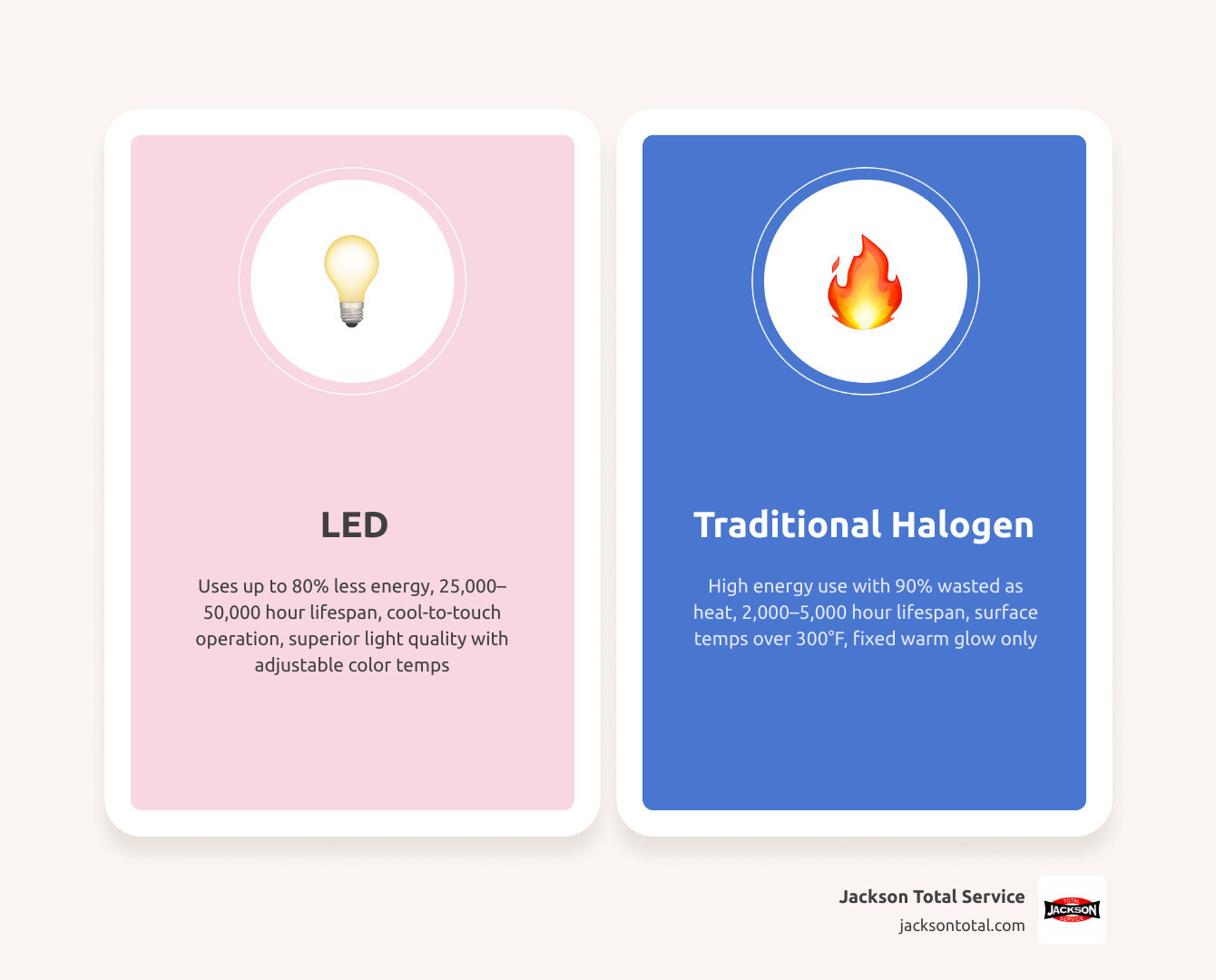
| Energy Use | Up to 80% less than halogen | High — most energy lost as heat |
| Lifespan | 25,000–50,000 hours | 2,000–5,000 hours |
| Heat Output | Cool to the touch | Can exceed 300°F surface temp |
| Maintenance | Very low — rarely needs bulb changes | Frequent replacements needed |
| Light Quality | Wide range of color temps (2700K–5000K) | Fixed warm glow (~2800K) |
| Upfront Cost | Higher | Lower |
| Long-Term Cost | Lower — significant energy savings | Higher over time |
Bottom line: LED wins on efficiency, lifespan, and safety. Traditional halogen offers lower upfront cost and a familiar warm glow, but costs more to run and maintain over time.
If you’ve noticed your outdoor lighting eating through your energy bill — or you’re tired of swapping out burned-out halogen bulbs every spring — you’re not alone. Homeowners across Naples, Bonita Springs, and the rest of Southwest Florida are rethinking their landscape lighting from the ground up.
The shift from traditional halogen and incandescent bulbs to LED technology isn’t just a trend. It’s a practical upgrade that affects everything from your monthly electricity costs to how your palm trees and garden beds look after dark. And in Florida’s demanding climate — with heat, humidity, and salt air working against your outdoor fixtures year-round — the technology you choose matters more than it might in other parts of the country.
This guide breaks down exactly how these two technologies stack up, so you can make a confident decision for your home or property.
The Core led vs traditional landscape lighting comparison
When we look at the fundamental differences between these two technologies, we are comparing two very different ways of creating light. Traditional landscape lighting usually relies on halogen technology. A halogen bulb is essentially an advanced incandescent lamp; it uses a tungsten filament and a small amount of halogen gas to produce light. This process is incredibly inefficient. In fact, traditional bulbs convert about 90% of their energy into heat, leaving only 10% to actually illuminate your garden.
In contrast, LED (Light Emitting Diode) technology is solid-state. It uses semiconductors to convert electricity directly into light through a process called electroluminescence. Because there is no filament to heat up until it glows, LEDs are remarkably efficient. In a modern led vs traditional landscape lighting comparison, the LED uses up to 80% less energy to produce the same amount of light. For example, a 10-watt LED can easily match the brightness of a 50-watt halogen bulb.
For homeowners in Fort Myers or Naples, this efficiency translates directly into lower operational costs. Most Landscape Lighting systems in our area are low-voltage (12V), requiring a transformer to step down the power from your home’s standard 120V. Because LEDs draw so much less power, you can often use smaller, less expensive transformers and thinner wire, or fit more lights on a single circuit without risking a voltage drop.
Why LED Technology Wins on Performance and Durability
Living in Southwest Florida means our outdoor equipment faces a constant barrage of high humidity, intense UV rays, and corrosive salt air. This is where the durability of LED really shines. Because LEDs are solid-state, they don’t have fragile glass envelopes or delicate filaments that can break due to vibrations or temperature swings.
The most staggering statistic in any led vs traditional landscape lighting comparison is the lifespan. A standard halogen bulb might last 2,000 to 5,000 hours. That sounds like a lot until you realize a high-quality LED is rated for 25,000 to 50,000 hours. If you run your lights for six hours every night, a halogen bulb might burn out in a year or two, while an LED could theoretically last over 20 years.
This longevity drastically reduces maintenance. Instead of spending your weekends climbing ladders or crawling through the bushes to replace dead bulbs, you can simply enjoy your yard. Furthermore, high-quality LED fixtures are often built as “integrated” units, meaning the light source is sealed inside a weather-resistant housing, providing superior protection against the Florida rain. For more on how these systems integrate with your home’s power, check out our Electrical Installation Naples, FL Complete Guide.
From an environmental perspective, LEDs are the clear winner. They contain no mercury or hazardous gases, and because they last so much longer, they keep thousands of glass and metal bulbs out of our local landfills.
Superior Light Quality in an led vs traditional landscape lighting comparison
In the early days of LED, critics complained the light was too “blue” or “harsh.” As of April 2026, those days are long gone. Modern LEDs offer incredible color flexibility. You can choose a 2700K “warm white” that perfectly mimics the golden hue of traditional halogen, or a 3000K “neutral white” that looks crisp and clean against stone architecture.
The Color Rendering Index (CRI) is also vital. High-quality LEDs now boast CRI ratings of 90 or higher, meaning they show the “true” colors of your hibiscus flowers and royal palms just as they appear in the sunlight. Unlike halogen bulbs, which cast light in a wide 360-degree pattern and require reflectors to aim, LEDs are naturally directional. This allows for precision beam control, letting us highlight a specific architectural feature or a tall tree without wasting light or creating glare for the neighbors. Knowing How to Choose the Best Landscape Lighting Installation in Fort Myers, FL often starts with understanding these nuances in light quality.
Safety Benefits: Heat Reduction and Insect Control
One of the most overlooked benefits of LED is safety. Because traditional halogen bulbs reach surface temperatures exceeding 300°F, they can be a fire hazard if they come into contact with dry mulch or low-hanging leaves. They can also cause skin burns if a child or pet accidentally touches a fixture. LEDs remain cool to the touch, making them much safer for homes with busy families and curious pets. This cool operation also benefits your plants; you can place an LED spotlight right up against a delicate shrub without worrying about “leaf scorch.”
Then there’s the “bug factor.” We all know that Florida insects love a good light source. However, many bugs are actually attracted to the UV radiation and intense heat emitted by halogen bulbs. LEDs emit almost no UV light and very little heat, which makes them significantly less attractive to the swarms of insects that usually gather around porch lights. To ensure your outdoor electrical setup is safe and optimized, refer to our Electrical Installation Estero, FL Guide.
Retrofitting and Smart Home Integration in 2026
If you already have a traditional lighting system, you don’t necessarily have to tear it all out. There are two main ways to upgrade:
- Drop-in Bulbs: You simply swap your old halogen bulbs for LED versions that fit the same sockets. This is the most budget-friendly way to start, though it doesn’t offer the same moisture protection as a fully integrated fixture.
- Integrated Fixtures: You replace the entire fixture with a dedicated LED unit. This is the “gold standard” for longevity because the LED and the housing are designed to work together to dissipate heat and keep out moisture.
Before you make the switch, it’s important to check your transformer. While most LEDs work with older magnetic transformers, you may need to “rebalance” the load. Because LEDs draw so much less power, an old transformer might actually put out too much voltage for the new bulbs, shortening their life. Our Electrical Services team can help ensure your system is properly balanced. For residents in Lee County, our Electrical Installation Fort Myers, FL Guide provides more localized tips on system upgrades.
Modern Design Flexibility with an led vs traditional landscape lighting comparison
The real magic of LED in 2026 is the integration with smart home technology. Because LEDs are electronic by nature, they are easily dimmable and controllable via apps. You can create “zones” in your yard — perhaps the path lights stay at 20% for safety, while the tree uplights go to 100% for a party.
With RGB color-changing LEDs, you can even change the mood of your landscape for the holidays or a big game with the tap of a screen. Modern systems also utilize astronomic timers, which automatically adjust for the changing sunset times in Southwest Florida, ensuring your home is never left in the dark. For those in North Naples looking for high-tech solutions, our Electrical Installation North Naples, FL Guide covers the latest in automation.
Frequently Asked Questions about Landscape Lighting
Can I replace my old halogen bulbs with LED “drop-ins” without changing fixtures?
Yes, in most cases you can. This is a popular way to reduce energy consumption quickly. However, you must ensure the LED bulb is rated for outdoor use and that the fixture is in good enough condition to protect the new bulb from Florida’s heavy rains. Also, keep in mind that integrated fixtures typically last longer because they are specifically engineered to keep the LED cool.
Do LED landscape lights really attract fewer insects in Florida?
Yes! Most nocturnal insects are drawn to the ultraviolet (UV) light and heat produced by halogen and incandescent bulbs. Because LEDs produce almost no UV rays and stay cool, they are much less likely to turn your backyard into a bug convention. For the best results, stick with “warm” color temperatures (below 3000K).
How long will a modern LED system last compared to traditional lighting?
The difference is night and day. A traditional halogen bulb usually lasts about 1 to 2 years with nightly use. A high-quality LED fixture is designed to last 15 to 25 years. While the upfront cost is higher, you save significantly over time by not having to buy dozens of replacement bulbs or pay for frequent service calls.
Conclusion
Deciding between led vs traditional landscape lighting comparison options is about more than just light bulbs; it’s about investing in the beauty, safety, and efficiency of your home. At Jackson Total Service, we’ve been helping Southwest Florida families stay comfortable and bright since 1964. Our deep roots in Naples, Fort Myers, Bonita Springs, and Estero mean we understand exactly what it takes to make a lighting system survive and thrive in our unique tropical environment.
Whether you need a brand-new installation or a professional retrofit of your existing system, our licensed technicians are available 24/7 to provide comprehensive home comfort solutions. We take pride in being your one-stop shop for HVAC, plumbing, and electrical needs, ensuring that every part of your home works in perfect harmony.
Ready to see your garden in a whole new light? Trust the local experts who have served this community for over six decades. Landscape Lighting is our passion, and we’re here to help you make the switch to a brighter, more efficient future. Give us a call today!