



Why Indoor Air Quality Starts Inside Your Walls
Understanding how clean ducts improve indoor air quality is one of the most important things a Southwest Florida homeowner can do for their family’s health. Your HVAC system works like a pair of lungs — it pulls air in, conditions it, and pushes it back out through every room in the house. But when the ducts carrying that air are coated in years of accumulated dust, mold spores, pet dander, and pollen, every breath your family takes indoors could be working against them.
According to the EPA, indoor air can be two to five times more polluted than the air outside — and in tightly sealed, air-conditioned Florida homes, that gap can widen fast.
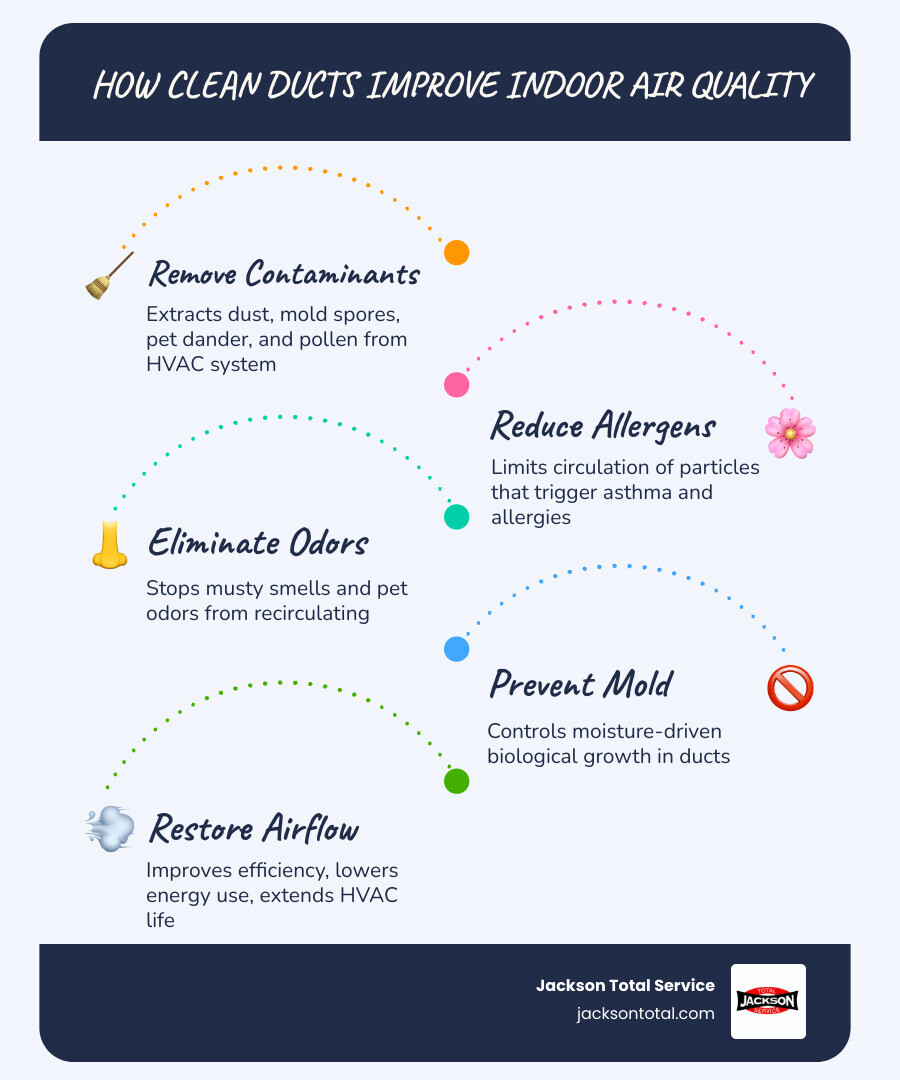
Here’s a quick summary of how clean ducts improve indoor air quality:
- Remove accumulated contaminants — dust, mold spores, pet dander, and pollen are physically extracted from the air distribution system
- Reduce allergen circulation — fewer particles moving through the system means fewer triggers for asthma and allergy sufferers
- Eliminate trapped odors — musty smells and pet odors caught in ductwork stop recirculating into living spaces
- Prevent mold spread — professional cleaning addresses moisture-driven biological growth before it spreads through the home
- Restore proper airflow — clear ducts allow conditioned air to move freely, reducing strain on your HVAC system
- Support HVAC efficiency — a clean system doesn’t have to work as hard, which lowers energy use and extends equipment life
The sections below walk through each of these benefits in detail, explain what warning signs to watch for, and show you exactly what a professional cleaning should look like.
how clean ducts improve indoor air quality by Removing Pollutants

The direct connection between duct cleaning and indoor air quality is simple: when contaminants build up inside the air distribution system, the HVAC fan can disturb and recirculate them through your home. Not every speck of dust in a duct becomes airborne, and the EPA is careful not to recommend routine cleaning for every home. But when contamination is substantial, cleaning can absolutely help.
Common pollutants that can collect in ductwork include:
- Household dust
- Pollen
- Pet dander
- Dust mite debris
- Mold spores
- Insect remains
- Rodent droppings
- Drywall dust after remodeling
- Chemical residue and lingering odors from cleaners, smoke, or other indoor sources
In Southwest Florida, this matters even more because homes run air conditioning for long stretches of the year. The more the system cycles, the more chances contaminants have to move through supply and return ducts.
Professional cleaning is most helpful when it removes confirmed buildup that is affecting the air path. That is why we always recommend looking at the whole IAQ picture, including filtration, humidity control, coil condition, and duct cleanliness. If mold is part of the problem, our guide to mold-free air conditioning is a smart next read, and our broader indoor air quality page covers the bigger picture.
how clean ducts improve indoor air quality for allergy sufferers
For allergy sufferers, cleaner ducts can mean fewer triggers circulating through the house. Pollen, dander, and fine dust are exactly the kind of microscopic irritants that can make a home feel stuffy even when it looks clean.
If someone in your household sneezes more when the AC kicks on, wakes up congested, or notices symptoms are worse at home than elsewhere, the duct system may be part of the issue. Removing built-up allergen reservoirs from the air path can reduce repeated exposure, especially when paired with proper filter replacement and humidity control.
That said, duct cleaning is not magic. It is one piece of a healthier-home strategy. Filters still need to fit properly. Moisture still needs to be controlled. The system still needs regular maintenance. But when ducts contain real contamination, a professional duct cleaning can reduce what keeps getting blown back into your living spaces.
how clean ducts improve indoor air quality in humid climates
Humidity is where Florida really enters the chat.
In places like Naples, Fort Myers, Estero, Bonita Springs, and Marco Island, moisture can create ideal conditions for biological growth inside HVAC systems. If humid air meets dust and dark duct surfaces, mold spores and musty odors may follow. Dirty ducts do not create moisture on their own, but contamination plus humidity is a bad combination.
That is why how clean ducts improve indoor air quality in Southwest Florida is closely tied to moisture control. Professional service should not just remove debris. It should also identify why contamination is building up in the first place, whether that is high indoor humidity, poor filtration, duct leakage, or microbial growth around key HVAC components.
For a deeper look at local humidity challenges, see Don’t Let the Humidity Win with This Tropical Duct Cleaning Guide.
Recognizing Warning Signs: Is it Time for Duct Cleaning in Naples or Fort Myers?
The EPA does not recommend duct cleaning on a fixed schedule for every home. Instead, it recommends cleaning under specific conditions. Those conditions are the best place to start.
You should consider a professional inspection if you notice:
- Visible mold growth inside hard-surface ducts or on HVAC components
- Rodent or insect infestation in the duct system
- Excessive dust and debris actually blowing from supply registers
- Musty or unpleasant odors when the system starts
- Dust collecting around vents soon after cleaning the house
- Increased allergy or asthma symptoms indoors
- Weak airflow in certain rooms
- A recent remodeling project that created heavy construction dust
If you live in Collier or Lee County and want location-specific service information, visit Duct Cleaning Naples FL or Duct Cleaning Fort Myers FL.
Identifying Vermin and Debris Clogs
One of the clearest signs that ducts need attention is evidence of pests. Vermin in ductwork is not just unpleasant. It can directly hurt air quality.
Warning signs include:
- Scratching sounds in walls or ceilings
- Droppings near vents or inside mechanical areas
- Insect nesting material
- Strange odors that do not go away
- Airflow that suddenly weakens in part of the home
Rodents and insects leave behind waste, nesting debris, and allergens. In severe cases, nests or debris can partially block airflow. That affects both comfort and system performance.
If you suspect contamination or restricted airflow in a coastal or island home, our Duct Cleaning Marco Island FL page can help you learn what to watch for.
Post-Renovation Air Quality Concerns
Home renovations are one of the most overlooked reasons to inspect ductwork. Drywall dust, sawdust, insulation fibers, and other fine debris can find their way into returns and trunk lines during construction.
Even if registers were covered, dust has a talent for getting everywhere. It is basically the glitter of home improvement.
After a remodel, a baseline duct inspection can help determine whether debris entered the system. This is especially important if you notice fine white dust reappearing quickly on furniture or smell stale construction odors long after the work is done.
For homeowners in southern Lee County, Duct Cleaning Bonita Springs FL is a useful local resource.
The Connection Between System Efficiency and Clean Air Channels
Duct cleaning is often discussed as an air-quality service, but it can also support HVAC performance when contamination is heavy enough to restrict airflow or foul key components.
Here is the mechanical side of it: your system depends on air moving through returns, across coils, and out supply ducts at the right rate. When debris accumulates, it can increase airflow resistance and static pressure. That forces the blower to work harder and can make the system run longer to reach the thermostat setting.
Research cited in the HVAC industry also shows that even small debris buildup on heat-transfer surfaces can reduce efficiency. In other words, your system does not love breathing through a dusty straw.
If you want to explore this efficiency angle further, read How Duct Cleaning Saves Your AC from the Humid Hustle or visit Duct Cleaning Estero FL.
Reducing Strain on Your Heating and Cooling System
When heavy debris is present, cleaning can help by restoring smoother airflow and reducing strain on major components such as:
- The blower motor
- The evaporator coil area
- The air handler cabinet
- Supply and return pathways
This does not mean every dusty duct is destroying your equipment. Light household dust is common and does not always justify cleaning. But if the system is clogged with debris, contaminated by pests, or affected by mold and moisture, removing that material can help protect long-term performance and reduce wear.
For homeowners in northern Lee County, Duct Cleaning North Fort Myers FL offers more information on local service needs.
Lowering Monthly Utility Costs
Can clean ducts lower utility bills? Sometimes, yes, but only when buildup is significant enough to affect airflow or force longer run times. Duct cleaning is not a guaranteed bill-lowering trick for every house. If the real problem is a clogged filter, leaky ductwork, an oversized AC, or poor system design, those issues need to be addressed too.
Still, when ducts or related components are heavily contaminated, restoring airflow can help the system operate more normally. That can reduce unnecessary runtime, support better comfort, and ease the burden on the equipment.
For homeowners in Cape Coral and nearby communities, Duct Cleaning Cape Coral FL provides more local guidance.
Professional Standards: What to Expect from a NADCA-Certified Service
A proper duct cleaning should follow recognized industry standards, especially the NADCA ACR Standard. The key concept is source removal: loosen contaminants, place the system under negative pressure, and capture debris so it does not spill into the home.
Here is the difference between professional cleaning and a rushed shortcut:
| Professional source removal | “Blow-and-go” shortcut |
|---|---|
| System inspection before cleaning | Little or no inspection |
| Negative pressure collection equipment | Weak vacuum or shop-vac style tools |
| HEPA-filtered containment where appropriate | Dust released back into living areas |
| Mechanical agitation to dislodge debris | Quick pass at vents only |
| Cleaning of multiple system components, not just visible registers | Surface-only cleaning |
| Clear explanation of findings | Vague claims and pressure tactics |
| Post-cleaning verification | No proof of results |
A qualified service should clean more than the duct walls alone. Depending on system design and condition, that can include supply and return ducts, registers, grilles, diffusers, and accessible HVAC components tied to the air path.
For local homeowners, Duct Cleaning Lehigh Acres FL is another helpful service page.
The Risks of Improper Cleaning Methods
Poorly performed duct cleaning can actually make indoor air quality worse. This is one of the most important consumer warnings in the entire topic.
If the contractor uses inadequate suction, poor containment, or rough methods, they may:
- Loosen dust and blow it into the home
- Aerosolize mold spores and other contaminants
- Damage flexible ductwork or insulation
- Leave access holes or poor repairs behind
- Clean only the easy-to-reach parts while skipping the actual problem areas
That is why we strongly advise homeowners to avoid suspiciously fast, suspiciously vague service claims. Proper cleaning takes time, care, and the right equipment.
If you are researching service in eastern Collier County, visit Duct Cleaning Golden Gate FL.
Verifying Results with Post-Cleaning Inspections
A professional job should not end with “trust us, it looks better in there.”
You should expect some form of verification, such as:
- Before-and-after photos or video
- Visual confirmation inside accessible duct sections
- Inspection of supply and return openings
- Confirmation that debris is not left in the system
- Explanation of any damage, mold concerns, or needed repairs
The EPA also encourages homeowners to verify that ducts are actually clean after the service, not just cleaner-looking at the vent covers. That is a big difference.
For island and coastal homeowners, Duct Cleaning Sanibel Island FL may be useful if you are evaluating service needs in a humid, salt-air environment.
Preventive Steps: Maintaining Your Home’s Air Quality in May 2026
Professional cleaning is not the whole strategy. The best way to keep ducts cleaner between visits is to reduce what gets into the system in the first place.
In May 2026, the fundamentals are still the same:
- Check HVAC filters regularly and replace them on schedule
- Use the highest MERV-rated filter your system can handle
- Keep return and supply vents unobstructed
- Vacuum and dust routinely with attention to pet hair and soft surfaces
- Control indoor humidity, ideally around 30% to 50%
- Address leaks in ductwork or around return areas
- Schedule regular HVAC maintenance for coils, blowers, and drains
Homes with pets, allergy sufferers, recent renovations, or high humidity may need closer monitoring. If you are in eastern Collier County, Duct Cleaning Ave Maria FL and Duct Cleaning Immokalee FL offer more local information.
The Role of Dryer Vent Cleaning in Home Safety
Dryer vent cleaning is a separate service from air duct cleaning, but it matters for both home safety and indoor conditions.
Lint buildup can:
- Restrict dryer airflow
- Increase drying times
- Add heat and moisture to the home
- Increase fire risk
Clogged dryer vents are one of the leading causes of house fires, which is why this service should never be treated like a “maybe later” item. In humid Southwest Florida homes, poor dryer venting can also contribute to excess moisture problems around the laundry area.
For homeowners in island communities, Duct Cleaning Pine Island FL can help you explore related air-path maintenance needs.
Minimizing Contamination Between Professional Visits
The best preventive habits are boring, consistent, and very effective:
- Replace filters every 1 to 3 months, or more often if you have pets or allergies
- Seal gaps that allow dusty attic or crawlspace air into returns
- Keep windows closed during high-pollen days if your allergies flare
- Use kitchen and bath ventilation to manage moisture
- Schedule HVAC inspections so dirty coils and drain issues do not feed bigger IAQ problems
- Clean registers and vent covers regularly, while remembering that surface cleaning is not the same as deep duct cleaning
For coastal homeowners, Duct Cleaning Fort Myers Beach FL offers more information about local conditions.
Frequently Asked Questions
How often should I have my air ducts professionally cleaned?
There is no universal schedule. The EPA recommends condition-based cleaning, not automatic annual service. Many homes may go years without needing it, while others need inspection sooner because of pets, remodeling, moisture issues, or pest activity. A 3-to-5-year conversation is common in the industry, but the right answer depends on what an inspection actually finds.
Can dirty air ducts actually make me sick?
Dirty ducts are not proven to cause illness in every home, and the EPA notes that research is still limited. But contaminated ducts can absolutely contribute to respiratory irritation when they contain mold, pest waste, or heavy allergen buildup that gets circulated into living spaces. For people with asthma, allergies, or sensitivity to airborne particles, that exposure can make symptoms worse.
Does duct cleaning help remove persistent household odors?
Yes, when the odor source is in the system. Musty smells, pet odors, smoke residue, and stale scents can linger in dust and debris inside ducts or HVAC components. Removing contamination from the air path can help stop those odors from being redistributed every time the fan runs. If mold or moisture is involved, the underlying cause also needs to be corrected or the smell may come back.
Conclusion
Clean ducts are not a cure-all, but they can make a meaningful difference when real contamination is present. That is the heart of how clean ducts improve indoor air quality: less debris circulating, fewer allergens in the air path, better airflow, and a healthier environment for your family.
At Jackson Total Service, we have served Southwest Florida since 1964, helping homeowners in Naples, Marco Island, Bonita Springs, Estero, Fort Myers, Cape Coral, and surrounding Lee and Collier County communities care for the systems their homes rely on every day. Because we provide HVAC, plumbing, and electrical services in one place, we can look at home comfort as a whole, not just one vent at a time.
If your home feels dusty, musty, or harder to keep comfortable, schedule your professional indoor air quality assessment today.