


When the Summer Heat Brings a Burnt-Ozone Warning
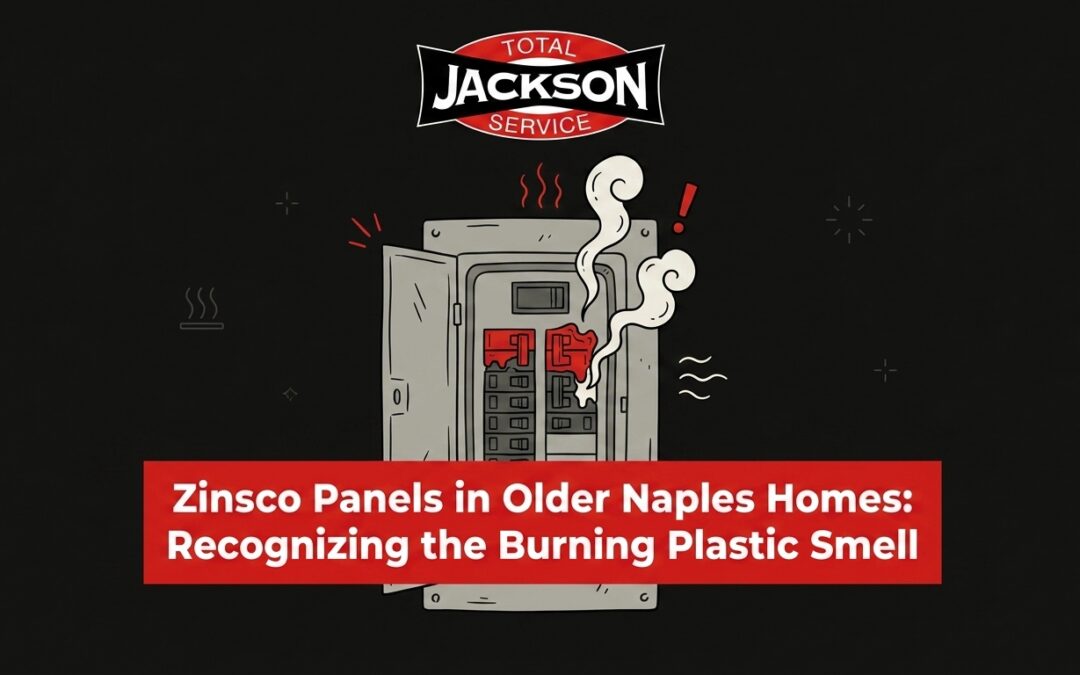
At Jackson Total Service, we often receive frantic calls right as families are prepping for the back-to-school transition. Your air conditioning system is running continuously to combat the intense late-summer heat, but there is a strange, metallic odor lingering near the utility closet. If you are noticing the burning plastic smell from Zinsco Panels in Older Naples Homes: Recognizing the Burning Plastic Smell, our electricians want you to know you are likely catching the first and only warning sign of a severe electrical hazard.
For more comprehensive guidance on protecting your property, explore our resources on modern home electrical panel safety or reach out directly for professional panel upgrade services.
In our decades of field experience, that faint scent—often described as burnt ozone, melting plastic, or a hot metallic odor—is rarely a temporary glitch. It is usually the direct result of active electrical arcing happening behind the closed metal door of your breaker box. During the August peak AC load, your home’s electrical infrastructure is pushed to its absolute limits. Air conditioning compressors draw massive amounts of sustained amperage. When that heavy current flows through an outdated or compromised connection, the resulting friction generates extreme, localized heat.
Why our team stresses that ignoring the smell is not an option:
- It indicates active melting: The odor means physical components inside the panel are currently reaching their melting point.
- It rarely trips the breaker: The specific design of these outdated panels often prevents the safety mechanism from engaging, allowing the overheating to continue uninterrupted.
- It worsens under load: The smell might disappear when the AC cycles off, but it will return—and escalate—the next time the system runs.
Many homeowners assume that if the lights are still on and the breaker hasn’t tripped, the system is functioning normally. However, investigating this specific burnt-ozone odor requires immediate professional intervention, not a wait-and-see approach. The longer the system runs under these conditions, the higher the risk of a catastrophic failure.
The Hidden History Behind Naples’ Mid-Century Electrical Systems
To understand why this specific hazard exists, you have to look back at the construction boom that shaped this region decades ago. With Jackson Total Service’s 60-year family legacy serving this community, our team possesses deep, generational knowledge of how these specific historic neighborhoods were originally wired and constructed. During the mid-century development phase, certain electrical components were the undisputed industry standard. Today, our electricians widely recognize those same components as significant fire hazards in vintage homes.
While older Naples historic neighborhoods boast incredible architectural charm and solid block construction, their original electrical infrastructure was simply not designed for modern energy consumption. A home built in the 1960s or 1970s was wired for a vastly different lifestyle. Today, building codes and safety standards have evolved dramatically to accommodate the heavy electrical loads of modern living.
Comparing Electrical Demands: Then vs. Now
| Appliance / System | Historical Demand (1970s) | Modern Demand (2020s) |
|---|---|---|
| Air Conditioning | Small window units or basic central air | High-capacity, multi-ton HVAC systems running continuously |
| Kitchen Appliances | Basic refrigerator and standard oven | Smart refrigerators, induction cooktops, multiple high-draw gadgets |
| Home Electronics | One or two televisions, basic lighting | Multiple large displays, home offices, extensive smart lighting |
| Vehicle Charging | None | Dedicated EV charging stations drawing high continuous amperage |
Understanding your home’s specific architectural era is the first step in diagnosing hidden electrical risks. The panels installed during this era were considered safe at the time, but decades of use and changing technology have revealed critical flaws.
The Era of Aluminum Wiring and Outdated Breakers
During specific transition periods in electrical manufacturing, copper shortages and cost-saving measures led builders to favor alternative materials. Aluminum was widely adopted for busbars—the solid metal strips inside the panel that distribute electricity to individual breakers. While aluminum is an excellent conductor, our field technicians have seen firsthand how differently it behaves compared to copper over long periods.
Aluminum expands and contracts significantly as it heats up and cools down. Over decades of daily use, this constant thermal expansion causes the connections to loosen. When a connection becomes loose, electrical resistance increases. Increased resistance creates more heat, which causes further expansion, creating a dangerous cycle that eventually leads to component failure.
The Mechanics of the Melting Plastic Scent
When our technicians open up these failing panels, we see that the burning odor you detect is not a phantom smell; it is a chemical reaction happening in real-time. Zinsco electrical panels, in particular, suffer from a well-documented design flaw that makes them uniquely susceptible to this exact failure mode. The issue lies in how the individual circuit breakers connect to the panel’s main power source.
In a properly functioning modern panel, breakers clip tightly onto the busbar. If a circuit draws too much power, the breaker trips, instantly cutting the flow of electricity and preventing damage. However, the older design utilizes a different clipping mechanism that can lose its tension over time. When the clip becomes loose, the electricity must jump—or “arc”—across the tiny gap between the breaker and the busbar.
Electrical arcing generates temperatures that can exceed 2,000 degrees Fahrenheit. This intense, localized heat begins to melt the plastic casing of the breaker itself. As the plastic liquefies, it often fuses the breaker directly to the aluminum busbar. The “burnt-ozone” smell you notice in the hallway or garage is the literal off-gassing of this melting insulation and plastic hardware.
Why the Breaker Fails to Trip
The most dangerous aspect of this mechanical failure is that it defeats the panel’s primary safety feature. When the plastic casing melts and fuses to the busbar, the internal tripping mechanism of the breaker can become physically jammed.
The sequence of failure our electricians typically observe follows these steps:
- Connection degrades: The tension clip holding the breaker to the busbar loosens over years of thermal expansion.
- Arcing begins: Electricity jumps the microscopic gap, creating intense friction and heat.
- Plastic melts: The breaker casing reaches its melting point, releasing the distinct burnt-plastic odor.
- Mechanism jams: The melted plastic flows into the breaker’s internal trip mechanism, solidifying and locking it in place.
- Continuous current: Even as the circuit overloads, the breaker cannot physically trip, allowing uninterrupted power to flow through a melting connection.
This uninterrupted current is what transforms a localized melting issue into a full-scale electrical hazard. The panel continues to supply power to the overloaded circuit, completely unaware that the safety mechanism has been compromised.

How Coastal Environmental Factors Accelerate Corrosion
While outdated electrical components are a concern anywhere in the country, working extensively across Southwest Florida has taught our team that the local environment plays a massive role in how quickly these systems degrade. A panel that might survive for fifty years in a dry, arid climate will degrade much faster in a coastal zone. The specific coastal salt air and high ambient humidity in our region significantly accelerate the oxidation and corrosion of the aluminum busbars inside Zinsco electrical panels.
Aluminum is highly vulnerable to oxidation when exposed to moisture and oxygen. Unlike copper, which develops a conductive patina, aluminum develops a layer of aluminum oxide. This oxide layer is an insulator, meaning it actively resists the flow of electricity. As this invisible layer builds up on the busbar, the breaker has to work harder to pull electricity through the connection, generating even more heat.
Environmental Stress Factors on Electrical Panels:
- High Ambient Humidity: Constant moisture in the air permeates older, unsealed utility rooms and garages, settling on exposed metal components.
- Salt-Laden Air: Coastal breezes carry microscopic salt particles that act as an aggressive catalyst for corrosion.
- Galvanic Corrosion: When dissimilar metals—like an aluminum busbar and a copper wire or breaker contact—interact in a humid environment, a chemical reaction occurs that rapidly degrades the weaker metal.
- Extreme Temperature Swings: Hot garages and utility closets exacerbate the thermal expansion and contraction of aging metals.
Because of these environmental realities, homeowners in coastal regions must be particularly vigilant. The combination of dissimilar metals, high humidity, and airborne salt creates a perfect storm for rapid electrical degradation. What begins as microscopic oxidation eventually becomes a high-resistance bottleneck that threatens the entire electrical system.
The Breaking Point: Sustained Cooling Loads in Late Summer
The mechanical flaws and environmental degradation detailed above can sit dormant for months during the cooler parts of the year. The system might handle the low amperage draw of basic lighting and televisions without issue. However, the breaking point almost always arrives during the hottest months of the year.
During the August peak AC load, modern HVAC systems draw sustained, high amperage for hours at a time. When an air conditioner compressor kicks on, it requires a massive surge of power. Once running, it demands a continuous, heavy flow of electricity to keep the house cool. This sustained draw pushes those degraded, high-resistance connections past their thermal limits.
The Danger of Intermittent Odors:
One common pattern our Jackson Total Service dispatchers see is that the burning smell is initially intermittent. A homeowner might notice the odor at four in the afternoon when the sun is beating down on the house and the AC is working its hardest. By evening, when the system cycles off, the smell dissipates. This leads to a false sense of security.
Intermittent smells often become constant during prolonged heatwaves. The heat generated at the breaker connection accumulates faster than it can dissipate. The combination of oxidized aluminum, weakened tension clips, and peak cooling demand is the primary catalyst for sudden failure. The panel is no longer just running warm; it is actively cooking itself from the inside out.
Responding to Active Arcing Without Risking DIY Safety
If you detect a burning plastic or ozone smell near your breaker box, it is critical to understand that you are dealing with an active emergency. Opening a panel that is emitting a burning smell is an extreme safety hazard. The situation requires immediate professional attention, and you must know when to call a professional electrician rather than attempting to investigate the issue yourself.
One of our local Naples customers experienced this firsthand on a Sunday just after Hurricane Ian, when they noticed active sparks coming directly from their electrical panel. Recognizing the danger, they immediately reached out to our team for help. A Jackson Total Service technician was dispatched in less than an hour, and the responding electrician efficiently resolved the hazardous panel issue before it could escalate into a devastating property fire.
Critical Safety Steps When You Smell Burning Plastic:
- Do NOT remove the panel cover: Removing the dead front cover can introduce a sudden rush of oxygen to a smoldering fire, potentially causing a dangerous arc flash.
- Do NOT touch the metal enclosure: If the internal components have melted and shorted against the casing, the entire metal box could be energized.
- Do NOT attempt to flip breakers: Forcing a melted breaker can cause it to shatter or spark violently.
- DO clear the area: Keep family members and pets away from the utility closet or garage where the panel is located.
- DO call for emergency service: Contact a licensed professional immediately and explain that you smell burning plastic near an active panel.
Especially in older Naples historic neighborhoods, rapid response times are vital when active sparking or melting odors are present. Never attempt to diagnose, touch, or repair an overheating electrical panel on your own. The risks of electrocution and arc flash are simply too high.
Frequently Asked Questions About Panel Odors and Safety
Why does my breaker box smell like burning plastic?
A burning plastic smell indicates that the insulation or the plastic casing of a circuit breaker is actively melting due to extreme heat. This happens when a loose connection or electrical arcing generates high temperatures, often triggered by heavy electrical loads like an air conditioner running continuously. It is a serious warning sign that requires immediate professional evaluation.
Are Zinsco electrical panels safe?
These specific panels are widely considered obsolete and hazardous by modern electrical standards. They suffer from a known design flaw where the breakers can fail to trip during an overload, instead melting and fusing directly to the aluminum busbar. Because they fail to provide reliable overcurrent protection, our industry professionals strongly recommend replacing them.
What does an electrical fire smell like?
An electrical fire often produces a distinct, acrid odor that smells like burning plastic, hot metal, or burnt ozone. It does not smell like a typical wood fire; instead, it has a sharp, chemical scent caused by the off-gassing of melting wire insulation and synthetic breaker components. If you notice this smell, you should treat it as an active hazard.
How do I know if my Zinsco panel is failing?
Common signs of failure include breakers that feel hot to the touch, a faint buzzing or crackling sound coming from the box, flickering lights across multiple rooms, and the signature burnt-ozone smell. However, because these panels often fail without tripping the breaker, the physical melting odor is sometimes the very first symptom homeowners notice.
Can a burning smell from an electrical panel go away on its own?
No, a burning smell from an electrical panel will never resolve itself. The odor might temporarily fade when heavy appliances cycle off, but the underlying damage—melted components and oxidized connections—remains. The smell will inevitably return and worsen the next time the circuit is placed under a heavy load.
Secure Your Home’s Electrical Infrastructure Today
A burning smell near your utility area is a definitive warning sign that should never be ignored or dismissed as a normal quirk of summer weather. The combination of heavy late-summer cooling demands and aging Zinsco electrical panels creates a significant risk to your property. However, identifying the odor early gives you the opportunity to address the hazard before it escalates into a catastrophic failure.
You do not have to live with the uncertainty of an outdated electrical system. Our team at Jackson Total Service can safely diagnose the source of the arcing, secure the immediate hazard, and provide a clear path forward for your home. Additionally, federal tax credits may apply to qualifying electrical panel upgrades, so we always advise readers to verify current programs with a tax professional. Protect your property and gain total peace of mind by scheduling a comprehensive inspection and exploring options for an electrical panel replacement today.