



Beat the Florida Heat: Your Guide to Ceiling Fans
Ceiling fan installation in cape coral fl is one of the smartest investments you can make for year-round comfort in Southwest Florida’s demanding climate. Whether you’re looking to reduce your energy bills, improve air circulation, or add a stylish touch to your living space, a properly installed ceiling fan delivers all three benefits.
Quick Answer: What You Need to Know About Ceiling Fan Installation in Cape Coral
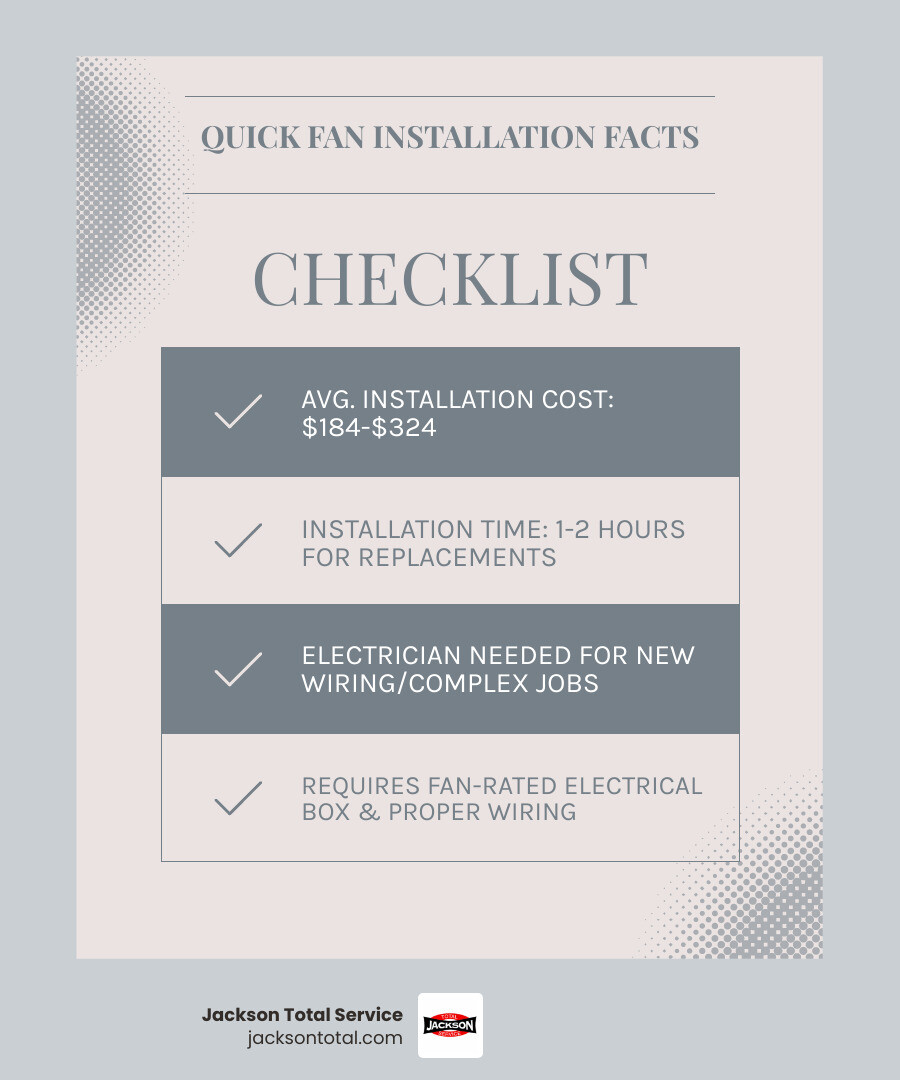
- Professional installation time: 1-2 hours for straightforward replacements, longer for new installations with wiring
- When to hire an electrician: New installations, no existing fixture, old/faulty wiring, high ceilings, or new switch installation
- When a handyman works: Direct replacement with existing, adequate wiring and no electrical modifications needed
- Key requirements: Fan-rated electrical box, proper bracing, 120-volt circuit, and grounding wire
Looking for comprehensive electrical services? Learn more about our electrical installation expertise, or if you’re ready to move forward, schedule your ceiling fan installation today.
This handbook walks you through everything you need to know about choosing, installing, and maintaining ceiling fans in Cape Coral’s unique climate. We’ll cover sizing guidelines, the difference between handyman and electrician installations, common troubleshooting tips, and why professional installation matters for both safety and performance. Cape Coral’s hot, humid summers and mild winters make ceiling fans a practical necessity—not just a decorative choice. Understanding your options helps you make the right decision for your home’s comfort and your family’s safety.
Why Install a Ceiling Fan in Your Cape Coral Home?
In Southwest Florida, especially in areas like Cape Coral, Bonita Springs, and Fort Myers, ceiling fans aren’t just a luxury; they’re a necessity. Our tropical climate means long, hot, and humid summers, where a constant breeze is not just comfortable but essential for keeping energy costs in check. Beyond the immediate relief they offer, ceiling fans provide a host of benefits that make them a smart addition to any home.
Improve Comfort and Lower Energy Bills
One of the primary reasons homeowners choose ceiling fan installation in Cape Coral FL is for the unparalleled comfort they provide. A ceiling fan creates a “wind chill” effect, making you feel cooler without actually lowering the room’s temperature. This means you can often set your air conditioner thermostat a few degrees higher, significantly reducing the strain on your HVAC system and, consequently, your monthly energy bills. With strategic ceiling fan use, you can achieve significant energy savings.
But the benefits aren’t just for summer. In the cooler months, by reversing the fan’s direction, you can create an updraft that gently pushes warm air, which naturally rises, back down into the living space. This helps distribute heat more evenly throughout the room, allowing your heating system to work less and saving you money year-round. It’s a simple, yet incredibly effective way to manage your home’s climate control efficiently.
Lift Your Home’s Style
Beyond their functional prowess, ceiling fans are also a fantastic way to improve your home’s aesthetic. They’ve evolved far beyond the basic models of yesteryear, now available in an incredible array of designs, finishes, and materials. Whether your home boasts a modern minimalist vibe, a cozy traditional feel, or a breezy coastal style perfect for Cape Coral living, there’s a ceiling fan to match.
Choosing the right fan can lift a room from merely functional to beautifully personalized. From sleek, contemporary designs with integrated LED lighting to rustic, farmhouse-inspired models with wooden blades, the options are endless. A thoughtfully selected ceiling fan can become a central decorative element, complementing your existing decor and adding a touch of sophistication or fun, depending on your taste.
Choosing the Perfect Ceiling Fan for Your Room
Selecting the right ceiling fan involves more than just picking one that looks good. To maximize comfort, efficiency, and safety, you need to consider several factors, including room size, ceiling height, and the fan’s features. Our goal is to help you make an informed decision for your ceiling fan installation in Cape Coral FL.
Sizing Your Fan Correctly
The size of your room directly dictates the appropriate blade span of your ceiling fan. A fan that’s too small won’t provide adequate air circulation, while one that’s too large can create an uncomfortable, overly windy environment. Here’s a general guide to help you size your fan correctly:
- Small Rooms (up to 75 sq ft): Think bathrooms, walk-in closets, or small entryways. Fans with a blade span of 29–36 inches are typically suitable.
- Medium Rooms (76-175 sq ft): Bedrooms, kitchens, and offices often fall into this category. A fan with a 42–48 inch blade span usually works best.
- Large Rooms (176-350 sq ft): Living rooms, dining rooms, and larger master bedrooms can benefit from fans with a 52–56 inch blade span.
- Great Rooms (>350 sq ft): For expansive open-concept areas or large family rooms, you might need a fan with a 60+ inch blade span, or even consider installing multiple fans for optimal airflow.
Beyond blade span, consider the fan’s Airflow (CFM – Cubic Feet per Minute), which indicates how much air the fan moves. Higher CFM generally means more effective cooling.
Types of Ceiling Fans
The world of ceiling fans offers a variety of specialized options to suit different needs and locations within your home:
- Standard Fans: These are the most common type, ideal for rooms with standard ceiling heights (8 feet or more). They typically use a downrod to hang from the ceiling.
- Low-Profile (Hugger) Fans: Perfect for rooms with lower ceilings (under 8 feet), these fans mount flush against the ceiling, maximizing headroom.
- Damp-Rated Fans: Designed for covered outdoor areas like porches, patios, or even bathrooms where they might be exposed to moisture but not direct rain.
- Wet-Rated Fans: These fans are built to withstand direct exposure to rain and other elements, making them suitable for pergolas, gazebos, or other uncovered outdoor spaces. They can also be used indoors.
- Smart Fans: Integrating with smart home systems, these fans can be controlled via apps, voice commands, and offer features like scheduling, temperature sensing, and even integration with other smart devices.
- Fans with Light Kits: Many ceiling fans come with integrated lighting, offering a convenient two-in-one solution for both air circulation and illumination. This is particularly useful in rooms that lack sufficient overhead lighting.
Choosing the right type ensures your fan performs optimally and safely in its intended environment.
The Professional Installation Process
While a new ceiling fan might look like a straightforward addition, the installation process, especially in a region like Cape Coral, requires careful attention to detail and adherence to safety standards. For reliable and safe operation, professional ceiling fan installation in Cape Coral FL is always recommended.
Key Steps in a Professional Ceiling Fan Installation in Cape Coral FL
A professional installation ensures that your fan is securely mounted, correctly wired, and operates efficiently. Here’s what you can expect during a typical installation:
- Turning Off Power: Safety is paramount. The first step is always to turn off the power to the circuit at your home’s main electrical panel.
- Removing Old Fixture (if applicable): If you’re replacing an existing light fixture, it will be carefully removed, and the wiring disconnected.
- Installing a Fan-Rated Electrical Box: This is a critical step. Standard electrical boxes are not designed to support the weight and motion of a ceiling fan. A professional will ensure a fan-rated electrical box is securely installed, capable of holding up to 70 pounds and preventing wobbling.
- Secure Bracing: Depending on your ceiling structure, additional bracing might be installed in the attic or above the ceiling to provide robust support for the fan.
- Connecting Wiring: The fan’s electrical wires are carefully connected to your home’s wiring, following local electrical codes and manufacturer instructions. This often involves connecting hot, neutral, and ground wires.
- Attaching Blades and Assembly: The fan motor housing is mounted, and then the blades and any light kit components are assembled and attached.
- Testing Fan Speeds and Lights: Once fully assembled, power is restored, and the fan is thoroughly tested to ensure all speeds, lighting, and directional settings (if applicable) function correctly.
A straightforward replacement of an existing light fixture with a ceiling fan in a location with adequate wiring can often be completed in 1-2 hours. However, new installations that require running new electrical lines, installing a new wall switch, or working with high ceilings may take longer.
Understanding Wiring Requirements
Proper wiring is the backbone of a safe and functional ceiling fan. Here’s what you need to know:
- Existing Wiring Assessment: When replacing an old fixture, a professional will assess the existing wiring. Most ceiling fans require a standard 120-volt, 15-amp circuit.
- Dedicated Circuit Needs: If there’s no existing fixture, or if the wiring is outdated and cannot support the fan’s electrical load, a new, dedicated circuit may be necessary. This ensures the fan receives consistent power without overloading other circuits.
- Grounding Wire Importance: A grounding wire is crucial for safety, providing a path for electricity to safely dissipate in case of a fault. In older homes, wiring systems might lack a grounding wire, necessitating an upgrade for modern ceiling fan installations.
- Wall Switch Installation: If you want to control your fan and lights from a wall switch (rather than just a pull chain or remote), new wiring might be needed to accommodate this. This could involve running new wires to a switch box and connecting them appropriately.
Working with electricity can be dangerous. Even a 120-volt outlet can cause serious harm. That’s why understanding and correctly implementing these wiring requirements is best left to experienced professionals. For any electrical repair needs in Cape Coral, our team is ready to assist with electrical repair Cape Coral FL.
Professional Ceiling Fan Installation in Cape Coral FL: Handyman vs. Licensed Electrician
Deciding whether to call a handyman or a licensed electrician for your ceiling fan installation in Cape Coral FL is a common question. The answer largely depends on the complexity of the job and the existing electrical infrastructure in your home. For safety, compliance, and peace of mind, understanding the distinctions is crucial.
| Feature | When to Hire a Handyman | When to Hire a Licensed Electrician |
|---|---|---|
| Project Complexity | Direct replacement of an existing fixture, simple assembly. | New installation, no existing fixture, complex wiring. |
| Existing Wiring | Pre-existing, adequate, and up-to-code wiring. | Old, faulty, or non-existent wiring; circuit modifications needed. |
| Electrical Modifications | No new switches, outlets, or circuit changes required. | Installing new wall switches, dedicated circuits, or power sources. |
| Ceiling Height | Standard, easily accessible ceilings. | High, vaulted, or sloped ceilings that require specialized equipment. |
| Safety & Code Compliance | Basic tasks where electrical expertise is not extensively required. | Ensures all work meets current local electrical codes and safety standards. |
| Insurance & Liability | May not carry specialized electrical liability insurance. | Carries comprehensive liability insurance for electrical work. |
When a Handyman Might Be Sufficient
A skilled handyman can be a cost-effective option for certain types of ceiling fan installation in Cape Coral FL. This is generally true when the job is a straightforward replacement and involves no new electrical work:
- Direct Replacement: If you’re simply swapping out an old ceiling fan or light fixture with a new ceiling fan, and the existing electrical box is already fan-rated and the wiring is adequate.
- Pre-existing, Adequate Wiring: When the room already has a proper 120-volt circuit and a grounding wire in place, and no modifications are needed.
- No New Switches: If you plan to control the fan and light using pull chains or a remote control, and no new wall switches need to be installed or wired.
- Low Ceilings: For rooms with standard ceiling heights that are easily accessible with a step ladder.
- Simple Assembly: If the fan unit itself is easy to assemble and install onto a pre-existing, correctly installed electrical box.
In these scenarios, a handyman can often handle the mechanical aspects of installation, but it’s always wise to confirm their experience with electrical connections.
Why a Licensed Electrician is Essential
For any scenario beyond a simple swap, a licensed electrician is not just recommended, but often essential. Their expertise ensures safety, compliance with local building codes, and the long-term reliability of your installation.
- New Installation: If you’re adding a ceiling fan to a room where there was no existing light fixture, a new electrical box will need to be installed, and new wiring may need to be run from the electrical panel. This is definitely a job for an electrician.
- No Existing Fixture: Similarly, if a location has no current electrical point, an electrician will safely extend power to that spot.
- Old or Faulty Wiring: Many older homes in Cape Coral might have outdated wiring that isn’t up to current codes or can’t handle the load of a modern ceiling fan, especially one with a light kit. An electrician can assess, upgrade, and ensure the wiring is safe.
- High or Sloped Ceilings: These installations often require specialized equipment, longer downrods, and specific mounting techniques to ensure stability and proper function. Electricians are equipped and trained for such complex setups.
- Installing a New Wall Switch: If you want to add a wall switch to control your fan and lights, this involves running new electrical lines and connecting them to your home’s circuit, a task that requires an electrician.
- Circuit Modifications: Any work that involves modifying your home’s electrical circuits, such as adding a dedicated circuit for the fan, requires the knowledge and skill of a licensed professional.
- Ensuring Code Compliance: Licensed electricians are well-versed in local electrical codes (like those in Cape Coral, Fort Myers, and Bonita Springs) and ensure that all installations meet these safety standards, preventing potential hazards and issues during home inspections.
For any complex electrical work, including new ceiling fan installation in Cape Coral FL, our team of licensed electricians is equipped to handle it safely and efficiently. We also provide electrical installation Cape Coral FL services for all your home’s needs.
Common Ceiling Fan Problems and Simple Fixes
Even after a professional ceiling fan installation in Cape Coral FL, or if you’ve had your fan for a while, you might encounter some common issues. Many of these problems have simple solutions you can troubleshoot yourself before needing to call in the experts.
Troubleshooting After Your Ceiling Fan Installation in Cape Coral FL
Here are some of the most frequent ceiling fan problems and how to address them:
- Wobbling: This is one of the most common complaints. A wobbling fan can be caused by unbalanced blades, loose screws, or even dust accumulation on the blades.
- Fix: First, ensure all blade screws are tight. Then, check for any bent blades. If the wobbling persists, you can use a ceiling fan balancing kit (often included with new fans or sold separately). These kits typically involve adding small weights to the blades to achieve balance.
- Clicking or Rattling Noises: These sounds usually indicate loose parts.
- Fix: Tighten all screws on the blade holders, light kit, and motor housing. Ensure the fan blades are securely attached and that no wires are touching the fan’s rotating parts. Sometimes, a loose canopy (the cover against the ceiling) can also cause rattling.
- Light Issues (Flickering, Dimming): If your fan’s lights are flickering or dimming unexpectedly, it could be a simple fix or indicate a wiring problem.
- Fix: Start by checking the bulbs; ensure they are screwed in tightly and are the correct wattage for the fixture. If using LED bulbs, confirm they are dimmable if your fan has a dimmer switch. Loose connections in the light kit or within the fan’s wiring can also cause flickering. If these simple checks don’t resolve the issue, it might be a deeper electrical problem.
- Slow or No Rotation: If your fan isn’t moving at all or is spinning very slowly, it could be a power issue or a motor problem.
- Fix: First, check the circuit breaker to ensure the fan has power. If the fan has a remote, check its batteries. Sometimes, a faulty capacitor (a component that helps the motor start and run) can cause slow rotation. This is often a job for a professional.
- Remote Control Problems: When the remote isn’t working, it can be frustrating.
- Fix: The easiest fix is often to replace the batteries in the remote. If that doesn’t work, try re-syncing the remote with the fan. The instructions for this are usually in your fan’s manual. Ensure there are no obstructions between the remote and the fan’s receiver.
While many of these issues can be resolved with simple troubleshooting, if you’re uncomfortable working with electrical components or can’t identify the cause of the problem, it’s always best to consult a qualified electrician. For more complex electrical issues, our team is here to help with electrical repair Cape Coral FL.
Frequently Asked Questions about Ceiling Fan Installation
We often get questions about ceiling fan installation in Cape Coral FL, so we’ve compiled answers to some of the most common ones to help you make informed decisions.
How long does a typical ceiling fan installation take?
The duration of a ceiling fan installation can vary based on several factors. A straightforward replacement, where an existing light fixture is swapped for a new ceiling fan and the wiring is already suitable, typically takes 1 to 2 hours. This assumes easy access and no unexpected electrical issues.
However, a new installation in a room without existing wiring or a suitable electrical box can take longer. This might involve running new electrical lines, installing a new wall switch, or reinforcing the ceiling. Factors like the complexity of the fan’s assembly, the height of the ceiling (requiring specialized ladders or scaffolding), and any necessary electrical upgrades will also influence the total time. Our professionals work efficiently to ensure your installation is completed safely and correctly.
Can a ceiling fan be installed where a light fixture currently is?
Yes, in many cases, a ceiling fan can be installed where a light fixture currently exists. However, there’s a crucial consideration: the electrical box in the ceiling. Standard electrical boxes designed only for light fixtures are typically not strong enough to support the weight and dynamic motion of a ceiling fan.
For safe ceiling fan installation in Cape Coral FL, the existing electrical box must be a fan-rated electrical box. These boxes are specially designed to hold heavier loads (up to 70 pounds) and withstand the vibrations caused by a spinning fan. If your current light fixture box is not fan-rated, our electricians will need to replace it with an appropriate one and ensure it’s securely braced to the ceiling joists. This step is vital for preventing the fan from eventually falling, which could cause significant damage or injury.
How do I reverse my ceiling fan for different seasons?
Reversing your ceiling fan’s direction is a smart way to optimize comfort and energy efficiency throughout the year. Most ceiling fans have a small switch located on the motor housing (often near where the blades attach).
- Summer (Counter-Clockwise Rotation): In the warmer months, you want the fan blades to turn counter-clockwise. This creates a downdraft, pushing air straight down and creating a cooling breeze (the wind chill effect). This makes you feel cooler and allows you to raise your thermostat setting, saving on AC costs.
- Winter (Clockwise Rotation): During the cooler periods, switch the fan blades to rotate clockwise. This creates an updraft, gently pulling air up towards the ceiling. This action helps to circulate the warm air that naturally rises, pushing it down along the walls and back into the room. This effectively redistributes heat, making the room feel warmer without needing to crank up your heater, similar to how our AC not cooling near Cape Coral FL services help maintain comfort.
Always ensure the fan is completely off before attempting to change the direction switch.
Ensure a Safe and Breezy Home
Investing in ceiling fan installation in Cape Coral FL is a decision that brings a multitude of benefits to your home, from significant energy savings and improved comfort to a stylish aesthetic uplift. We’ve explored how proper sizing can optimize airflow, the different types of fans available for various needs, and the critical distinction between when to trust a handyman versus a licensed electrician for installation.
The safety and long-term performance of your ceiling fan depend on professional, code-compliant installation. Working with electricity carries inherent risks, and ensuring your fan is securely mounted and correctly wired is paramount. For over 60 years, our team has been dedicated to providing comprehensive home comfort solutions in Southwest Florida. We understand the unique demands of the Cape Coral climate and are committed to delivering reliable, safe, and efficient electrical services.
Don’t let the Florida heat get the best of your comfort or your energy bills. For expert electrical services and home comfort solutions, trust a team with decades of experience. Our licensed electricians are ready to ensure your ceiling fan installation in Cape Coral FL is handled with the utmost professionalism and care, providing you with a safe and breezy home for years to come.
Learn more about our Ceiling Fan Installation services and how we can bring comfort and efficiency to your Cape Coral home.