



Why Your AC Running Constantly But House Still Hot and Humid Is a Real Problem in Southwest Florida
If your ac is running constantly but your house is still hot and humid, you’re not imagining it — and you’re definitely not alone. In Southwest Florida, where summer humidity regularly pushes above 80% outdoors, this is one of the most common comfort complaints homeowners face.
Here’s the quick answer before we dive deeper:
Most common reasons your AC runs nonstop but can’t cool or dehumidify your home:
- Oversized AC unit – cools too fast, shuts off before pulling moisture out of the air
- Dirty evaporator or condenser coils – reduce the system’s ability to absorb heat and moisture
- Clogged air filter – restricts airflow and causes the whole system to struggle
- Thermostat fan set to “On” – blows air over wet coils and pushes moisture back into the room
- Leaky ductwork – lets humid attic or crawl space air pour into your living areas
- Low refrigerant – reduces the coil’s ability to cool and condense moisture
- Frozen evaporator coil – blocks airflow and shuts down dehumidification entirely
The tricky part is that your AC has two jobs: removing heat and removing moisture. When something goes wrong, it often loses the ability to dehumidify first — so the temperature on your thermostat might look fine while the air still feels thick and sticky. Indoor humidity above 60% can make your home feel noticeably warmer even when the AC is technically running, and in Naples and the surrounding Lee and Collier County areas, that threshold gets crossed fast.
The good news? Most of these problems have straightforward fixes — some you can handle yourself today, and others that a licensed technician can resolve quickly.
Why is my ac running constantly but house still hot and humid?
Living in Southwest Florida since 1964, we at Jackson Total Service have seen every possible reason for a home feeling like a swamp. To understand why your ac is running constantly but your house is still hot and humid, you have to look at how heat transfer works.
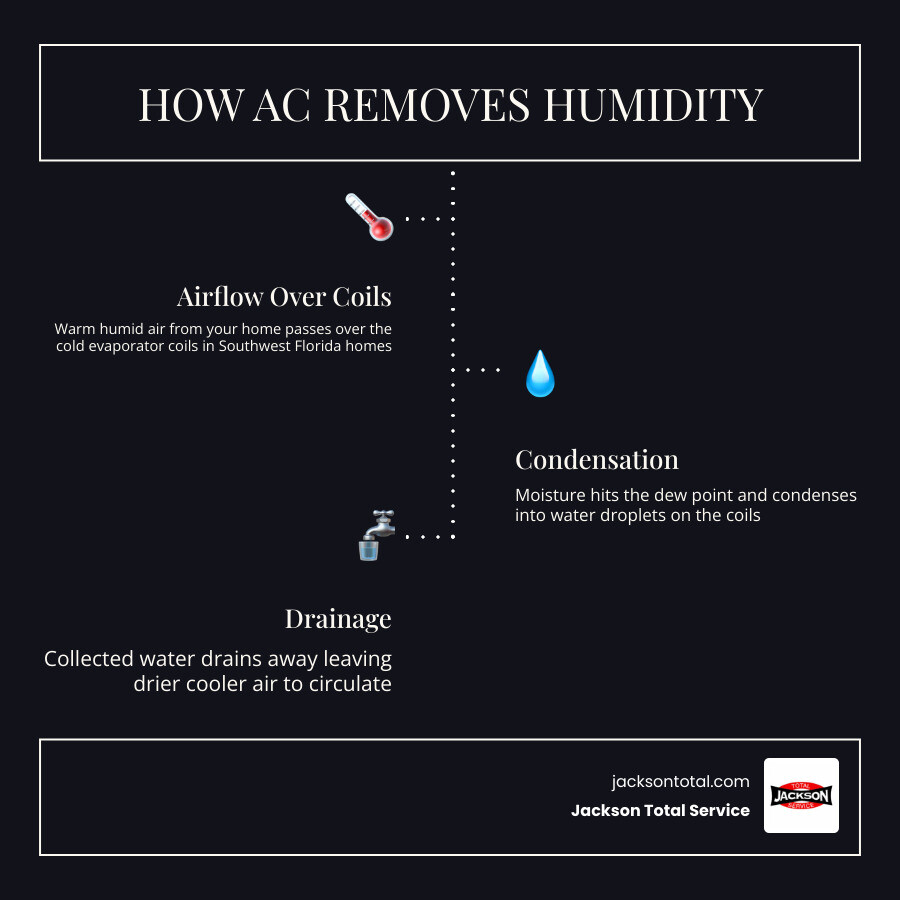
Your air conditioner doesn’t actually “create” cold; it removes heat and moisture from your indoor air. This happens at the evaporator coil. As warm, humid air from your Naples home passes over these cold coils, the moisture in the air hits its “dew point” and condenses into liquid water—much like a cold glass of sweet tea “sweats” on a hot July afternoon. That water then drips into a drain pan and exits your home.
If your system is running but the air is still muggy, the condensation process has broken down. For a deeper look at the mechanical side of this, check out our guide on Why Is My Air Conditioner Not Cooling My House?.

The impact of an oversized AC running constantly but house still hot and humid
It sounds counterintuitive, but a “bigger” AC isn’t always better. In fact, an oversized unit is a leading cause of high indoor humidity. When a system is too powerful for the square footage of your home, it performs what we call “short cycling.”
It blasts the house with cold air, reaches the thermostat setting in five to ten minutes, and shuts off. However, it takes roughly 15 to 20 minutes of continuous runtime for the evaporator coil to get cold enough to start pulling significant moisture out of the air. If the system shuts off too soon, the air stays humid, making you feel “cold and clammy.” This is why a proper Manual J load calculation is vital when installing a new unit. If you’re wondering if your current unit is the right fit, our Should You Fix It or Nix It? Your AC Decision Guide can help you weigh your options.
How dirty coils lead to an AC running constantly but house still hot and humid
Your AC relies on clean surfaces to swap heat. If the evaporator coils (inside) are covered in dust or the condenser coils (outside) are caked in Florida sand and salt air, the system can’t breathe.
Dirty coils can reduce your system’s dehumidification efficiency by 30-40%. Because the heat exchange is sluggish, the compressor has to work twice as hard and run much longer to try and reach the set temperature. This leads to that frustrating scenario where the ac is running constantly but your house is still hot and humid. For homeowners in Fort Myers and Cape Coral, we’ve put together a specific AC Problems Fort Myers FL Guide to help navigate these local environmental challenges. Regular maintenance is the best defense here; learn more in our Guide to Florida AC Maintenance Frequency.
5 Steps to Fix Your AC and Lower Indoor Humidity
If you are currently sweating in your own living room, follow these five steps to troubleshoot and fix the issue.
Step 1: Switch Thermostat Fan to Auto
This is the simplest fix, yet it’s the one most people overlook. Most thermostats have two fan settings: “On” and “Auto.”
| Feature | Fan “On” Mode | Fan “Auto” Mode |
|---|---|---|
| Airflow | Runs 24/7 regardless of cooling | Only runs when cooling is active |
| Humidity Impact | High – Re-evaporates moisture | Low – Allows moisture to drain |
| Energy Usage | Higher | Lower |
| Comfort | Can feel drafty and humid | More consistent humidity control |
When the fan is set to “On,” it blows air over the evaporator coils even when the cooling cycle has stopped. Those coils are still wet with condensed water. By blowing air over them, you are essentially “picking up” that water and blowing it right back into your house. Switch it to Auto to allow the water to drain away properly.
Step 2: Replace Air Filters Monthly
In May 2026, as we head into the peak of the cooling season, your filters are working overtime. A clogged filter restricts the volume of air moving through your system. When airflow is too low, the evaporator coil can actually get too cold and freeze into a block of ice. Once the coil is frozen, it acts as an insulator, preventing any further heat or moisture removal. If you suspect your system is already struggling, you may need a professional Air Conditioning Repair to safely thaw and inspect the unit.
Step 3: Inspect and Seal Ductwork
Did you know that nearly 30% of cooled air is lost through leaky ductwork in the average home? In places like Naples and Bonita Springs, many ducts run through sweltering attics. If your ducts have holes or disconnected joints, your AC isn’t just losing cold air — it’s actually sucking in 100-degree, 90% humidity air from your attic and pumping it into your bedroom.
Leaky ducts make it impossible for an AC to keep up. Ensuring your ducts are sealed and clean is a major step toward comfort. See How Duct Cleaning Saves Your AC From the Humid Hustle for more details on how this affects your indoor air quality.
Step 4: Clean the Outdoor Condenser Unit
The outdoor portion of your AC is responsible for dispersing the heat removed from your home. If it’s crowded by hibiscus bushes, palm fronds, or debris, the heat has nowhere to go. This causes the system to run indefinitely without actually cooling the house. Ensure there is at least a two-foot clearance on all sides of the unit. You can gently rinse the fins with a garden hose to remove salt and dirt, but be careful not to use high pressure, which can bend the delicate metal fins.
Step 5: Schedule a Professional Refrigerant Check
If your ac is running constantly but your house is still hot and humid, you might have a refrigerant leak. Refrigerant is the “courier” that carries heat out of your home. If levels are low, the system can’t absorb enough heat or moisture to make a difference.
Signs of low refrigerant include:
- A hissing or bubbling sound near the unit.
- Ice buildup on the copper refrigerant lines.
- Air coming out of the vents feels lukewarm.
If you are experiencing an AC Not Cooling Near Cape Coral FL, it’s time to call in a NATE-certified technician to check the “subcooling” and “superheat” levels—technical measurements that ensure your system is charged perfectly.
Hidden Causes of Persistent Indoor Dampness
Sometimes the problem isn’t just the AC; it’s the house itself. In Southwest Florida, we deal with “infiltration”—the fancy term for humid air sneaking into your home.
- Thermal and Air Barriers: If your attic insulation is thin or you have gaps around your windows and doors, your home is constantly fighting a losing battle against the Florida sun.
- Exhaust Fans: Not using your bathroom fans during showers or your kitchen hood while cooking can add gallons of water to your indoor air every week.
- The “Envelope” of the Home: If your home has high “duct leakage to outside,” it creates a pressure imbalance that pulls humid air in through electrical outlets and baseboards.
Addressing these issues is crucial for maintaining a healthy home. Excess moisture leads to more than just discomfort; it’s the primary driver of mold growth. For a complete strategy on keeping your air clean, read The Ultimate Guide to Mold-Free Air Conditioning.
Frequently Asked Questions about AC Humidity
What is the ideal indoor humidity level for Florida homes?
For maximum comfort and to prevent mold growth, you should aim for 30% to 50% relative humidity. Once you cross the 60% threshold, the air begins to feel “heavy,” and dust mites and mold spores begin to thrive. Many modern smart thermostats can track this for you, or you can buy a simple hygrometer at any hardware store in Fort Myers or Naples.
Can an AC unit cool the air without removing moisture?
Yes. This usually happens if the fan speed is set too high or if the system is oversized. If air moves across the cooling coils too quickly, the moisture doesn’t have enough time to condense. The result is air that is 70 degrees but still has a relative humidity of 70%—leaving you feeling sticky.
Why does my house feel sticky even when the temperature is low?
This is caused by “latent heat.” Your thermostat only measures “sensible heat” (the actual temperature). It doesn’t measure how much water is in the air. High humidity prevents your sweat from evaporating, which is the body’s natural cooling mechanism. When the humidity is high, a 72-degree room can feel like 80 degrees.
Conclusion
At Jackson Total Service, we’ve been the trusted name for home comfort in Southwest Florida for over 60 years. We understand that a home in Naples, Marco Island, or Fort Myers isn’t just a building—it’s your sanctuary from the heat. When your ac is running constantly but your house is still hot and humid, it’s more than an inconvenience; it’s a threat to your comfort and your home’s health.
Whether you need a simple tune-up, a duct sealing service, or a full system replacement tailored to the unique Florida climate, our team of experts is ready to help. We provide all comfort solutions—HVAC, plumbing, and electrical—under one roof, so you never have to juggle multiple contractors.
Don’t spend another day in a “swampy” house. Contact us today for expert Air Conditioning Services and let us bring the cool, dry comfort back to your home.