




Is It Time to Repair or Replace? What the $5,000 Rule Tells You
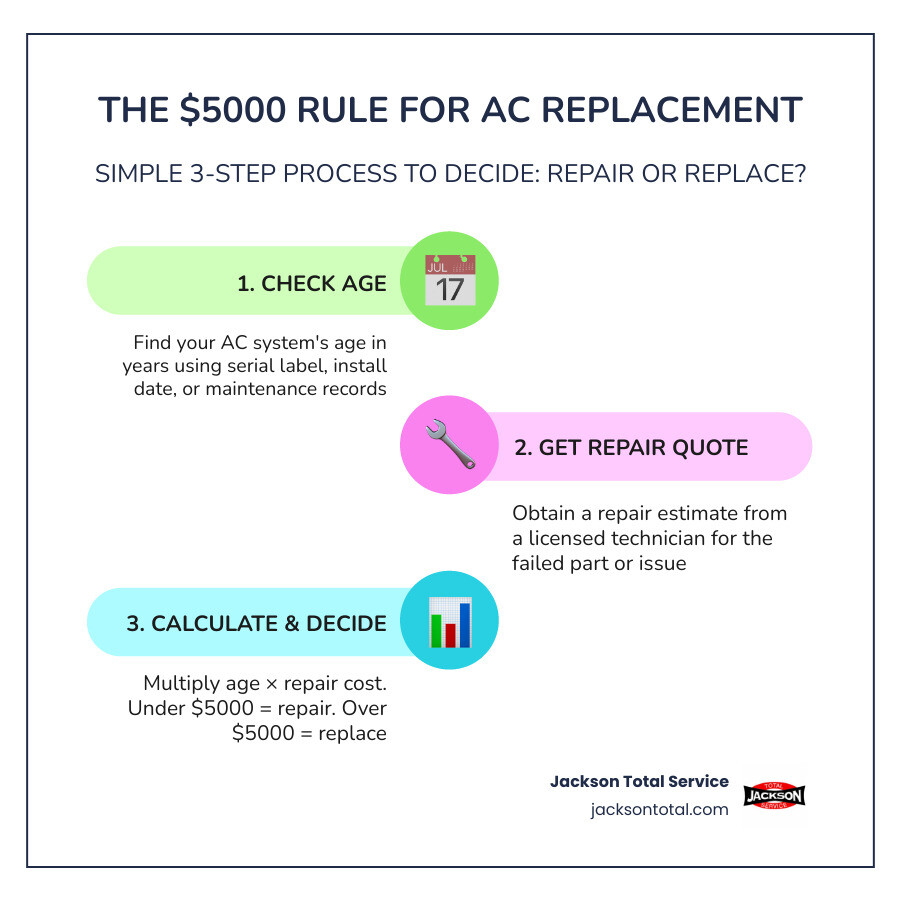
The 5000 dollar rule for AC replacement is a simple formula that helps homeowners decide whether to fix their current system or invest in a new one.
Here’s how it works at a glance:
| Step | What To Do |
|---|---|
| 1 | Find your AC system’s age in years |
| 2 | Get a repair estimate from a licensed technician |
| 3 | Multiply: Age × Repair Cost = Decision Number |
| 4 | If the result is under $5,000 → repair is likely worth it |
| 5 | If the result is over $5,000 → replacement usually makes more sense |
Quick example: A 12-year-old AC unit facing a $500 motor repair gives you 12 × $500 = $6,000. Because that number exceeds $5,000, replacement is generally the smarter move.
If your air conditioner keeps breaking down — or just can’t keep up with the heat and humidity here in Southwest Florida — you’re facing one of the most common and stressful decisions a homeowner can make: repair it or replace it? Nobody wants to spend money on a system that’s already on its last legs, but a full replacement feels like a big commitment too.
That’s exactly where the $5,000 rule comes in. It’s a practical, industry-tested guideline that takes the guesswork out of the equation. Instead of going on gut feeling alone, you run a quick calculation and get a number that points you in the right direction. It won’t make the decision for you — but it gives you a solid starting point before you talk to a technician.
In this guide, we’ll walk you through how the rule works, how to calculate it for your own system, and what other factors matter — especially if you live in a place like Naples, Bonita Springs, or anywhere else in Lee or Collier County where AC systems work harder and wear out faster than they do in most of the country.
What Is the 5000 Dollar Rule for AC Replacement?
At its core, the $5,000 rule is a rule of thumb. It is not a law, a code requirement, or a magic calculator that knows your future. What it does do is give us a fast way to judge whether putting more money into an aging AC is sensible or whether replacement is likely the better long-term choice.
The formula is simple:
System age x repair cost = decision number
If that number is below $5,000, repair often makes sense.
If it is above $5,000, replacement usually deserves serious consideration.
This rule is popular because it helps homeowners avoid pouring money into a unit that may soon need another repair. In other words, it protects you from the classic “well, we already spent so much on it…” trap.
How the 5000 dollar rule for ac replacement works
To use the rule, you need just two numbers:
- The age of your system in years
- The estimated cost of the current repair
Then you multiply them.
For example:
- 6-year-old system x modest repair = likely repair territory
- 10-year-old system x moderate repair = could be borderline
- 12-year-old system x major repair = often replacement territory
The older the system, the less repair cost it takes to cross the threshold. That makes sense. A repair on a newer unit may buy you years of reliable service. The same repair on an aging unit may only buy you one more season and a fresh headache.
Why homeowners use this rule
Homeowners like this rule because it is:
- Easy to understand
- Fast to calculate
- Helpful for budget planning
- Good at cutting through emotional decision-making
It also helps frame the bigger question: are you paying to solve a one-time problem, or are you funding a slow-motion goodbye tour for your AC?
If your system has had frequent breakdowns, rising energy use, uneven cooling, or humidity issues, the formula often confirms what your utility bill has been trying to tell you for a while.
Quick examples that make the rule easy to understand
Here are a few simple examples:
- A 5-year-old AC with a small electrical repair: usually repair
- A 10-year-old AC with a blower motor issue: depends on condition, efficiency, and history
- A 12-year-old system with a motor repair: often replacement
- An older system with a compressor failure: replacement is commonly the smarter route
Borderline cases matter too. If your number lands close to $5,000, do not treat the rule like a courtroom verdict. Treat it like a yellow light. Slow down, gather more information, and look at the whole picture.

How to Calculate the Rule and Decide Repair vs. Replacement
The math is simple. The decision is not always simple. That is why we recommend using the formula as your starting point, then pairing it with a professional diagnosis and a realistic look at system condition.
Step 1: Find your AC system’s true age
Do not guess. “It feels kind of old” is not a technical measurement.
You can usually find the age by checking:
- The manufacturer label on the outdoor condenser
- Installation paperwork
- Maintenance records
- Warranty documents
If you cannot tell from the label, a licensed technician can often identify the manufacture date from the serial number.
The difference between an 8-year-old unit and a 12-year-old unit matters a lot when using the 5000 dollar rule for ac replacement.
Step 2: Get a clear repair diagnosis before doing the math
Before you multiply anything, make sure you know what is actually wrong.
A vague statement like “it needs work” is not enough. You want to know:
- Which part failed
- Whether there are hidden issues
- Whether refrigerant is involved
- Whether the repair is minor or major
- Whether the system has signs of broader wear
For example, a failed capacitor is very different from a compressor issue or a refrigerant leak in an older unit. One may be a straightforward repair. The other may be your AC waving a tiny white flag.
If you need help with diagnosis and repair in Collier County, here is more information about AC repair in Naples.
Step 3: Multiply age by repair need and read the result
Once you have the unit age and a reliable repair quote, multiply them.
Then interpret the result like this:
- Under $5,000: repair is often reasonable
- Around $5,000: review efficiency, history, and warranty before deciding
- Over $5,000: replacement often provides better long-term value
This is the decision number, not the final decision.
When to repair your AC instead of replacing it
Repair usually makes more sense when:
- The system is still relatively new
- The repair is minor
- The unit has been reliable overall
- It is still under warranty
- Efficiency is still decent
- Your home is cooling evenly and humidity is controlled
A newer unit with one isolated problem is often worth fixing. The same is true if the issue is small and the rest of the system is in good shape.
When replacement usually makes more sense
Replacement usually moves to the front of the line when:
- The system is near the end of its lifespan
- A major component has failed
- You have had repeated repairs in recent years
- Utility bills keep climbing
- The home has hot spots, weak airflow, or poor humidity control
- The unit uses outdated refrigerant
- The repair result is clearly over the threshold
Here is a quick comparison:
| Repair signals | Replacement signals |
|---|---|
| Newer system | Older system near end of life |
| Minor part failure | Major component failure |
| Strong warranty coverage | Warranty expired |
| Few past repairs | Frequent recent repairs |
| Good comfort and airflow | Uneven cooling and humidity issues |
| Modern refrigerant and decent efficiency | Outdated refrigerant and low efficiency |
What Else Matters Beyond the 5000 Dollar Rule?
The formula is helpful, but it is not the whole story. Two systems can land on the same number and still deserve different recommendations.
Lifespan guidelines for ACs, furnaces, and heat pumps
In general, industry guidance puts average lifespan around:
- Central AC: about 12 to 15 years
- Furnace: about 15 to 20 years
- Heat pump: about 15 to 20 years
In Southwest Florida, cooling systems often work harder because of long run times, high humidity, and coastal conditions. Salt air and moisture can speed up corrosion, and heavy use means wear adds up faster. So while national lifespan numbers are helpful, local conditions matter more.
Repair history, comfort problems, and indoor air quality
A single repair on an otherwise dependable unit is one thing. A pattern is another.
If your system has had multiple repairs over the last few years, the $5,000 rule may actually be understating the real issue. You are not just judging one repair. You are judging a trend.
Also look at performance problems such as:
- Rooms that never cool properly
- Weak airflow
- Long run times
- Sticky indoor humidity
- Musty smells
- More dust than usual
- New noises or vibration
These issues can point to deeper system decline, duct issues, or indoor air quality concerns. For help preventing small issues from turning into replacement decisions, review this guide to air conditioning maintenance in Estero.
When the rule does not apply
There are situations where the math should not be the main factor.
For example:
- Safety hazards
- Serious electrical problems
- Warranty-covered repairs
- Storm damage questions
- Plans to move very soon
- Major system mismatch issues
On the heating side, a cracked heat exchanger is a classic example of a safety issue that overrides repair math. On the cooling side, severe electrical concerns or system conditions that threaten reliability and safety should come first too.
Why matched systems and ductwork condition matter
Sometimes the real question is not just “repair or replace?” It is “replace what?”
In many homes, the indoor and outdoor components are designed to work as a matched system. Replacing only one part of a split system can reduce efficiency, create compatibility issues, and shorten the life of the new equipment.
Ductwork matters too. Even a high-efficiency new AC can struggle if the ducts leak, are undersized, or are full of debris. We always recommend looking at the full comfort system, not just the box outside making noise in the yard.
Efficiency, Refrigerants, and Climate Factors That Can Change the Answer
This is where the rule gets more interesting. Sometimes a system technically lands in repair territory but still deserves replacement because of efficiency, refrigerant issues, or Southwest Florida climate stress.
How newer efficiency standards affect replacement decisions
Modern systems are much more efficient than older ones. Research consistently shows newer HVAC systems can reduce monthly energy use by roughly 20% to 40% compared to much older, lower-efficiency equipment. ENERGY STAR-certified models can improve savings even more.
SEER2 is the current efficiency standard homeowners will see when shopping for new cooling equipment. Since federal standards increased in 2023, newer air conditioners and heat pumps generally meet higher performance benchmarks than older systems.
That matters because if your current unit is old and inefficient, repairing it may restore operation without fixing the bigger problem: it still costs more to run than a modern system.
Why R-22 and older refrigerants can push you toward replacement
If your AC uses R-22 refrigerant, that is a big factor. R-22 has been phased out, which means supply is limited and repairs involving refrigerant can become much less practical.
That does not automatically mean every R-22 system must be replaced tomorrow. But if an older unit has a refrigerant leak, needs a recharge, or requires hard-to-find parts, replacement often becomes the better answer very quickly.
Older refrigerants and obsolete components tend to push a borderline case firmly toward replacement.
How the rule changes in hot and humid places like Southwest Florida
In Naples, Bonita Springs, Estero, Fort Myers, Cape Coral, Marco Island, and nearby communities, AC systems do not get much downtime. They run long hours, remove a lot of moisture, and battle salt air in coastal areas.
That means:
- Lifespans can be shorter than in milder climates
- Corrosion can become a bigger factor
- Humidity control matters almost as much as temperature
- Small inefficiencies show up fast in comfort and utility use
In other words, a 12-year-old system in Southwest Florida may have seen a much harder life than a same-age unit in a milder region. That is why local maintenance matters so much. For more on that, see our guide to Florida AC maintenance frequency.
Humidity, mold, and airflow issues that a new system may solve
A replacement decision is not only about preventing breakdowns. It can also be about improving how your home feels.
A newer properly sized system may help with:
- Better dehumidification
- More even cooling
- Cleaner airflow
- Less noise
- Better filtration and air quality
- Lower mold risk tied to moisture problems
If humidity and air quality are part of your AC frustration, these resources may help:
- The Ultimate Guide to Mold-Free Air Conditioning
- How Duct Cleaning Saves Your AC from the Humid Hustle
Common Homeowner Questions About the 5000 Dollar Rule for AC Replacement
Can a new AC or HVAC system qualify for tax credits or rebates?
Potentially, yes. Certain energy-efficient upgrades may qualify for federal incentives under the Energy Efficient Home Improvement Credit, depending on the equipment and current rules in 2026.
In general:
- Qualifying high-efficiency systems may be eligible
- Annual limits and equipment requirements apply
- Documentation matters
- Utility or manufacturer rebates may also exist in some cases
Because incentive rules can change, we recommend checking current program details before making a final decision.
Will homeowners insurance pay for AC replacement?
Usually, homeowners insurance does not cover AC replacement caused by normal age, wear and tear, corrosion, or lack of maintenance.
It may help only if the damage came from a covered event, such as certain storms or other listed perils in your policy. If your system failed because it is old and tired, insurance generally will not treat that as a covered surprise.
Should you replace just the AC or the whole HVAC system?
Sometimes replacing only the AC makes sense. Other times, the smarter move is to replace the full matched system, especially when the indoor and outdoor equipment are old, mismatched, or incompatible.
This is especially important if:
- The air handler is also aging
- The indoor coil is worn
- Efficiency would suffer with a partial swap
- Warranty or performance depends on matched equipment
A professional evaluation is the best way to determine whether partial replacement is wise or whether it would just create tomorrow’s repair call.
How Southwest Florida Homeowners Can Make the Smart Next Step
If your AC is struggling in the Florida heat, here is the simplest way to move forward without overthinking it:
- Confirm the age of your system
- Get a clear diagnosis from a licensed technician
- Use the $5,000 rule as a first filter
- Review repair history, efficiency, refrigerant type, and comfort issues
- Ask whether your ductwork, indoor unit, and outdoor unit are all working together properly
- Check for any available incentives on qualifying replacements
- Make the decision based on long-term comfort, not just today’s emergency
For homeowners in Naples and surrounding areas, you can learn more about air conditioning services in Naples, read tips on beating the heat and the clock with your Florida HVAC, or explore our full range of air conditioning services.
At Jackson Total Service, we have served Southwest Florida since 1964, helping homeowners across Collier and Lee counties make smart home comfort decisions without the confusion. Whether you are in Naples, North Naples, Marco Island, Golden Gate, Immokalee, Ave Maria, Bonita Springs, Fort Myers, Estero, Cape Coral, Fort Myers Beach, North Fort Myers, Sanibel Island, Pine Island, or Lehigh Acres, we are here to help you evaluate the full picture.
The bottom line is simple: the 5000 dollar rule for AC replacement is a useful guide, not a substitute for good judgment. If your unit is newer and the repair is minor, repair may be the right call. If your system is older, inefficient, unreliable, or struggling with Florida humidity, replacement may save you frustration in the long run.
And if you are stuck between the two, that is exactly when we come in.