


Why Choosing the Right Water Treatment for Hard Water Matters in Southwest Florida
When it comes to choosing the right water treatment for hard water, getting it wrong can quietly cost you hundreds of dollars a year — in higher energy bills, worn-out appliances, and endless cleaning. Southwest Florida homeowners face some of the hardest water in the country, with many areas testing at 7–11 grains per gallon (GPG) or higher. That mineral-heavy water leaves scale on your fixtures, shortens the life of your water heater, and can even dry out your skin and hair.
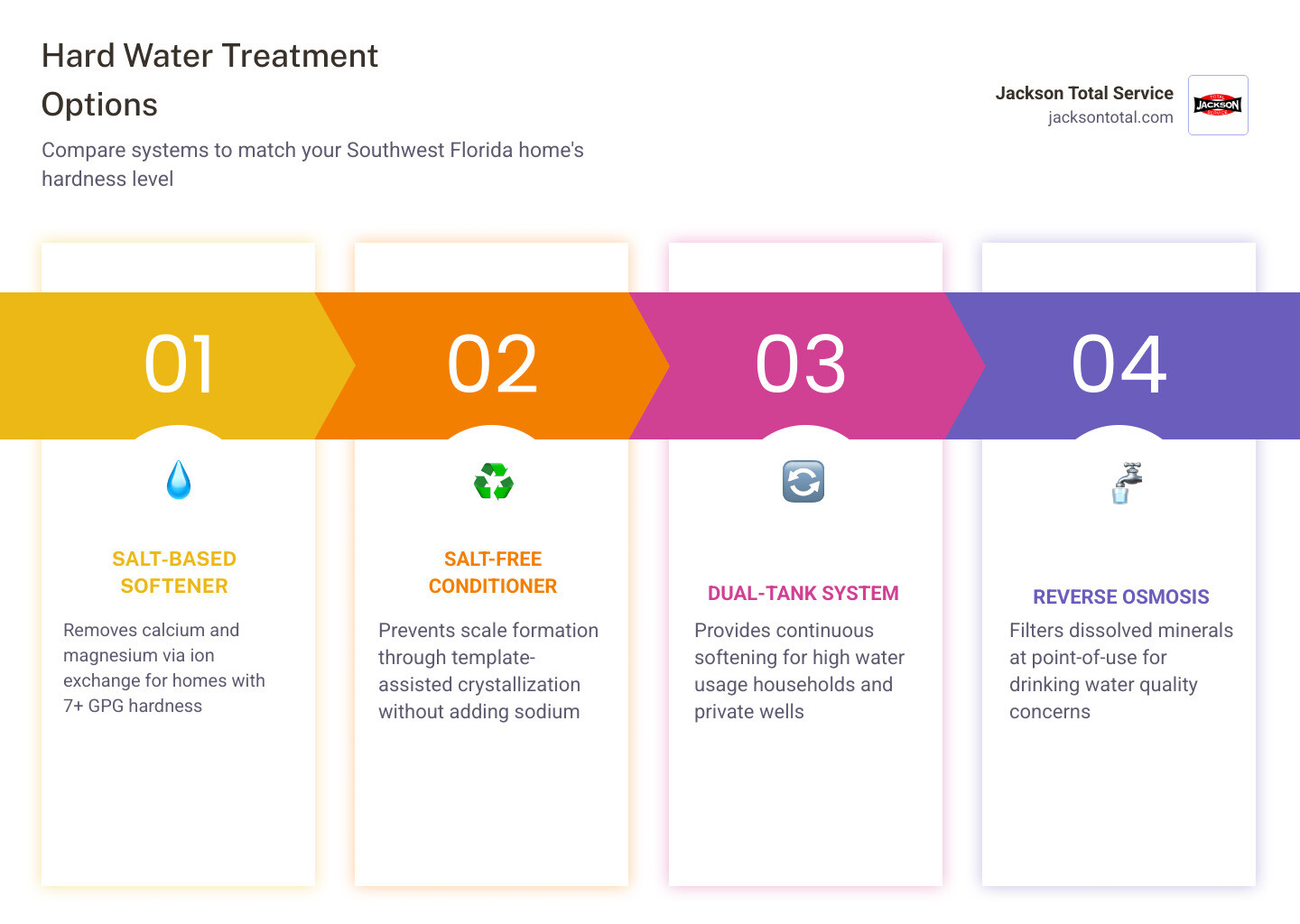
Here’s a quick look at the main hard water treatment options to help you decide:
| Treatment Type | How It Works | Best For |
|---|---|---|
| Salt-based water softener | Ion exchange removes calcium and magnesium | Heavy hardness (7+ GPG), whole-home protection |
| Salt-free water conditioner | Changes mineral structure to prevent scale | Mild to moderate hardness, low-sodium diets |
| Dual-tank softener | Two-tank system for uninterrupted softening | High-usage households, well water |
| Reverse osmosis (point-of-use) | Membrane filters dissolved minerals at the tap | Drinking water quality concerns |
| Magnetic/electronic conditioner | Alters mineral behavior with electromagnetic fields | Low-commitment, low-hardness situations |
More than 85% of U.S. homes have hard water — and in Southwest Florida, the problem is especially common. Even a thin 1mm layer of limescale on a heating element can push your energy use up by 7–10%. Left untreated for a few years, that buildup compounds fast.
The good news? Once you know your hardness level and your household’s needs, picking the right system is straightforward. This guide walks you through exactly how to do that.
Understanding Hard Water and Its Impact on Your Southwest Florida Home
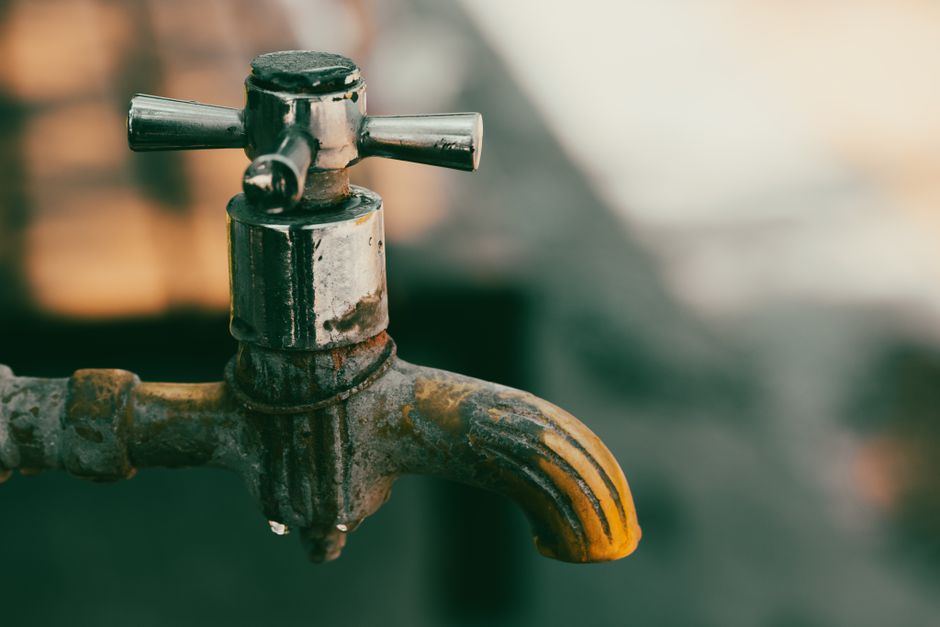
To understand why hard water is such a nuisance in places like Naples, Fort Myers, and Cape Coral, we have to look beneath the surface. Our water in Southwest Florida primarily comes from underground limestone aquifers. As rainwater filters through this chalky geology, it dissolves and picks up heavy amounts of calcium and magnesium minerals. By the time it reaches your home’s plumbing, it is highly saturated with these minerals.
The real trouble begins when this water is heated. When calcium bicarbonate is heated above 60°C (140°F), it undergoes a chemical conversion into insoluble calcium carbonate—better known as limescale. This scale acts as a heavy thermodynamic insulator. When it coats the heating elements inside your water heater, it blocks heat transfer, meaning your system has to run longer and hotter just to warm your shower water.
Research shows that scale buildup can reduce water heater efficiency by up to 30% within three years. Over a four-year period, the average household can expect around 6mm of limescale to accumulate inside their plumbing and appliances, leading to an astronomical 40% reduction in home energy efficiency.
Beyond the utility bills, hard water wreaks havoc across your entire household:
- Plumbing and Fixtures: Limescale narrows the inside of your pipes, restricts water flow, and leaves crusty white deposits on showerheads and faucets.
- Appliances: Washing machines, dishwashers, and ice makers wear out years ahead of their time. For a deeper look at protecting these systems, read our guide on how to Stop the Scale Before Your Appliances Fail.
- Skin and Hair: Hard water prevents soaps and shampoos from lathering properly. Instead, it leaves a stubborn soap scum film on your skin and hair, which can clog pores, exacerbate eczema, and leave your hair feeling heavy, dry, and dull.
- Laundry: Clothes washed in hard water require up to 30% more detergent and often come out feeling stiff, scratchy, and looking prematurely faded.
How to Test Your Home’s Water Hardness
Before you invest in any system, you need to know exactly what is in your water. Water hardness is measured in either parts per million (PPM) or, more commonly, grains per gallon (GPG). One GPG is equivalent to approximately 17.1 PPM of calcium carbonate.
To help you put your test results into perspective, the water industry classifies hardness using the following scale:
- 0–3 GPG: Soft water (no treatment needed)
- 3.5–7 GPG: Moderately hard water (treatment optional but recommended for appliance longevity)
- 7.5–11 GPG: Hard water (treatment highly recommended to prevent scale and plumbing damage)
- 11–15 GPG: Very hard water (treatment is essential)
- Over 15 GPG: Extremely hard water (heavy-duty treatment is essential)
To find your home’s hardness level, you have three primary paths:
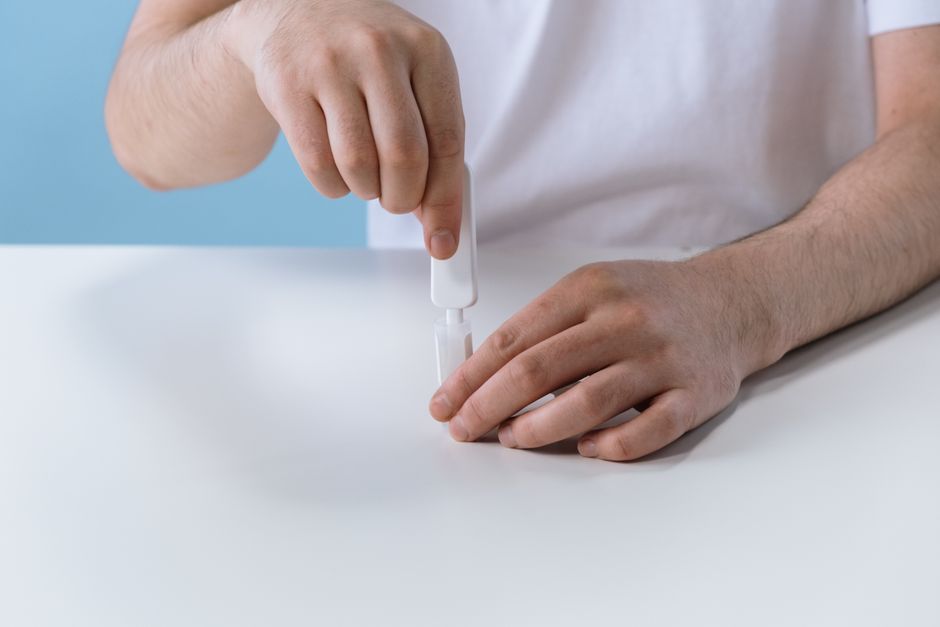
- DIY Water Test Strips: You can easily request or purchase a basic chemical test strip. You simply dip the strip into a cold tap water sample and compare the color change to a reference chart to get a quick GPG reading.
- Municipal Water Quality Reports: If you live on city water in Naples, Bonita Springs, or Estero, your local utility provider is required to publish an annual Consumer Confidence Report (CCR). This report outlines the average hardness levels of your municipal supply. However, keep in mind that municipal treatment does not typically remove hardness minerals, so city water is often just as hard as well water.
- Professional Water Testing: If your home relies on a private well—which is very common in parts of Golden Gate, Lehigh Acres, and outer Collier County—a professional lab test is highly recommended. Well water can fluctuate in mineral content and may also contain iron, sediment, or sulfur that requires specialized filtration alongside a softener.
Choosing the Right Water Treatment for Hard Water
Choosing the right water treatment for hard water requires balancing your water test results, your household’s daily water consumption, and physical space constraints. No single water filter removes everything, and shopping for a system based on brand name alone rather than your specific water profile is a common pitfall.
When selecting a system, you must first calculate your required system capacity. Sizing a water softener is a simple mathematical equation:
$$\text{Daily Hardness Removal} = \text{People in Household} \times 75 \text{ Gallons Per Day} \times \text{Water Hardness (GPG)}$$
For example, if you have a family of four in Fort Myers with a water hardness of 10 GPG:
- 4 people × 75 gallons = 300 gallons used per day.
- 300 gallons × 10 GPG = 3,000 grains of hardness that must be removed daily.
To prevent your system from constant, inefficient regeneration cycles, you want a system that can handle at least a week’s worth of hardness before regenerating. In this scenario, a system with a capacity of 24,000 to 32,000 grains would be ideal. Standard residential systems typically range from 16,000-grain capacities for small homes up to 100,000-grain capacities for estate homes with high water demands.
Additionally, always look for third-party certifications when comparing systems. Look for the NSF/ANSI 44 certification for residential cation exchange water softeners, which verifies that the system successfully removes calcium and magnesium while operating efficiently. For point-of-use systems like reverse osmosis, look for NSF/ANSI 58 certification. To explore options tailored directly to local plumbing networks, check out our dedicated Water Conditioning services.
Selecting Salt-Based Systems when Choosing the Right Water Treatment for Hard Water
For homes dealing with true hard water (above 7 GPG), salt-based ion exchange systems remain the industry gold standard. These systems physically remove calcium and magnesium ions from your water supply.
Inside a salt-based system’s mineral tank are thousands of microscopic, negatively charged resin beads. These beads are pre-loaded with positively charged sodium or potassium ions. As hard water flows through the tank, the stronger positive charge of the calcium and magnesium ions causes them to cling to the resin beads. In doing so, they displace the weaker sodium ions, which are released into your water supply.
Eventually, the resin beads become fully saturated with hardness minerals and can no longer perform ion exchange. This triggers the regeneration cycle (or recharge). The system flushes the resin bed with a highly concentrated salt brine from the adjacent brine tank. This surge of sodium forces the calcium and magnesium off the beads and flushes them down the drain, leaving the resin freshly recharged and ready to soften water again.
Modern systems utilize demand-initiated regeneration, which uses an internal water meter to regenerate only after a specific volume of water has been treated. This cuts down salt and water consumption by 30% to 40% compared to older, timer-based systems.
For large families, homes with high water demands, or properties on well water, a dual-tank system is often the best choice. Single-tank systems cannot provide soft water during their regeneration cycles (which usually occur in the middle of the night). Dual-tank systems feature two resin tanks; when one tank goes into regeneration, the system automatically switches to the second tank, ensuring a continuous, 24/7 supply of softened water.
Considering Salt-Free Alternatives when Choosing the Right Water Treatment for Hard Water
If you are on a strict low-sodium diet, live in an area with local brine discharge restrictions, or simply prefer not to handle heavy bags of salt, salt-free water conditioners are an alternative worth exploring.
It is important to note that salt-free systems do not actually “soften” water because they do not remove minerals. Instead, they utilize a process called Template-Assisted Crystallization (TAC) to condition the water.
As water passes through a TAC media tank, the dissolved calcium and magnesium minerals are chemically bound into microscopic, inert crystals. These crystals remain suspended in the water, but they lose their ability to bind to metal, glass, or plastic surfaces. Because the minerals are still physically present in the water, a standard liquid hardness test will show the same GPG reading before and after conditioning. However, the formation of scale on your plumbing and heating elements is successfully prevented.
While salt-free systems require virtually no annual maintenance and use no water for regeneration, they do have limitations. They are generally less effective in homes with extremely hard water (above 15 GPG) or homes with high levels of dissolved iron, manganese, or copper, which can ruin the TAC media.
If you want the mineral-removing power of a traditional softener without adding sodium to your water, you can also opt to use potassium chloride pellets in a standard salt-based system instead of traditional sodium chloride.
Frequently Asked Questions about Hard Water Treatment
Is softened water safe to drink if you are on a low-sodium diet?
Yes, softened water is generally safe to drink, but it does introduce a small amount of sodium to your daily intake. On average, drinking softened water can add about 417 mg of sodium per day to your diet—roughly the equivalent of three slices of bread—depending on how hard your water was to begin with. As a rule of thumb, every 10 GPG of hardness removed adds about 50–75 mg of sodium per liter of water.
If you are on a medically supervised low-sodium diet, you have a couple of excellent options:
- Use Potassium Chloride: You can fill your softener’s brine tank with potassium chloride pellets instead of salt. It is slightly more expensive but adds dietary potassium instead of sodium.
- Install a Reverse Osmosis System: By installing a point-of-use reverse osmosis (RO) filter at your kitchen sink, you can strip out the added sodium along with other potential impurities, leaving you with purified, sodium-free drinking water.
What is the difference between a water softener and a water conditioner?
While these terms are often used interchangeably, they represent two entirely different water treatment technologies. Here is a direct comparison to help you understand the key differences:
| Feature | Water Softener (Salt-Based) | Water Conditioner (Salt-Free/TAC) |
|---|---|---|
| Primary Technology | Ion exchange using resin beads | Template-Assisted Crystallization (TAC) |
| Mineral Removal | Yes (physically removes calcium & magnesium) | No (alters mineral structure) |
| Scale Prevention | Highly effective | Highly effective |
| Lathering & Soap Use | Greatly improves lather; reduces soap use by 50% | Minimal change in soap lathering |
| Water Feel | Smooth, silky, sometimes “slippery” feel | Feels like standard tap water |
| Wastewater & Electricity | Requires electricity and flushes wastewater | No electricity or wastewater |
| Ongoing Maintenance | Regular salt replenishment, periodic tank cleaning | Media replacement every 3–5 years |
How often does a water softening system require maintenance?
To keep a salt-based water softener running efficiently for its typical 10 to 15-year lifespan, you should plan for a few simple maintenance tasks:
- Salt Replenishment: Check your brine tank every 4 to 6 weeks. The salt should always sit at least a few inches above the water level.
- Bridging Checks: Occasionally, a hard crust of salt (a “salt bridge”) can form in the brine tank, creating an empty pocket beneath it. If this happens, the salt won’t dissolve, and the system won’t soften. Simply break up any crust with a broom handle.
- Brine Tank Cleaning: We recommend fully draining and cleaning your brine tank once a year. Dump any remaining salt, wash the interior with warm soapy water, rinse it thoroughly, and refill it with fresh salt.
- Resin Cleaners: If your water has high iron levels, the resin beads can become fouled over time. Adding a liquid resin cleaner to the brine well once or twice a year will keep the ion exchange process running at peak efficiency.
Conclusion
Choosing the right water treatment for hard water is one of the smartest investments you can make for your Southwest Florida home. Whether you live in Naples, Bonita Springs, Cape Coral, or Fort Myers, protecting your plumbing, water heater, and appliances from the relentless toll of limescale will save you money, energy, and cleaning frustration for years to come.
Since 1964, our team at Jackson Total Service has been the trusted name for comprehensive HVAC, plumbing, and electrical comfort solutions throughout Southwest Florida. We understand the unique water challenges of our region, and we are here to help you find, install, and maintain the perfect system for your household.
Ready to say goodbye to crusty fixtures, dry skin, and high utility bills? Contact us today to learn more about our professional https://jacksontotal.com/water-conditioning/ solutions and let our licensed plumbing experts design the perfect system for your home.