



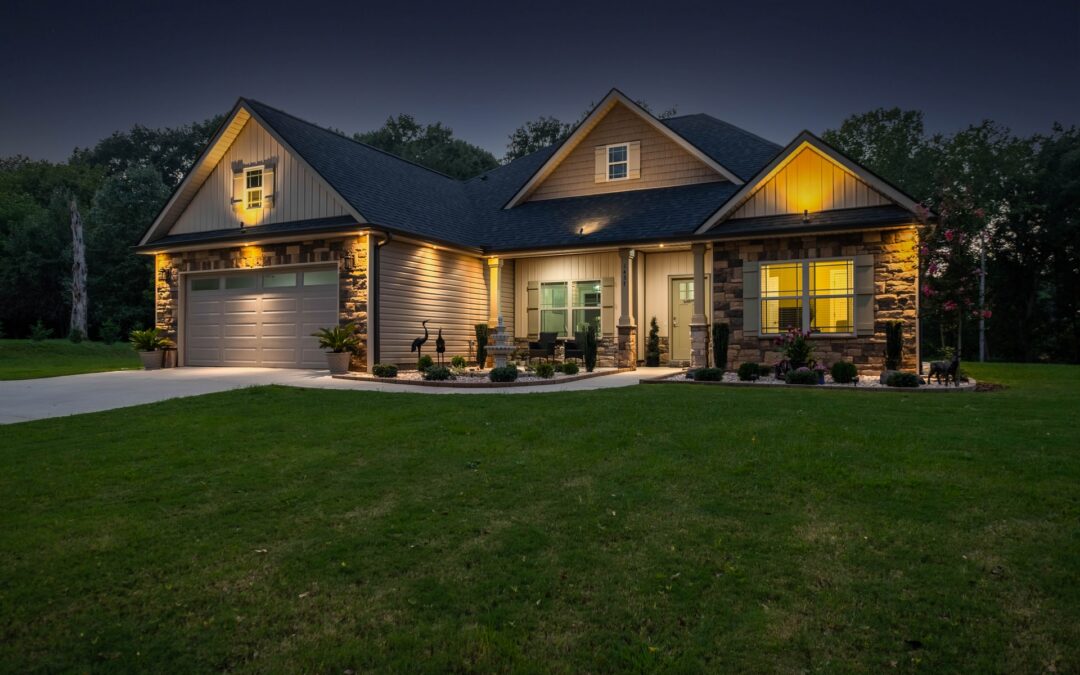
Why Choosing the Right Landscape Lighting Technology Matters for Your Home
Choosing the right landscape lighting technology can completely change how your home looks, feels, and functions after dark. A well-lit yard does more than just look attractive — it improves safety along walkways, deters intruders, and extends the time you actually enjoy your outdoor spaces.
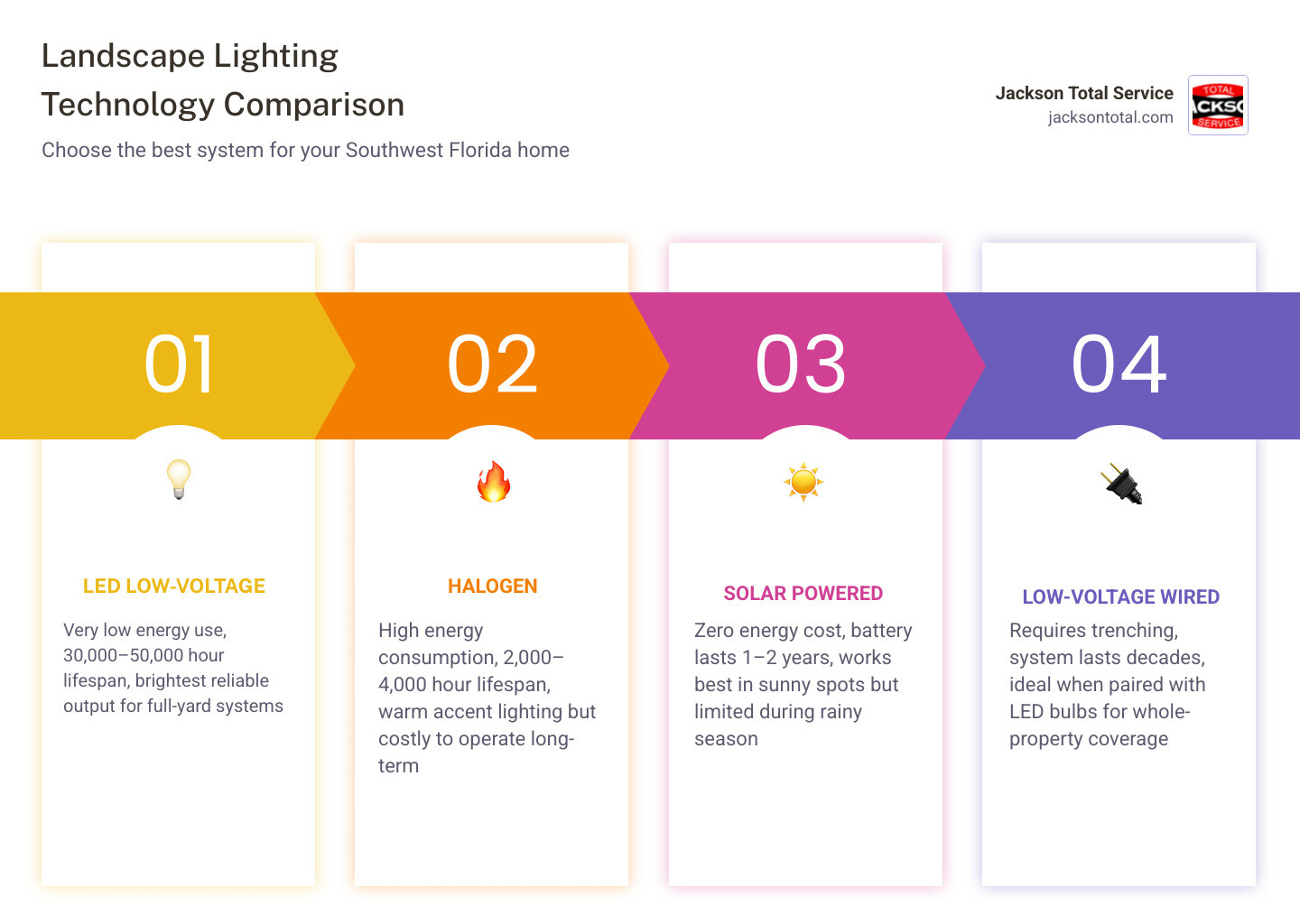
Here’s a quick overview of the main landscape lighting technologies to help you decide:
| Technology | Best For | Energy Use | Lifespan | Installation |
|---|---|---|---|---|
| LED | All applications | Very low | 30,000–50,000 hrs | Low-voltage wired |
| Halogen | Warm accent lighting | High | 2,000–4,000 hrs | Low-voltage wired |
| Solar | Accent, low-traffic areas | None (sun-powered) | Battery: 1–2 yrs | No wiring needed |
| Low-Voltage Wired | Full-yard systems | Low (with LED) | System lasts decades | Trenching required |
For most homeowners in Southwest Florida, LED low-voltage wired systems offer the best combination of brightness, reliability, and long-term value. Solar works well for accent lighting in sunny spots but struggles during Florida’s rainy season. Halogen is largely outdated and costs significantly more to run.
The sections below walk through each technology in detail — covering fixture types, wattage, materials, smart controls, and whether to go DIY or hire a professional electrician.
Choosing the right landscape lighting technology word roundup:
Comparing Core Landscape Lighting Technologies
When evaluating outdoor illumination, four primary technologies dominate the market: Light Emitting Diodes (LEDs), halogen bulbs, solar-powered fixtures, and low-voltage wired systems. Understanding how these systems stack up in terms of energy efficiency, lifespan, brightness, and maintenance is the first step in making an informed decision.
LED Technology: The Modern Standard
LED landscape lighting has become the gold standard for residential outdoor lighting in 2026. This technology operates by passing an electrical current through a semiconductor, which emits light with incredibly high efficacy.
- Energy Efficiency: LEDs use up to 80% less electricity than traditional halogen bulbs. For example, a 5-watt LED produces the same brightness (lumen output) as a 30-watt halogen bulb.
- Lifespan: An LED bulb or integrated fixture is rated to last between 30,000 and 50,000 hours. If run for five hours every night, these lights can easily last 15 to 25 years before needing replacement.
- Brightness: LEDs offer precise beam control and highly consistent light output. They do not fade as they age; instead, they slowly dim over decades, preventing sudden dark spots in your yard.
- Maintenance: Beyond occasional cleaning, LEDs require virtually zero maintenance. Because they generate very little heat, they do not attract insects as heavily as hot halogen bulbs, and they won’t damage surrounding tropical foliage.
To dive deeper into why this technology has taken over the industry, read our detailed breakdown on Why Your Garden Is Begging for an LED Upgrade.
Halogen Bulbs: Classic Warmth with High Demands
Halogen was once the go-to choice for landscape designers due to its warm, natural light. However, in 2026, it is rapidly being phased out due to its inherent inefficiencies.
- Energy Efficiency: Halogen bulbs convert only a small fraction of their energy into light; the rest is lost as heat. This results in high utility bills compared to modern alternatives.
- Lifespan: With a lifespan of only 2,000 to 4,000 hours, halogen bulbs must be replaced every one to two years.
- Brightness: Halogen provides excellent color rendering, but the bulbs dim significantly over their short lifespan.
- Maintenance: High heat output makes halogen fixtures prone to rapid seal degradation, moisture intrusion, and frequent bulb burnouts.
Solar Power: Cordless but Climate-Dependent
Solar lighting captures sunlight via small photovoltaic panels and stores it in rechargeable batteries to power the fixtures at night.
- Energy Efficiency: Solar systems cost nothing to operate, making them highly eco-friendly.
- Lifespan: While the LED bulbs inside last a long time, the rechargeable batteries degrade quickly and typically require replacement every 12 to 24 months.
- Brightness: Standard solar lights deliver low lumen outputs (often only 5 to 15 lumens), making them unsuitable for security or high-intensity architectural uplighting.
- Maintenance: Solar panels must be kept perfectly clean and free of debris to charge. If they are shaded by growing landscaping, their performance drops dramatically.
Low-Voltage Wired Systems: The Ultimate Backbone
A low-voltage wired system uses a step-down transformer to convert standard 120V household power into a safe 12V or 15V current.
- Energy Efficiency: When paired with LED fixtures, low-voltage systems are incredibly energy-efficient while maintaining maximum brightness.
- Lifespan: The copper wiring and heavy-duty transformers are designed to last for decades.
- Brightness: This system provides consistent, unwavering power to every single light on the line, regardless of weather conditions.
- Maintenance: Maintenance is minimal, involving basic visual inspections and checking that cables remain safely buried.
Low-Voltage Wired vs. Solar-Powered Systems
Many homeowners face a choice: do they invest in a hardwired low-voltage system, or do they opt for the quick setup of solar-powered lights? Let’s look at how these two approaches compare in the unique environment of Southwest Florida.
The 12V Low-Voltage Advantage
Low-voltage (12V) systems are the industry standard for professional residential installations. Because the voltage is stepped down by a transformer, the system carries no risk of serious electrical shock. This makes it completely safe for children and pets, even when the ground is saturated with water after a heavy summer downpour.
Furthermore, low-voltage cables only need to be buried about six inches deep, which makes installation far simpler and less invasive to your lawn than line-voltage (120V) systems that require deep conduit trenching.
The Solar Reality in Southwest Florida
Solar lights are incredibly easy to install since they don’t require cables, transformers, or trenching. However, their reliance on direct sunlight makes them highly volatile in coastal Florida.
During our intense summer rainy season, afternoon storms and heavy cloud cover can leave solar batteries undercharged. This leads to dim, flickering, or completely dark fixtures by mid-evening. Additionally, the extreme humidity and salt air in places like Marco Island and Naples can accelerate the degradation of cheap solar plastics and internal batteries.
If you are wondering whether the initial investment of a wired system pays off over time, check out our local guide: Im Looking for LED Landscape Lighting in Naples Collier County Is It Worth the Extra Cost.
Key Factors in Choosing the Right Landscape Lighting Technology
To build a system that stands up to the elements and delivers beautiful illumination, you must look closely at the materials, fixture styles, and technical specifications of the hardware you select.
Fixture Materials and Coastal Durability
In Southwest Florida, the salt air, intense UV rays, and high humidity will quickly destroy cheap materials. Choosing the right landscape lighting technology means choosing materials that can survive our harsh climate.
- Solid Brass: The absolute gold standard. Solid brass does not rust or corrode. Over time, it develops a beautiful, natural bronze patina that blends seamlessly into garden beds. It is highly resistant to salt spray, making it perfect for beachfront properties in Naples and Fort Myers Beach.
- Copper: Like brass, copper is incredibly durable and naturally patinas into a stunning verdigris finish. It is highly resilient against coastal moisture.
- Stainless Steel: Offers a sleek, modern look. However, you must use marine-grade (316) stainless steel to prevent tea-staining and rust in coastal environments.
- Powder-Coated Aluminum: An affordable option, but it has a limited lifespan near the coast. Eventually, the paint will bubble, chip, or fade under the intense Florida sun, exposing the underlying metal to rapid oxidation.
For any outdoor electrical project, ensuring proper material selection and safe connections is critical. Learn more about our comprehensive Electrical Installation services to see how we build systems designed to last.
Choosing the Right Landscape Lighting Technology for Different Fixture Types
Different areas of your yard require specific fixture types to create a balanced, layered look.
- Path Lights: Typically standing 14 inches tall, these fixtures cast a downward pool of light. They should be staggered along walkways to prevent a “runway” look.
- Spotlights (Bullet Lights): These feature adjustable knuckles and narrow beam angles. They are ideal for uplighting palm trees, highlighting architectural columns, or showcasing garden sculptures.
- Flood Lights: These deliver a wide, soft beam of light. They are perfect for illuminating broad areas like driveways, retaining walls, or dense privacy hedges.
- Well Lights (In-Ground Lights): These sit flush with the ground. They are excellent for uplighting trees where lawnmowers might damage above-ground fixtures, or for lighting the base of architectural features.
- Step and Deck Lights: Mounted directly to stair risers, posts, or retaining walls, these provide subtle, downward-directed light to ensure safe footing on outdoor steps and patios.
If you are planning an installation in Lee County, read our guide on How to Choose the Best Landscape Lighting Installation in Fort Myers FL for area-specific tips.
Technical Specifications for Choosing the Right Landscape Lighting Technology
Getting the aesthetics right requires matching the technical specifications of your bulbs to their intended purpose.
Lumens vs. Wattage
Always select bulbs based on lumens (the actual light output) rather than wattage (the power consumed). Because LEDs are so efficient, a very low wattage bulb can produce high lumen outputs:
- Pathways and Steps: 50–150 lumens (subtle, glare-free guidance).
- Small Shrubs and Accents: 100–250 lumens.
- Medium Trees and Facades: 250–400 lumens.
- Large Palms and Multi-Story Homes: 400–800 lumens.
Color Temperature (Kelvin)
Color temperature dictating the warmth or coolness of the light:
- 2700K (Warm White): The industry standard for residential spaces. It provides a cozy, golden glow that enhances natural wood, stonework, and foliage.
- 3000K (Soft White): A slightly cooler, crisp white. It works beautifully on modern architectural designs and ultra-green tropical plants.
- 4000K+ (Cool White): Best avoided for residential landscaping, as it can look stark, blue, and commercial.
Voltage Drop and Wiring Topologies
Voltage drop occurs when electrical resistance causes the voltage to decrease as it travels down a long wire run. If the voltage drops below 10.5V, LED fixtures may flicker or fail to light up.
To prevent this, we avoid “daisy-chain” wiring (running one long wire from light to light). Instead, we use a star topology (or hub system), where equal-length wires run from a central junction box back to the transformer. This ensures every single fixture receives the exact same voltage for perfectly uniform brightness across your yard.
System Architecture: Transformers, Wiring, and Smart Controls
A reliable landscape lighting system relies on a well-designed power and control infrastructure behind the scenes.
Sizing the Transformer
The transformer is the heart of your low-voltage system. To choose the right size, calculate your total fixture wattage and add a 25% safety buffer to allow for future expansion.
Additionally, we always follow the 80% capacity rule: a transformer should never be loaded beyond 80% of its rated capacity. For example, if you have ten 5-watt LED lights (50W total), a 100-watt transformer provides a healthy, safe buffer. For longer wire runs, we use multi-tap transformers (which offer 12V, 13V, 14V, and 15V taps) to push slightly higher voltage down the line and counteract voltage drop.
Smart Controls and Automation
In 2026, basic mechanical timers are a thing of the past. Modern systems utilize smart controllers integrated with Wi-Fi or Bluetooth. This allows you to:
- Create custom lighting zones (e.g., keeping security lights on all night while dimming garden accent lights at midnight).
- Set astronomical timers that automatically adjust to seasonal shifts in sunset and sunrise.
- Control your entire system via smartphone apps or voice assistants.
Neighbor Courtesy: Preventing Glare and Light Spillover
Great landscape lighting highlights your home without blinding your guests or your neighbors. To avoid glare and light pollution:
- Use fixtures with built-in glare shields or shrouds.
- Angle spotlights downward or directly upward against walls, rather than outward toward neighboring properties.
- Choose downlights or fully shielded path lights to keep light focused exactly where it is needed.
DIY vs. Professional Installation and Long-Term Maintenance
While putting a few solar stakes in the ground is an easy weekend task, installing a comprehensive, long-lasting low-voltage system is a different story.
The Case for Professional Electrical Installation
While low-voltage systems are safe for DIYers, achieving a professional-grade look that lasts for decades requires specialized tools and expertise. A licensed electrician brings several key advantages:
- System Balancing: Calculating load, wire gauges, and voltage drops to ensure every light shines with consistent brightness.
- Code Compliance: Ensuring your transformer is plugged into a properly installed, weather-protected GFCI outlet and that all wiring meets local Southwest Florida building codes.
- Proper Waterproofing: Using professional, silicone-filled waterproof wire connectors. Standard wire nuts will corrode within months in our humid climate, leading to system failure.
Long-Term Maintenance Checklist
To protect your investment, we recommend performing basic maintenance twice a year:
- Lens Cleaning: Wipe down glass lenses with a mild vinegar solution to remove hard water deposits, dirt, and salt residue, which can block up to 30% of the light output.
- Vegetation Pruning: Trim back growing plants and ground cover that may block light beams or crowd fixtures.
- Wire Depth Checks: Ensure heavy rains haven’t exposed buried cables, and re-bury any lines that have surfaced.
Investing in a professionally designed and maintained system pays off. It significantly boosts your home’s curb appeal, safety, and perceived value. For more on this, read Light Up Your Life and Your Property Value.
Frequently Asked Questions About Outdoor Lighting
Can I replace my existing halogen bulbs with LEDs?
Yes, in almost all cases. Most low-voltage landscape fixtures are “lamp-ready,” meaning you can easily swap out old halogen MR16 or bi-pin bulbs with LED retrofits. Just ensure the new LED bulbs are compatible with your existing transformer’s output (AC vs. DC) and that the total wattage remains well below your transformer’s capacity.
Do solar landscape lights work reliably in Southwest Florida?
While solar lights can work well for minor accent lighting in wide-open, sunny areas, they are generally unreliable as a primary source of illumination in Southwest Florida. Our frequent afternoon summer storms, heavy cloud cover, and shaded garden beds often leave solar batteries undercharged, resulting in dim or non-functional lights when you need them most.
Are permits required for installing landscape lighting in Naples, FL?
In most cases, installing low-voltage (12V) landscape lighting runs do not require a building permit. However, if you need to install a new outdoor GFCI outlet or run a new 120V line to power your transformer, a permit is required, and the work must be performed by a licensed electrician to ensure safety and local code compliance.
Conclusion
Choosing the right landscape lighting technology is an investment in your home’s beauty, safety, and long-term value. While solar has its place for quick accent spots, a professionally designed, low-voltage LED system is the only way to achieve consistent, stunning results that stand up to the unique challenges of our Southwest Florida climate.
At Jackson Total Service, we have been helping homeowners across Naples, Fort Myers, Cape Coral, and the surrounding areas since 1964. As a trusted local provider of comprehensive HVAC, plumbing, and electrical services, we handle everything from basic repairs to complex, custom outdoor lighting designs.
Ready to transform your property after dark? Explore our professional Landscape Lighting services or contact us today to schedule your outdoor lighting consultation with our team of skilled, licensed electricians!