



Could You Hear a Garage Fire From the Master Suite?
Are you confident that a fire starting in your attached garage tonight would trigger an alarm loud enough to wake you on the opposite side of the house? When weighing interconnected vs. independent smoke detectors for sprawling ranch homes, this is the most critical question you can ask. Many homeowners assume that because they have alarms installed, they are fully protected. However, the physical layout of your home drastically changes how sound travels, leaving distant bedrooms vulnerable if a fire breaks out in a rarely occupied wing.
If you are evaluating your current setup, upgrading your electrical and home safety services, or considering hiring a licensed electrician for smoke detector installation, understanding this difference is the first step toward true peace of mind.
In Naples sprawling single-story estate and ranch homes, floor plans are designed for privacy and space. While sprawling layouts are fantastic for daily living, they create a serious acoustic barrier during an emergency. A localized alarm sounding in the laundry room or guest suite may simply not be loud enough to pierce through multiple walls and doors to reach the master bedroom.
The Acoustic Reality of Sprawling Single-Story Homes
To understand why the layout of your home matters so much, we have to look at the science of sound travel. Early fire detection is only useful if the occupants can actually hear the warning.
The 85-Decibel Drop-Off
A standard residential smoke alarm is designed to produce 85 decibels of sound at a distance of 10 feet. To put that in perspective, 85 decibels is roughly equivalent to a loud blender or a lawnmower running right next to you. At 10 feet, it is unmistakable and piercing.
However, sound energy dissipates quickly over distance. In Naples sprawling single-story estate and ranch homes, the distance between an attached garage and the primary bedroom can easily exceed 50 to 100 feet. As sound travels down long hallways and across open living spaces, the decibel level drops significantly. By the time that 85-decibel alarm reaches the other side of the house, it may sound like nothing more than a faint background noise.
Modern Building Materials Block Sound
Distance is not the only factor working against you. Modern home construction utilizes materials specifically designed to dampen sound for privacy. These materials include:
- Solid-core interior doors: Unlike older hollow doors, solid-core doors are dense and heavy, blocking a massive amount of acoustic energy.
- Insulated interior walls: Many large homes feature insulation in the interior walls surrounding the master suite or media rooms to prevent noise transfer.
- Heavy textiles and furnishings: Thick carpets, heavy drapery, and large plush furniture absorb sound waves rather than reflecting them.
Because most fatal residential fires occur between 11 PM and 7 AM when occupants are in a deep sleep, you need an alarm system that can overcome these acoustic barriers. Reviewing your essential electrical safety tips should always include a realistic assessment of whether your current alarms are loud enough to wake you from a deep sleep behind a closed, solid-core door.

Independent Smoke Detectors: Limitations in Large Footprints
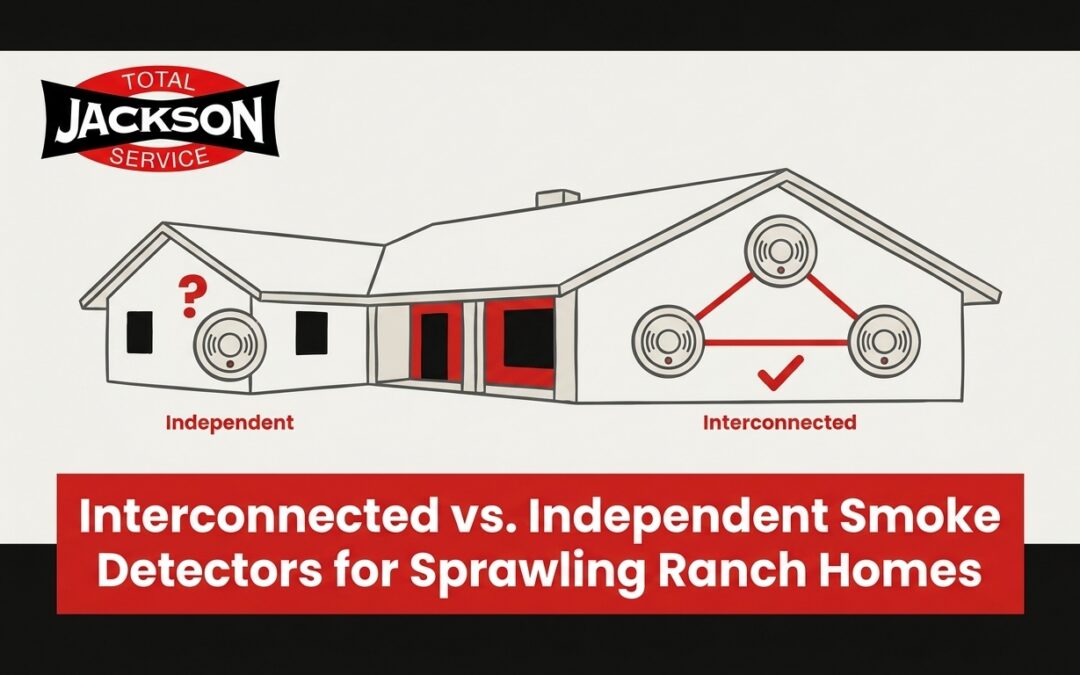
Independent smoke detectors are standalone units. They can be battery-operated or hardwired into your home’s electrical system, but they do not communicate with one another. If one independent detector senses smoke, only that specific unit will sound its alarm.
The False Sense of Security
In a small apartment or a compact, open-concept home, independent detectors are often sufficient. The space is small enough that a single alarm can be heard clearly from any room. They are also incredibly easy to install, requiring nothing more than a few screws and a fresh battery.
However, in large footprints, they present a dangerous limitation. If a fire starts in a rarely occupied space—such as an attached garage, a distant guest wing, or a mechanical room—the local alarm will trigger. But if you are asleep on the far side of the house, surrounded by insulated walls and closed doors, you may sleep right through the critical first few minutes of the fire.
The Middle-of-the-Night Maintenance Hunt
Beyond the safety risks, independent detectors create a significant nuisance factor in sprawling homes. We have all experienced the dreaded low-battery chirp at 2 AM. With independent units, you are forced to walk through every room, hallway, and guest space to figure out exactly which unit is complaining. If you are wondering why smoke alarms chirp during late summer humidity, it is often due to minor voltage drops in aging batteries—a frustration that multiplies when you have eight or ten independent units scattered across a large floor plan.
Interconnected Systems: Complete Coverage for Split Floor Plans
The solution to the distance and soundproofing problem is an interconnected smoke detector system. The premise is simple and life-saving: when one alarm senses smoke, every single alarm in the house sounds simultaneously.
The Core Benefits of Interconnectivity
- Immediate Whole-Home Awareness: If a fire sparks in the garage, the alarm in your master bedroom will sound instantly at full volume. There is no delay and no muffled sound.
- NFPA Safety Standards: The National Fire Protection Association (NFPA) recognizes this life-saving benefit, which is why interconnected smoke alarms are now required in all new residential construction.
- Faster Evacuation Times: By alerting every occupant at the exact same moment, families have precious extra minutes to execute their escape plan.
Wireless vs. Hardwired Interconnected Systems
Historically, upgrading to an interconnected system meant tearing open drywall to run communication wires between every detector in the house. Today, that is no longer necessary. Modern wireless interconnected technology uses secure radio frequencies to link the units. If one detects smoke, it sends a wireless signal to the others, triggering a whole-home alarm without requiring invasive rewiring.
For homes that are already hardwired but lack interconnectivity, upgrading the system requires professional expertise. Because hardwired systems integrate directly with your home’s electrical grid, this is never a DIY project. Working with live voltage carries a high risk of shock and fire if handled incorrectly. Always rely on a qualified professional when hiring a licensed electrician for smoke detector installation to ensure the system is safely integrated and up to current safety codes.
How Florida’s Climate Impacts Your Smoke Alarms
Your location plays a surprising role in how well your safety systems operate. The regional climate directly impacts the lifespan and reliability of both independent and interconnected detectors.
High Humidity and Battery Corrosion
In our region, the air is thick with moisture for much of the year. High indoor humidity can wreak havoc on the internal components of battery-operated independent units. Moisture accelerates battery corrosion, leading to poor connections, premature battery failure, and those frustrating false alarms. If you rely on standalone battery units, this climate factor means you must be vigilant about checking the battery contacts for rust or buildup.
Lightning Density and Power Surges
Southwest Florida is famous for its intense afternoon thunderstorms and holds some of the highest lightning density rates in the country. Frequent lightning strikes and the resulting power grid fluctuations pose a serious threat to hardwired interconnected systems. A sudden power surge can fry the sensitive logic boards inside modern detectors, rendering the entire interconnected network useless.
To protect these critical safety devices, your home needs a robust electrical foundation. Ensuring you have the proper electrical panel capacity for modern home safety allows for the installation of whole-home surge protection. This intercepts lightning-induced voltage spikes at the panel before they can travel through your wiring and destroy your hardwired smoke alarms.
Addressing Malfunctions: When It’s Time for Professional Repair
Smoke detectors are not set-it-and-forget-it devices. Over time, sensors degrade, dust accumulates, and internal wiring can fail. Recognizing the signs of a malfunctioning system is vital for your family’s protection.
Common signs of failure include:
- Random, unexplained chirping: If replacing the battery does not stop the chirp, the unit’s internal sensor is likely failing.
- Frequent false alarms: Alarms that trigger from normal cooking heat or bathroom steam may have degraded sensors.
- Failure to test: If you press the test button and the alarm is weak, delayed, or silent, the unit must be replaced immediately.
The fall transition is the ideal time for pre-heating-season safety checks. Before the temperatures drop and you turn on your heating system for the first time, you must verify that your early warning systems are fully operational. Heating equipment is a leading cause of residential fires, making the fall transition a critical window for maintenance.
When electrical safety systems fail unexpectedly, you need fast, qualified repairs. Relying on a trusted local team with a 60-year family legacy in Southwest Florida ensures that your home is treated with a deep, multi-generational commitment to community safety. Professional technicians can quickly diagnose whether a false alarm is due to a faulty unit, a loose wiring connection, or a broader electrical issue.
Side-by-Side Comparison: Which System Protects Your Home Best?
To summarize the differences, here is how independent and interconnected systems stack up against each other, particularly for Naples sprawling single-story estate and ranch homes.
| Feature | Independent Smoke Detectors | Interconnected Smoke Detectors |
|---|---|---|
| Audibility Across Large Distances | Poor. Only the local alarm sounds, which may not be heard behind closed doors. | Excellent. When one sounds, all units sound at full volume simultaneously. |
| Installation Complexity | Very easy. Standalone units require no communication wiring or syncing. | Moderate. Wireless units are easier, but hardwired systems require a licensed professional. |
| Life-Safety Value for Split Floor Plans | Low. Leaves distant bedrooms highly vulnerable to remote fires. | High. Meets modern NFPA standards for optimal whole-home protection. |
| Maintenance and Troubleshooting | Tedious. You must locate the specific unit that is chirping or failing. | Streamlined. Many modern systems indicate which specific unit initiated the alarm. |
Frequently Asked Questions About Smoke Detector Systems
Are interconnected smoke detectors worth the investment for a single-story home?
Yes, they are absolutely worth the investment, especially in sprawling floor plans. In a large single-story home, the distance between the garage or kitchen and the master bedroom can muffle a standard 85-decibel alarm. Interconnected systems eliminate this distance barrier by sounding every alarm in the house simultaneously, ensuring you wake up immediately regardless of where the fire starts.
Can I mix interconnected and independent smoke alarms in the same house?
While you physically can have both in the same house, it is highly discouraged. Mixing systems creates dangerous gaps in your safety net. If a fire starts near an independent alarm, it will not trigger the interconnected network, leaving the rest of the house unaware of the danger. For optimal safety, all alarms in the home should be on the same interconnected network.
Do wireless interconnected smoke alarms need a WiFi connection to work?
No, wireless interconnected smoke alarms do not rely on your home’s WiFi network. They use their own secure, dedicated radio frequency to communicate with one another. This means that even if your internet goes down or your router loses power during a storm, your smoke alarms will still communicate and trigger each other flawlessly.
How far apart can interconnected smoke alarms be placed in a large floor plan?
Most wireless interconnected smoke alarms have a communication range of 150 to 300 feet in an open area. However, walls, doors, and large appliances can reduce this range. In Naples sprawling single-story estate and ranch homes, the units act as a mesh network; as long as each alarm can communicate with the next closest unit, the signal will successfully relay across the entire house.
What happens if one interconnected smoke alarm fails or loses battery power?
If a single unit loses battery power, it will usually chirp locally to alert you to the dead battery, but it will not trigger the whole-home alarm. If a unit completely fails, the rest of the interconnected system will continue to function and communicate with each other. However, you should replace any failing unit immediately to maintain complete coverage in that specific room.
Secure Your Home with the Right Safety System
When it comes to protecting your family, relying on outdated standalone alarms in a large home leaves too much to chance. Interconnected systems solve the critical distance and audibility problems inherent in sprawling ranch layouts. By ensuring that a fire in the garage instantly sounds the alarm in your master suite, you gain the precious minutes needed to get everyone to safety.
Modern wireless interconnectivity makes this critical safety upgrade entirely non-invasive, meaning you can achieve whole-home protection without tearing into your walls. Because the fall transition is the ideal time for pre-heating-season safety checks, there is no better moment to evaluate your current system. If you are comparing interconnected vs. independent smoke detectors for sprawling ranch homes, reach out to a qualified professional to discuss your home’s unique layout, schedule a comprehensive safety check, and secure the peace of mind you deserve.