



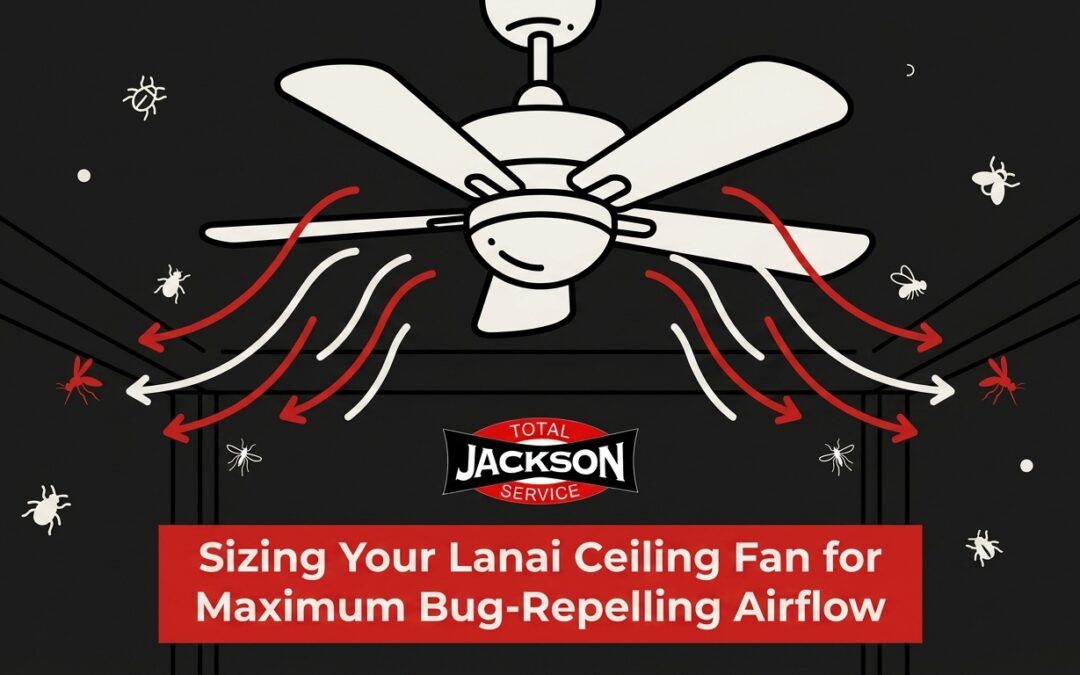
The Science of Using Airflow as a Mosquito Deterrent
Mosquitoes are notoriously weak flyers, averaging flight speeds of only 1 to 1.5 mph under normal conditions. Because of this biological limitation, getting the math right on sizing your lanai ceiling fan for maximum bug-repelling airflow is the most effective way to reclaim your outdoor space. A standard, gentle breeze often isn’t enough to keep these pests at bay; homeowners need a mechanical pest-deterrent system that physically blocks insects from entering the seating area. For comprehensive support with your home’s systems, explore our electrical services in Southwest Florida.
The core concept behind using a ceiling fan for pest control is the creation of a downward “air curtain.” When a fan pushes air toward the floor at a high enough velocity, it creates a turbulent barrier that mosquitoes simply cannot navigate. To be effective, this downdraft must exceed 2 mph at the level where you are sitting. If the air is moving any slower, determined pests will still find a way through the current to land on you.
During those beautiful but humid September fall evenings, chemical sprays and citronella candles often fall short because they disperse unevenly in open air. A properly sized ceiling fan, however, provides a constant, reliable defense. Selecting the exact blade span and motor power is the ultimate decision point for a bug-free patio. It transforms a decorative fixture into an active shield, ensuring your outdoor living area remains comfortable and usable throughout the peak bug seasons.
How High-CFM Motors Disrupt Mosquito Flight Paths
The problem: Many homeowners install standard cooling fans on their patios, only to find that mosquitoes still swarm the area at dusk. The cause: These standard units lack the specific motor power required to move a massive volume of air in an unconfined outdoor space. The solution: Upgrading to a high-velocity motor that meets strict CFM (Cubic Feet per Minute) requirements to physically force insects out of the area.
CFM is the measurement of how much air a fan moves in one minute when operating at its highest speed. It is the single most critical metric for outdoor fans. While an indoor fan might only need 3,000 to 4,000 CFM to circulate air in an enclosed living room, an open-air lanai has no walls to contain the breeze. The air instantly disperses outward. When you are looking for a reliable ceiling fan installation service, ensuring the unit has a high enough CFM rating should be your top priority.
To create an effective barrier against mosquitoes, high-velocity outdoor fans must push between 5,000 and 7,000+ CFM. This massive volume of air creates a sustained downward pressure zone. When a mosquito attempts to fly into this zone, the sheer force of the downdraft overwhelms its weak wings.
- Flight disruption: The turbulent air throws the insect off its flight path, making it impossible to land accurately.
- Forced grounding: The downward pressure physically pushes the mosquito toward the floor, away from seating areas.
- Avoidance behavior: Insects naturally seek the path of least resistance and will abandon the turbulent zone for still air elsewhere.
By understanding these CFM (Cubic Feet per Minute) requirements, you can select a motor that does more than just circulate ambient air—it actively defends your outdoor living space from airborne pests.
Sizing Your Downward Air Curtain by Square Footage
To capture the full benefit of a bug-repelling air curtain, the fan must be sized correctly for the specific dimensions of your patio. The goal is to cover the functional seating area, not necessarily the entire concrete footprint of the lanai. If your patio is 400 square feet, but your dining and lounging area only occupies a 150-square-foot section, you should size the fan to aggressively cover that specific 150-square-foot zone.
Undersizing the fan is the most common mistake made on Naples FL lanais. If the blade span is too small for the seating arrangement, it leaves vulnerable, still-air gaps at the edges of the patio where mosquitoes can easily enter. Conversely, if a space is exceptionally large or uniquely shaped (such as an L-shaped lanai), a single massive unit may not provide uniform coverage. In these cases, installing two appropriately sized fans spaced evenly apart is far more effective at maintaining a continuous air curtain than relying on one central fixture.
CFM and Blade Span Quick Reference
Using the correct combination of blade span and CFM ensures the downdraft reaches the edges of your seating area without losing velocity. Below is a quick reference guide to match your functional square footage with the minimum required hardware.
| Lanai Square Footage | Minimum Blade Span | Minimum CFM Required |
|---|---|---|
| Up to 144 sq ft (e.g., 12×12) | 42 to 50 inches | 4,000+ CFM |
| 144 to 225 sq ft (e.g., 15×15) | 52 to 56 inches | 5,000+ CFM |
| Over 225 sq ft (e.g., 20×20) | 60+ inches | 6,000 to 7,000+ CFM |
Keep in mind that mounting height also plays a role in these calculations. For optimal bug deterrence, the blades should sit roughly 8 to 9 feet above the floor. If your lanai features a vaulted ceiling, you will need a correctly sized downrod to bring the fan down to the effective height, ensuring the air curtain doesn’t dissipate before reaching your seating area.

Why Blade Span and Pitch Dictate Your Protective Zone
While the motor dictates the sheer volume of air moved, the physical blades shape the width and aggression of the air curtain. Blade span determines the overall diameter of the protective zone. A 52-inch fan will create a column of downward air roughly 52 inches wide, spreading slightly as it hits the floor. If your outdoor dining table is 72 inches long, a 52-inch fan will leave the people seated at the ends of the table completely unprotected.
Equally important is the blade pitch, which is the angle at which the blades are tilted relative to the motor. The pitch affects how aggressively the air is scooped and pushed downward. When choosing the right ceiling fan blades, you must look for a pitch of at least 12 to 15 degrees for outdoor bug repulsion.
The mechanics of blade pitch:
- Flat pitches (under 10 degrees): These blades will merely slice through the air with minimal resistance, creating a very gentle breeze. They are highly inefficient for pest control, regardless of how fast the motor spins.
- Aggressive pitches (12 to 15+ degrees): These blades act like shovels, scooping large volumes of air and forcing it downward. This is what generates the intense, turbulent downdraft needed to meet strict CFM (Cubic Feet per Minute) requirements.
Balancing aesthetics with aerodynamics is crucial. Narrow, stylized blades might look incredibly modern, but they often lack the surface area needed to move a high volume of air. For optimal outdoor performance, opt for wider blades with a steep pitch, ensuring the fixture functions as a true mechanical deterrent rather than just a decorative piece.
Surviving the High Humidity and Salt Air of Coastal Climates
The problem: High-CFM motors run hot and require robust protection from the elements, but standard outdoor fans often fail prematurely in tropical environments. The cause: The harsh reality of the local tropical climate, including coastal salt-air exposure and extreme high humidity, rapidly corrodes internal components and warps inferior blade materials. The solution: Strict adherence to UL Damp and UL Wet ratings, alongside selecting weather-resistant construction materials, to ensure longevity.
In coastal environments, the air is thick with moisture and corrosive salt. A fan that might last a decade on a dry, inland patio will seize up in just a few seasons on Naples FL lanais if it isn’t built for the climate. Understanding safety ratings is the first step in protecting your investment. A comprehensive ceiling fan installation guide will always emphasize the critical difference between UL Damp and UL Wet ratings.
A UL Damp rating means the fixture can handle ambient moisture and high humidity, making it suitable for fully covered patios where direct rain cannot reach it. However, if your lanai has exposed edges, a slatted pergola roof, or is subject to blowing rain during afternoon storms, a UL Wet rating is mandatory. Wet-rated fans feature sealed motor housings and waterproof wiring compartments that can withstand direct water exposure.
Beyond the motor housing, blade material is equally vital. Standard MDF (medium-density fiberboard) or wooden blades will quickly absorb moisture from the humid air, causing them to droop, warp, and throw the fan off balance. Instead, select fans equipped with ABS plastic, marine-grade stainless steel, or specifically treated weather-resistant composite blades that will hold their pitch and shape no matter how humid the season gets.
The Importance of Safe, Professional Outdoor Electrical Wiring
High-velocity motors draw significant power to maintain those crucial CFM (Cubic Feet per Minute) requirements, and they demand dedicated, weather-sealed wiring to operate safely. The hidden dangers of DIY electrical work in wet, outdoor environments cannot be overstated. A minor wire exposure that might only cause a tripped breaker indoors can become a severe fire or shock hazard when exposed to coastal humidity and storm-driven rain.
Outdoor electrical systems face extreme stress, especially during severe weather events. One local homeowner reached out on a Sunday during the fall season, shortly after Hurricane Ian, when sparks began shooting from their electrical panel. A technician named Paul responded immediately, routing an electrician, Jeff, to the property in under an hour. Jeff quickly and efficiently repaired the hazardous wiring, ensuring the home’s electrical system was stable and secure. This level of responsiveness and technical skill highlights why professional intervention is critical when dealing with compromised or highly stressed electrical components.
Ensuring lanai installations meet strict local building codes is paramount. With 60 years of multi-trade expertise, relying on seasoned professionals guarantees that your outdoor fixtures can withstand storm-season conditions. Professional electricians use specialized outdoor conduit, weather-resistant receptacles, and properly sealed junction boxes to prevent moisture intrusion.
Furthermore, a licensed professional will ensure that the electrical load of a high-CFM fan doesn’t overload your existing patio circuits. They will verify that the mounting box is specifically rated to support the dynamic weight and vibration of a heavy, high-velocity unit. Relying on licensed experts prevents catastrophic failures, keeps your property up to code, and ensures your new pest-deterrent system operates safely year-round.
Frequently Asked Questions About Lanai Fans and Pest Control
How much CFM is needed for an outdoor ceiling fan to stop bugs?
To effectively stop bugs, an outdoor ceiling fan needs to produce between 5,000 and 7,000+ CFM. This high volume of airflow creates a downward velocity of at least 2 mph, which is required to disrupt the flight paths of weak-flying insects. Standard indoor fans typically max out around 3,000 to 4,000 CFM, which is why they often fail to keep patios bug-free. Always check the manufacturer’s maximum CFM rating before purchasing an outdoor unit.
What size ceiling fan do I need for a 12×12 lanai?
For a 12×12 lanai (144 square feet), you need a ceiling fan with a minimum blade span of 42 to 50 inches. This size ensures the air curtain covers the primary seating area without dissipating too early. Additionally, the fan should be rated for at least 4,000 to 5,000 CFM to maintain enough downward pressure to deter pests. If your seating area is spread out toward the edges of the 12×12 space, leaning toward a 52-inch span will provide better edge-to-edge coverage.
Do ceiling fans actually keep mosquitoes away?
Yes, ceiling fans are highly effective at keeping mosquitoes away when sized and positioned correctly. Because mosquitoes are weak flyers, a strong, sustained downdraft acts as a physical barrier that they cannot fly through. Unlike chemical sprays that blow away or candles that only cover a small radius, a high-CFM fan provides a constant, reliable zone of protection over your seating area. It is one of the most effective mechanical pest deterrents available for outdoor living spaces.
How fast do mosquitoes fly compared to fan downdrafts?
Mosquitoes fly at an average speed of only 1 to 1.5 mph, making them highly susceptible to wind currents. A properly sized outdoor ceiling fan generates a downdraft exceeding 2 mph at the seating level. Because the fan’s air velocity is significantly faster than the insect’s top flight speed, the mosquito is physically unable to navigate the turbulent air. This forces the insect to either land on the ground or seek out calmer, still air away from your patio.
Can I use an indoor ceiling fan on a covered patio?
No, you should never use an indoor ceiling fan on a covered patio, even if the area is protected from direct rain. Indoor fans lack the sealed motor housings and rust-resistant hardware necessary to withstand outdoor humidity. The ambient moisture in the air will quickly corrode the internal wiring and cause wooden or MDF blades to warp and droop. Always use a fan specifically rated for outdoor environments to ensure safety and longevity.
What is the difference between UL Damp and UL Wet ratings for lanai fans?
A UL Damp rating indicates that a fan can withstand high humidity and indirect moisture, making it suitable for fully covered lanais where rain cannot reach it. A UL Wet rating means the fan is built with completely sealed electrical components and can withstand direct exposure to rain, snow, and hose water. If your lanai has an open pergola roof, exposed edges, or frequently experiences blowing rain during storms, a UL Wet-rated fan is absolutely required for safety.
Reclaim Your Outdoor Living Space This Season
The right combination of CFM and blade span creates a highly functional, bug-free zone that allows you to truly enjoy your outdoor spaces. By understanding the physics of downward airflow, you can transform an unusable, mosquito-heavy patio into a comfortable retreat, especially during those beautiful September fall evenings. Sizing your fan correctly ensures that the breeze is strong enough to keep pests away without being overwhelmingly loud or disruptive to your gatherings. If you are ready to upgrade your lanai, consult with a professional to evaluate your specific outdoor electrical capabilities and airflow needs before your next outdoor event.