



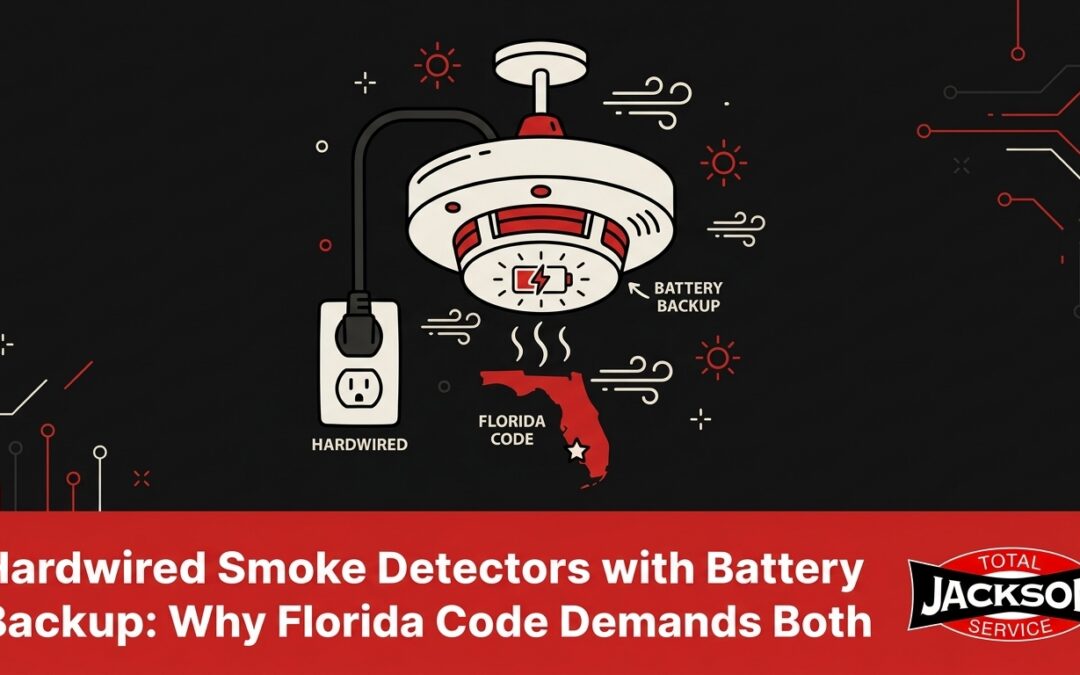
Why September Power Outages Put Coastal Homes to the Test
As we transition into early fall and navigate the peak of September’s storm season, our electricians at Jackson Total Service frequently field questions about hardwired smoke detectors with battery backup: why Florida code demands both. Whether you are planning a major pre-heating-season home renovation, scheduling a routine electrical inspection, or simply trying to update old fixtures, you might have been told that your existing battery-only smoke alarms are no longer compliant. For many homeowners, this requirement feels frustrating. You might wonder why a simple battery-operated unit, which seems perfectly fine, isn’t considered “good enough” by today’s standards.
In our decades of serving Naples, we continually remind customers that modern building standards are designed for worst-case scenarios, not just everyday convenience. When severe weather hits and the grid goes down for days or even weeks, a single-source power system becomes dangerously inadequate. Upgrading to a dual-layer system is not merely a box to check for a building inspector; it is a critical decision point for your family’s safety. For a comprehensive look at keeping your property secure, explore our Southwest Florida electrical and home systems guide.
During the height of storm season, extended power outages are a reality we all have to navigate. When utility power drops, the risks inside your home actually increase. By understanding the reasoning behind these strict regulations, you can make informed decisions about your home’s electrical infrastructure and ensure your safety net remains active exactly when you need it most.
Understanding Florida Building Code Section R314
To understand why our technicians insist on a specific type of alarm, you have to look at the rulebook. In our years of keeping Naples homes up to code, we’ve seen firsthand that the regulations regarding Florida smoke detector code requirements are clear and unforgiving. Specifically, the Florida Building Code (Residential) Section R314 mandates that all residential smoke alarms must receive their primary power from the building’s wiring and must also include a battery backup.
Furthermore, the National Fire Protection Association (NFPA) 72 standard requires these systems to be physically or wirelessly linked. This means you are legally required to have an interconnected system where, if one alarm detects smoke, every single alarm in the house sounds simultaneously. You can learn more about the mechanics of this requirement by reading about interconnected vs. independent smoke detectors.
These rules apply strictly to new construction, significant remodels, additions, and specific interior alterations that require a permit. The state implemented these regulations specifically to eliminate the dangerous blind spots created by older, standalone units.
Standalone vs. Code-Compliant Hardwired Systems
| System Feature | Standalone Battery Units (Older Homes) | Hardwired with Battery Backup (Code Compliant) |
|---|---|---|
| Primary Power Source | Disposable 9V or AA batteries | Home’s 120V electrical wiring |
| Secondary Power Source | None (Single point of failure) | Sealed 10-year lithium or replaceable 9V |
| Interconnectivity | No. Only the unit nearest the fire sounds. | Yes. If one sounds, all units in the home sound. |
| Vulnerability | Dead batteries leave the home unprotected. | Requires professional installation. |
As the table illustrates, the modern mandate removes the human-error element of forgetting to change a battery, while also guaranteeing that a fire starting in an unoccupied garage will immediately alert a family sleeping on the second floor.
The Mechanical Necessity of the Dual-Power Requirement
Living in Naples FL and surrounding coastal communities means dealing with severe summer thunderstorms transitioning into unpredictable fall weather patterns. Relying solely on utility power for your life-safety devices is inherently risky in this environment. The dual-power requirement exists because each power source compensates for the other’s specific vulnerabilities.
The Advantage of a Hardwired Network
The primary advantage of hardwiring your smoke detectors is the constant, reliable power supply provided by your home’s electrical panel. Hardwiring allows for the critical interconnectivity mandated by the NFPA. When an electrical signal can travel instantly between units, it creates a whole-home safety net. You never have to worry about a localized fire growing out of control silently because the alarm was too far away to hear.
The Vulnerability of Total Grid Reliance
However, hardwiring alone has a massive, glaring vulnerability: total failure during grid outages. If a severe storm knocks out a transformer, or a hurricane takes down transmission lines across the county, a hardwired-only system goes completely dead. Your home would be left entirely unprotected at a time when emergency services are already stretched thin.
The Battery Backup Solution
This is exactly why the battery backup is a non-negotiable secondary layer. The battery keeps the interconnected safety net active when utility power drops. It bridges the gap between the moment the lights go out and the moment the utility company restores service. This dual-layer approach provides uninterrupted protection regardless of the grid’s status, which is a core component of proper electrical safety preparation before hurricanes.

Hidden Fire Risks During Extended Grid Failures
It is incredibly common for homeowners to view the dual-power mandate as unnecessary bureaucratic red tape. If you are already paying for a remodel, adding electrical work to retrofit smoke alarms feels like an annoying extra step. However, contrasting this perceived inconvenience with the reality of post-storm electrical hazards changes the perspective entirely.
During the September peak hurricane season, prolonged outages force residents to resort to alternative power sources. People light candles for illumination, hook up portable generators, and use camping stoves. According to NFPA data, these alternative power sources drastically increase residential fire risks. Ironically, these risks peak precisely when older, hardwired-only alarms would be completely dead.
Post-Storm Electrical Surges
Beyond candles and generators, there is the added risk of post-storm electrical surges. When the utility grid finally comes back online, the sudden influx of power can cause aging electrical panels to spark, or compromised wiring to short out.
During the chaotic weeks following a major storm, these electrical hazards become all too real. For example, on a Sunday just a week and a half after Hurricane Ian, a Naples homeowner called us in a panic after noticing sparks shooting directly from their electrical panel. Our dispatch team responded immediately, sending one of our expert electricians who arrived within an hour. We were able to quickly diagnose and resolve the panel issue before it escalated into a devastating fire. If a fire had started and their smoke alarms lacked battery backups because the grid was still unstable, the outcome could have been tragic. This is why having a reliable safety net is non-negotiable, and it often starts with ensuring your home’s wiring can handle the load, which might involve professional electrical panel upgrades.
What to Do When Your Hardwired System Malfunctions
Even the most advanced dual-layer systems require occasional attention. Our service calls throughout Southwest Florida show us that understanding Florida smoke detector code requirements also means knowing how to maintain the hardware once it is installed. If your system starts acting up, you need to know how to respond safely.
Signs of a Failing System
A malfunctioning hardwired system will usually let you know it is struggling. Here is what we typically tell our clients to look and listen for:
- Constant chirping: A rhythmic, high-pitched chirp usually indicates a dying backup battery. Even in a hardwired system, the battery needs sufficient charge to pass the system’s self-test.
- Irregular beeping: Random beeps can indicate an expired sensor. Smoke alarm sensors degrade over time and typically have a maximum lifespan of 10 years from the date of manufacture.
- False alarms: If the interconnected system triggers without any smoke present, dust buildup, high humidity, or a failing unit could be sending a false signal across the communication wire.
The Dangers of DIY Electrical Work
The critical warning: Never attempt to disconnect, bypass, or rewire a malfunctioning hardwired unit yourself. Because these units are tied directly into your home’s 120-volt electrical system, cutting the wrong wire can result in severe electrical shock, or it can disable the interconnectivity for the entire house, leaving you unprotected.
When you encounter a persistent issue, the safest route is to search for reliable smoke alarm repair near me. Any work involving your home’s primary electrical wiring must be handled by a licensed professional to ensure safety and ongoing code compliance. For more ways to protect yourself from household voltage, review these essential electrical safety tips.
Investing in Long-Term Family Safety Over Quick Fixes
When you look past the immediate frustration of a code-compliance mandate, we always emphasize to our customers that replacing an old battery unit with a compliant hardwired system is a definitive upgrade to your home’s safety. It is a long-term investment in household security rather than an arbitrary expense.
Modern hardwired units often feature 10-year sealed lithium battery backups. This technological advancement significantly reduces the maintenance headaches associated with older models. You no longer have to drag a ladder out at 2:00 AM to silence a low-battery chirp from a traditional 9-volt backup. The sealed battery lasts for the entire lifespan of the sensor, meaning you simply replace the whole unit once a decade.
For homeowners in Naples FL and surrounding coastal communities, our team at Jackson Total Service maintains a strict commitment to prioritizing family safety and adhering to Florida’s hurricane-ready building codes. We believe in ensuring long-term protection over cheap, non-compliant fixes. The peace of mind that comes from knowing your home is protected against both everyday electrical fires and severe storm-induced emergencies is invaluable. Having these systems professionally installed guarantees they will perform flawlessly when you need them most.
Frequently Asked Questions About Florida Smoke Alarm Codes
Why do hardwired smoke detectors need battery backups?
Hardwired smoke detectors need battery backups to ensure continuous operation during severe power outages. If the utility grid fails, the battery maintains the interconnected safety network, providing crucial early warnings when your home is most vulnerable.
Does Florida require hardwired smoke detectors?
Yes, under Section R314 of the residential building code, Florida requires hardwired smoke detectors with battery backups. This strict mandate applies to all new builds, additions, and specific interior alterations that require a permit.
Do smoke detectors have to be interconnected in Florida?
Yes, NFPA 72 mandates that if one alarm sounds, all alarms in the home must sound simultaneously. This interconnectivity provides early warning throughout the entire home, ensuring that a fire in the garage alerts people sleeping upstairs immediately.
Can I replace a hardwired smoke alarm with a battery-only unit?
No, it is strictly against code to downgrade a hardwired system to a battery-only unit. Doing so compromises the interconnected safety features of the home and removes the primary, reliable power source.
How long do backup batteries last in hardwired detectors?
Traditional 9-volt backup batteries should be replaced annually to ensure proper function. However, modern code-compliant units often feature 10-year sealed lithium backup batteries that last for the entire operational life of the detector.
Secure Your Home’s Safety Network Before the Next Storm
With the September peak hurricane season bringing severe weather threats and the cooler fall months approaching, now is the time to evaluate your home’s electrical defenses. Do not wait for a midnight emergency or a failed building inspection to discover your alarms are outdated or non-compliant. Talk to our local electrical experts at Jackson Total Service today to upgrade your smoke detectors and ensure your family has a reliable, dual-layer safety net ready for whatever the season brings.