



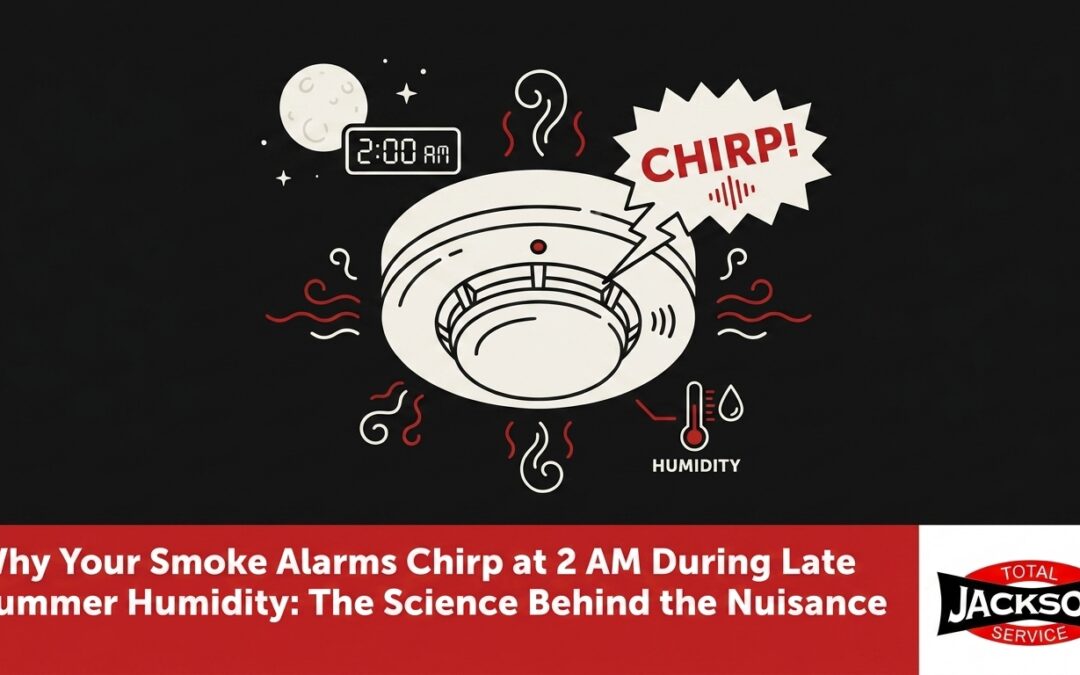
Woken Up by a Beeping Ceiling? Understanding the Midnight Smoke Alarm Mystery
Are you trying to figure out exactly why your smoke alarms chirp at 2 AM during late summer humidity, jolting your entire household awake just when the house finally feels comfortable? You are far from alone in this frustration. At Jackson Total Service, we field countless calls from exhausted homeowners dealing with this exact issue. There are few things more maddening than being pulled out of a deep sleep by a relentless, high-pitched beep echoing down the hallway. When this happens, your immediate instinct is likely to grab a chair, pull the device off the ceiling, and remove the battery just to make the noise stop. However, this common nuisance is actually a complex interaction between your home’s electrical safety devices and the specific environmental conditions inside your house.
When you are staring up at a beeping ceiling fixture in the middle of the night, you face an immediate decision point: is a simple battery swap going to fix the issue permanently, or is the aging detector signaling that it requires a full replacement? Understanding the environmental triggers at play—specifically the intense August late-summer humidity and the resulting nighttime cooling cycles of your air conditioning system—is the key to answering that question. Resolving these persistent electrical quirks safely is absolutely crucial for your ongoing home protection, as a disabled alarm leaves your family vulnerable.
For a comprehensive look at how local environmental factors impact your entire home, explore our complete Southwest Florida home services guide.
The Physics of the 2 AM Temperature and Voltage Drop
To understand why your alarms seem to have a vendetta against your sleep schedule, we have to look at the basic mechanics of battery operation. The batteries inside your smoke detectors do not store electricity like a bucket stores water; rather, they store chemical energy. Chemical reactions inside the battery generate the specific voltage required to keep the smoke alarm’s internal low-battery sensor satisfied. As long as the voltage remains above a certain predetermined threshold, the alarm stays quiet and continues monitoring the air for smoke particles.
However, battery chemistry is highly sensitive to ambient temperature. When nighttime temperatures naturally drop inside your home, the internal chemical reactions inside those batteries begin to slow down. As the chemical reaction slows, the battery’s overall voltage output temporarily dips. If a battery is brand new, this slight dip is completely unnoticeable because the total voltage remains well above the alarm’s minimum requirement. But if a battery is already aging and sitting right on the borderline of acceptable power, this nighttime 2 AM temperature and voltage drop pushes the output just below the threshold. The moment the sensor detects this inadequate voltage, it triggers the low-battery alert.
This explains the specific timing of the chirp. By 2 AM, your home has typically been sealed up and cooled for several hours, reaching its lowest indoor temperature point of the day. The battery gets cold, the voltage drops, and the chirping begins. By mid-morning, when the house warms up again, the battery chemistry speeds back up, the voltage rises, and the chirping mysteriously stops, leaving homeowners deeply confused.
How Battery Chemistry Reacts to Cooler Air
The correlation between ambient room temperature and battery voltage output is a fundamental principle of physics. When you understand this dynamic, the random midnight alarms start to make perfect logical sense.
- The low-battery threshold: Standard residential smoke detectors are engineered to sound a warning chirp when the battery voltage drops to a specific level, ensuring you have ample time to replace it before the unit dies completely.
- Ion mobility: As the air around the battery cools, the ions inside the battery electrolyte move more sluggishly. This increased internal resistance directly lowers the available electrical output.
- The rebound effect: As the sun rises and ambient indoor temperatures increase, ion mobility improves. The voltage creeps back above the low-battery threshold, which is why the detector often stops chirping before you have a chance to buy replacement batteries the next day.
Dealing with these fluctuations can be incredibly frustrating, which is why knowing when to call a professional electrician is essential for diagnosing persistent voltage and sensor issues.

The Interplay Between HVAC Cooling Cycles and Electrical Sensors
While the basic physics of battery chemistry explains the voltage drop, we also have to examine the powerful role of your home’s heating, ventilation, and air conditioning system. Extreme daytime humidity forces air conditioning systems to run aggressively deep into the night just to remove moisture and cool the home down to a comfortable sleeping temperature. When your AC system is working overtime to combat Naples’ extreme August humidity, it creates a unique indoor environment characterized by rapid temperature shifts and concentrated cold air drafts.
Because warm air holds more moisture than cold air, high indoor humidity can occasionally cause micro-condensation to form on the highly sensitive electrical sensors within the smoke detector. These sensors—whether photoelectric or ionization-based—rely on a clear, unobstructed path to detect smoke particles. When microscopic droplets of moisture accumulate on the sensor plates due to rapid temperature swings, the detector’s internal logic can become confused, leading to false alarms or erratic chirping behaviors.
Furthermore, the rapid cooling from an AC vent blowing directly near a ceiling-mounted smoke detector accelerates the temperature drop around that specific unit. The air exiting your supply registers is significantly colder than the ambient room temperature. If a detector is mounted too close to a vent, it is constantly blasted with this chilled air, driving the battery temperature down much faster than the rest of the room. The combination of dense moisture, micro-condensation, and rapid localized cooling creates the perfect storm for sensitive, aging batteries.
Understanding this phenomenon requires looking at the house as an interconnected system. With Jackson Total Service’s 60-year family legacy and multi-trade expertise, our team frequently sees how understanding both HVAC humidity control and electrical alarm wiring provides a complete picture of this common nuisance. We’ve learned firsthand that it is rarely just an electrical issue or just an HVAC issue; it is the interplay of cold air, high moisture, and sensitive voltage thresholds working together to disrupt your sleep.
Hardwired vs. Battery-Only Detectors: Why a Fresh Battery Doesn’t Always Work
One of the most common frustrations our electricians hear from homeowners is dutifully changing the battery in their chirping smoke detector, only to have the exact same unit start beeping again twenty minutes later. To understand why this happens, you must differentiate between standalone battery-operated units and interconnected hardwired smoke alarms with battery backups.
Standalone units operate entirely independently. If the battery dies, only that specific unit chirps. However, modern building codes require interconnected hardwired detectors. These units are physically wired into your home’s 120-volt electrical system and communicate with each other via a dedicated traveler wire. If one unit in the bedroom experiences a backup battery voltage drop, it sends a signal through the traveler wire, causing the entire system throughout the house to chirp simultaneously. This makes finding the actual culprit incredibly difficult, as a fresh battery in the hallway unit won’t stop the chirp if the failing battery is actually in the basement.
Beyond battery issues, the National Fire Protection Association (NFPA 72) outlines a strict guideline: smoke alarms must be completely replaced every 10 years from the date of manufacture. Over a decade of operation, the internal sensors degrade, accumulate microscopic dust, and lose their calibration. Dust accumulation, tiny spiders or insects crawling into the sensing chamber, and general sensor degradation often mimic a low-battery chirp in units older than a decade. No amount of fresh batteries will fix a sensor that has reached the end of its mechanical lifespan.
| Detector Type | Power Source | Chirp Behavior | Troubleshooting Approach |
|---|---|---|---|
| Standalone Battery | 9V or AA batteries only | Only the affected unit chirps | Replace battery; if chirp persists, replace the entire unit. |
| Hardwired Interconnected | 120V house power + backup battery | One low battery can make all units chirp | Identify the initiating unit; replace backup batteries systematically. |
| Sealed 10-Year Lithium | Internal sealed lithium battery | Chirps only at end-of-life (10 years) | Cannot change battery; must replace the entire detector. |
Identifying the Source of the Chirp
When an interconnected system starts sounding off, locating the specific unit initiating the alert requires patience and a methodical approach. Ensuring your devices are up to date is a vital part of modern home electrical safety.
- Look for the flashing light: On most hardwired systems, the unit that initiated the low-battery chirp will have a differently colored or rapidly flashing LED indicator light compared to the other interconnected units.
- Check the manufacturing date: Twist the alarm off its ceiling mounting bracket and look at the back label. The date of manufacture is printed clearly. If the date is more than ten years in the past, the unit is expired and must be replaced entirely.
- Clear the sensing chamber: Use a vacuum attachment or canned air to gently blow out any accumulated dust or debris from the side vents of the detector, as blockages can trigger false alerts.
The Dangers of Ignoring Persistent Electrical Quirks
When a smoke detector refuses to stop chirping despite fresh batteries and cleaning, the temptation to simply disconnect the unit and leave it on the counter is strong. However, discussing the risks of simply disconnecting a chirping hardwired alarm out of frustration is critical—doing so leaves your home and family completely unprotected in the event of a nighttime fire. Moreover, persistent chirping after a battery change in a hardwired system often points to deeper electrical issues rather than a simple sensor fault.
Persistent home issues rarely resolve themselves. For example, just as families were prepping for the back-to-school transition late this summer, one local homeowner experienced a major sewer line blockage affecting their toilets, sinks, and shower. Our dispatcher Lynn scheduled technician Jeremy, who quickly assessed the situation, cleared the blockage, and thoroughly explained the underlying cause to the homeowner. Whether our team is dealing with a severe plumbing backup or a persistent electrical nuisance, bringing in a qualified professional is the only way to ensure the underlying cause is actually fixed. Ignoring the warning signs only leads to more severe property damage or safety hazards down the line.
If a hardwired detector continues to malfunction, it could indicate underlying wiring issues, loose wire nut connections in the ceiling junction box, or localized power surges that have damaged the internal circuitry. We strongly advise against attempting to rewire or replace hardwired 120-volt smoke detector harnesses without proper licensing and training. Working with live household voltage carries a significant risk of severe electrical shock or creating a fire hazard through improper splicing.
Resolving sudden, inconvenient electrical problems safely requires a knowledgeable professional who can respond promptly. A licensed electrician can test the traveler wire for proper voltage, ensure the neutral connections are secure, and verify that your whole house surge protection systems are functioning correctly to prevent future damage to sensitive ceiling devices.
Long-Term Solutions for Aging Home Safety Systems
If your home is outfitted with aging, yellowing smoke detectors that constantly demand new 9-volt batteries, it is time to consider comprehensive electrical upgrades. The most effective long-term solution is upgrading to modern, sealed 10-year lithium battery smoke detectors. These advanced units completely eliminate the 2 AM chirp, as the battery is designed to last for the entire decade-long lifespan of the sensor. Once the ten years are up, the unit will alert you that it is time for a full replacement, bypassing the bi-annual battery changing ritual entirely.
The local climate plays a massive role in the lifespan of your fixtures. Southwest Florida’s high-humidity, salt-air environment can significantly accelerate corrosion on battery contacts and wiring harnesses in older homes. In our decades of serving Naples, FL, our electricians find it incredibly common to pull down a five-year-old smoke detector only to find the internal battery terminals coated in a layer of green copper oxidation or rust. This corrosion creates electrical resistance, which mimics a low battery and triggers the infuriating midnight chirp.
Having a licensed electrician evaluate and replace an entire interconnected hardwired system ensures that all devices are communicating properly and are rated for the current building codes. During this process, the electrician will also verify the integrity of the home’s electrical panel.
Professional Evaluation Checklist for Home Safety Systems:
- Age verification: Checking the date codes on all smoke and carbon monoxide detectors in the home.
- Harness inspection: Examining the 120-volt wiring harnesses for signs of heat damage, loose connections, or salt-air corrosion.
- Interconnectivity testing: Triggering one alarm to ensure the traveler wire successfully activates all other alarms in the sequence.
- Circuit load evaluation: Ensuring the home’s electrical panel and dedicated safety circuits are properly equipped to handle modern devices without nuisance tripping.
Investing in professional electrical upgrades guarantees that your family is protected by reliable, modern technology that won’t disrupt your sleep with false alarms.
Frequently Asked Questions
Why does my smoke detector only chirp at night?
Your smoke detector chirps at night because ambient temperatures drop, causing the internal battery’s chemical reactions to slow down. This slowdown results in a temporary dip in voltage output. If the battery is already weak, this nighttime voltage dip pushes it below the detector’s minimum power threshold, triggering the low-battery alert. Once the house warms up the next day, the voltage often recovers enough to stop the chirping.
Can high humidity cause a smoke alarm to chirp?
Yes, high indoor humidity can absolutely cause a smoke alarm to chirp or trigger a false alarm. Dense moisture in the air can create micro-condensation on the sensitive photoelectric or ionization sensors inside the unit. The detector interprets these microscopic water droplets as smoke particles or a sensor fault, initiating the alarm sequence until the moisture evaporates.
How do I stop my smoke alarm from chirping at 2 AM?
The most immediate fix is to safely remove the device from its mounting bracket and replace the battery with a brand new, high-quality alkaline or lithium unit. However, if the device is hardwired, you must ensure you are changing the battery in the specific unit that initiated the chirp. If a fresh battery does not stop the noise, the unit may be expired or suffering from dust accumulation and requires replacement.
Why is my hardwired smoke alarm chirping after a battery change?
If a hardwired alarm continues to chirp after a fresh battery is installed, the unit has likely reached the end of its 10-year mechanical lifespan. Alternatively, the chirp could be caused by dust in the sensing chamber, a loose wire nut in the ceiling junction box, or residual error codes. You can try holding the reset button for 15 seconds to clear the internal memory, but persistent chirping usually indicates the need for a new detector.
When should I replace my hardwired smoke detector?
According to the National Fire Protection Association (NFPA), all smoke detectors, including hardwired models, must be completely replaced 10 years from their date of manufacture. You can find this date printed on a sticker on the back of the device. Even if the unit appears to be functioning normally, the internal sensors degrade over time and lose their ability to reliably detect smoke particles.
How can I tell if the chirp is a low battery or a failing sensor?
A low-battery chirp is typically a single, consistent beep occurring every 30 to 60 seconds. A failing sensor or end-of-life warning often presents as a double chirp, a different cadence, or is accompanied by a uniquely colored flashing LED light (such as yellow or red). Consulting the manufacturer’s manual for your specific model will help you decode the exact meaning of the chirp pattern.
Rest Easy with Reliable Home Safety
Understanding why your smoke alarms chirp at 2 AM during late summer humidity transforms a frustrating midnight disruption into a clear, solvable physics problem. By recognizing how temperature drops, humidity, and aging sensors interact, you can make informed decisions about your home’s safety devices. Whether you need our team for a simple system reset or a complete upgrade to sealed 10-year interconnected units, relying on the licensed professionals at Jackson Total Service ensures a clear, logical explanation and a safe, permanent resolution. Protect your home and your sleep schedule by addressing persistent electrical quirks the right way.