



Why Electrical Safety Preparation Before Hurricanes Can Save Your Home and Family
Electrical safety preparation before hurricanes is one of the most important — and most overlooked — steps a Southwest Florida homeowner can take before a storm makes landfall. Hurricane season runs from June 1 through November 30, and for residents in Naples, Bonita Springs, Estero, and Marco Island, that threat is very real, very local, and very serious.
Here is a quick overview of the most critical electrical safety steps to take before a hurricane:
- Unplug all non-essential electronics and appliances to protect them from power surges
- Install whole-home surge protection at your main electrical panel
- Test and inspect GFCI outlets — especially outdoors and in bathrooms or kitchens
- Have your electrical panel inspected by a licensed electrician before storm season
- Set up a generator with a proper transfer switch — never connect it directly to your home’s wiring
- Charge all devices and backup power banks before the storm arrives
- Label your circuit breakers clearly so you can shut off power quickly and safely
- Move cords and electronics off the floor in case of flooding
Hurricanes bring a dangerous combination of high winds, storm surge, flooding, and powerful lightning. Each of those forces puts your home’s electrical system under serious stress. According to the Consumer Product Safety Commission, between 1999 and 2009 alone, 542 people died from carbon monoxide poisoning connected to portable generators — most of them inside their own homes. That single statistic shows how quickly electrical and power-related decisions during a storm can turn deadly.
Florida is also the lightning capital of the United States, meaning power surges from nearby strikes are a routine threat — not a rare one. A surge can destroy your HVAC system, refrigerator, television, and smart home devices in a fraction of a second.
The good news: with the right preparation, most of these risks are preventable.
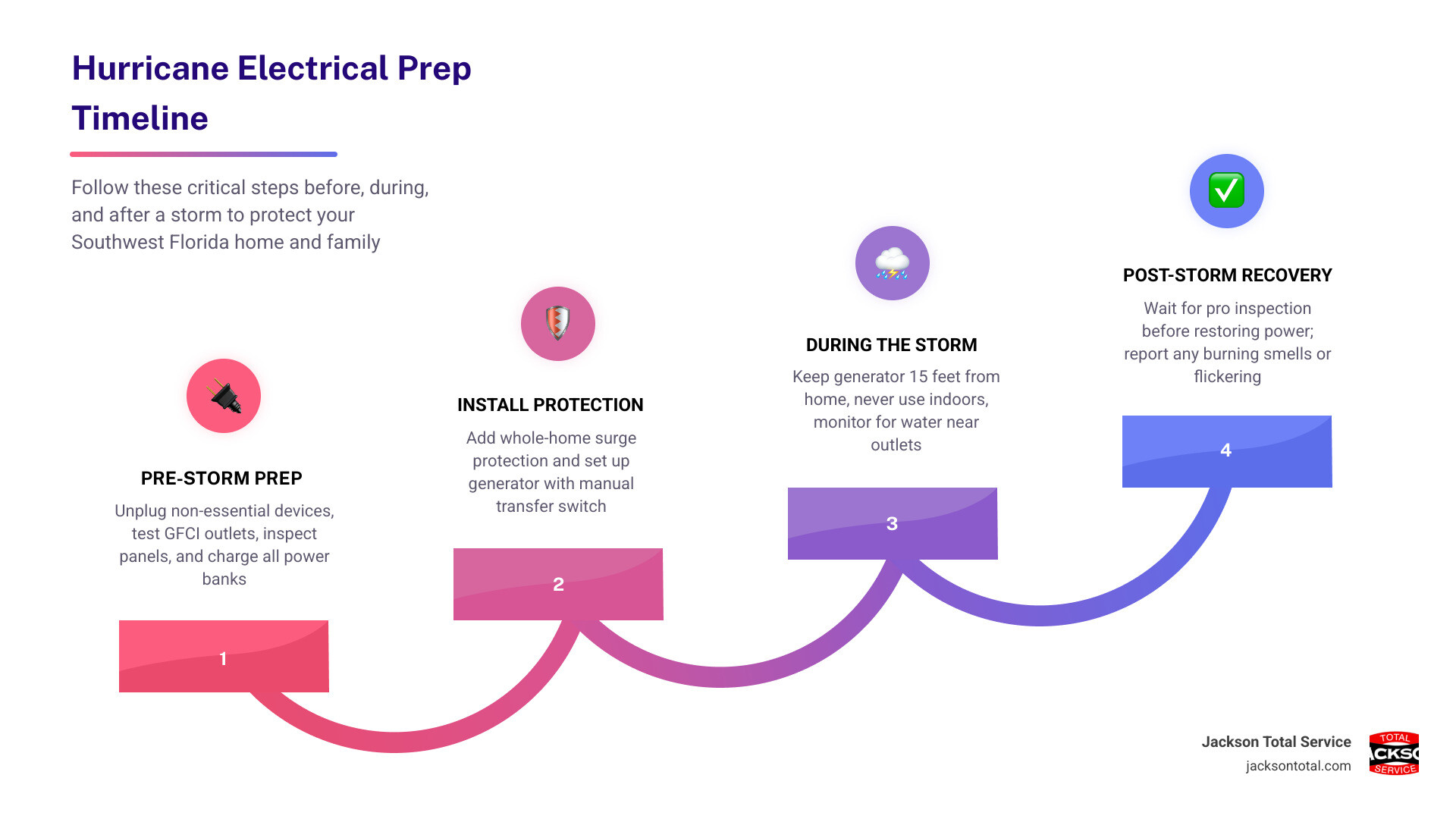
Essential Electrical Safety Preparation Before Hurricanes

When a major storm enters the Gulf of Mexico and sets its sights on Southwest Florida, local store shelves quickly empty of water, batteries, and canned goods. But while stocking your pantry is essential, preparing your home’s electrical infrastructure is what keeps your physical property standing and your family safe.
A comprehensive emergency kit should always include electrical essentials: high-quality flashlights (avoid candles, which pose a major fire risk if there is a gas leak or knocked-over lamp), a battery-operated or hand-crank NOAA weather radio, and plenty of spare batteries.
Before the outer bands of the storm arrive, make sure all your cell phones, tablets, and portable power banks are charged to 100%. These power banks are your lifeline when the grid goes down, allowing you to stay in contact with emergency services and monitor local updates.
Once your devices are charged, it is time to focus on your appliances. Unplugging non-essential electrical equipment is one of the simplest yet most effective ways to prevent major financial loss. When the power grid fluctuates during a storm, or when the utility company attempts to restore power after landfall, massive voltage spikes can travel through your home’s wiring. Any device left plugged into a standard outlet—such as your television, computer, microwave, or washing machine—can instantly fry.
For more tips on securing your entire household infrastructure before a storm, read our guide on How to Batten Down the Hatches for Your Home Systems.
Pre-Storm Checklist for Outlets, Wiring, and Panels
Your electrical safety preparation doesn’t stop at unplugging your living room TV. You need to inspect the areas of your home where water and electricity are most likely to meet.
- Test GFCI Outlets: Ground Fault Circuit Interrupters (GFCIs) are designed to instantly shut off power when they detect an electrical path to ground (such as through water or a person). Walk through your home and test every GFCI outlet in your kitchen, bathrooms, laundry room, garage, and outdoor spaces. Press the “TEST” button; you should hear a click, and the power to the outlet should cut out. Press “RESET” to restore it. If an outlet fails to trip or reset, it must be replaced immediately before a storm hits.
- Secure Outdoor Outlets: Ensure all outdoor receptacles have weatherproof, “in-use” covers. These plastic hoods protect the outlet from driving rain even when a cord is plugged in.
- Protect Your Outdoor HVAC Unit: Your air conditioning condenser sits outside, fully exposed to the elements. Secure the unit with heavy-duty hurricane straps or metal brackets to prevent high winds from ripping it off its pad. If you live in a low-lying, flood-prone zone in Cape Coral or Fort Myers Beach, check if your unit is elevated on a concrete or metal stand. Do not cover your AC unit with plastic tarps; this traps moisture inside, accelerating rust and damaging the sensitive electrical controls.
- Label Your Breaker Box: If you need to shut off power to a flooded room or turn off the main breaker in an emergency, you do not want to be guessing which switch does what in the dark. Use a permanent marker to clearly label every breaker in your panel.
To learn more about the fundamentals of keeping your electrical system grounded and safe, check out these Stay Grounded with These Essential Electrical Safety Tips.
Critical Mistakes to Avoid in Your Electrical Safety Preparation Before Hurricanes
In the rush of storm preparation, homeowners often fall victim to dangerous myths and shortcuts. Avoiding these common mistakes can save your property from catastrophic damage:
- The Window Taping Myth: Taping X-shapes across your windows does absolutely nothing to prevent them from shattering. In fact, it does something worse: it holds large, heavy shards of glass together, creating massive, wind-blown projectiles that can easily slice through electrical wiring or cause severe bodily injury. Skip the tape and use properly anchored 5/8-inch exterior-grade plywood or hurricane shutters instead.
- DIY Electrical Wiring: Never attempt to modify your electrical panel, install a generator inlet box, or bypass safety controls yourself. DIY electrical work is dangerous under normal circumstances; during a hurricane, a loose neutral wire or an ungrounded circuit can lead to electrocution or an electrical fire when water enters the home.
- Ignoring Warning Signs: If your lights routinely flicker, your panel hums, or certain outlets feel warm to the touch, do not wait for a hurricane to test their limits. These are signs of loose connections or overloaded circuits that are highly likely to fail or spark a fire under the stress of a storm.
For more details on avoiding dangerous residential electrical hazards, review our guide on how to Don’t Get Zapped with These Home Safety Tips.
Hardening Your Home with Surge Protection and Panel Upgrades
When a hurricane damages the power grid, the resulting electrical surges can be incredibly destructive. Many homeowners believe that standard, store-bought power strips are enough to protect their valuable electronics. Unfortunately, these point-of-use strips are only designed to handle minor voltage fluctuations—not the massive surges caused by lightning strikes or utility grid switching.
| Feature | Whole-Home Surge Protectors | Point-of-Use Power Strips |
|---|---|---|
| Installation Point | Main electrical panel | Individual wall outlets |
| Protection Coverage | Every outlet, appliance, and hardwired system (HVAC, pumps) | Only devices plugged directly into the strip |
| Surge Capacity | Up to 40,000–60,000+ amps | Very limited (measured in Joules, easily overwhelmed) |
| Lifespan | Multi-year protection; often comes with manufacturer warranties | Can degrade after a single minor surge without warning |
| Protects Major Appliances? | Yes (AC, refrigerator, washer/dryer, stove) | No |
If you want to understand how these systems work to protect your home’s entire electrical network, you can read The Inner Workings of Whole House Surge Protection Explained.
Beyond surge protection, the age and condition of your electrical panel play a massive role in your storm resilience. If your home was built several decades ago and still utilizes old Federal Pacific Stab-Lok or Zinsco panels, you are facing a significant safety hazard. These outdated panels have documented design flaws that prevent breakers from tripping during an overload or short circuit, often leading to electrical fires. In fact, many Florida home insurance companies now completely refuse to write or renew policies for homes containing these panels. Upgrading to a modern, code-compliant circuit breaker panel is a necessary step to protect your home before hurricane season begins.
Why Surge Protection is Vital for Electrical Safety Preparation Before Hurricanes
Southwest Florida is famously located in the lightning capital of the United States. During a hurricane or severe tropical storm, lightning strikes are incredibly frequent. If lightning strikes a nearby power line, transformer, or even the ground near your home, millions of volts of electricity can enter your electrical system.
Furthermore, the process of restoring power after a hurricane is incredibly hard on household electronics. As utility crews work to repair downed lines in Naples, Fort Myers, or Sanibel Island, they must cycle power on and off to different sections of the grid. These grid fluctuations cause rapid, repetitive voltage spikes.
Without whole-home surge protection, these spikes will travel directly into your home, degrading the sensitive microprocessors inside your HVAC compressor, refrigerator, smart thermostat, and security systems. Installing a whole-home surge protector rated for 40,000 to 60,000 amps at your main panel acts as a heavy-duty shield, safely redirecting excess voltage into the earth before it can ever reach your appliances.
Safe Generator Operation During and After a Storm
When the power goes out, generators become the most valuable asset in your hurricane survival plan. However, they are also one of the most dangerous if operated incorrectly. Whether you are using a portable gasoline-powered unit or a permanently installed standby generator, safety must always come first.
To explore your backup power options in more detail, you can read our comprehensive guide on Generators.
Preventing Carbon Monoxide Poisoning and Backfeeding
The most pressing danger associated with portable generators is carbon monoxide (CO) poisoning. Carbon monoxide is an odorless, colorless, and tasteless gas that can build up to lethal levels in minutes.
- The 15-Foot Rule: Never, under any circumstances, run a portable generator inside your home, garage, carport, porch, or near an open window or door. Even with the garage door wide open, deadly CO fumes can become trapped and seep into your living spaces. Always place the generator outdoors on a flat, dry surface at least 15 to 20 feet away from your home, with the engine exhaust pointed away from all structures.
- Install CO Detectors: Before the storm, test your indoor carbon monoxide detectors and replace their backup batteries.
- Never “Backfeed” Your Home: One of the most dangerous mistakes a homeowner can make is attempting to power their home by plugging a portable generator directly into a standard wall outlet (often called “backfeeding”). This dangerous practice sends electricity backward through your home’s wiring and out into the neighborhood power lines. This can easily electrocute utility workers trying to repair the lines, destroy your generator, and spark a devastating house fire.
- Use a Transfer Switch: To safely connect a generator to your home’s electrical panel, you must have a licensed electrician install a manual or automatic transfer switch. This device completely isolates your home’s electrical system from the main power grid, allowing you to safely run critical appliances (like your refrigerator or AC) without risking backfeeding.
Post-Storm Electrical Inspection and Recovery
Once the winds calm and the storm passes, the temptation to immediately return to normal life is strong. However, post-storm recovery is actually when many electrical injuries and fires occur.
As you step outside to assess the damage to your Naples or Fort Myers home, keep your eyes on the ground. High winds can easily knock down overhead power lines. Always assume that any downed utility wire is fully energized and deadly. Stay at least 35 feet away from downed lines and report them immediately to your local utility company or emergency services.
Standing water can easily conduct electricity. If a downed power line is touching a puddle, a flooded street, or a wet yard, the entire area of water can become energized. Never wade through standing water after a storm. If you find yourself near a downed line, do not run or take large strides, as the voltage difference in the ground can pass through your body. Instead, keep your feet close together and flat on the ground, and shuffle away slowly.
If your home experienced flooding or storm surge that reached your electrical outlets, switches, or lower-level panel, do not attempt to turn your power back on. Water damages the internal insulation of electrical components, and salt water from coastal storm surges is highly corrosive. Attempting to energize a water-damaged electrical system can lead to immediate short circuits, electric shocks, or electrical fires.
When to Call a Licensed Electrician
While some storm cleanup tasks are perfectly safe for homeowners, assessing and repairing your home’s electrical system is not one of them. You should contact a licensed electrician immediately if you notice any of the following warning signs:
- Water Intrusion: If water has dripped into your electrical panel, or if floodwaters reached your wall outlets.
- Burning Smells or Sparks: Any unusual odor, popping sounds, or visible sparks coming from outlets, appliances, or your breaker box.
- Flickering Lights: This often indicates a damaged service line or a loose neutral wire from the utility pole to your weatherhead.
- Tripped Breakers That Won’t Reset: If a breaker instantly trips after you attempt to reset it, there is an active short circuit or ground fault in the line.
- Damaged Weatherhead: The weatherhead is the metal pole on your roof where utility lines enter your home. If a falling tree branch bent this pole or pulled the wires loose, a licensed professional must repair it before the utility company can safely restore your power.
Southwest Florida’s coastal environment presents unique challenges. Salt air and high humidity accelerate rust and corrosion on electrical contacts, making professional inspections even more critical after a major storm.
Frequently Asked Questions About Hurricane Electrical Safety
Can I run a portable generator in my garage if the door is open?
No. You must never run a portable generator inside a garage, even if the garage door is completely open. Carbon monoxide is heavier than air and can easily pool inside the garage space and seep into your home’s attic, ventilation system, or adjacent living rooms. Always operate your generator outdoors, on a dry surface, at least 15 to 20 feet away from windows, doors, and vents.
What should I do if floodwaters reach my electrical outlets?
If floodwaters rise high enough to reach your electrical outlets, do not touch your electrical panel or attempt to turn off individual breakers if you are standing in water or if the panel itself is wet. If you can safely reach your main breaker while standing on a completely dry surface, turn off the main power switch to the entire house. Otherwise, leave the home immediately and contact a licensed electrician to safely disconnect the power and inspect the system before anyone re-enters.
Is it safe to touch appliances that got wet but are now dry?
No. Even if an appliance or outlet looks completely dry on the outside, moisture, mud, and salt residue can remain trapped inside the internal electrical components. When you plug in or turn on a water-damaged appliance, this hidden moisture can cause a short circuit, destroy the device, or deliver a severe electrical shock. Any electrical equipment that has been submerged or heavily splashed must be thoroughly inspected and cleared by a professional before use.
Conclusion
Preparing your home’s electrical system before a hurricane is not just about protecting your expensive electronics—it is about keeping your family safe from fires, shocks, and carbon monoxide poisoning. By taking proactive steps like installing whole-home surge protection, setting up a safe generator connection, and scheduling a pre-season electrical panel inspection, you can face storm season with complete peace of mind.
Since 1964, Jackson Total Service has been providing trusted, comprehensive HVAC, plumbing, and electrical services to homeowners throughout Southwest Florida. We are proud to serve our neighbors in Naples, Bonita Springs, Estero, Marco Island, Fort Myers, Cape Coral, and the surrounding communities. With our team of highly skilled, licensed technicians, we offer all your home comfort and safety solutions in one place—eliminating the hassle of managing multiple contractors.
Don’t wait for a storm tracking map to appear on your television. Schedule professional storm prep with Jackson Total Service today, and ensure your home is fully prepared for whatever nature throws our way.