



Why Tropical Weather Is One of the Toughest Tests for Outdoor LED Lighting
How LED lights perform in tropical weather is one of the most important questions any Southwest Florida homeowner should ask before investing in outdoor lighting. The short answer: LEDs are genuinely tough — but tropical conditions expose weaknesses in standard fixtures that simply don’t show up in milder climates.
Here’s a quick summary of what you need to know:
- LED diodes themselves are highly durable, but drivers, seals, and housings are vulnerable to tropical heat and humidity
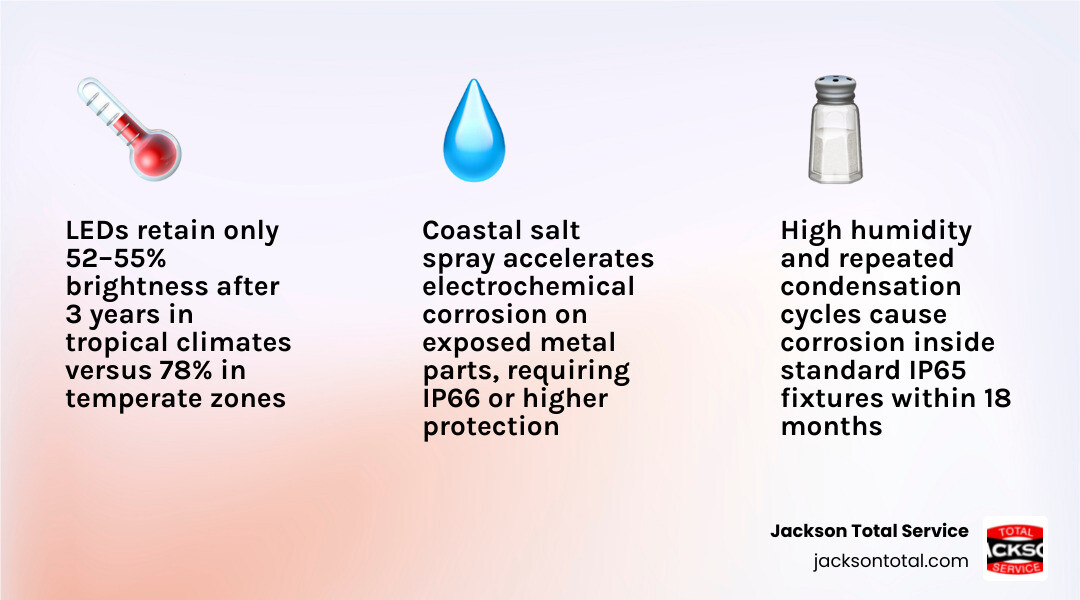
- High humidity accelerates corrosion and causes repeated condensation cycles inside fixtures
- Extreme heat reduces brightness faster — LEDs in tropical regions retain only 52–55% of original brightness after 3 years, compared to 78% in temperate climates
- Standard IP65 fixtures are often not enough — IP66 or higher is recommended for Southwest Florida’s outdoor conditions
- Coastal salt air adds an extra layer of risk, speeding up corrosion on exposed metal components
- Proper fixture design and regular maintenance are what separate a lighting system that lasts from one that fails within a year
Southwest Florida — including Naples, Bonita Springs, Marco Island, and the Lee and Collier County coast — sits squarely in one of the most demanding lighting environments in North America. Year-round heat above 30°C, humidity that regularly tops 80–90%, intense UV radiation, and salt-laden coastal air combine to stress every component of an outdoor lighting system in ways that standard, temperate-climate products simply aren’t built to handle.
Engineers who inspect lighting systems in comparable tropical environments have found that even fixtures rated IP65 can show significant lumen depreciation after just 18 months of tropical exposure. The failures aren’t random — they follow predictable patterns driven by heat, moisture, and chemistry. Understanding those patterns is the first step to choosing lighting that actually holds up.
How led lights perform in tropical weather vocabulary:
- choosing the right landscape lighting technology
- is led landscape lighting worth the extra cost
- led vs traditional landscape lighting comparison
How LED Lights Perform in Tropical Weather: The Thermal-Humidity Challenge

To understand how outdoor lighting survives in Southwest Florida, we have to look closely at the physics of semiconductors. LEDs (Light Emitting Diodes) are electronic components. Unlike traditional incandescent bulbs that waste 90% of their energy as heat, LEDs are highly efficient, converting nearly all electrical energy into light. However, they are still highly sensitive to their operating environment.
While LEDs naturally thrive in freezing temperatures, high ambient heat degrades their efficiency. An LED’s optimal operating temperature is around 25°C (77°F). In places like Naples, Fort Myers, and Cape Coral, summer temperatures regularly climb far past this mark, with metal housings exposed to direct sunlight easily exceeding 60°C (140°F).
When ambient temperatures soar, it triggers a chain reaction of thermal degradation. This process is governed by the “10°C rule” of electronics: for every 10°C rise in long-term operating temperature, the service life of sensitive internal components—specifically the electrolytic capacitors inside the LED driver—is cut in half. High temperatures also increase the junction temperature of the LED chip itself, leading to permanent lumen depreciation (the gradual loss of brightness) and shifting the light’s color temperature, sometimes turning a warm, inviting white into a harsh blue or purple hue.
When you combine high heat with humidity levels that routinely exceed 80%, the heat dissipation efficiency of standard fixtures drops by 18% to 25%. The thick, moisture-laden air acts like an insulating blanket, trapping heat inside the fixture and cooking the delicate electronics within. This is why understanding how to choose the right landscape lighting technology is so critical for Florida homeowners.
Understanding How LED Lights Perform in Tropical Weather Over Time
The long-term performance gap between temperate and tropical climates is stark. In a mild, dry climate, a quality LED fixture is incredibly stable, maintaining roughly 78% of its original brightness after three years of continuous use.
However, in tropical high-temperature regions, that same LED product typically retains only 52% to 55% of its brightness over the same three-year span. This rapid decline isn’t necessarily a sign of a defective product; rather, it is a symptom of environmental mismatch. Standard retail-grade LEDs are tested in pristine, 25°C laboratory conditions. They are simply not engineered to withstand the relentless thermal-electrical stress of a Southwest Florida summer.
When deciding if a high-quality system is right for your home, many ask, is led landscape lighting worth the extra cost? The answer lies in durability. While cheaper, standard LEDs degrade and dim within months, fixtures built with heavy-duty heat sinks and premium drivers maintain their light output and color integrity for years, saving you from frequent replacements.
Key Factors in How LED Lights Perform in Tropical Weather and Coastal Areas
For coastal communities like Marco Island, Sanibel Island, and Fort Myers Beach, salt spray adds another destructive element to the mix. Airborne salt particles can travel up to 50 kilometers inland, carrying highly corrosive chloride ions.
When salt-laden moisture settles on an aluminum LED housing, it initiates electrochemical corrosion. In tropical marine environments, the corrosion rate of unprotected aluminum is roughly 0.78 μm per year—nearly eight times faster than in dry, inland environments. As the metal corrodes, the fixture’s heat sinks degrade, losing their ability to pull heat away from the LED chip. If you live near the water, working with Fort Myers Beach lighting experts is essential to ensure your home’s outdoor lighting is built with marine-grade materials that can resist this relentless coastal wear.
Primary Failure Mechanisms of LEDs in Hot and Humid Climates
When outdoor LEDs fail in tropical climates, it is rarely due to a single catastrophic event. Instead, it is usually the result of slow, compounding environmental stresses.
The primary driver of these failures is the diurnal temperature cycle. Every day in Southwest Florida, the sun heats outdoor fixtures to extreme temperatures. When night falls and the lights turn on, they generate internal heat. When they turn off, the air inside the fixture cools and contracts, creating a vacuum that pulls in humid outside air.
This cycle occurs roughly 2.3 times daily in tropical climates, leading to a host of internal issues:
- Condensation and Lens Haze: As warm, humid air is drawn into the fixture and hits the cooler lens, it condenses into liquid water. This repeated cycle causes a 1.8% monthly increase in lens haze, scattering light and reducing visible brightness.
- Solder Joint Fatigue: The rapid heating and cooling cycles cause different materials inside the LED to expand and contract at different rates. This thermal expansion mismatch reduces the fatigue life of solder joints by up to 55%, leading to loose connections and flickering lights.
- Electrolytic Corrosion: When moisture mixes with ionic contaminants (like salt) on the circuit board, electrical currents trigger rapid electrochemical corrosion, dissolving copper traces and causing short circuits.
- Mold and Fungal Growth: Spores thrive in warm, dark, damp environments. Mold growing inside a fixture can block light output, degrade plastic lenses, and destroy internal seals.
| Failure Mode | Percentage of Tropical Failures | Primary Environmental Driver | Long-Term Impact on Fixture |
|---|---|---|---|
| Condensation Damage | 45% | Diurnal temperature cycles & high humidity | Internal water pooling, lens fogging, short circuits |
| Electrolytic Corrosion | 25% | Moisture penetration & coastal salt air | Dissolved copper traces, component connection failure |
| Mold & Fungal Growth | 15% | Warm, stagnant dampness inside housing | Lens clouding, seal degradation, light blockage |
| Seal Degradation | 8% | Intense UV exposure & ozone | Gasket cracking, loss of ingress protection |
| Power Supply Failure | 5% | Heat-induced capacitor wear & voltage surges | Complete loss of power, flickering |
| Delamination | 2% | Thermal-humidity stress on epoxy resins | Separation of LED layers, moisture ingress |
Moisture Penetration vs. Liquid Water Resistance
One of the biggest misconceptions in outdoor lighting is that a waterproof fixture is automatically humidity-proof. It isn’t.
Water vapor molecules are roughly 1,000 times smaller than liquid water droplets. While a standard IP65-rated fixture is perfectly capable of blocking a heavy downpour, its seals are often powerless against microscopic water vapor. Over weeks and months, high-pressure humidity seeps past silicone gaskets, slowly condensing into liquid water once inside.
This is why standard IP65 outdoor fixtures often fail within 6 to 12 months in tropical climates. To survive, fixtures require advanced ingress protection. In tropical environments, the service life of an IP54-rated fixture is cut down to 35–50% of its nominal value. Upgrading to IP66 increases service life retention to 75–85%, while IP68-rated fixtures retain 90–95% of their expected lifespan because they are engineered to block microscopic vapor penetration.
Component Vulnerability: Is It the Diode or the Driver?
Surprisingly, the LED diodes themselves are incredibly water-resistant. Made of semiconductor materials encapsulated in tough epoxy or silicone resins, a raw LED diode can theoretically operate underwater indefinitely.
Instead, the real weak link in any LED system is the driver (the power supply) and the surrounding housing components.
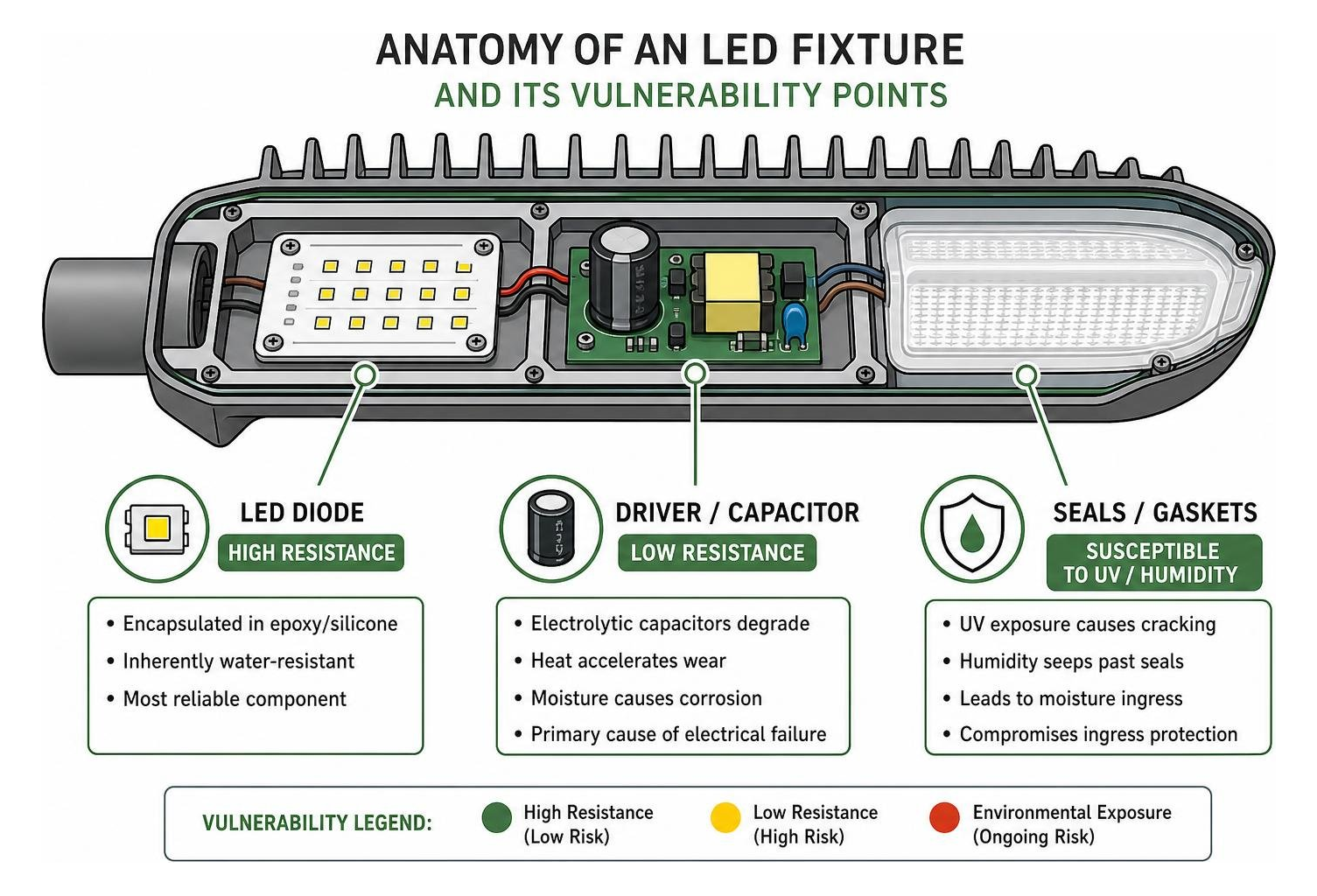
The driver contains electrolytic capacitors that regulate the electrical current. Standard capacitors are rated for 85°C, which is easily exceeded inside a sealed metal housing baking in the Florida sun. Additionally, standard printed circuit boards (PCBs) use resin substrates that soften and expand under extreme heat, causing the LED chips to desolder and break their connections.
Engineering Solutions: Designing LEDs for Tropical Resilience
To combat the harsh realities of Southwest Florida’s climate, lighting manufacturers have developed specialized engineering designs. When you are looking to upgrade, understanding these features will help you invest in a system that lasts for decades rather than months.
Advanced Encapsulation and Moisture Barriers
One of the most significant breakthroughs in tropical LED design is GOB (Glue on Board) technology. Traditional LEDs use SMD (Surface Mounted Device) chips, which leave the electrical contacts exposed to the air. GOB technology applies a highly transparent, protective epoxy or silicone potting compound over the entire circuit board surface. This completely seals the LEDs, solder joints, and electrical paths from moisture, dust, and salt air.
While a standard SMD fixture might last only a year or two in humid conditions, a GOB-protected fixture can easily operate for five years or more without any moisture-related issues. Another robust option is COB (Chip on Board) technology, which mounts the LED chips directly to a substrate, reducing the number of vulnerable solder joints. If you are exploring options, reading up on why your garden is begging for an LED upgrade can help you visualize how these advanced designs protect your outdoor spaces.
Thermal Management and Voltage Regulation
Effective heat dissipation is the secret to long-lasting LEDs. Premium tropical fixtures use pure, die-cast aluminum heat sinks with deep, engineered cooling fins that maximize surface area, allowing heat to escape even in thick, humid air.
Additionally, these fixtures utilize ceramic substrates instead of cheap resin, which prevents the LED chips from shifting or desoldering under thermal stress. To protect against the unstable voltage common during Southwest Florida’s frequent tropical storms, high-quality fixtures are equipped with wide-voltage drivers (typically rated AC85~265V). These drivers can easily absorb voltage fluctuations that would instantly burn out a standard, narrow-voltage model.
Best Practices for Installing and Maintaining Tropical Outdoor Lighting
Even the best-engineered LED fixture will fail prematurely if it is installed incorrectly or left neglected. Proper installation and routine upkeep are essential to get the most out of your lighting investment.
When installing outdoor lighting in wet, tropical areas, professional techniques make all the difference:
- Forward Tilt and Drainage: Mounting fixtures with a slight 5-to-10-degree forward tilt prevents water from pooling on the lens or around the seals, letting gravity do the work.
- Adequate Ventilation: Avoid crowding fixtures into tight, unventilated spaces or burying them deep in thick ground cover, which traps heat.
- Avoid Low Spots: Never place standard fixtures in low-lying garden beds prone to standing water during heavy summer rainstorms.
- Use Marine-Grade Hardware: Always opt for 316 stainless steel or solid brass hardware to prevent rust from seizing your fixtures.
Because professional installation is so critical to protecting your equipment, it is wise to learn how professional lighting installation protects your investment and read up on how to choose the best landscape lighting installation in Fort Myers FL to ensure your project is completed to the highest standards.
Once installed, a simple maintenance routine will keep your system running beautifully:
- Clean the Lenses Quarterly: Wipe down fixture lenses with a soft cloth and mild soap to remove mold, mineral deposits, and salt film.
- Inspect the Seals: Every six months, check the rubber and silicone gaskets for signs of cracking or drying out.
- Clear Surrounding Foliage: Keep plants trimmed back at least six inches from fixtures to ensure proper airflow and prevent moisture buildup.
- Tighten Connections: Check wiring connections annually to ensure tropical storms and yard maintenance haven’t loosened the waterproof cable glands.
Frequently Asked Questions About Tropical LED Performance
Is an IP65 rating sufficient for tropical outdoor lighting?
Generally, no. While an IP65 rating means a fixture is protected against dust and direct water jets (like a sprinkler or heavy rain), it does not protect against long-term exposure to high-pressure water vapor. Over time, tropical humidity will penetrate IP65 seals, leading to internal condensation and eventual failure. For Southwest Florida, we highly recommend upgrading to IP66, IP67, or IP68 ratings for any exposed outdoor fixtures.
Why do LED lights dim faster in hot climates like Florida?
LEDs dim over time through a process called lumen depreciation. In hot climates, the high ambient temperature prevents the fixture from dissipating heat efficiently. This raises the junction temperature of the LED chip, accelerating the degradation of the light-producing phosphor material. This thermal stress causes the light to dim significantly faster than it would in a cooler, temperate climate.
How does salt air affect outdoor LED fixtures?
Salt air contains highly corrosive chloride ions that settle on metal fixtures. This triggers electrochemical corrosion, which rapidly eats away at standard aluminum housings, destroys protective powder coatings, and ruins heat sinks. To prevent this, coastal installations should always use fixtures made of solid brass, copper, or marine-grade 316 stainless steel.
Conclusion
Investing in outdoor lighting can completely transform your home, but Southwest Florida’s intense heat, heavy humidity, and coastal salt air require a system built for the challenge. By choosing high-quality fixtures with advanced thermal management, high IP ratings, and robust moisture barriers, you can ensure your property stays brilliantly illuminated for years to come.
At Jackson Total Service, we have been providing trusted home comfort solutions across Naples, Fort Myers, Cape Coral, Bonita Springs, and Estero since 1964. Our experienced electrical team can help you design, install, and maintain a beautiful, highly resilient outdoor lighting system tailored to our unique coastal climate, proving that you can easily light up your life and your property value.
Ready to upgrade your home’s outdoor spaces with lighting built to survive the Florida elements? Explore our professional landscape lighting services or contact us today to schedule a consultation with our local experts!