



Why Choosing the Right Water Treatment System in Florida Matters
Figuring out which water treatment system is right for Florida homes can feel overwhelming — and for good reason. Florida water is genuinely complicated. One neighborhood has city water that smells like a swimming pool. Another has well water with a rotten-egg odor. A third has hard water leaving white scale on every faucet and fixture. There is no single right answer for every home, which is exactly why so many homeowners end up confused or oversold.
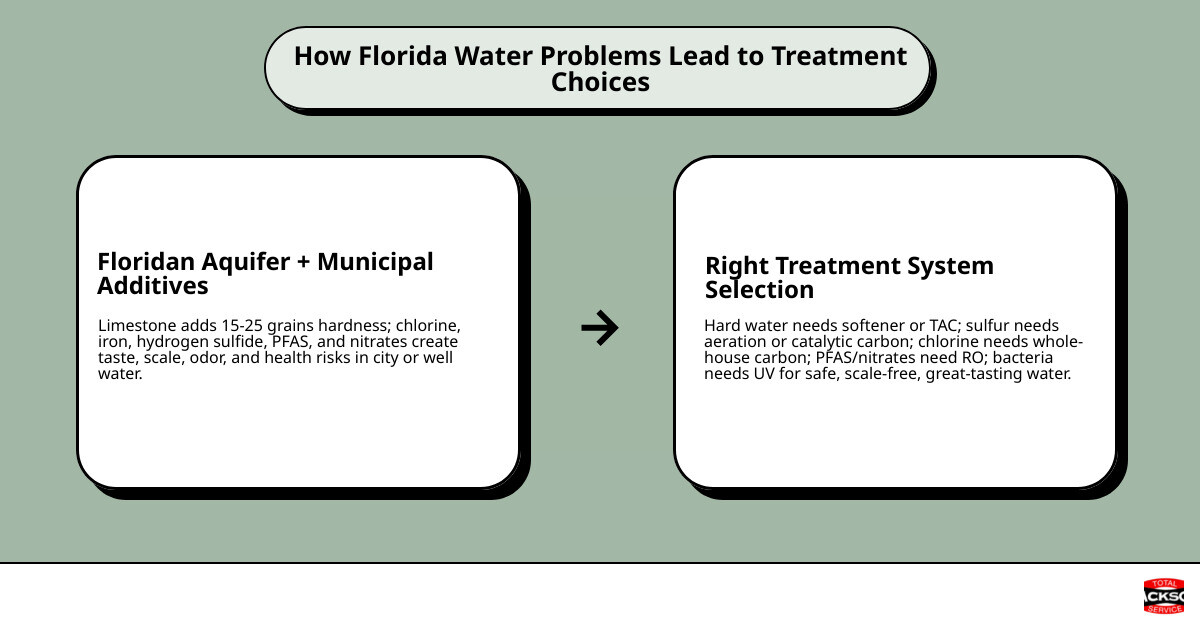
Here is a quick-reference guide to match your situation to the right starting point:
| Your Main Problem | Water Source | Best Starting Point |
|---|---|---|
| Hard water, white scale, spots | City or well | Water softener or salt-free TAC conditioner |
| Chlorine taste or pool smell | City water | Whole-house carbon filter |
| Rotten egg / sulfur smell | Well water | Aeration system or catalytic carbon filter |
| PFAS or nitrate concerns | City or well | Under-sink reverse osmosis (RO) |
| Bacteria or microorganism risk | Well water | UV disinfection system |
| Multiple issues combined | Well water | Multi-stage system (sediment + carbon + softener + UV) |
| Drinking water taste only | City water | Under-sink RO or quality carbon filter |
Southwest Florida sits on top of the Floridan Aquifer — a massive limestone formation that naturally loads groundwater with calcium and magnesium. Hardness levels across most of Florida run 15 to 25 grains per gallon, which is roughly three to five times the national average. Add in the chlorine or chloramines that municipal suppliers use for disinfection, plus iron, tannins, hydrogen sulfide, and emerging PFAS contamination near certain industrial and military sites, and you have a water quality picture that is more complex than most states.
About 80% of Florida residents get water from public systems regulated under the federal Safe Drinking Water Act. The remaining 20% rely on private wells that have no mandatory testing requirements — meaning the homeowner is fully responsible for knowing what is in their water. Whether you are on city water in Naples or on a private well in Collier County, the right treatment system depends on what is actually in your water, not just what the neighbor installed.
This guide walks through every major Florida water problem, the systems that solve them, and how to match the right technology to your home without overbuilding or overspending.
Common Florida Water Quality Challenges
To choose the right treatment system, you first have to understand the unique geological and environmental factors that shape our water supply in Southwest Florida. Our water is safe to drink when it leaves municipal plants, but the journey to your tap—or directly from the ground—introduces a variety of aesthetic and health-related challenges.
For a comprehensive look at how these mineral-heavy profiles interact with your household infrastructure, refer to our Detailed Guide to How Hard Water Affects Your Plumbing and Appliances.
Hard Water and Limestone Scale
If you have ever noticed white, chalky spots on your freshly washed glassware or a crusty buildup around your showerhead, you are dealing with Florida’s signature water issue: hard water.
Because our groundwater travels through thick layers of limestone, it dissolves high amounts of calcium and magnesium carbonate. Water hardness is measured in grains per gallon (GPG). While the national average sits around 7 to 10 GPG, municipal and well water in cities like Fort Myers and Cape Coral frequently registers between 15 and 25 GPG.
This extremely hard water is highly destructive over time. It creates rock-hard scale inside your pipes, water heater, dishwasher, and washing machine. This scale acts as an insulating barrier, forcing your water heater to work much harder and shortening the lifespan of your expensive appliances. If you want to protect your home’s equity, it is critical to learn how to Stop the Scale Before Your Appliances Fail.
Sulfur Smell and Rotten Egg Odor
One of the most common complaints from homeowners utilizing private wells in Lee and Collier counties is a strong, offensive rotten-egg smell. This odor is caused by hydrogen sulfide gas, which is produced by naturally occurring sulfur bacteria in the deep groundwater of the Floridan Aquifer.
This gas is highly volatile. You will often find that the smell is significantly worse when you run hot water because your water heater’s anode rod can react with the sulfates to produce even more gas. Beyond the unpleasant odor, hydrogen sulfide is highly corrosive to copper plumbing, brass fixtures, and silver. For those tired of dealing with this issue, you can learn how to Stop Drinking the Swamp with Better Water Quality and Taste.
Chlorine, PFAS, and Municipal Additives
If you live in municipal areas like Naples, Bonita Springs, or Estero, your water does not typically smell like sulfur, but it might smell like a public swimming pool. Municipal water treatment plants must disinfect water to prevent bacterial outbreaks, and they do this by adding chlorine or chloramines (a mixture of chlorine and ammonia). While necessary for public health, these chemicals strip the natural oils from your skin and hair in the shower, degrade rubber plumbing seals, and make drinking water taste terrible.
Furthermore, Florida has dozens of confirmed PFAS (per- and polyfluoroalkyl substances) contamination sites, typically concentrated near industrial zones and military bases. These “forever chemicals” do not break down naturally and have been linked to long-term health concerns. The EPA’s enforceable limit for certain PFAS compounds is incredibly low—just 4 parts per trillion—making advanced home filtration a high priority for health-conscious families.
Determining Which Water Treatment System Is Right for Florida Homes
Before you buy any filtration equipment, you need to know exactly what is in your water. Investing in a heavy-duty system to treat a problem you do not have is a waste of resources, while ignoring hidden contaminants like lead or PFAS can put your family’s health at risk.
City Water vs. Private Well Water Solutions
If your home is connected to a public utility, your water has already been treated to meet federal safety standards. Your primary goals will be aesthetic improvement (removing chlorine taste and odor), scale prevention (softening hard limestone water), and creating a safety barrier against disinfection byproducts and trace contaminants.
For city water, a combination of a whole-house carbon filter and a water softener is usually the ideal setup.
If you rely on a private well, you are the utility operator. Your water comes straight from the ground, meaning it is highly susceptible to seasonal fluctuations, high sediment loads, iron, tannins (which turn the water a tea-like brown), sulfur gas, and bacterial contamination. Well systems require a tailored, multi-stage approach that often includes a sediment pre-filter, iron/sulfur oxidation systems, a water softener, and a UV sterilizer to guarantee biological safety.
Matching Filtration Technology to Your Specific Water Issues
To help you visualize how different technologies address specific Florida water issues, we have compiled a breakdown of the most common filtration methods:
| Technology | What It Removes | What It Leaves Behind | Best Used For |
|---|---|---|---|
| Activated Carbon | Chlorine, chloramines, VOCs, bad tastes, odors | Hardness minerals, heavy metals, nitrates, bacteria | City water taste and odor improvement |
| Reverse Osmosis (RO) | PFAS, lead, copper, arsenic, nitrates, dissolved solids | Mostly nothing (strips healthy minerals, which can be remineralized) | Pure drinking water at the kitchen tap |
| Water Softener (Ion Exchange) | Calcium, magnesium (hardness), low levels of clear-water iron | Chlorine, chemicals, sulfur odor, bacteria | Whole-house plumbing and appliance protection |
| Aeration / Air Injection | Hydrogen sulfide (sulfur gas), dissolved iron | Hardness minerals, chlorine, bacteria | Well water sulfur and iron removal |
| UV Purification | Bacteria, viruses, protozoa, mold | Chemicals, heavy metals, hardness minerals, odors | Biological safety on private wells |
If you are trying to navigate these choices, our Ultimate Guide to Choosing the Right Water Treatment for Hard Water provides an in-depth breakdown of how to build the perfect defense system for your home.
Comparing Whole-House POE vs. Under-Sink POU Systems
One of the most important decisions you will make is choosing between a Point-of-Entry (POE) system and a Point-of-Use (POU) system.
- Point-of-Entry (POE) Systems: These are whole-house systems installed where the main water line enters your home. Every drop of water that enters your house—whether it goes to your kitchen sink, your shower, your washing machine, or your outdoor hose bibb—passes through this system.
- Point-of-Use (POU) Systems: These are localized filters installed at a specific tap, most commonly under the kitchen sink or connected to your refrigerator’s ice maker.
If your primary concern is the damage hard water causes to your plumbing, water heater, and appliances, or if you hate the chlorine smell in the shower, a whole-house POE system is necessary. However, if your main concern is simply having pure, bottled-quality water for drinking and cooking, a kitchen-specific POU system is a highly efficient and practical choice.
Deciding Which Water Treatment System Is Right for Florida Drinking Water
When it comes to drinking water safety and taste, reverse osmosis (RO) is the gold standard. An RO system forces water through a semipermeable membrane with incredibly tiny pores, effectively removing 94% to 99% of all dissolved solids, heavy metals, nitrates, and PFAS compounds.
For an active family of four, relying on small pitcher filters or faucet-mounted attachments can quickly become frustrating. A family that drinks water, makes coffee, fills water bottles, cooks pasta, and hydrates pets throughout the day can easily burn through small filters in a matter of weeks.
Furthermore, the average family of four can spend a significant amount of money each year on bottled water. Investing in an under-sink RO system completely eliminates this expense, providing unlimited, high-purity water directly from a dedicated kitchen tap.
Salt-Based Softeners vs. Salt-Free Scale Control
Because hard water is so prevalent in our Southwest Florida service area, choosing how to handle scale buildup is a major decision.
- Salt-Based Water Softeners: These systems use a process called ion exchange. As hard water passes through a tank filled with resin beads, the calcium and magnesium ions are chemically swapped for sodium ions. This physically removes the hardness minerals from the water. The result is “true” soft water that allows soaps to lather beautifully, leaves skin and hair feeling silky, and completely prevents scale from forming in your pipes and appliances.
- Salt-Free Scale Control (Template Assisted Crystallization – TAC): These systems do not actually remove the calcium and magnesium. Instead, they pass the water through a specialized media that changes the chemical structure of the minerals, preventing them from binding to surfaces and forming hard scale. While TAC systems reduce scale buildup by roughly 70% to 90% without using salt or electricity, they do not provide the physical benefits of soft water, such as improved soap lathering and softer skin.
For a deeper dive into how these conditioning technologies work and how they can extend the life of your home’s plumbing, explore our dedicated page on Water Conditioning.
Frequently Asked Questions About Florida Water Treatment
Which water treatment system is right for Florida well water with a sulfur smell?
To permanently eliminate a rotten-egg sulfur smell from well water, we recommend a multi-stage approach. The most effective method is an air injection/aeration system. This system introduces oxygen into the water to oxidize the dissolved hydrogen sulfide gas, turning it into physical sulfur particles that can then be filtered out by a carbon or catalytic media bed.
For severe sulfur issues, a chemical injection system (using chlorine or hydrogen peroxide) can be used to sanitize the well, destroy sulfur-producing bacteria, and neutralize the odor before the water enters your home.
How often do water filtration systems in Florida require maintenance?
The maintenance schedule for your water system depends heavily on your water source and the sediment levels in your area:
- Sediment Pre-filters: In high-sediment groundwater or well areas, sediment cartridges can clog 20% to 30% faster than standard manufacturer estimates. We recommend checking these filters every 3 months instead of the typical 6 months.
- Water Softeners: You will need to add salt to the brine tank every 1 to 2 months, depending on your household water usage.
- Activated Carbon Media: Whole-house carbon media typically lasts between 3 and 7 years before it saturated and needs to be replaced.
- UV Sterilizers: The ultraviolet lamp must be replaced annually, as the light intensity degrades over time even if the bulb is still shining.
- Reverse Osmosis Systems: Under-sink RO sediment and carbon pre-filters should be changed every 6 to 12 months, while the main semipermeable membrane typically lasts 2 to 3 years.
Do I need a permit to install a water treatment system in Southwest Florida?
Yes. Florida plumbing codes require a permit for any major modification to your home’s main water supply line, which includes the installation of whole-house water softeners and filtration systems.
Pulling a permit ensures that the system is installed up to local code, has the necessary backflow prevention devices to protect the public water supply, and is properly draining its backwash water. Skipping the permitting process can lead to code violations, issues when selling your home, and potential insurance claim denials if a DIY installation leaks and causes water damage.
Conclusion
Finding the perfect water treatment setup for your Southwest Florida home does not have to be a guessing game. By focusing on your specific water source, identifying your primary daily pain points, and getting an accurate water analysis, you can easily select a system that protects both your family’s health and your home’s plumbing.
Since 1964, Jackson Total Service has been providing trusted, comprehensive home comfort solutions—including expert plumbing, HVAC, and electrical services—to homeowners across Southwest Florida. Whether you are dealing with stubborn limestone scale in Naples, severe sulfur odors on a well in Golden Gate, or chlorinated city water in Bonita Springs, Estero, or Fort Myers, our licensed plumbers are here to help. We pride ourselves on delivering honest assessments, professional installations, and reliable maintenance without high-pressure sales tactics.
Ready to transform your home’s water quality? Schedule Your Free Water Conditioning Consultation Today!