


Why Water Quality and Taste Matter More Than You Think in Southwest Florida
How water conditioning improves water quality and taste is something thousands of Southwest Florida homeowners deal with every day — often without realizing the root cause. If your tap water smells faintly of chlorine, leaves white crust around your faucets, or just doesn’t taste quite right, your water chemistry is likely to blame.
Here’s a quick answer to what water conditioning does and how it helps:
How Water Conditioning Improves Water Quality and Taste
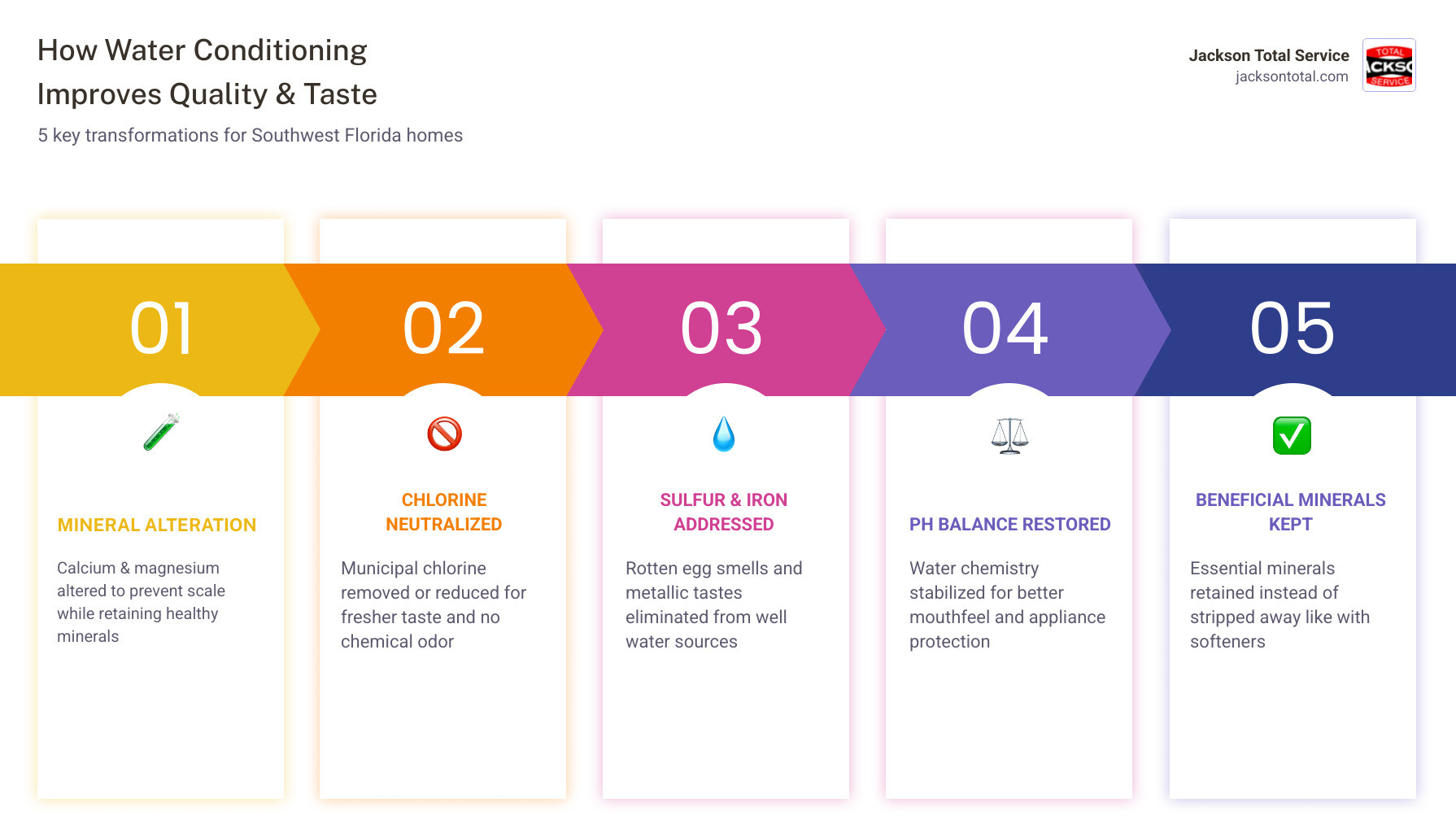
- Reduces scale buildup by changing how hard minerals like calcium and magnesium behave in your pipes and fixtures
- Removes or neutralizes chlorine and other compounds that cause unpleasant taste and odor
- Addresses iron and sulfur that cause metallic flavors or rotten egg smells, especially in well water
- Preserves beneficial minerals while preventing them from sticking to surfaces and appliances
- Protects plumbing and water-using appliances from the damage that leads to poor water quality over time
Southwest Florida’s water supply draws heavily from local aquifers that are naturally high in calcium and magnesium. On top of that, municipal water systems add chlorine as a disinfectant — which is necessary, but not exactly pleasant to taste or smell. The result? Water that can feel hard, taste off, and quietly cause damage throughout your home.
Water conditioning is a category of treatment that targets these exact problems. It’s not the same as a water filter, and it’s not always the same as a water softener — though those terms often get used interchangeably. Understanding the difference is the first step toward choosing the right solution for your home.
Quick how water conditioning improves water quality and taste definitions:
- how hard water affects your plumbing and appliances
- water conditioning benefits for florida homeowners
What Is Water Conditioning and How Does It Differ From Softening?
To understand how to get the best water for your household, we first need to clear up a very common point of confusion: the difference between water conditioning and traditional water softening. While both systems tackle the issues associated with hard water, they do so using entirely different scientific methods and produce different results at your tap.
Traditional water softening relies on a chemical process called ion exchange. In a standard water softener, hard water passes through a tank filled with tiny plastic resin beads. These beads are loaded with sodium or potassium ions. As the hard water flows over them, the calcium and magnesium ions (the minerals that cause hardness) swap places with the sodium ions. The hardness minerals are physically removed from the water and trapped in the resin bed, leaving you with “soft” water.
While highly effective at eliminating scale, traditional softeners require regular salt replenishment and discharge a salty brine during their self-cleaning cycles. This sodium addition can also give the water a slightly “slippery” feel on your skin and a subtle taste difference that some homeowners dislike.
Water conditioning, on the other hand, is a physical or chemical process that alters how these mineral ions behave without actually removing them from the water. Instead of swapping calcium and magnesium for sodium, a water conditioner restructures these minerals so they lose their ability to bind to surfaces.
Because the minerals are still present but rendered harmlessly inert, conditioned water does not have that slippery, hard-to-rinse feel. It also doesn’t require salt, doesn’t produce wastewater, and doesn’t add sodium to your drinking supply.
This difference in mineral management is critical when looking at Detailed Guide to How Hard Water Affects Your Plumbing and Appliances. While a softener removes the minerals to prevent scale, a conditioner neutralizes their sticking power to protect your home’s infrastructure while keeping your drinking water chemically balanced.
Understanding How Water Conditioning Improves Water Quality and Taste
So, how does keeping these minerals in the water actually improve your drinking experience? It all comes down to natural flavor and mouthfeel.
Many people actually prefer the taste of water that contains natural minerals. If you have ever tasted distilled water or pure reverse osmosis water, you might have noticed it tastes flat, empty, or even slightly bitter. This is because our taste buds are accustomed to the natural, subtle flavors provided by trace amounts of calcium, magnesium, and potassium.
By utilizing physical conditioning rather than chemical extraction, a water conditioner allows you to enjoy the health benefits and crisp taste of these natural minerals without the destructive side effects of limescale. It is a salt-free, chemical-free way to maintain mineral balance.
However, because the minerals remain in the water, a conditioner won’t change your total dissolved solids (TDS) reading or your raw water hardness numbers on a standard chemical test. Instead, it prevents those minerals from bonding to your glassware, coffee maker, and plumbing.
If you are trying to decide which approach fits your household’s unique needs, our Ultimate Guide to Choosing the Right Water Treatment for Hard Water breaks down the exact scenarios where conditioning outshines traditional softening, and vice versa.
How Water Conditioning Improves Water Quality and Taste
When we think about water quality, we aren’t just talking about safety — we are talking about the daily experience of pouring a glass of water and actually enjoying it. In Southwest Florida, municipal treatment facilities do a fantastic job of making sure our water is safe from harmful pathogens. However, the chemicals used to achieve this safety can leave your tap water tasting like a public swimming pool.

A comprehensive water conditioning system goes beyond mineral management to address the aesthetic elements of your water. By pairing physical mineral conditioning with advanced carbon filtration, these systems remove the organic compounds, chlorine, and trace elements that ruin the flavor of your coffee, tea, and home-cooked meals.
For many homeowners, untreated tap water can sometimes have an unusual sweet, metallic, or chemical taste. A sweet taste is often caused by high concentrations of calcium or iron interacting with older plumbing systems.
By stabilizing these minerals and filtering out chemical residues, water conditioning restores a clean, refreshing, neutral flavor. If you are tired of relying on plastic water bottles or bulky pitcher filters, learning more about how to Stop Drinking the Swamp with Better Water Quality and Taste can completely transform your relationship with your home’s tap.
Addressing Common Contaminants and Odors
Let’s look at the specific culprits that water conditioning systems target to improve the quality of your water:
- Municipal Chlorine: Added by water utilities to disinfect water as it travels through miles of underground pipes. While necessary for public health, residual chlorine leaves a harsh chemical taste and odor at your tap. Water conditioners with integrated activated carbon easily neutralize chlorine, instantly improving taste and smell.
- Sulfur and the “Rotten Egg” Smell: Particularly common in homes that rely on well water in Southwest Florida, hydrogen sulfide gas creates a highly unpleasant odor. Conditioning systems equipped with oxidizing filters can convert this gas into solid sulfur particles and filter them out, eliminating the smell entirely.
- Iron and Metallic Flavors: High iron content can cause your water to taste like pennies and leave rusty orange stains on your sinks, tubs, and laundry. Oxidizing conditioners convert dissolved iron into filterable sediment, removing both the metallic taste and the staining potential.
- pH Imbalance: The ideal pH range for drinking water is between 6.5 and 8.5. Water that is too acidic can corrode your plumbing and taste sour or metallic, while highly alkaline water can taste bitter. Advanced water conditioning systems can help stabilize and balance your water’s pH, ensuring a smooth, clean taste.
Types of Water Conditioning Systems and How They Work
To find the right system for your home, it helps to understand the different technologies available in July 2026. Each method uses a unique scientific approach to solve hard water and taste issues.
| Technology Type | How It Works | Key Benefits | Best For |
|---|---|---|---|
| Template Assisted Crystallization (TAC) | Uses specialized ceramic media to convert dissolved calcium and magnesium into microscopic, inactive crystals. | Salt-free, chemical-free, zero water waste, up to 90% scale reduction. | Homeowners wanting scale protection while keeping natural minerals. |
| Electromagnetic / Magnetic Descalers | Uses wires wrapped around pipes to create magnetic fields that temporarily disrupt mineral bonding. | Extremely low maintenance, compact, no plumbing modifications needed. | Apartments, rentals, or mild hard water situations. |
| Oxidation and Filtration | Uses air or chemical oxidizers to turn dissolved iron, sulfur, and manganese into solids, followed by physical filtration. | Removes rotten egg odors and metallic tastes, prevents rust stains. | Homes on private wells with high iron or sulfur content. |
| Activated Carbon Conditioning | Adsorbs organic chemicals, chlorine, pesticides, and VOCs onto highly porous carbon surfaces. | Dramatically improves taste and odor, removes chemical contaminants. | Municipal water users bothered by chlorine taste and smell. |
Each of these systems plays a specific role in residential water treatment. In many cases, we recommend a multi-stage approach that combines physical scale prevention (like TAC) with carbon filtration to address both mineral scaling and chemical tastes simultaneously. If you want to explore how these systems are integrated into a single, worry-free installation, check out our dedicated page on Water Conditioning.
Choosing a System: How Water Conditioning Improves Water Quality and Taste
Selecting the perfect water conditioning setup requires a systematic approach. We always advise homeowners to follow these four essential steps before making a decision:
- Perform a Comprehensive Water Test: You cannot treat what you do not know is there. A professional water test will identify your exact hardness levels (measured in grains per gallon, or GPG), pH balance, and the presence of specific contaminants like iron, sulfur, or chlorine.
- Determine Your Flow Rate: Your system must be sized correctly to handle your home’s peak water usage. A system that is too small will restrict your water pressure, while an oversized system is an unnecessary expense. For a typical home with three or more bathrooms, we look for a system that can comfortably support a flow rate of 10 to 12 gallons per minute (GPM).
- Verify Third-Party Certifications: Look for systems that have been independently tested and certified by organizations like the NSF (National Sanitation Foundation) or the WQA (Water Quality Association). Key certifications include NSF/ANSI 42 (for aesthetic effects like chlorine, taste, and odor) and NSF/ANSI 44 (for water softening performance).
- Compare Regeneration Styles: If you do opt for a salt-based system, avoid older timer-based models. Instead, choose a system featuring demand-initiated regeneration (DIR). These smart systems monitor your actual water usage and only regenerate when necessary. This can reduce your salt use by 26% to 60% and save up to 25% to 40% of the water wasted by traditional, timer-based systems.
The Benefits of Water Conditioning for Southwest Florida Homes
Investing in water conditioning isn’t just about enjoying a better glass of water; it’s about protecting your entire home. Hard water is incredibly tough on your plumbing infrastructure and your wallet.
When hard water is heated, dissolved calcium and magnesium precipitate out of the water, forming a rock-hard layer of scale inside your pipes, fixtures, and appliances. This scale acts as an insulator, forcing your water heater to work twice as hard to heat your water. In fact, heavy mineral scale can double the energy consumption of your water heater, increasing your overall household energy spending by 20% to 30%.
By installing a water conditioner, you prevent this scale from forming. This simple step keeps your water heater running at peak efficiency, preserves the water pressure throughout your home, and extends the lifespan of expensive appliances like dishwashers, washing machines, and tankless water heaters.
To learn more about how scale buildup damages your home and how to prevent it, read our guide on how to Stop the Scale Before Your Appliances Fail.
Comparing Conditioning to Reverse Osmosis and Boiling
How does water conditioning stack up against other popular water treatment methods? Let’s compare them:
- Boiling: Boiling water is excellent for emergency situations because it kills harmful bacteria, viruses, and parasites. It can also cause volatile chlorine to evaporate. However, boiling does absolutely nothing to remove heavy metals, minerals, or chemical pollutants. In fact, as water evaporates during boiling, the concentration of minerals and contaminants left behind actually increases.
- Reverse Osmosis (RO): RO systems use a semi-permeable membrane to strip virtually everything from your water, including dissolved solids, minerals, heavy metals, and chemicals. While it provides incredibly pure drinking water, RO is typically installed as a point-of-use system (like a single tap under the kitchen sink) because it is slow and produces wastewater. Traditional RO systems can waste up to 5 gallons of water for every gallon of clean water produced. However, modern WaterSense labeled RO systems are much more efficient, generating 2.3 gallons of waste or less per gallon of treated water.
- Water Conditioning: Unlike RO, a whole-house water conditioner treats all the water entering your home. It doesn’t strip out beneficial minerals, doesn’t produce wastewater (in the case of salt-free systems), and doesn’t require a holding tank. It provides scale protection for your entire plumbing system while improving the taste of every tap in the house.
Frequently Asked Questions About Water Conditioning
What maintenance is required for a water conditioner?
The maintenance required depends on the type of system you install.
- Salt-Free (TAC) Systems: These are incredibly low-maintenance. They do not require salt, chemicals, or backwashing. The primary maintenance task is replacing the ceramic conditioning media every 2 to 5 years, depending on your water usage and water chemistry.
- Carbon Filters and Sediment Pre-filters: If your system includes a sediment pre-filter, it should be replaced every 6 to 12 months to prevent clogging and maintain water pressure. Carbon media beds typically need replacement every 3 to 5 years.
- Annual Inspections: We recommend having a professional plumbing technician inspect your system once a year to check for proper flow rates, verify valve operation, and ensure your water quality remains optimal.
Is conditioned water safe to drink?
Yes, conditioned water is completely safe and highly beneficial to drink. Because physical water conditioners (like TAC systems) do not use sodium to swap out minerals, they do not add any salt to your drinking water. This makes conditioned water an excellent option for individuals on low-sodium diets.
Furthermore, because the system preserves natural minerals like calcium and magnesium, you get to enjoy the health benefits and crisp taste of mineral-rich water without the scaling issues that usually come with it.
How do I know if my home needs water conditioning?
There are several clear warning signs that your home is suffering from hard, untreated water:
- White Mineral Crust: If you notice stubborn white, chalky buildup on your showerheads, faucets, or inside your kettle, you have hard water.
- Spotty Dishes: Glassware and silverware coming out of the dishwasher looking cloudy or covered in white spots is a classic sign of mineral residue.
- Dry Skin and Dull Hair: Hard water minerals prevent soaps and shampoos from lathering and rinsing properly, leaving a film on your skin and hair that causes dryness and irritation.
- Poor Water Taste or Smell: If your water tastes metallic, sweet, or smells strongly of chlorine or sulfur, your water quality needs attention.
- Frequent Appliance Issues: If your water heater, dishwasher, or washing machine requires frequent repairs or fails prematurely, scale buildup is the likely culprit.
Conclusion
At Jackson Total Service, we have been helping Southwest Florida homeowners stay comfortable and secure in their homes since 1964. As a family-owned business with deep roots in Naples, Fort Myers, Cape Coral, Bonita Springs, Estero, Marco Island, and the surrounding communities, we understand the unique challenges posed by our local aquifers.
Whether you are dealing with stubborn limescale, a harsh chlorine taste, or a sulfur odor from a private well, our team of licensed plumbing experts is here to help. We provide comprehensive, honest water testing to identify exactly what is in your water, allowing us to design a customized water treatment plan tailored to your household’s needs, budget, and lifestyle.
Ready to experience the difference that clean, crisp, scale-free water can make for your family and your plumbing? Contact us today to schedule your comprehensive water quality consultation and take the first step toward a healthier, better-tasting home with our professional Water Conditioning services.