


Why Florida Homeowners Need a Smarter Plan to Keep Their AC Running Longer
Knowing how to extend the life of your AC in Florida can save you thousands of dollars and spare you from sweating through a breakdown in the middle of July. In Southwest Florida — where your air conditioner runs nearly year-round — the stakes are higher than almost anywhere else in the country.
Here is a quick summary of the most effective ways to extend your AC’s life in Florida:
- Replace air filters every 30 days during peak season (more often during pollen season, February through June)
- Schedule professional maintenance twice a year — once in spring before the heat peaks, and once in fall
- Set your thermostat to 78°F when home and avoid pushing it lower than needed
- Keep the outdoor condenser clear with at least two feet of clearance and rinse it regularly
- Flush the condensate drain line monthly to prevent algae clogs and safety shutoffs
- Address repairs promptly — small problems become expensive ones fast in Florida’s heat and humidity
- Install a whole-home surge protector to guard against Florida’s frequent lightning storms
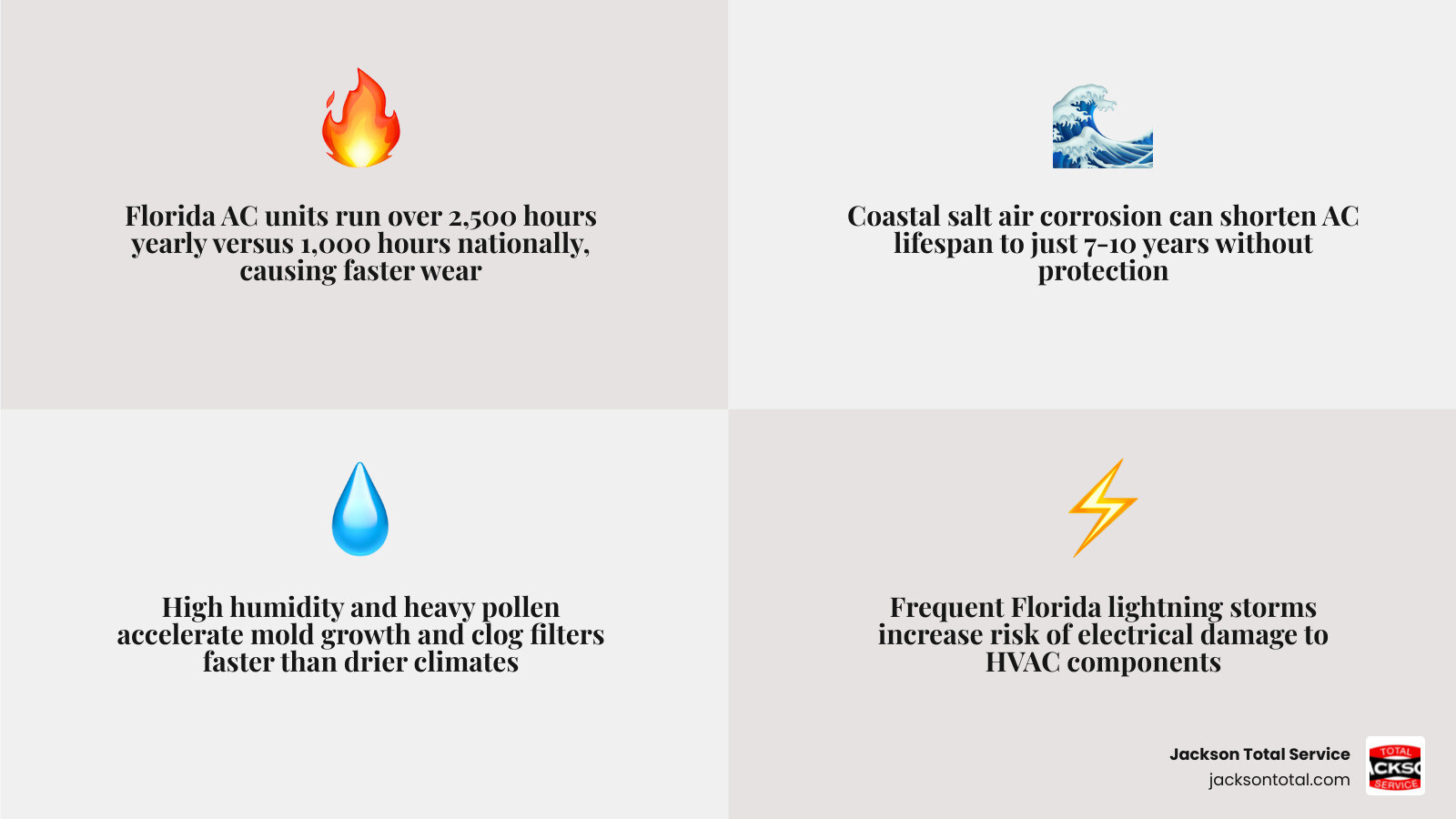
Most AC units in Florida last between 10 and 15 years — noticeably shorter than the national average of up to 20 years in cooler climates. The reason is simple: while a northern system might run around 1,000 hours a year, a Florida unit can clock over 2,500 hours annually. That relentless workload, combined with high humidity, salt air along the coast, heavy pollen, and intense electrical storms, puts serious stress on every component.
The good news? A well-maintained system can beat those odds. There are documented cases of Florida homeowners keeping their units running for 30 years with consistent care and smart habits. At Jackson Total Service, we’ve been helping Southwest Florida homeowners protect their comfort and their investment since 1964 — and the strategies in this guide reflect decades of real-world experience in Naples, Bonita Springs, Estero, Marco Island, and the surrounding Lee and Collier County communities.
Understanding the Florida AC Lifespan vs. National Average
To truly appreciate why your air conditioner needs extra attention down here, it helps to look at the numbers. Nationally, a standard central air conditioning system can easily coast past the 15-year mark, often reaching up to 20 years with minimal fuss. In Southwest Florida, however, the average lifespan of an AC unit drops to between 10 and 15 years. If you live right on the coast in places like Marco Island or Fort Myers Beach, salt air corrosion can push that lifespan down even further, sometimes to just 7 to 10 years without proactive protection.
Why does our tropical climate act like a time machine for HVAC wear and tear? It comes down to sheer operational hours. An air conditioner in a northern state might only run for three or four months out of the year, totaling roughly 500 to 1,000 hours of runtime. In Naples or Cape Coral, our cooling season lasts nine to ten months. Our systems frequently run 12 to 16 hours a day during the sweltering summer months, easily racking up 2,500+ operational hours every single year.
Furthermore, your AC is not just cooling your home; it is also working overtime to pull moisture out of the air. When the outdoor humidity regularly climbs past 80%, your system has to run longer cycles just to keep your indoor spaces feeling dry and comfortable. This relentless workload is explained in detail in our article, The Heat is On: Why Tropical Cooling is a Full-Time Job for Your HVAC.
| Lifespan Factor | National Average | Southwest Florida Average |
|---|---|---|
| Average Lifespan | 15 to 20 years | 10 to 15 years (7 to 10 on the coast) |
| Annual Runtime | 500 – 1,500 hours | 2,500+ hours |
| Primary Stressors | Occasional heat waves, dust | Near year-round heat, extreme humidity, salt air, lightning |
| Dehumidification Load | Moderate / Seasonal | Heavy / Continuous |
| Corrosion Risk | Low | High (galvanic corrosion from salt spray) |
How to Extend the Life of Your AC in Florida: The Ultimate Homeowner Checklist
While the climate is working against your HVAC system, you have a powerful tool on your side: consistent, proactive habits. You do not need to be a certified technician to perform the daily and monthly tasks that keep operational strain to a minimum.
Master the Air Filter Schedule to Protect Airflow
The single most important thing you can do for your air conditioner is to keep the air flowing freely. A dirty, clogged air filter acts like a wall, forcing your system’s blower motor to work twice as hard to pull air through. This extra resistance quickly overheats the motor, jacks up your utility bills, and can even cause the indoor evaporator coil to freeze over.
For Southwest Florida homes, we recommend using a MERV 8 pleated filter. It provides the perfect balance between capturing dust and pollen without restricting your system’s airflow. While manufacturers often claim these filters last 90 days, Florida’s heavy usage changes the rules:
- February to June (Pollen Season): Check and replace your filter every 30 days. Our heavy oak and pine pollen can clog a filter surprisingly fast.
- July to October (Peak Summer): Replace every 30 to 45 days due to continuous system runtime.
- November to January (Milder Months): Replace every 60 days.
- Homes with Pets or Smokers: Stick to a strict 30-day replacement schedule year-round.
Keeping your airflow unrestricted is especially critical because of how humidity impacts your system. You can learn more about this relationship in our guide on Why Your AC Needs Extra Love in Humid Climates.
Maintain Outdoor Condenser Clearance and Cleanliness
Your outdoor condenser unit has one primary job: dumping the heat collected from inside your home into the outdoor air. If the condenser is choked by overgrown landscaping, weeds, or fallen leaves, it cannot release that heat efficiently. This causes the compressor to run hotter and work longer cycles, which is one of the most common causes of premature compressor failure.
- Maintain a 2-foot clearance zone: Keep shrubs, trees, and ornamental plants trimmed back at least 24 inches from all sides of the outdoor cabinet.
- Keep the top clear: Ensure there are no low-hanging branches or overhead structures blocking the air blowing out of the top of the unit.
- Clear yard debris: Regularly sweep away grass clippings, leaves, and mulch from the base of the unit. Never let weeds grow up through the bottom grate.
- Gentle monthly rinsing: Use a standard garden hose with a gentle spray nozzle to rinse away dust, sand, and pollen from the metal fins. Never use a pressure washer, as the high pressure will instantly bend the delicate aluminum fins and permanently restrict airflow.
Optimize Thermostat Settings and Use Ceiling Fans
Setting your thermostat to 68°F on a 95°F day is a recipe for system exhaustion. An air conditioner is designed to comfortably cool your home to about 15 to 20 degrees below the outdoor temperature. Trying to force it lower than that results in continuous, non-stop operation that rapidly wears out the compressor and fan motors.
- The Magic Number (78°F): The U.S. Department of Energy recommends setting your thermostat to 78°F when you are at home. Every degree you raise your thermostat in the summer can reduce your system’s workload—and your cooling costs—by up to 6% to 8%.
- The Wind-Chill Helper: Supplement your AC with ceiling fans. Running a ceiling fan creates a wind-chill effect that makes a room feel 4 to 6 degrees cooler than it actually is. Just remember: fans cool people, not rooms, so turn them off when you leave.
- Smart Thermostat Habits: Upgrade to a smart thermostat to automatically raise the temperature to 82°F when you are away at work. However, never turn your AC completely off when you leave for the day. Doing so allows indoor humidity to skyrocket, forcing your system to work in overdrive for hours to recover when you return, which actually shortens its lifespan.
For more practical tips on keeping your home comfortable without overworking your equipment, check out our guide on Cooling Your Florida Home Without Breaking the Bank.
The Role of Professional Maintenance and Frequency
While monthly homeowner habits lay a great foundation, they cannot replace the trained eye of a professional technician. Think of professional maintenance like an oil change and tune-up for your car—neglecting it might not cause an immediate breakdown, but it practically guarantees a shorter lifespan and lower efficiency over time.

To keep your system running optimally in Southwest Florida, scheduling professional service is non-negotiable. For a detailed breakdown of what to expect, read through Don’t Sweat It: Your Guide to Florida AC Maintenance Frequency.
Why Twice-Yearly Tune-Ups are Essential in Southwest Florida
While homeowners in cooler climates can get away with a single annual visit, Southwest Florida’s demands make a twice-yearly schedule far more practical.
We recommend scheduling your first visit in the early spring (March or April) to prepare the system for the brutal summer marathon ahead. Your second visit should be scheduled in the late fall (October or November) to clean out the debris accumulated during months of heavy summer use and to verify that the electrical connections and startup components are still in safe working order.
To see how local maintenance keeps systems running smoothly in our service areas, read our article on Why Regular AC Maintenance is a Breeze in Bonita Springs FL.
Crucial Professional Tasks: Coil Cleaning and Drain Line Flushing
During a professional maintenance visit, our technicians focus on several critical areas that directly impact your system’s longevity:
- Evaporator and Condenser Coil Cleaning: Over time, a layer of fine dust, pollen, and pet dander builds up on the indoor evaporator coil, while dirt and salt residue coat the outdoor condenser coil. This buildup acts as an insulating blanket, preventing efficient heat transfer and forcing the compressor to run hotter and longer.
- Condensate Drain Line Flushing: Because our air conditioners pull gallons of water out of the humid air every day, the indoor drain pan and drain line are constantly wet. This creates the perfect breeding ground for algae, mold, and slime. If left untreated, this biological growth will clog the drain line, causing water to back up into your home. Modern systems have a safety float switch that shuts the AC off to prevent water damage, but the sudden shutdown always seems to happen on the hottest weekend of the year. Professionals flush these lines and add specialized pan tablets to keep the drain clear.
- Electrical Inspections: Technicians inspect the contactors, tighten loose wire connections, and test the capacitors. Capacitors act like temporary batteries that give your compressor and fan motors the extra electrical boost they need to start up. In Florida’s heat, capacitors are the most common component to fail. Catching a weak capacitor during a routine tune-up prevents it from failing and causing hard starts that can permanently damage your expensive compressor.
To learn more about keeping your system clean and avoiding biological growth inside your equipment, check out The Ultimate Guide to Mold-Free Air Conditioning.
Mitigating Florida’s Harsh Environmental Factors
Our local climate presents a unique trifecta of environmental hazards: corrosive salt air, intense humidity, and frequent electrical storms. Protecting your system from these elements requires targeted strategies.
To understand how keeping your ductwork clean fits into this protective strategy, read Don’t Let the Humidity Win with This Tropical Duct Cleaning Guide.
Combating Salt Air Corrosion in Coastal Zones
If you live within five miles of the Gulf of Mexico—whether in Naples, Marco Island, or Fort Myers Beach—your outdoor unit is constantly exposed to salt-laden air. Salt acts as an electrolyte that triggers galvanic corrosion between the aluminum fins and copper tubing of your condenser coil. Over time, this corrosion causes the fins to crumble into dust, destroying the unit’s ability to release heat.
- Look for Coated Coils: When purchasing a new system, ensure the outdoor unit features factory-applied corrosion-resistant coatings, often referred to as “Blue Coil” or “Gold Coil” technology.
- Freshwater Rinses: If you live very close to the water, make it a habit to gently rinse your outdoor condenser coils with fresh water from a garden hose once a week. This washes away the salt crystals before they can bond to the metal.
Managing High Humidity and Preventing Mold Growth
High indoor humidity is not just uncomfortable; it also encourages mold and mildew growth inside your ductwork and AC cabinet. When mold accumulates on the blower wheel or inside the ducts, it restricts airflow and degrades your indoor air quality.
- Duct Sealing: Leaky ducts in your attic pull hot, humid, dusty air into your home, forcing the AC to work harder to cool and dehumidify. Sealing these leaks keeps the humid air out and the cool air in.
- Whole-Home Dehumidifiers: If your home struggles to stay below 55% humidity even with the AC running, a dedicated whole-home dehumidifier can take the moisture-removal burden off your air conditioner, allowing it to run shorter, more efficient cycles.
For a deeper dive into how professional duct cleaning protects your system from humidity-driven issues, take a look at How Duct Cleaning Saves Your AC from the Humid Hustle.
Storm and Lightning Protection for Your HVAC System
Southwest Florida is one of the most lightning-active regions in the country. A nearby lightning strike can send a massive voltage spike through your home’s electrical lines, instantly frying your AC’s control boards, capacitors, and compressor windings.
- Install Whole-Home Surge Protection: Ask a licensed electrician to install a high-quality surge protector directly at your main electrical panel, along with a dedicated surge protector at the outdoor AC disconnect box.
- Secure the Condenser: Ensure your outdoor unit is properly anchored to a concrete pad using heavy-duty hurricane tie-down straps to keep it stable during high winds.
Sizing, Installation, and Upgrades for Maximum Longevity
The journey to a long-lasting air conditioner actually begins before the system is even turned on. How the system is sized, where it is installed, and the technology you choose play massive roles in its ultimate lifespan.
To learn more about how system efficiency ratings impact your long-term comfort and budget, check out Is High SEER Worth the Cash or Just Blowing Smoke?.
How Proper Sizing and Placement Prevent System Overload
A common mistake is assuming that “bigger is always better” when it comes to air conditioning.
- The Danger of Oversizing: If an AC unit is too large for your home, it will cool the air very quickly and shut off before it has a chance to pull humidity out of the air. This results in “short-cycling”—turning on and off frequently. Because the startup cycle puts the most mechanical stress on the compressor and draws the most electricity, short-cycling rapidly wears out the system and leaves your home feeling damp and clammy.
- The Danger of Undersizing: Conversely, a system that is too small will run continuously without ever reaching your thermostat’s set temperature, leading to premature motor failure.
- The Shading Myth: Some homeowners try to build DIY wooden structures or plant dense hedges to shade their outdoor unit. This is actually a myth that can do more harm than good. These structures restrict airflow and trap hot air around the condenser, forcing the unit to recycle its own heat and run much hotter. The best “shade” for an outdoor unit is a completely clear path for unrestricted airflow.
Florida-Specific Upgrades: How to Extend the Life of Your AC in Florida Coastal Areas
If you are looking to maximize your system’s defense against our unique climate, several modern upgrades are highly effective:
- Inverter-Driven Compressors: Unlike standard single-stage compressors that run at either 100% capacity or 0% (on or off), inverter-driven systems can modulate their speed precisely. They can run continuously at a low, highly efficient speed (like cruise control on a highway), which dramatically reduces startup wear and tear and provides unmatched humidity control.
- Corrosion-Resistant Aftermarket Coatings: For ultimate protection near the coast, specialized anti-corrosive coatings can be professionally applied to your condenser coils to shield the metal from salt spray.
Repair vs. Replace: Knowing When Your AC is Nearing the End
Even with the absolute best maintenance plan, every mechanical system eventually reaches the end of its functional life. Knowing when to stop pouring money into repairs and invest in a new system is key to protecting your budget.
For help navigating this major home decision, read through Should You Fix It or Nix It: Your AC Decision Guide.
Recognizing the Warning Signs of AC Failure
As your system approaches the end of its lifespan, it will usually start dropping hints that it is struggling:
- Frequent Breakdowns: If you are calling for repairs multiple times in a single summer, those costs quickly add up.
- Rising Utility Bills: An aging compressor loses its efficiency over time, requiring more and more electricity to deliver the same amount of cooling.
- Weak or Warm Airflow: If some rooms are hot while others are cold, or if the air coming out of your vents feels weak and humid, your system is reaching its limit.
- Strange Noises: Squealing, grinding, or loud rattling noises from the outdoor cabinet usually point to a failing compressor or motor bearings.
Making the Smart Financial Choice: How to Extend the Life of Your AC in Florida vs. Replacing It
To help make the decision easier, professional HVAC technicians often use two helpful guidelines:
- The 5,000 Rule: Multiply the age of your system by the cost of the repair. If the result is greater than $5,000, replacing the unit is generally the smarter long-term financial move. For example, spending $600 on a repair for a 10-year-old system ($6,000) is often a gamble, as other components are likely nearing failure.
- The 50% Rule: If a single repair costs 50% or more of what a brand-new system would cost, replacement is almost always the better option, especially if the unit is over 10 years old.
- The Refrigerant Factor: If your older system still uses R-22 refrigerant (which was phased out completely), or if you have a system using R-410A (which began its phase-out process in 2025), finding replacement refrigerant for leaks will become increasingly difficult and expensive. Upgrading to a modern system utilizing current, environmentally friendly refrigerants ensures your home remains serviceable and highly efficient for years to come.
Frequently Asked Questions about Florida AC Care
How long does an AC unit typically last in Florida?
On average, an air conditioning unit in Florida lasts between 10 and 15 years. This is shorter than the national average of 15 to 20 years because our systems run up to three times as many hours per year, deal with intense humidity, and face corrosive salt air near coastal areas like Naples and Marco Island.
Does shading my outdoor AC unit improve its efficiency and lifespan?
No. Building a structure or planting thick bushes to shade your outdoor unit is actually a myth. These shading attempts almost always restrict the crucial airflow your system needs to dump heat. If hot air cannot escape, the unit will recycle its own heat and run hotter, which reduces efficiency and shortens the compressor’s lifespan. The best setup is a completely clear, open area around the unit.
How often should I flush my AC condensate drain line?
We recommend flushing your condensate drain line once a month with a cup of regular white vinegar. This simple step helps kill algae and prevent the buildup of thick slime that can clog the line, trigger your safety float switch, and suddenly shut down your entire system on a hot summer day.
Conclusion
Extending the life of your air conditioner in Southwest Florida does not require luck—it requires a consistent plan. By staying on top of simple monthly habits like changing your air filters, keeping your outdoor unit clear, and flushing your drain line, you can protect your system from the daily grind of our tropical climate.
When you combine those smart habits with twice-yearly professional tune-ups, you give your equipment the best possible chance of running efficiently well past the 10-year mark.
At Jackson Total Service, we have been keeping homes comfortable across Collier and Lee counties since 1964. Our experienced, licensed technicians are proud to provide comprehensive HVAC, plumbing, and electrical solutions to our neighbors in Naples, Bonita Springs, Estero, Marco Island, and the surrounding communities.
If you want to ensure your system is fully prepared to handle the Florida heat, contact us today to schedule our comprehensive air conditioning services and keep your home a cool, reliable sanctuary all year long.